Oman Canvas Market Size, Share & Growth Rate
The Oman Canvas Market was estimated at USD 939 Million in 2025 and is projected to reach USD 1333 Million by 2032, growing at a CAGR of 5.1% from 2026 to 2032. This growth trajectory is primarily driven by the expanding construction sector, which is fueled by significant infrastructure projects and urban development. Additionally, the increasing interest in outdoor activities and tourism is further propelling the demand for durable and versatile canvas products across various applications.
Oman Canvas Market Year-wise Growth Rate and Key Drivers
This graph highlights how the Oman Canvas Market has steadily grown over the years, supported by major growth factors.
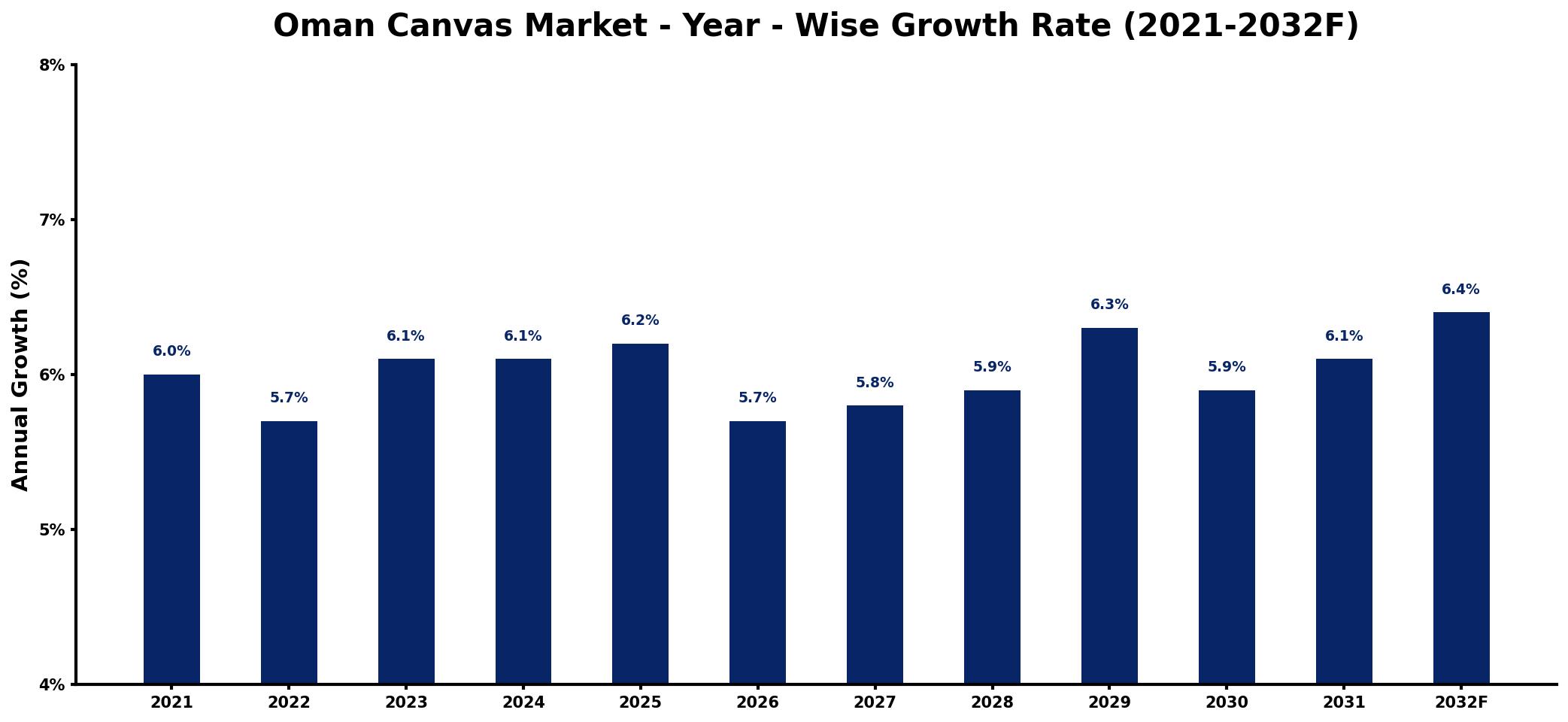
The table below presents the year‑wise growth rates along with the key drivers influencing the market
| Year | Growth Rate | Major Drivers |
| 2021 | 6.0% | Rising demand in construction sector |
| 2022 | 5.7% | Increased investment in infrastructure projects |
| 2023 | 6.1% | Expanding art and design community |
| 2024 | 6.1% | Growth in outdoor recreational activities |
| 2025 | 6.2% | Boost in custom merchandise sales |
| 2026 | 5.7% | Emergence of eco-friendly materials |
| 2027 | 5.8% | Surge in educational art programs |
| 2028 | 5.9% | Increase in tourism and events |
| 2029 | 6.3% | Growing online retail platforms |
| 2030 | 5.9% | Expansion of local manufacturing capabilities |
| 2031 | 6.1% | Development of innovative design trends |
| 2032 | 6.4% | growing emerging market penetration |
Note: Market size estimations and growth projections presented in this report are based on 6Wresearch's proprietary forecasting methodology, utilizing the latest available industry data, government publications, and primary research inputs.
Oman Canvas Market Synopsis
The most significant factor shaping the Oman canvas market currently is the construction boom. As Oman continues to invest heavily in infrastructure and urbanization, the demand for canvas in applications such as tents, tarpaulins, and awnings is surging. This trend is closely tied to the growing tourism sector, which is creating a wider market for canvas products.
Moreover, the increasing appreciation for arts and crafts among the Omani population is positively influencing the canvas market. As more individuals engage in artistic pursuits, the demand for high-quality canvas as a preferred medium for painting and creative projects is on the rise, indicating a promising future for this sector.
Oman Canvas Market Key Takeaways
- The market is experiencing robust growth driven by construction and tourism sectors.
- High-quality canvas materials are increasingly in demand for diverse applications.
- Interest in arts and crafts is contributing to market expansion.
- Local manufacturing is supported by government policies and initiatives.
- Competition from synthetic materials poses challenges for traditional canvas products.
Evaluation of Restraints in Oman Canvas Market
Despite its growth potential, the Oman canvas market faces notable restraints. One key issue is the competition posed by synthetic alternatives, which often provide superior durability at lower costs. Additionally, the availability of high-quality raw materials is limited locally, necessitating reliance on imports that expose the market to fluctuations in international pricing. The traditional production methods also suffer from a shortage of skilled labor, highlighting the need for modernization to align with contemporary consumer preferences.
Oman Canvas Market Trends
A significant trend in the Oman canvas market is the increasing focus on sustainable and eco-friendly materials. As consumers become more environmentally conscious, there is a growing demand for canvas produced from organic or recycled fibers. Moreover, technological advancements in manufacturing processes are enabling the production of canvas that combines traditional aesthetics with modern performance characteristics, appealing to a broader audience.
Oman Canvas Market Opportunities
The Oman canvas market is ripe for investment opportunities, particularly in expanding local production capabilities. By enhancing manufacturing technologies and training programs, there is potential to elevate the quality of Omani canvas products, enabling them to compete more effectively on a global scale. Furthermore, tapping into the burgeoning tourism sector presents a unique opportunity for companies to diversify their product offerings, creating specialized canvas items tailored to outdoor recreational activities.
Government Initiatives in the Oman Canvas Market
The Omani government is actively fostering the growth of the canvas market through a range of supportive initiatives. Policies such as tax exemptions for the importation of raw materials and subsidies for upgrading production equipment have been implemented to encourage local textile manufacturing. Additionally, government-backed training programs aim to enhance the skills of the workforce, ensuring that the industry can produce high-quality canvas products that meet both domestic and international standards.
Future Insights of the Oman Canvas Market
Looking ahead to 2026-2032, the Oman canvas market is poised for significant growth, driven by ongoing urbanization and an expanding tourism sector. The shift towards eco-friendly materials and sustainable practices will likely redefine product offerings, aligning with global consumer trends. As local manufacturers adapt to modern production techniques and expand their capabilities, the market is expected to strengthen its position both regionally and internationally.
Oman Canvas Market Latest Developments (2025 - 2026)
In recent months, the Oman canvas market has seen increased activity as manufacturers work to modernize their production techniques. Efforts to enhance the quality of canvas materials have become a focal point, aligning with the rising consumer demand for durable and high-performance products. Concurrently, collaborative initiatives between industry stakeholders and government agencies are gaining momentum, aiming to elevate the standards of local production and broaden market reach.
Oman Canvas Market - Key Attractiveness of the Report
- 10 Years of Market Numbers
- Historical Data Starting from 2022 to 2025
- Base Year: 2025
- Forecast Data until 2032
- Key Performance Indicators Impacting the Market
- Major Upcoming Developments and Projects
Key Highlights of the Report:
- Oman Canvas Market Outlook
- Market Size of Oman Canvas Market, 2025
- Forecast of Oman Canvas Market, 2032
- Historical Data and Forecast of Oman Canvas Revenues & Volume for the Period 2022-2032F
- Oman Canvas Market Trend Evolution
- Oman Canvas Market Drivers and Challenges
- Oman Canvas Price Trends
- Oman Canvas Porter's Five Forces
- Oman Canvas Industry Life Cycle
- Historical Data and Forecast of Oman Canvas Market Revenues & Volume By Types for the Period 2022-2032F
- Historical Data and Forecast of Oman Canvas Market Revenues & Volume By Plane Canvas for the Period 2022-2032F
- Historical Data and Forecast of Oman Canvas Market Revenues & Volume By Duck Canvas for the Period 2022-2032F
- Historical Data and Forecast of Oman Canvas Market Revenues & Volume By Application for the Period 2022-2032F
- Historical Data and Forecast of Oman Canvas Market Revenues & Volume By Tent for the Period 2022-2032F
- Historical Data and Forecast of Oman Canvas Market Revenues & Volume By Luggage Fabric for the Period 2022-2032F
- Historical Data and Forecast of Oman Canvas Market Revenues & Volume By Automotive Fabric for the Period 2022-2032F
- Historical Data and Forecast of Oman Canvas Market Revenues & Volume By Apparel for the Period 2022-2032F
- Historical Data and Forecast of Oman Canvas Market Revenues & Volume By Others for the Period 2022-2032F
- Oman Canvas Import Export Trade Statistics
- Market Opportunity Assessment By Types
- Market Opportunity Assessment By Application
- Oman Canvas Top Companies Market Share
- Oman Canvas Competitive Benchmarking By Technical and Operational Parameters
- Oman Canvas Company Profiles
- Oman Canvas Key Strategic Recommendations






































