Oman Cargo Shipping Market Size, Share & Growth Rate
The Oman Cargo Shipping Market was estimated at USD 153 Million in 2025 and is projected to reach USD 206 Million by 2032, growing at a CAGR of 4.3% from 2026 to 2032. This positive trajectory is largely driven by Oman's strategic location along key maritime routes, allowing it to serve as a vital transshipment hub. Additionally, the ongoing enhancements in port infrastructure and governmental support for trade liberalization are expected to further bolster market growth.
Oman Cargo Shipping Market Year-wise Growth Rate and Key Drivers
This graph highlights how the Oman Cargo Shipping Market has steadily grown over the years, supported by major growth factors.
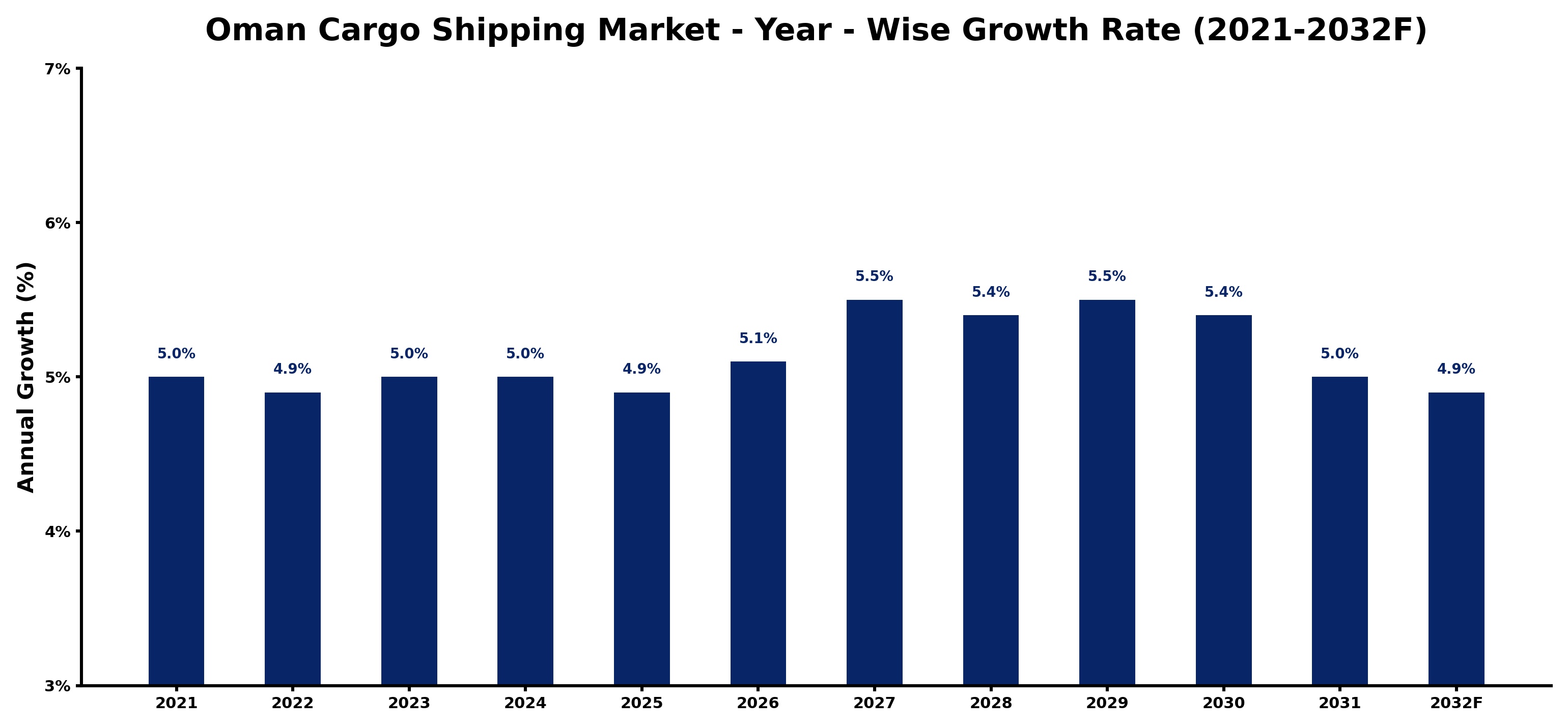
The table below presents the year‑wise growth rates along with the key drivers influencing the market
| Year | Growth Rate | Major Drivers |
| 2021 | 5.0% | Expansion of transportation and logistics networks |
| 2022 | 4.9% | Growing urbanization and commercial development |
| 2023 | 5.0% | Growing urbanization and commercial development |
| 2024 | 5.0% | Increasing adoption of advanced technologies |
| 2025 | 4.9% | Growing renewable energy integration projects |
| 2026 | 5.1% | Increasing smart city development projects |
| 2027 | 5.5% | Expansion of transportation and logistics networks |
| 2028 | 5.4% | Government infrastructure modernization initiatives |
| 2029 | 5.5% | Increasing smart city development projects |
| 2030 | 5.4% | Expansion of manufacturing activities |
| 2031 | 5.0% | Increasing adoption of advanced technologies |
| 2032 | 4.9% | Expansion of transportation and logistics networks |
Note - Market size estimations and growth projections presented in this report are based on 6Wresearch's advanced forecasting approach, validated with industry datasets as of June 2026.
Oman Cargo Shipping Market Synopsis
In Oman, the surge in container shipping demand, particularly for goods traversing to and from the Middle East and beyond, has significantly influenced the cargo shipping landscape. The country is developing its port capabilities to accommodate larger vessels, thereby increasing its competitiveness on the global stage.
Moreover, specialized logistics solutions tailored to the unique needs of various industries, including oil and gas, agriculture, and manufacturing, are emerging as crucial drivers of efficiency and service enhancement. As a result, the integration of advanced technologies into shipping practices is becoming increasingly essential.
Oman Cargo Shipping Market Key Takeaways
- The strategic geographic positioning of Oman enhances its role as a key transshipment hub in regional trade.
- Significant investments in port infrastructure development are poised to improve cargo handling and processing capabilities.
- Government policies are geared towards facilitating trade and attracting foreign investment into the cargo shipping sector.
- Technological advancements in logistics are driving operational efficiency and competitiveness among shipping companies.
- Ongoing geopolitical dynamics in the region necessitate continuous assessments of shipping routes and operations.
Evaluation of Restraints in Oman Cargo Shipping Market
Despite its strategic advantages, the Oman cargo shipping market faces several restraints that may impact its growth trajectory. Geopolitical tensions and maritime security concerns in the region pose significant risks to shipping routes, potentially disrupting operations. Additionally, fluctuations in fuel prices can affect operational costs, while competition from neighboring ports presents ongoing challenges to profitability. Furthermore, limitations in current port infrastructure could restrict the efficient handling of increasing cargo volumes, resulting in delays and escalating logistics costs for stakeholders.
Oman Cargo Shipping Market Trends
Current trends in the Oman cargo shipping market highlight a growing emphasis on sustainability and environmental compliance. Shipping companies are increasingly adopting eco-friendly practices and technologies to reduce their carbon footprint. Moreover, the rise of digital solutions for tracking and managing shipments is enhancing transparency and efficiency across the supply chain. There is also a noticeable shift towards integrating AI and automation in logistics operations, aiming to streamline processes and improve service delivery.
Oman Cargo Shipping Market Opportunities
There are significant opportunities for growth within the Oman cargo shipping market, particularly through the expansion of logistics services catering to emerging industries. With the government's push to diversify the economy, sectors such as renewable energy and manufacturing are poised to increase demand for efficient cargo solutions. Furthermore, the development of free trade agreements and partnerships could enhance Oman's position in global trade, attracting further investment into its shipping infrastructure and services.
Government Initiatives in the Oman Cargo Shipping Market
The Omani government is actively pursuing initiatives to boost the cargo shipping market by enhancing port facilities and streamlining regulatory frameworks. Recent policies focus on infrastructure investments that improve the overall efficiency of cargo handling and transportation. Additionally, trade facilitation measures are being implemented to attract foreign investment and enhance Oman's competitive edge as a logistics hub in the region. Moreover, environmental sustainability has become a priority, with the government promoting regulations that minimize the ecological impact of maritime activities.
Future Insights of the Oman Cargo Shipping Market
Looking ahead to 2026-2032, the Oman cargo shipping market is expected to experience continued growth driven by infrastructure advancements and strategic government policies aimed at fostering trade. As global shipping demands evolve, the market will likely adapt by integrating more innovative technologies and enhancing service offerings. Additionally, as geopolitical landscapes shift, Oman is well-positioned to capitalize on new trade routes, solidifying its role as a central player in maritime logistics.
Oman Cargo Shipping Market Latest Developments (May 2025 - June 2026)
Recent developments within the Oman cargo shipping market reflect a commitment to enhancing operational capabilities and improving service quality. Investments in port expansion projects are progressing, aimed at increasing capacity and facilitating larger vessel calls. Furthermore, various stakeholders are exploring partnerships to implement cutting-edge technologies that optimize logistics processes. These advancements are indicative of the market's responsiveness to global shipping trends and its dedication to maintaining a competitive edge.
Oman Cargo Shipping Market - Key Attractiveness of the Report
- 10 Years of Market Numbers
- Historical Data Starting from 2022 to 2025
- Base Year: 2025
- Forecast Data until 2032
- Key Performance Indicators Impacting the Market
- Major Upcoming Developments and Projects
Key Highlights of the Report:
- Oman Cargo Shipping Market Outlook
- Market Size of Oman Cargo Shipping Market, 2025
- Forecast of Oman Cargo Shipping Market, 2032
- Historical Data and Forecast of Oman Cargo Shipping Revenues & Volume for the Period 2022-2032F
- Oman Cargo Shipping Market Trend Evolution
- Oman Cargo Shipping Market Drivers and Challenges
- Oman Cargo Shipping Price Trends
- Oman Cargo Shipping Porter's Five Forces
- Oman Cargo Shipping Industry Life Cycle
- Historical Data and Forecast of Oman Cargo Shipping Market Revenues & Volume By Cargo Infrastructure for the Period 2022-2032F
- Historical Data and Forecast of Oman Cargo Shipping Market Revenues & Volume By Port Developments in Asia for the Period 2022-2032F
- Historical Data and Forecast of Oman Cargo Shipping Market Revenues & Volume By Port Developments in Europe for the Period 2022-2032F
- Historical Data and Forecast of Oman Cargo Shipping Market Revenues & Volume By Port Developments in North America for the Period 2022-2032F
- Historical Data and Forecast of Oman Cargo Shipping Market Revenues & Volume By Port Developments in South America for the Period 2022-2032F
- Historical Data and Forecast of Oman Cargo Shipping Market Revenues & Volume By Port Developments in Africa for the Period 2022-2032F
- Historical Data and Forecast of Oman Cargo Shipping Market Revenues & Volume By Cargo Type for the Period 2022-2032F
- Historical Data and Forecast of Oman Cargo Shipping Market Revenues & Volume By Container Cargo for the Period 2022-2032F
- Historical Data and Forecast of Oman Cargo Shipping Market Revenues & Volume By Bulk Cargo for the Period 2022-2032F
- Historical Data and Forecast of Oman Cargo Shipping Market Revenues & Volume By General Cargo for the Period 2022-2032F
- Historical Data and Forecast of Oman Cargo Shipping Market Revenues & Volume By Oil & Gas for the Period 2022-2032F
- Historical Data and Forecast of Oman Cargo Shipping Market Revenues & Volume By Industry Type for the Period 2022-2032F
- Historical Data and Forecast of Oman Cargo Shipping Market Revenues & Volume By Food, Manufacturing for the Period 2022-2032F
- Historical Data and Forecast of Oman Cargo Shipping Market Revenues & Volume By Oil & Ores for the Period 2022-2032F
- Historical Data and Forecast of Oman Cargo Shipping Market Revenues & Volume By Electrical & Electronics for the Period 2022-2032F
- Oman Cargo Shipping Import Export Trade Statistics
- Market Opportunity Assessment By Cargo Infrastructure
- Market Opportunity Assessment By Cargo Type
- Market Opportunity Assessment By Industry Type
- Oman Cargo Shipping Top Companies Market Share
- Oman Cargo Shipping Competitive Benchmarking By Technical and Operational Parameters
- Oman Cargo Shipping Company Profiles
- Oman Cargo Shipping Key Strategic Recommendations






































