Oman Cellulose Acetate Fiber Market Size, Share & Growth Rate
The Oman Cellulose Acetate Fiber Market was estimated at USD 314 Million in 2025 and is projected to reach USD 432 Million by 2032, growing at a CAGR of 4.7% from 2026 to 2032. This growth trajectory is underpinned by a rising demand for eco-friendly materials across various sectors, particularly textiles and pharmaceuticals. The shift towards sustainable manufacturing practices and heightened consumer awareness regarding the environmental impact of synthetic fibers further propels the market's expansion.
Oman Cellulose Acetate Fiber Market Year-wise Growth Rate and Key Drivers
This graph highlights how the Oman Cellulose Acetate Fiber Market has steadily grown over the years, supported by major growth factors.
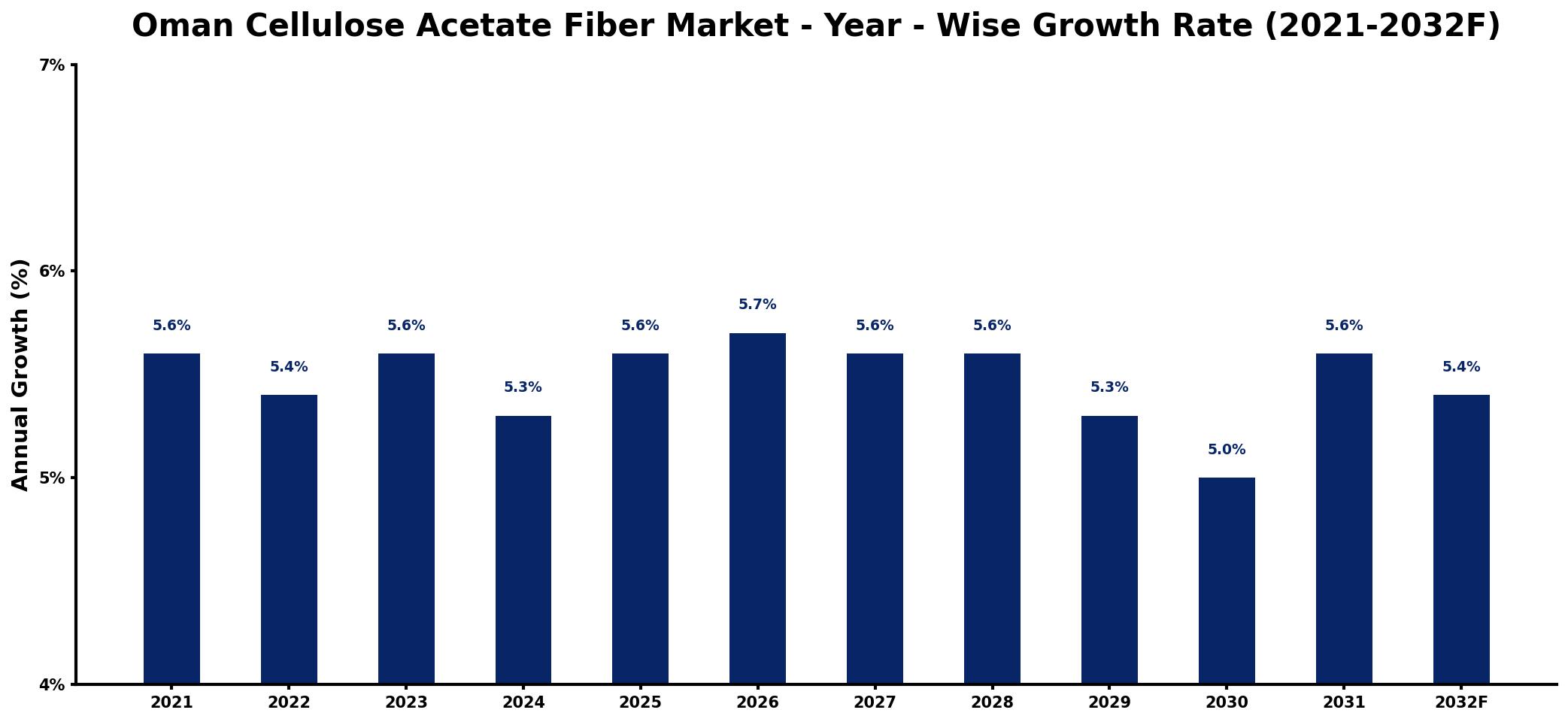
The table below presents the year‑wise growth rates along with the key drivers influencing the market
| Year | Growth Rate | Major Drivers |
| 2021 | 5.6% | increased demand from textile industry |
| 2022 | 5.4% | growing interest in sustainable materials |
| 2023 | 5.6% | rising applications in automotive sector |
| 2024 | 5.3% | expansion of global production facilities |
| 2025 | 5.6% | investment in research and development |
| 2026 | 5.7% | increased consumer awareness of eco-friendliness |
| 2027 | 5.6% | enhanced manufacturing technologies adoption |
| 2028 | 5.6% | growing popularity in home furnishings |
| 2029 | 5.3% | shifts towards innovative packaging solutions |
| 2030 | 5.0% | emphasis on biodegradable product alternatives |
| 2031 | 5.6% | increased collaboration with fashion brands |
| 2032 | 5.4% | expansion into emerging markets |
Note: Market size estimations and growth projections presented in this report are based on 6Wresearch's proprietary forecasting methodology, utilizing the latest available industry data, government publications, and primary research inputs.
Oman Cellulose Acetate Fiber Market Synopsis
The Oman Cellulose Acetate Fiber market is increasingly recognized for its versatility and sustainability. Driven by eco-conscious consumer preferences, the fiber is being adopted across multiple industries, including textiles and automotive, due to its favorable properties such as durability and biodegradability.
Recent developments indicate a transition towards advanced production technologies aimed at enhancing the quality of cellulose acetate fibers. This shift is critical as industries respond to a growing demand for greener alternatives to traditional synthetic fibers, positioning cellulose acetate as a key player in a sustainable future.
Oman Cellulose Acetate Fiber Market Key Takeaways
- Increasing demand for sustainable materials is driving growth in the cellulose acetate fiber market.
- Innovative manufacturing processes are enhancing the quality and applications of cellulose acetate fibers.
- The market is witnessing notable interest from sectors such as textiles, pharmaceuticals, and automotive.
- Government initiatives are fostering an environment conducive to industry growth and innovation.
- Investments in research and development are essential for overcoming challenges and capitalizing on market opportunities.
Evaluation of Restraints in Oman Cellulose Acetate Fiber Market
While the Oman Cellulose Acetate Fiber market is positioned for growth, it faces several constraints. Intense competition from alternative synthetic fibers can hinder market penetration. Moreover, fluctuating raw material costs can disrupt production processes. The industry must also navigate environmental regulations and maintain sustainable practices, which require ongoing investment and commitment. Infrastructure limitations and a shortage of skilled labor in the region present additional hurdles that companies must address to ensure resilience and competitiveness.
Oman Cellulose Acetate Fiber Market Trends
A key trend in the Oman Cellulose Acetate Fiber market is the increasing preference for biodegradable and renewable materials in the textile industry. Consumers are actively seeking out products that align with their sustainability values. Simultaneously, manufacturers are investing in advanced technologies to enhance the properties of cellulose acetate fibers, making them more appealing for a variety of applications. Furthermore, there is a growing emphasis on circular economy principles, leading to innovative recycling methods that incorporate cellulose acetate fibers.
Oman Cellulose Acetate Fiber Market Opportunities
The Oman Cellulose Acetate Fiber market offers substantial investment opportunities, particularly in establishing local manufacturing facilities to meet domestic demand and serve export markets. Additionally, research and development initiatives focusing on enhancing the functionality and applications of cellulose acetate fibers present a promising avenue for growth. As industries continue to prioritize sustainability, companies that innovate in this space can capture significant market share. Strategic partnerships and collaborations can also provide avenues for expanding capabilities and enhancing product offerings.
Government Initiatives in the Oman Cellulose Acetate Fiber Market
The Omani government has undertaken various initiatives to bolster the Cellulose Acetate Fiber market. These initiatives emphasize investment in research and development, fostering an innovative ecosystem for industry stakeholders. Programs aimed at promoting sustainable production practices are being introduced, alongside incentives for companies that prioritize environmental standards. Additionally, regulatory frameworks are in place to support fair trade practices and stimulate local production, thereby reducing reliance on imports and contributing to economic development.
Future Insights of the Oman Cellulose Acetate Fiber Market
Looking ahead to 2026-2032, the Oman Cellulose Acetate Fiber market is poised for steady growth driven by a persistent shift towards sustainable materials. The ongoing awareness regarding the ecological impacts of synthetic fibers will further enhance the adoption of cellulose acetate as a viable alternative. Continuous advancements in manufacturing technologies are expected to facilitate improved product quality and broaden application spectrums. Consequently, the market is likely to evolve, aligning more closely with global sustainability trends while reinforcing its position as a crucial component in various industries.
Oman Cellulose Acetate Fiber Market Latest Developments (2025 - 2026)
Recent developments in the Oman Cellulose Acetate Fiber market indicate a concerted effort by industry stakeholders to enhance production capabilities and sustainability practices. Many companies are adopting eco-friendly manufacturing techniques, while others are exploring new applications for cellulose acetate fibers in emerging sectors such as healthcare. Furthermore, collaborative efforts between public and private entities are being reinforced to promote innovation and drive growth within the sector, positioning the market for future success.
Oman Cellulose Acetate Fiber Market - Key Attractiveness of the Report
- 10 Years of Market Numbers
- Historical Data Starting from 2022 to 2025
- Base Year: 2025
- Forecast Data until 2032
- Key Performance Indicators Impacting the Market
- Major Upcoming Developments and Projects
Key Highlights of the Report:
- Oman Cellulose Acetate Fiber Market Outlook
- Market Size of Oman Cellulose Acetate Fiber Market, 2025
- Forecast of Oman Cellulose Acetate Fiber Market, 2032
- Historical Data and Forecast of Oman Cellulose Acetate Fiber Revenues & Volume for the Period 2022-2032F
- Oman Cellulose Acetate Fiber Market Trend Evolution
- Oman Cellulose Acetate Fiber Market Drivers and Challenges
- Oman Cellulose Acetate Fiber Price Trends
- Oman Cellulose Acetate Fiber Porter's Five Forces
- Oman Cellulose Acetate Fiber Industry Life Cycle
- Historical Data and Forecast of Oman Cellulose Acetate Fiber Market Revenues & Volume By Type for the Period 2022-2032F
- Historical Data and Forecast of Oman Cellulose Acetate Fiber Market Revenues & Volume By Plastic for the Period 2022-2032F
- Historical Data and Forecast of Oman Cellulose Acetate Fiber Market Revenues & Volume By Fiber for the Period 2022-2032F
- Historical Data and Forecast of Oman Cellulose Acetate Fiber Market Revenues & Volume By Application for the Period 2022-2032F
- Historical Data and Forecast of Oman Cellulose Acetate Fiber Market Revenues & Volume By Photographic Films for the Period 2022-2032F
- Historical Data and Forecast of Oman Cellulose Acetate Fiber Market Revenues & Volume By Cigarette Filters for the Period 2022-2032F
- Historical Data and Forecast of Oman Cellulose Acetate Fiber Market Revenues & Volume By Tapes & Labels for the Period 2022-2032F
- Historical Data and Forecast of Oman Cellulose Acetate Fiber Market Revenues & Volume By Textiles & Apparel for the Period 2022-2032F
- Oman Cellulose Acetate Fiber Import Export Trade Statistics
- Market Opportunity Assessment By Type
- Market Opportunity Assessment By Application
- Oman Cellulose Acetate Fiber Top Companies Market Share
- Oman Cellulose Acetate Fiber Competitive Benchmarking By Technical and Operational Parameters
- Oman Cellulose Acetate Fiber Company Profiles
- Oman Cellulose Acetate Fiber Key Strategic Recommendations






































