Oman Cigarette Market Size, Share & Growth Rate
The Oman Cigarette Market was estimated at USD 176 Million in 2025 and is projected to reach USD 236 Million by 2032, growing at a CAGR of 4.3% from 2026 to 2032. This growth trajectory is driven primarily by a stable consumer base, with a gradual adaptation to changing preferences towards less harmful smoking alternatives. Additionally, the government's regulatory framework, while stringent, provides a defined landscape for companies willing to innovate and comply with health-focused initiatives.
Oman Cigarette Market Year-wise Growth Rate and Key Drivers
This graph highlights how the Oman Cigarette Market has steadily grown over the years, supported by major growth factors.
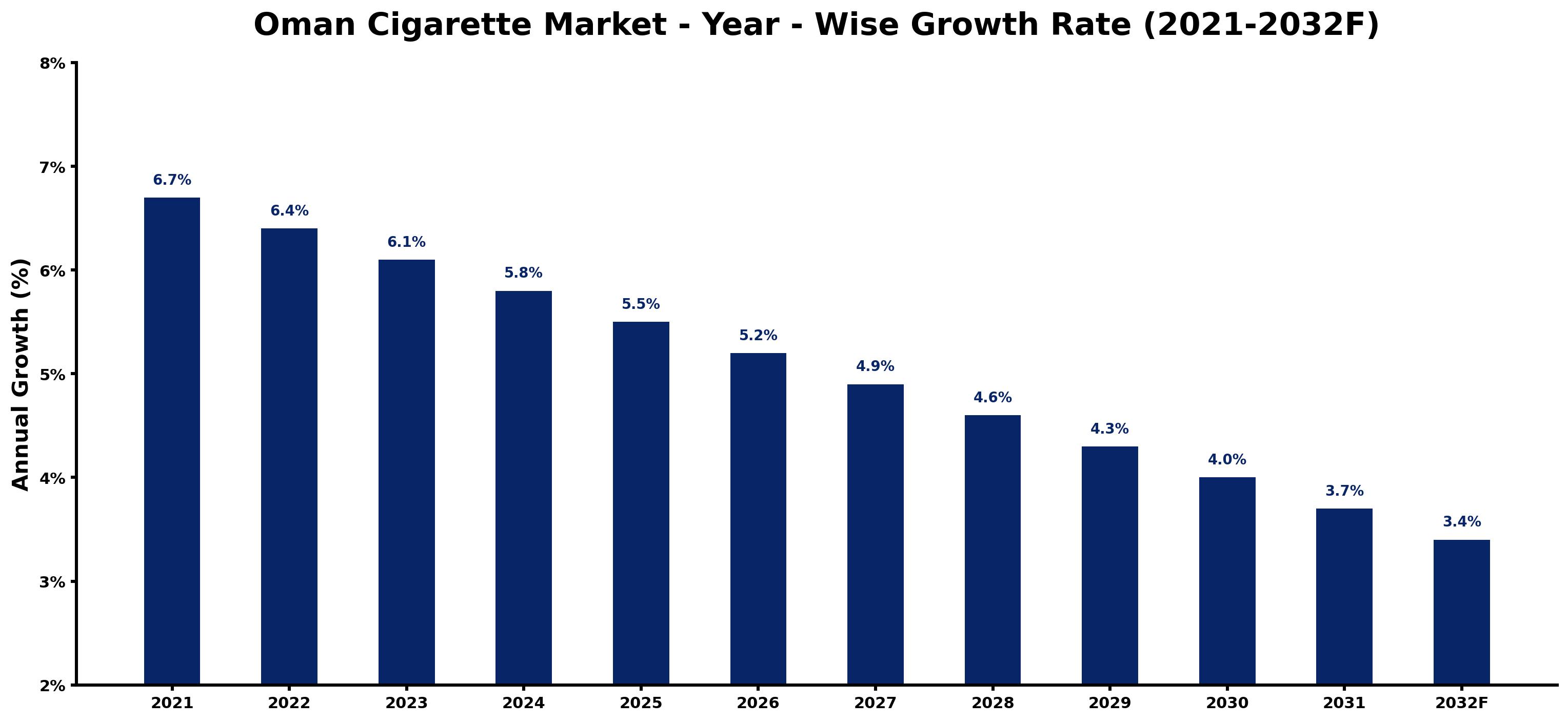
The table below presents the year‑wise growth rates along with the key drivers influencing the market
| Year | Growth Rate | Major Drivers |
| 2021 | 6.7% | Growing urbanization and commercial development |
| 2022 | 6.4% | Rising electricity demand across industries |
| 2023 | 6.1% | Expansion of commercial construction activities |
| 2024 | 5.8% | Rising electricity demand across industries |
| 2025 | 5.5% | Government infrastructure modernization initiatives |
| 2026 | 5.2% | Growing adoption of energy efficient systems |
| 2027 | 4.9% | Technology transition toward sustainable alternatives |
| 2028 | 4.6% | Environmental regulations reducing traditional demand |
| 2029 | 4.3% | Technology transition toward sustainable alternatives |
| 2030 | 4.0% | Technology transition toward sustainable alternatives |
| 2031 | 3.7% | Declining investments in legacy infrastructure |
| 2032 | 3.4% | Growing adoption of energy efficient systems |
Note - Market size estimations and growth projections presented in this report are based on 6Wresearch’s advanced forecasting approach, validated with industry datasets as of June 2026.
Oman Cigarette Market Synopsis
The most significant force shaping the Oman Cigarette Market today is the increasing public health awareness and regulatory measures aimed at reducing traditional tobacco consumption. As health campaigns gain traction, consumers are increasingly seeking alternatives, impacting the dynamics of traditional cigarette sales.
As a result, we are witnessing a shift in consumer behavior, especially among younger demographics, who are more inclined to explore e-cigarettes and heated tobacco products. Companies are strategically aligning their product portfolios to address this evolving landscape, presenting both challenges and opportunities in an increasingly health-conscious market.
Oman Cigarette Market Key Takeaways
- The market is poised for steady growth driven by evolving consumer preferences.
- Health awareness is reshaping demand dynamics, promoting alternative tobacco products.
- Government regulations significantly influence market strategies and product offerings.
- Opportunities for investment are present, particularly in premium and flavored segments.
- Market players must navigate a competitive landscape that includes illicit trade challenges.
Evaluation of Restraints in Oman Cigarette Market
The Oman Cigarette Market faces notable restraints, primarily stemming from stringent government regulations that limit advertising and impose heavy taxes on tobacco products. These regulatory measures, while intended to protect public health, can hinder market growth by increasing product prices and reducing accessibility. Furthermore, the rising awareness of health risks associated with traditional smoking fuels a societal shift towards healthier alternatives, thus limiting the market potential for conventional cigarette sales. These factors compel companies to diversify their offerings and adapt to an environment increasingly dominated by reduced-risk products.
Oman Cigarette Market Trends
The landscape of the Oman Cigarette Market is currently being reshaped by several key trends. There is a marked increase in the popularity of e-cigarettes and vaping products as consumers gravitate towards perceived less harmful alternatives. Furthermore, technological advancements in product design have made these alternatives more appealing, especially to the younger generation. Public health campaigns and a growing focus on wellness continue to influence consumer choices, emphasizing the need for traditional manufacturers to innovate. Simultaneously, there is an emerging interest in flavored and premium products, which presents avenues for market expansion amid shifting preferences.
Oman Cigarette Market Opportunities
Investment opportunities in the Oman Cigarette Market are significant. Companies can leverage the stable economic environment and rising disposable incomes by introducing innovative products tailored to emerging consumer preferences. The premium segment, in particular, is witnessing increased demand, as consumers are willing to pay more for quality. Furthermore, tapping into the growing e-cigarette market offers a strategic avenue for growth. Strategic partnerships and collaborations within the alternative tobacco sector can also provide additional avenues for market penetration and expansion.
Government Initiatives in the Oman Cigarette Market
The Omani government has established a comprehensive policy framework aimed at mitigating tobacco use across the nation. Key initiatives include the prohibition of smoking in public spaces, the imposition of higher taxes on tobacco products, and the implementation of graphic health warnings on packaging. These measures not only serve to inform the public about the dangers of tobacco but also seek to foster a smoke-free environment. Moreover, strict laws against advertising and sponsorship aim to limit tobacco's visibility in the marketplace, aligning with global health priorities.
Future Insights of the Oman Cigarette Market
Looking ahead to the period from 2026 to 2032, the Oman Cigarette Market is poised for transformative changes driven by evolving consumer attitudes and continued government interventions. As anti-smoking campaigns and health initiatives gain momentum, a decline in traditional cigarette consumption is anticipated. Instead, the market may increasingly shift toward alternative tobacco products, necessitating traditional manufacturers to adapt swiftly. Companies that prioritize innovation and align their strategies with health-conscious trends will be better positioned to thrive in this changing landscape.
Oman Cigarette Market Latest Developments (May 2025 - June 2026)
In the latest industry developments, there has been a noticeable emphasis on product diversification within the Oman Cigarette Market. Companies are actively launching new product lines that cater to emerging trends in health and wellness. Additionally, several initiatives aimed at educating consumers about the risks of smoking have gained traction, coinciding with a broader governmental push towards promoting healthier lifestyles. This environment of innovation is set against a backdrop of ongoing challenges with illicit cigarette trade, prompting a call for more stringent enforcement and compliance measures.
Oman Cigarette Market - Key Attractiveness of the Report
- 10 Years of Market Numbers
- Historical Data Starting from 2022 to 2025
- Base Year: 2025
- Forecast Data until 2032
- Key Performance Indicators Impacting the Market
- Major Upcoming Developments and Projects
Key Highlights of the Report:
- Oman Cigarette? Market Outlook
- Market Size of Oman Cigarette? Market, 2025
- Forecast of Oman Cigarette? Market, 2032
- Historical Data and Forecast of Oman Cigarette? Revenues & Volume for the Period 2022-2032F
- Oman Cigarette? Market Trend Evolution
- Oman Cigarette? Market Drivers and Challenges
- Oman Cigarette? Price Trends
- Oman Cigarette? Porter's Five Forces
- Oman Cigarette? Industry Life Cycle
- Historical Data and Forecast of Oman Cigarette? Market Revenues & Volume By Type for the Period 2022-2032F
- Historical Data and Forecast of Oman Cigarette? Market Revenues & Volume By Light for the Period 2022-2032F
- Historical Data and Forecast of Oman Cigarette? Market Revenues & Volume By Medium for the Period 2022-2032F
- Historical Data and Forecast of Oman Cigarette? Market Revenues & Volume By Others for the Period 2022-2032F
- Historical Data and Forecast of Oman Cigarette? Market Revenues & Volume By Distribution Channel for the Period 2022-2032F
- Historical Data and Forecast of Oman Cigarette? Market Revenues & Volume By Tobacco Shops for the Period 2022-2032F
- Historical Data and Forecast of Oman Cigarette? Market Revenues & Volume By Supermarket and Hypermarkets for the Period 2022-2032F
- Historical Data and Forecast of Oman Cigarette? Market Revenues & Volume By Convenience Stores for the Period 2022-2032F
- Historical Data and Forecast of Oman Cigarette? Market Revenues & Volume By Online Stores for the Period 2022-2032F
- Historical Data and Forecast of Oman Cigarette? Market Revenues & Volume By Others for the Period 2022-2032F
- Oman Cigarette? Import Export Trade Statistics
- Market Opportunity Assessment By Type
- Market Opportunity Assessment By Distribution Channel
- Oman Cigarette? Top Companies Market Share
- Oman Cigarette? Competitive Benchmarking By Technical and Operational Parameters
- Oman Cigarette? Company Profiles
- Oman Cigarette? Key Strategic Recommendations






































