Oman Glassware Market Size, Share & Growth Rate
The Oman Glassware Market was estimated at USD 664 Million in 2025 and is projected to reach USD 944 Million by 2032, growing at a CAGR of 5.2% from 2026 to 2032. This projected growth is underpinned by a burgeoning hospitality sector and evolving consumer preferences that emphasize high-quality, aesthetically pleasing glassware. As households increasingly seek elegance and functionality in their dining experiences, demand for premium glassware is on the rise, fueling market expansion.
Oman Glassware Market Year-wise Growth Rate and Key Drivers
This graph highlights how the Oman Glassware Market has steadily grown over the years, supported by major growth factors.
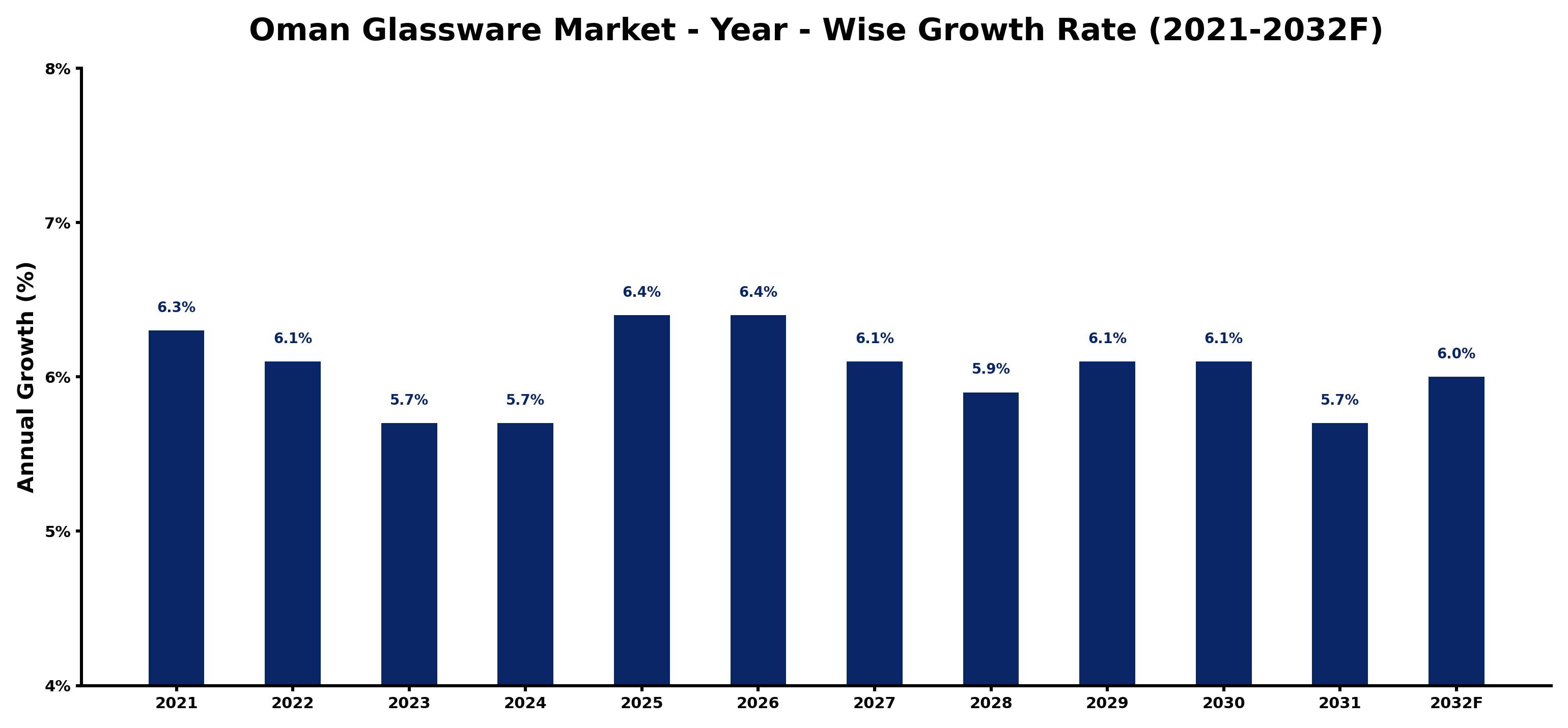
The table below presents the year‑wise growth rates along with the key drivers influencing the market
| Year | Growth Rate | Major Drivers |
| 2021 | 6.3% | Government infrastructure modernization initiatives |
| 2022 | 6.1% | Expansion of commercial construction activities |
| 2023 | 5.7% | Rapid growth in telecom and data center sectors |
| 2024 | 5.7% | Increasing industrial automation investments |
| 2025 | 6.4% | Rapid growth in telecom and data center sectors |
| 2026 | 6.4% | Increasing industrial infrastructure investments |
| 2027 | 6.1% | Expansion of transportation and logistics networks |
| 2028 | 5.9% | Expansion of commercial construction activities |
| 2029 | 6.1% | Rising electricity demand across industries |
| 2030 | 6.1% | Increasing adoption of advanced technologies |
| 2031 | 5.7% | Rising electricity demand across industries |
| 2032 | 6.0% | Growing urbanization and commercial development |
Note - Market size estimations and growth projections presented in this report are based on 6Wresearch’s advanced forecasting approach, validated with industry datasets as of June 2026.
Oman Glassware Market Synopsis
The recent surge in the Oman glassware market reflects a growing appetite for refined dining experiences, bolstered by the hospitality industry's growth. Yet, while current momentum is strong, the market faces challenges that could impede its future trajectory, particularly regarding production costs and technological advancements.
As the market evolves, consumers are increasingly looking for unique glass products that enhance both functionality and aesthetic appeal. This shift towards consumer-centric glassware will play a crucial role in shaping the future of the market, even as manufacturers grapple with cost pressures and regulatory requirements.
Oman Glassware Market Key Takeaways
- The Oman glassware market is poised for significant growth driven by rising demand from the hospitality and foodservice sectors.
- Consumer preferences are shifting towards elegant and functional glassware for both home use and commercial purposes.
- Local manufacturers face challenges including high energy costs and limited technological innovation.
- Government policies emphasize quality control and compliance with international standards, impacting market dynamics.
- Investment in the sector remains attractive, fueled by expanding opportunities in diverse applications.
Evaluation of Restraints in Oman Glassware Market
Despite the promising growth outlook, several constraints hinder the Oman glassware market. The escalating costs of raw materials and energy supply remain a critical concern, as glass manufacturing is notably energy-intensive. These fluctuations can create a competitive disadvantage for local producers against imported alternatives. Furthermore, a lack of significant technological advancements limits operational efficiencies, making it challenging for manufacturers to innovate or improve product quality. Coupled with stringent environmental regulations regarding emissions, these factors collectively create a complex landscape that local manufacturers must navigate.
Oman Glassware Market Trends
Current trends in the Oman glassware market indicate a strong consumer inclination toward sustainable and eco-friendly products. As awareness of environmental issues grows, consumers increasingly prefer glassware that minimizes environmental impact. Moreover, the rise of online retail platforms is also transforming distribution channels, allowing for greater accessibility and variety in product offerings.
In addition, decorative glassware is gaining traction, as more consumers seek unique, artistic pieces to enhance their home environments. This trend is complemented by a growing interest in custom or personalized glassware, catering to consumer desires for unique items that reflect personal style.
Oman Glassware Market Opportunities
The Oman glassware market presents various growth and investment opportunities, particularly in the premium segment. As affluent consumers increasingly prioritize quality and design, manufacturers have the chance to innovate and elevate their product offerings. Furthermore, targeting the burgeoning hospitality industry with tailored solutions can open new revenue streams. Developing partnerships with restaurants and hotels to provide customized glassware can create competitive advantages and enhance market presence.
Government Initiatives in the Oman Glassware Market
The Omani government plays a pivotal role in shaping the glassware market through policies focused on consumer protection and product safety. Initiatives promoting compliance with international quality standards are instrumental in enhancing market transparency and building consumer trust. Additionally, public spending on infrastructure and tourism development creates an encouraging environment for the growth of the hospitality sector, indirectly benefiting the glassware market.
Future Insights of the Oman Glassware Market
Looking ahead to 2026-2032, the Oman glassware market is set to undergo significant transformation, driven by changing consumer preferences and a gradual recovery in the hospitality sector. With a continuous push towards higher quality and innovative products, manufacturers are expected to invest more in R&D. This period will likely see enhanced product lines, improved manufacturing processes, and greater emphasis on sustainability as market players respond to consumer demands for environmentally responsible options.
Oman Glassware Market Latest Developments (May 2025 - June 2026)
Recent developments in the Oman glassware market highlight an increasing focus on sustainability and quality. Manufacturers are beginning to invest in more energy-efficient production methods and sustainable raw materials, aligning with global trends towards environmentally conscious products. Additionally, collaborations with local artisans for unique designs are emerging as brands seek to differentiate themselves and cater to the growing demand for artisanal glassware.
Oman Glassware Market - Key Attractiveness of the Report
- 10 Years of Market Numbers
- Historical Data Starting from 2022 to 2025
- Base Year: 2025
- Forecast Data until 2032
- Key Performance Indicators Impacting the Market
- Major Upcoming Developments and Projects
Key Highlights of the Report:
- Oman Glassware Market Outlook
- Market Size of Oman Glassware Market, 2025
- Forecast of Oman Glassware Market, 2032
- Historical Data and Forecast of Oman Glassware Revenues & Volume for the Period 2022-2032F
- Oman Glassware Market Trend Evolution
- Oman Glassware Market Drivers and Challenges
- Oman Glassware Price Trends
- Oman Glassware Porter's Five Forces
- Oman Glassware Industry Life Cycle
- Historical Data and Forecast of Oman Glassware Market Revenues & Volume By Type for the Period 2022-2032F
- Historical Data and Forecast of Oman Glassware Market Revenues & Volume By Soda Lime Glass for the Period 2022-2032F
- Historical Data and Forecast of Oman Glassware Market Revenues & Volume By Lead Glass for the Period 2022-2032F
- Historical Data and Forecast of Oman Glassware Market Revenues & Volume By Heat Resistant Glass for the Period 2022-2032F
- Historical Data and Forecast of Oman Glassware Market Revenues & Volume By Distribution Channel for the Period 2022-2032F
- Historical Data and Forecast of Oman Glassware Market Revenues & Volume By e-Commerce for the Period 2022-2032F
- Historical Data and Forecast of Oman Glassware Market Revenues & Volume By Supermarkets/Hypermarkets for the Period 2022-2032F
- Historical Data and Forecast of Oman Glassware Market Revenues & Volume By Specialized Stores for the Period 2022-2032F
- Historical Data and Forecast of Oman Glassware Market Revenues & Volume By End-user for the Period 2022-2032F
- Historical Data and Forecast of Oman Glassware Market Revenues & Volume By Hotels & Restaurants for the Period 2022-2032F
- Historical Data and Forecast of Oman Glassware Market Revenues & Volume By Corporate Canteens for the Period 2022-2032F
- Historical Data and Forecast of Oman Glassware Market Revenues & Volume By Bars & Caf for the Period 2022-2032F
- Historical Data and Forecast of Oman Glassware Market Revenues & Volume By Household for the Period 2022-2032F
- Historical Data and Forecast of Oman Glassware Market Revenues & Volume By Others for the Period 2022-2032F
- Oman Glassware Import Export Trade Statistics
- Market Opportunity Assessment By Type
- Market Opportunity Assessment By Distribution Channel
- Market Opportunity Assessment By End-user
- Oman Glassware Top Companies Market Share
- Oman Glassware Competitive Benchmarking By Technical and Operational Parameters
- Oman Glassware Company Profiles
- Oman Glassware Key Strategic Recommendations






































