Oman Greenhouse Horticulture Market Size, Share & Growth Rate
The Oman Greenhouse Horticulture Market was estimated at USD 90 Million in 2025 and is projected to reach USD 98 Million by 2032, growing at a CAGR of 1.2% from 2026 to 2032. This growth trajectory is underpinned by rising consumer preferences for fresh, locally-grown produce and significant governmental support aimed at enhancing food security. Furthermore, the transition to modern greenhouse technologies enhances production efficiency and crop quality, serving as a catalyst for market expansion.
Oman Greenhouse Horticulture Market Year-wise Growth Rate and Key Drivers
This graph highlights how the Oman Greenhouse Horticulture Market has steadily grown over the years, supported by major growth factors.
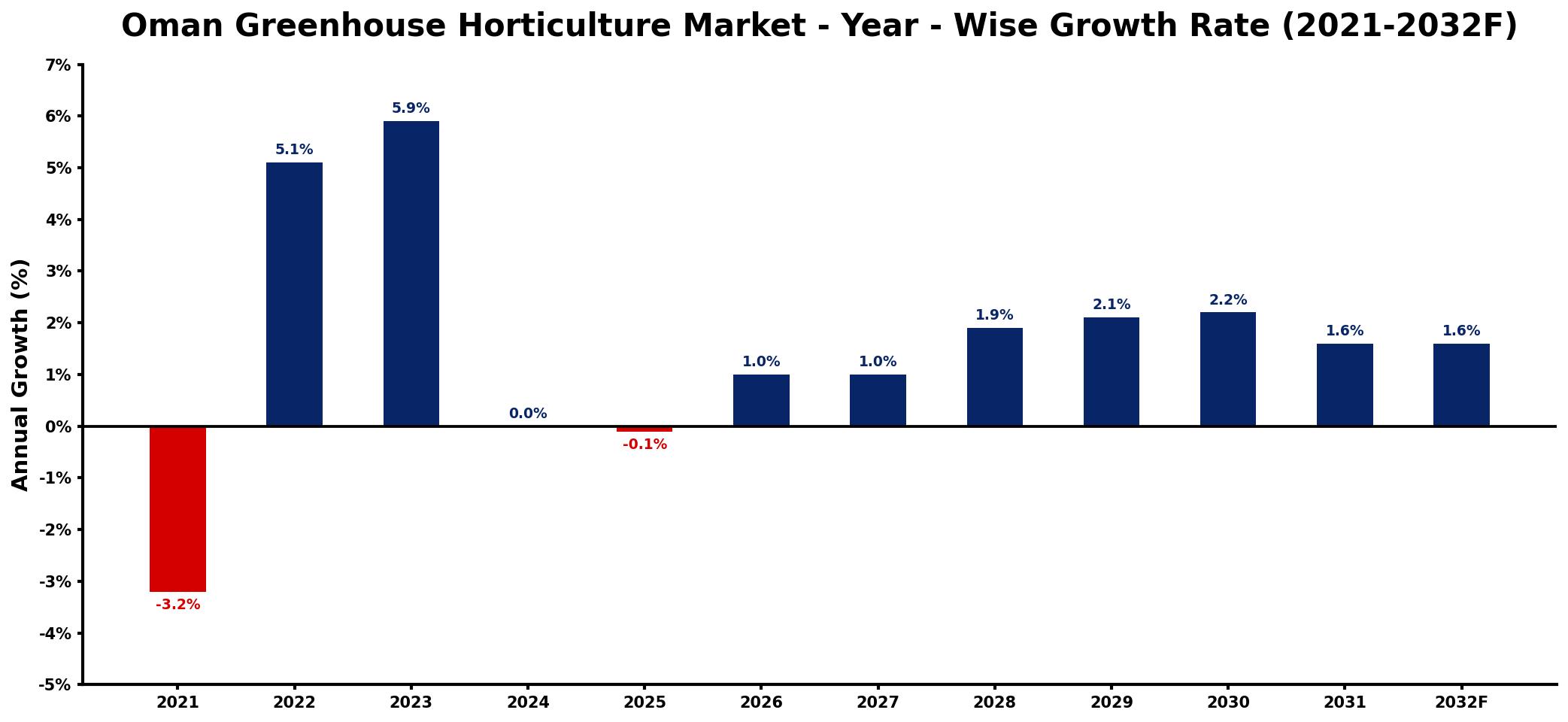
The table below presents the year‑wise growth rates along with the key drivers influencing the market
| Year | Growth Rate | Major Drivers |
| 2021 | -3.2% | decrease in consumer spending habits |
| 2022 | 5.1% | rise in local food demand |
| 2023 | 5.9% | increased investment in technology |
| 2024 | 0.0% | expansion of agricultural initiatives |
| 2025 | -0.1% | drop in international exports |
| 2026 | 1.0% | growth in export opportunities |
| 2027 | 1.0% | enhanced government support programs |
| 2028 | 1.9% | development of sustainable practices |
| 2029 | 2.1% | emergence of new market players |
| 2030 | 2.2% | increased focus on organic produce |
| 2031 | 1.6% | growing urban agriculture trends |
| 2032 | 1.6% | strengthening partnerships with retailers |
Note: Market size estimations and growth projections presented in this report are based on 6Wresearch's proprietary forecasting methodology, utilizing the latest available industry data, government publications, and primary research inputs.
Oman Greenhouse Horticulture Market Synopsis
The Oman Greenhouse Horticulture Market is characterized by a marked increase in the cultivation of high-demand crops such as tomatoes, cucumbers, and bell peppers. This shift towards specialized crop production is driven by a growing population and an escalating demand for nutritious food options.
Additionally, the sector benefits from Omans favorable climatic conditions, which are conducive to greenhouse farming. However, the industry is not without challenges; water scarcity remains a pressing issue that necessitates innovative solutions for sustainable agricultural practices.
Oman Greenhouse Horticulture Market Key Takeaways
- Increasing consumer demand for high-quality, fresh produce is shaping cultivation practices.
- Government initiatives are bolstering investment in greenhouse technology and sustainable farming practices.
- The adoption of advanced technologies such as hydroponics and vertical farming is on the rise.
- Investment opportunities exist in greenhouse construction and local partnerships for operational modernization.
- Ongoing research and development efforts are essential for overcoming existing market challenges.
Evaluation of Restraints in Oman Greenhouse Horticulture Market
While the Oman Greenhouse Horticulture Market presents significant opportunities, it is also hampered by several key restraints. Limited suitable land for greenhouse development poses a challenge for expansion, compounded by high initial costs associated with setting up advanced facilities. Additionally, the region's extreme climate, characterized by high temperatures and low humidity, necessitates specific technologies to maintain optimal growing conditions, increasing operational complexity. These factors contribute to a fragmented market landscape, making standardized practices hard to achieve.
Oman Greenhouse Horticulture Market Trends
Current trends in the Oman Greenhouse Horticulture Market emphasize sustainability and innovation. The rise of organic farming and eco-friendly growing techniques reflects a broader commitment to environmental stewardship. Additionally, the integration of smart farming solutions and automation is enhancing efficiency, allowing producers to respond adeptly to market demands.
Consumer interest in exotic and specialty crops continues to rise, pushing growers to diversify their offerings. As the market evolves, the emphasis on environmentally sustainable practices remains a critical factor in meeting consumer expectations.
Oman Greenhouse Horticulture Market Opportunities
Investment opportunities in the Oman Greenhouse Horticulture Market are abundant, primarily driven by the need for innovative solutions in food production. The push for food security amid a growing population and limited arable land calls for advancements in greenhouse technologies. Investors should focus on areas such as climate control systems and sustainable farming practices like hydroponics and vertical farming. Collaborating with local farmers to enhance their operational capabilities presents an additional avenue for growth.
Government Initiatives in the Oman Greenhouse Horticulture Market
The Omani government is actively promoting the greenhouse horticulture sector through various policies and initiatives designed to stimulate agricultural development. Subsidies and financial incentives for farmers adopting greenhouse technologies are a cornerstone of these efforts. Moreover, the government is enhancing awareness about the advantages of greenhouse farming, alongside providing technical assistance and training to optimize crop yields.
Future Insights of the Oman Greenhouse Horticulture Market
The outlook for the Oman Greenhouse Horticulture Market from 2026 to 2032 remains robust. With the increasing emphasis on food security and the demand for locally grown produce, growth is expected to be sustained. Governmental support in the form of financial incentives and technical assistance will further catalyze market growth. However, continuous innovation and adaptation will be essential to navigate challenges such as water scarcity and climatic fluctuations.
Oman Greenhouse Horticulture Market Latest Developments (2025 - 2026)
In the most recent period, the Oman Greenhouse Horticulture Market has seen a marked increase in investments directed towards modern greenhouse technologies and automation. Industry players are placing greater emphasis on sustainability, with an uptick in the adoption of organic and eco-friendly farming practices. Additionally, collaborations between local farmers and technology providers are becoming more common, as the sector seeks to enhance productivity and crop quality.
Oman Greenhouse Horticulture Market - Key Attractiveness of the Report
- 10 Years of Market Numbers
- Historical Data Starting from 2022 to 2025
- Base Year: 2025
- Forecast Data until 2032
- Key Performance Indicators Impacting the Market
- Major Upcoming Developments and Projects
Key Highlights of the Report:
- Oman Greenhouse Horticulture Market Outlook
- Market Size of Oman Greenhouse Horticulture Market, 2025
- Forecast of Oman Greenhouse Horticulture Market, 2032
- Historical Data and Forecast of Oman Greenhouse Horticulture Revenues & Volume for the Period 2022-2032F
- Oman Greenhouse Horticulture Market Trend Evolution
- Oman Greenhouse Horticulture Market Drivers and Challenges
- Oman Greenhouse Horticulture Price Trends
- Oman Greenhouse Horticulture Porter's Five Forces
- Oman Greenhouse Horticulture Industry Life Cycle
- Historical Data and Forecast of Oman Greenhouse Horticulture Market Revenues & Volume By Material Type for the Period 2022-2032F
- Historical Data and Forecast of Oman Greenhouse Horticulture Market Revenues & Volume By Glass for the Period 2022-2032F
- Historical Data and Forecast of Oman Greenhouse Horticulture Market Revenues & Volume By Plastic for the Period 2022-2032F
- Historical Data and Forecast of Oman Greenhouse Horticulture Market Revenues & Volume By Crop Type for the Period 2022-2032F
- Historical Data and Forecast of Oman Greenhouse Horticulture Market Revenues & Volume By Fruits and Vegetables for the Period 2022-2032F
- Historical Data and Forecast of Oman Greenhouse Horticulture Market Revenues & Volume By Flowers and Ornamentals for the Period 2022-2032F
- Historical Data and Forecast of Oman Greenhouse Horticulture Market Revenues & Volume By Nursery Crops for the Period 2022-2032F
- Historical Data and Forecast of Oman Greenhouse Horticulture Market Revenues & Volume By Others for the Period 2022-2032F
- Historical Data and Forecast of Oman Greenhouse Horticulture Market Revenues & Volume By Technology for the Period 2022-2032F
- Historical Data and Forecast of Oman Greenhouse Horticulture Market Revenues & Volume By Heating System for the Period 2022-2032F
- Historical Data and Forecast of Oman Greenhouse Horticulture Market Revenues & Volume By Cooling System for the Period 2022-2032F
- Oman Greenhouse Horticulture Import Export Trade Statistics
- Market Opportunity Assessment By Material Type
- Market Opportunity Assessment By Crop Type
- Market Opportunity Assessment By Technology
- Oman Greenhouse Horticulture Top Companies Market Share
- Oman Greenhouse Horticulture Competitive Benchmarking By Technical and Operational Parameters
- Oman Greenhouse Horticulture Company Profiles
- Oman Greenhouse Horticulture Key Strategic Recommendations






































