Oman High Strength Steel Market Size, Share & Growth Rate
The Oman High Strength Steel Market was estimated at USD 154 Million in 2025 and is projected to reach USD 205 Million by 2032, growing at a CAGR of 4.2% from 2026 to 2032. This growth trajectory is primarily fueled by increased investment in infrastructure projects, particularly in construction and heavy machinery, where the demand for durable and resilient materials is paramount. Furthermore, the automotive sectors shift towards lightweight design is bolstering the adoption of high strength steel, enhancing performance and safety across various applications.
Oman High Strength Steel Market Year-wise Growth Rate and Key Drivers
This graph highlights how the Oman High Strength Steel Market has steadily grown over the years, supported by major growth factors.
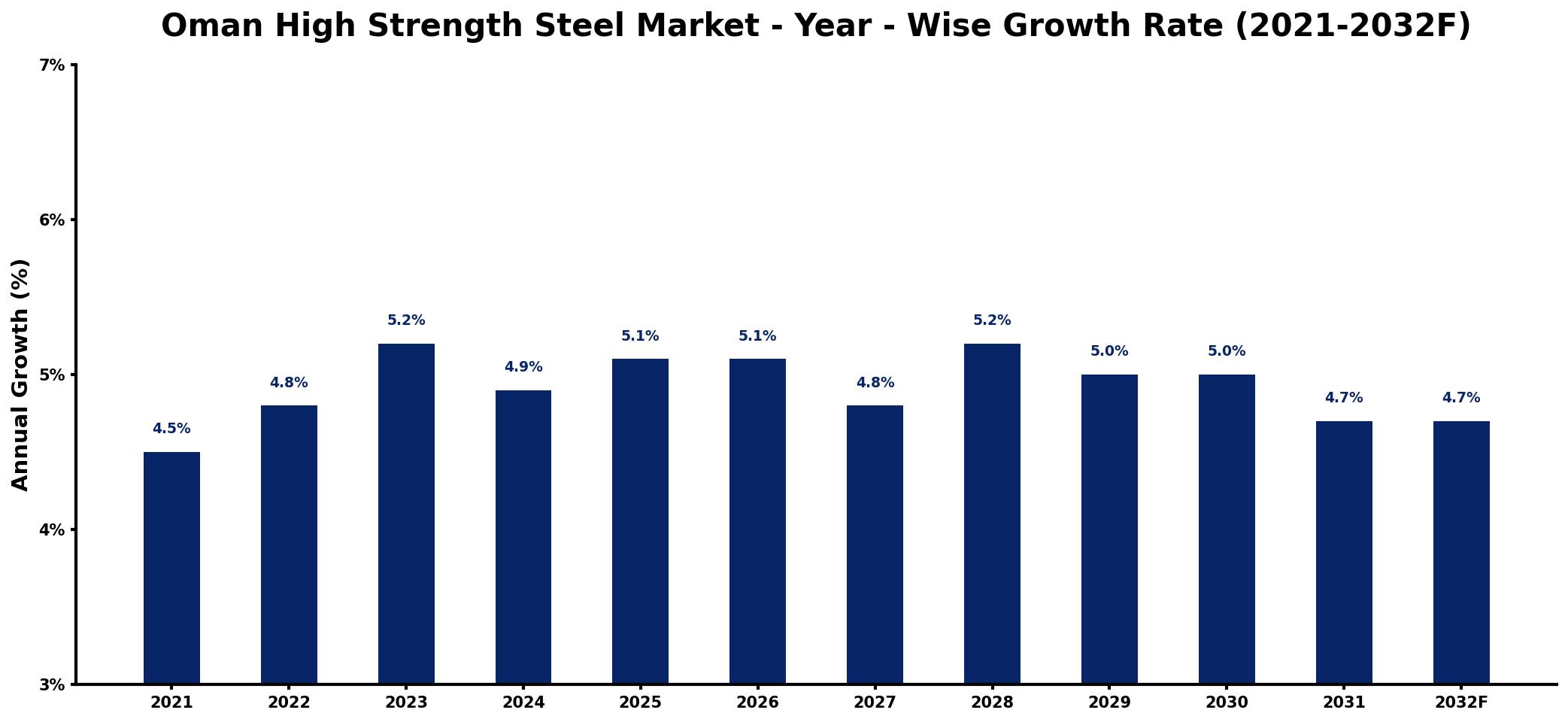
The table below presents the year‑wise growth rates along with the key drivers influencing the market
| Year | Growth Rate | Major Drivers |
| 2021 | 4.5% | Construction sector expansion drives demand |
| 2022 | 4.8% | Infrastructure projects require advanced materials |
| 2023 | 5.2% | Automotive industry growth increases usage |
| 2024 | 4.9% | Energy sector investments boost consumption |
| 2025 | 5.1% | Manufacturing advancements drive material needs |
| 2026 | 5.1% | Government initiatives promote infrastructure projects |
| 2027 | 4.8% | stronger distribution network expansion |
| 2028 | 5.2% | Transportation projects enhance material requirements |
| 2029 | 5.0% | Technological innovations create new applications |
| 2030 | 5.0% | Renewable energy projects increase demand |
| 2031 | 4.7% | Industrial growth sustains material needs |
| 2032 | 4.7% | Regional trade agreements enhance supply |
Note: Market size estimations and growth projections presented in this report are based on 6Wresearch's proprietary forecasting methodology, utilizing the latest available industry data, government publications, and primary research inputs.
Oman High Strength Steel Market Synopsis
Oman is experiencing a notable uptick in the utilization of high strength steel, driven by its superior mechanical properties and versatility. The construction and infrastructure sectors are significantly influencing this trend, as they prioritize materials that ensure structural integrity and safety in demanding applications.
The increasing emphasis on lightweight and efficient designs in the automotive industry further propels the market. As manufacturers seek to improve vehicle performance while adhering to stringent safety regulations, high strength steel emerges as a crucial component in achieving these objectives.
Oman High Strength Steel Market Key Takeaways
- The Oman High Strength Steel Market is projected to grow at a CAGR of 4.2% from 2026 to 2032.
- Infrastructure and construction demand are key drivers for market expansion in Oman.
- High strength steel's application in automotive manufacturing is on the rise, focusing on lightweight design.
- Technological advancements will play a significant role in improving production efficiency and product quality.
- Government policies are increasingly favoring sustainable practices in steel usage, further incentivizing market growth.
Evaluation of Restraints in Oman High Strength Steel Market
Despite the promising growth prospects, the Oman High Strength Steel Market faces several restraints that may impede its full potential. High production costs and the necessity for advanced technology pose significant challenges for manufacturers. Investments in research and development are crucial to ensure consistent quality and performance, particularly in industries such as automotive and construction. Additionally, the competition from alternative materials and traditional steel options threatens to limit market share and affects pricing strategies. Regulatory requirements add further complexity, requiring companies to navigate stringent standards while managing operational costs.
Oman High Strength Steel Market Trends
The trend towards sustainability is gaining momentum within the Oman High Strength Steel Market. Manufacturers are increasingly adopting eco-friendly production processes and utilizing recycled materials to meet growing environmental standards. Moreover, the integration of advanced manufacturing technologies, such as automation and digitalization, is shaping the future landscape, enhancing efficiency and reducing operational costs. Additionally, collaborative efforts between industry stakeholders aim to foster innovation, driving the development of new high-strength steel applications across various sectors.
Oman High Strength Steel Market Opportunities
Significant opportunities for growth exist within the Oman High Strength Steel Market, particularly in the context of ongoing infrastructure projects and the push for energy-efficient automotive designs. The government's commitment to enhancing its infrastructure provides a fertile ground for increased steel demand. Furthermore, with the growing trend of lightweight automotive components, manufacturers have the chance to innovate and expand their product lines. Investment in R&D to develop novel steel grades that cater to specific industry needs can also unlock new revenue streams.
Government Initiatives in the Oman High Strength Steel Market
The Omani government actively encourages the use of high-strength steel in construction, automotive, and manufacturing sectors, aiming to enhance structural integrity and sustainability. Policies promoting public spending on infrastructure development are vital in fostering a favorable environment for the high strength steel market. Additionally, incentives for technological upgrades and eco-friendly production practices align with global trends, promoting the industry's growth while addressing environmental concerns.
Future Insights of the Oman High Strength Steel Market
Looking forward to 2026-2032, the Oman High Strength Steel Market is poised for robust growth, driven by evolving industry demands and government support. The ongoing shift towards lightweight and high-performance materials in various applications will further accelerate market development. As manufacturers embrace innovation and sustainability, the sector is likely to witness advancements that not only enhance performance but also reduce environmental impact, solidifying high strength steel's position as a cornerstone of modern engineering solutions.
Oman High Strength Steel Market Latest Developments (2025 - 2026)
Recent developments in the Oman High Strength Steel Market indicate a strong commitment towards technological advancements and sustainability initiatives. Companies are increasingly exploring partnerships to enhance production capabilities while minimizing their environmental footprint. Additionally, investment in R&D is being prioritized to develop innovative steel solutions tailored for demanding applications in construction and automotive sectors. These directions reflect the market's responsiveness to global trends and local needs, ensuring future competitiveness.
Oman High Strength Steel Market - Key Attractiveness of the Report
- 10 Years of Market Numbers
- Historical Data Starting from 2022 to 2025
- Base Year: 2025
- Forecast Data until 2032
- Key Performance Indicators Impacting the Market
- Major Upcoming Developments and Projects
Key Highlights of the Report:
- Oman High Strength Steel Market Outlook
- Market Size of Oman High Strength Steel Market, 2025
- Forecast of Oman High Strength Steel Market, 2032
- Historical Data and Forecast of Oman High Strength Steel Revenues & Volume for the Period 2022-2032F
- Oman High Strength Steel Market Trend Evolution
- Oman High Strength Steel Market Drivers and Challenges
- Oman High Strength Steel Price Trends
- Oman High Strength Steel Porter's Five Forces
- Oman High Strength Steel Industry Life Cycle
- Historical Data and Forecast of Oman High Strength Steel Market Revenues & Volume By Product Type for the Period 2022-2032F
- Historical Data and Forecast of Oman High Strength Steel Market Revenues & Volume By Dual Phase Steel for the Period 2022-2032F
- Historical Data and Forecast of Oman High Strength Steel Market Revenues & Volume By Bake Hardenable Steel for the Period 2022-2032F
- Historical Data and Forecast of Oman High Strength Steel Market Revenues & Volume By Carbon Manganese Steel for the Period 2022-2032F
- Historical Data and Forecast of Oman High Strength Steel Market Revenues & Volume By Other Product Types for the Period 2022-2032F
- Historical Data and Forecast of Oman High Strength Steel Market Revenues & Volume By Application for the Period 2022-2032F
- Historical Data and Forecast of Oman High Strength Steel Market Revenues & Volume By Automotive for the Period 2022-2032F
- Historical Data and Forecast of Oman High Strength Steel Market Revenues & Volume By Construction for the Period 2022-2032F
- Historical Data and Forecast of Oman High Strength Steel Market Revenues & Volume By Yellow Goods and Mining Equipment for the Period 2022-2032F
- Historical Data and Forecast of Oman High Strength Steel Market Revenues & Volume By Aviation and Marine for the Period 2022-2032F
- Historical Data and Forecast of Oman High Strength Steel Market Revenues & Volume By Other Applications for the Period 2022-2032F
- Oman High Strength Steel Import Export Trade Statistics
- Market Opportunity Assessment By Product Type
- Market Opportunity Assessment By Application
- Oman High Strength Steel Top Companies Market Share
- Oman High Strength Steel Competitive Benchmarking By Technical and Operational Parameters
- Oman High Strength Steel Company Profiles
- Oman High Strength Steel Key Strategic Recommendations






































