Oman Livestock Market Size, Share & Growth Rate
The Oman Livestock Market was estimated at USD 189 Million in 2025 and is projected to reach USD 263 Million by 2032, growing at a CAGR of 4.8% from 2026 to 2032. This growth trajectory is fueled by an increasing population that demands fresh, locally-sourced meat products. Additionally, a rising trend towards organic and ethically-raised livestock is influencing consumer preferences, contributing to the market's robust expansion.
Oman Livestock Market Year-wise Growth Rate and Key Drivers
This graph highlights how the Oman Livestock Market has steadily grown over the years, supported by major growth factors.
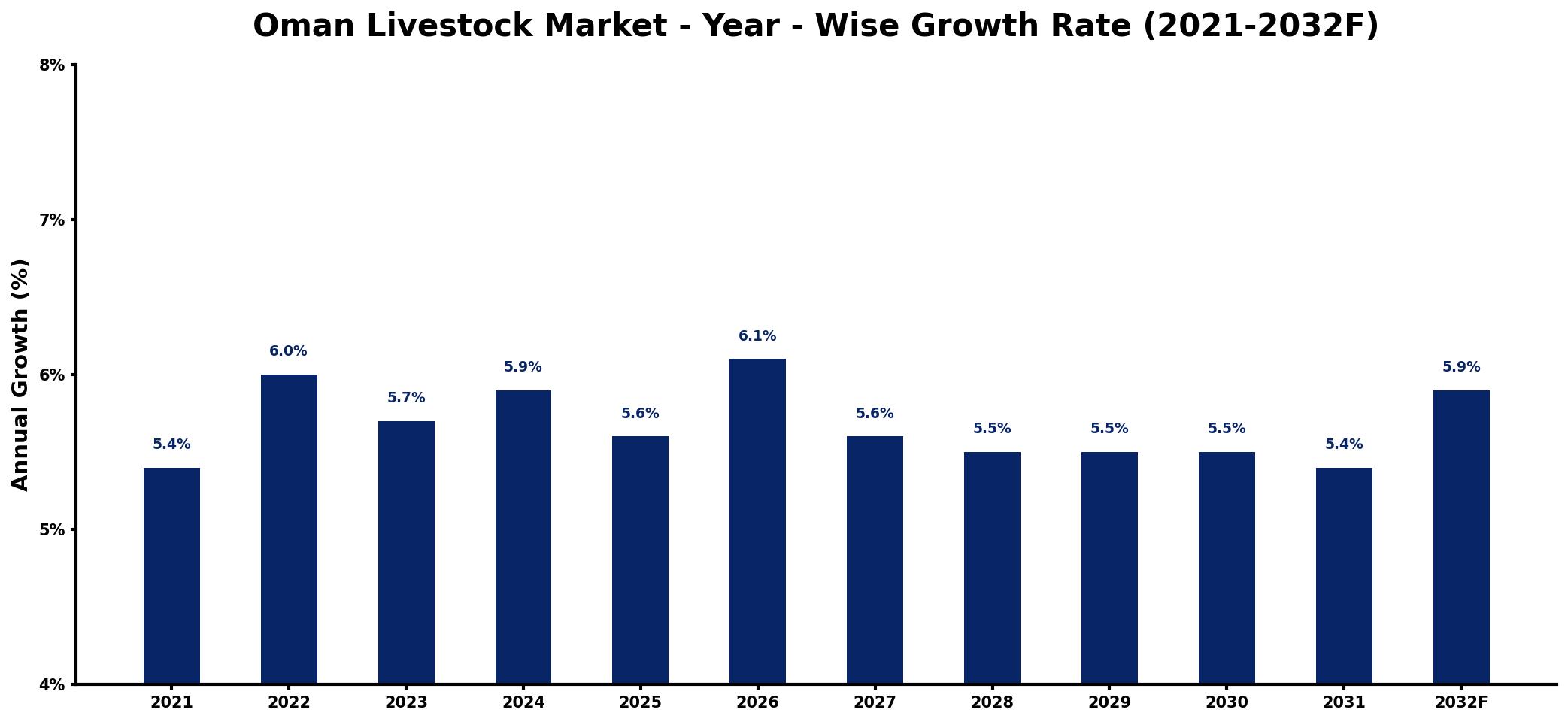
The table below presents the year‑wise growth rates along with the key drivers influencing the market
| Year | Growth Rate | Major Drivers |
| 2021 | 5.4% | increased consumer demand for protein |
| 2022 | 6.0% | expansion of feed production facilities |
| 2023 | 5.7% | growing export opportunities for meats |
| 2024 | 5.9% | rising investments in agriculture technology |
| 2025 | 5.6% | enhanced distribution network efficiency |
| 2026 | 6.1% | increased focus on sustainable practices |
| 2027 | 5.6% | growth in local farming initiatives |
| 2028 | 5.5% | expanding industrial usage applications |
| 2029 | 5.5% | increased urban population consumption trends |
| 2030 | 5.5% | growing demand for organic products |
| 2031 | 5.4% | enhanced agricultural education programs |
| 2032 | 5.9% | rising interest in agribusiness investments |
Note: Market size estimations and growth projections presented in this report are based on 6Wresearch's proprietary forecasting methodology, utilizing the latest available industry data, government publications, and primary research inputs.
Oman Livestock Market Synopsis
The Oman Livestock Market is characterized by its dynamic interaction between traditional and modern trading methods, particularly involving sheep, goats, and camels. Traditional souks serve as vital hubs for livestock trade, while modern facilities are evolving to meet the growing demand for premium livestock products.
Livestock farming plays an integral role in Oman's economy, providing livelihoods for numerous rural households. As consumer consciousness regarding food safety and quality increases, the market is evolving to prioritize sustainable and transparent practices that resonate with contemporary values.
Oman Livestock Market Key Takeaways
- The market demonstrates a consistent growth rate, driven by the demand for high-quality meat.
- There is a clear shift toward organic and locally-sourced livestock products among consumers.
- The integration of technology in livestock trading is on the rise, enhancing efficiency.
- Investment opportunities abound in livestock farming and supply chain logistics.
- Government policies are strategically aimed at improving the welfare of livestock and supporting local farmers.
Evaluation of Restraints in Oman Livestock Market
The Oman Livestock Market faces several restraints that can impede its growth trajectory. Fluctuating prices resulting from unpredictable supply and demand dynamics create uncertainty for both producers and consumers. Limited infrastructure hampers effective animal care and transportation, while insufficient adoption of modern technologies for trading processes can hinder operational efficiency. Additionally, inconsistencies in quality control can undermine buyer confidence, affecting overall market competitiveness. Addressing these issues necessitates focused investments in infrastructure and technology integration, as well as comprehensive regulatory reforms to enhance transparency and efficiency within the market.
Oman Livestock Market Trends
A notable trend in the Oman Livestock Market is the increasing consumer preference for organic and ethically raised livestock products, a reflection of heightened awareness regarding health and environmental impact. Furthermore, there is a growing inclination towards online platforms for livestock purchasing, showcasing a significant shift in consumer behavior influenced by technological advancements. As market participants adapt to these trends, we are likely to see greater emphasis on sustainability and transparency throughout the supply chain.
Oman Livestock Market Opportunities
There are multiple avenues for investment in the Oman Livestock Market, particularly in livestock farming and trading. The rising demand for livestock feed and healthcare products presents lucrative opportunities for entrepreneurs in manufacturing and distribution. Moreover, as online trading platforms gain traction, investors can explore innovative business models that leverage technology to enhance market accessibility and operational efficiency. These emerging dynamics make the livestock sector in Oman an attractive proposition for strategic investments aimed at capturing the market's growth potential.
Government Initiatives in the Oman Livestock Market
The Omani government has established a supportive regulatory framework to bolster the livestock sector. Policies are designed to safeguard animal welfare, regulate pricing, and support local farmers through various subsidies and incentives. Moreover, the Ministry of Agriculture and Fisheries Wealth plays a pivotal role in monitoring import-export activities to maintain food security and quality standards. These initiatives aim to create a fair and competitive environment in the livestock market while ensuring the well-being of consumers and producers alike.
Future Insights of the Oman Livestock Market
Looking ahead to 2026-2032, the Oman Livestock Market is set to experience considerable growth, propelled by increasing consumer demand for high-quality meat products and a burgeoning population. The government's ongoing initiatives to modernize the livestock sector, along with advancements in breeding techniques and supply chain management, are expected to drive improvements in productivity and efficiency. However, potential challenges such as fluctuating feed prices and climate change implications may require proactive strategies to mitigate risks. Overall, the market appears well-positioned for continued expansion, especially as it embraces modernization and value-added production to satisfy evolving consumer preferences.
Oman Livestock Market Latest Developments (2025 - 2026)
Recent developments in the Oman Livestock Market indicate a concerted effort towards integrating technology into livestock trading. The emergence of digital platforms has begun reshaping traditional trading practices, making transactions more accessible and efficient. Additionally, there is an increasing emphasis on sustainability, with several initiatives aimed at promoting organic farming and reducing the environmental footprint of livestock production. These directions reflect a broader trend towards modernization and consumer-centric practices that are expected to define the market's future.
Oman Livestock Market - Key Attractiveness of the Report
- 10 Years of Market Numbers
- Historical Data Starting from 2022 to 2025
- Base Year: 2025
- Forecast Data until 2032
- Key Performance Indicators Impacting the Market
- Major Upcoming Developments and Projects
Key Highlights of the Report:
- Oman Livestock Market Outlook
- Market Size of Oman Livestock Market, 2025
- Forecast of Oman Livestock Market, 2032
- Historical Data and Forecast of Oman Livestock Revenues & Volume for the Period 2022-2032F
- Oman Livestock Market Trend Evolution
- Oman Livestock Market Drivers and Challenges
- Oman Livestock Price Trends
- Oman Livestock Porter's Five Forces
- Oman Livestock Industry Life Cycle
- Historical Data and Forecast of Oman Livestock Market Revenues & Volume By Animal Type for the Period 2022-2032F
- Historical Data and Forecast of Oman Livestock Market Revenues & Volume By Ruminants for the Period 2022-2032F
- Historical Data and Forecast of Oman Livestock Market Revenues & Volume By Poultry for the Period 2022-2032F
- Historical Data and Forecast of Oman Livestock Market Revenues & Volume By Swine for the Period 2022-2032F
- Historical Data and Forecast of Oman Livestock Market Revenues & Volume By Aquaculture for the Period 2022-2032F
- Oman Livestock Import Export Trade Statistics
- Market Opportunity Assessment By Animal Type
- Oman Livestock Top Companies Market Share
- Oman Livestock Competitive Benchmarking By Technical and Operational Parameters
- Oman Livestock Company Profiles
- Oman Livestock Key Strategic Recommendations






































