Oman Ploughing and Cultivating Machinery Market Size, Share & Growth Rate
The Oman Ploughing and Cultivating Machinery Market was estimated at USD 406 Million in 2025 and is projected to reach USD 584 Million by 2032, growing at a CAGR of 5.3% from 2026 to 2032. This steady growth trajectory is largely attributed to the ongoing mechanization of farming practices in Oman, driven by both technological advancements and government support. As local farmers increasingly seek to boost productivity and efficiency, the demand for innovative ploughing and cultivating solutions continues to expand.
Oman Ploughing and Cultivating Machinery Market Year-wise Growth Rate and Key Drivers
This graph highlights how the Oman Ploughing and Cultivating Machinery Market has steadily grown over the years, supported by major growth factors.
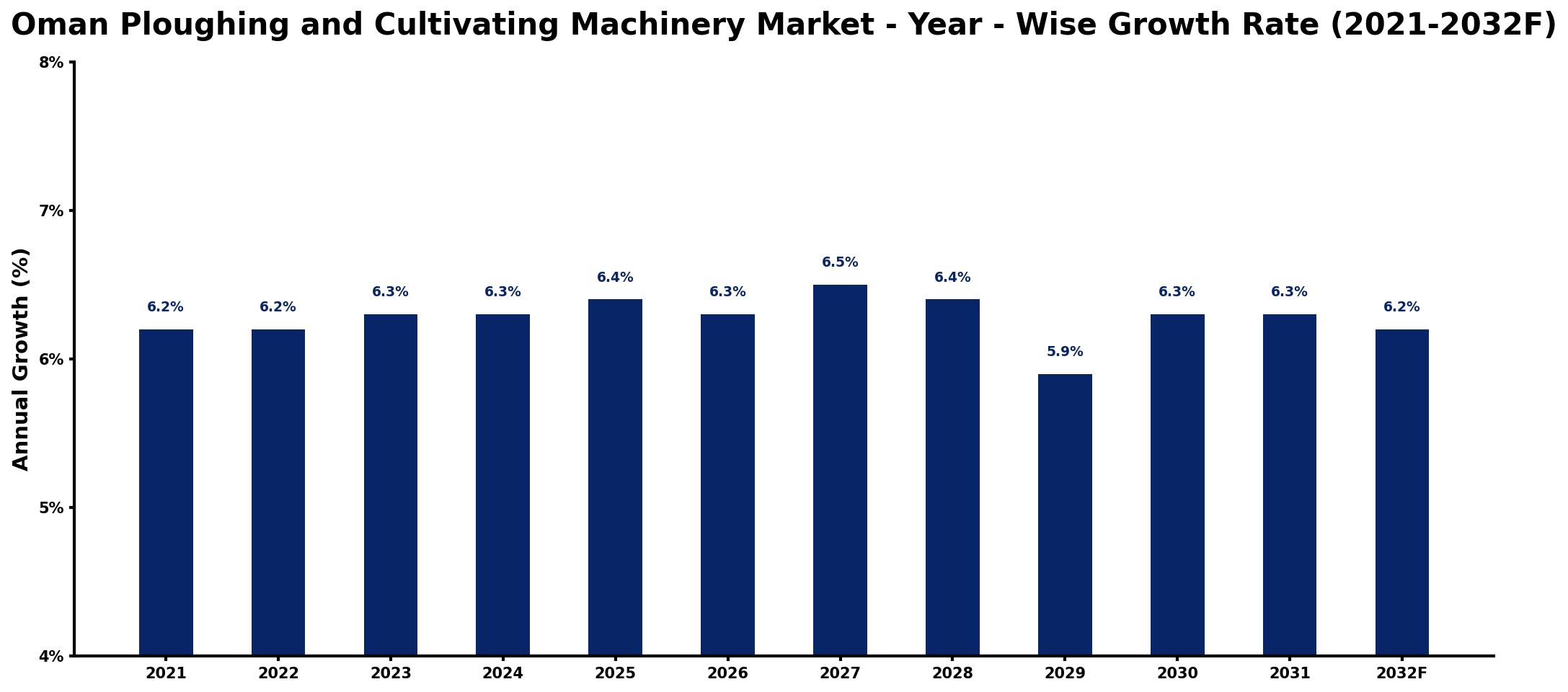
The table below presents the year‑wise growth rates along with the key drivers influencing the market
| Year | Growth Rate | Major Drivers |
| 2021 | 6.2% | Rising agricultural investment trends |
| 2022 | 6.2% | Increasing demand for automation |
| 2023 | 6.3% | Expansion of export markets |
| 2024 | 6.3% | Technological advancements in farming |
| 2025 | 6.4% | Growing interest in sustainable practices |
| 2026 | 6.3% | Enhancement of irrigation systems |
| 2027 | 6.5% | Increase in farmer education programs |
| 2028 | 6.4% | Development of rural infrastructure |
| 2029 | 5.9% | Shifts towards organic farming initiatives |
| 2030 | 6.3% | Strengthening of cooperative farming models |
| 2031 | 6.3% | Growth in government subsidies |
| 2032 | 6.2% | Rising consumer demand for food |
Note: Market size estimations and growth projections presented in this report are based on 6Wresearch's proprietary forecasting methodology, utilizing the latest available industry data, government publications, and primary research inputs.
Oman Ploughing and Cultivating Machinery Market Synopsis
In Oman, there is a noticeable shift towards mechanization, particularly in the use of tractor-mounted ploughs and cultivators. This transition is not only enhancing productivity but also meeting the urgent need for food security within the country. The adoption of advanced machinery is helping farmers minimize labor dependency, thereby fostering a more sustainable agricultural ecosystem.
Government initiatives aimed at modernizing the agricultural sector are paving the way for increased investments in advanced machinery. As farmers recognize the tangible benefits of using modern equipment, there is a growing market for durable and user-friendly ploughing and cultivating solutions tailored to local conditions.
Oman Ploughing and Cultivating Machinery Market Key Takeaways
- The market is experiencing a significant shift towards mechanization, with farmers increasingly investing in modern ploughing and cultivating machinery.
- Government policies promoting subsidies and modernization are facilitating the adoption of advanced agricultural equipment.
- Eco-friendly and fuel-efficient machinery are gaining popularity due to rising environmental concerns.
- Precision farming techniques are becoming integrated into everyday practices, enhancing overall farming efficiency.
- Investment opportunities are abundant for suppliers of innovative agricultural equipment and services.
Evaluation of Restraints in Oman Ploughing and Cultivating Machinery Market
Despite the optimistic outlook, several factors pose challenges to market growth. Access to advanced technology remains limited, primarily due to a strong reliance on traditional farming methods. This dependency slows the uptake of modern machinery and precision farming techniques. Furthermore, the high costs associated with importing equipment, coupled with insufficient local manufacturing capabilities, hinder the market's potential. Skilled labor shortages in operating and maintaining modern machinery also pose a significant barrier, necessitating targeted solutions to enable further growth.
Oman Ploughing and Cultivating Machinery Market Trends
The landscape of the Oman Ploughing and Cultivating Machinery Market is characterized by evolving trends that are reshaping agricultural practices. There is a growing emphasis on the adoption of precision farming techniques, which leverage technology to optimize crop yields and reduce input costs. Additionally, the integration of GPS and sensor technology in machinery is enhancing operational efficiency. The market is also witnessing an increasing focus on sustainable and eco-friendly farming practices, propelling demand for fuel-efficient machinery that minimizes environmental impact. As these trends gain traction, they are likely to drive the market towards innovative solutions that cater to the changing dynamics of agriculture in Oman.
Oman Ploughing and Cultivating Machinery Market Opportunities
Investors looking to enter the Oman Ploughing and Cultivating Machinery Market will find numerous opportunities stemming from the country's agricultural modernization efforts. As the government pushes for enhanced food security and agricultural efficiency, there is a palpable demand for advanced ploughing and cultivating equipment. This represents a chance for businesses to provide innovative machinery and support services tailored to local needs. Additionally, the relative untapped nature of this market offers a promising landscape for early movers to establish partnerships with local distributors and agricultural stakeholders, ensuring long-term success.
Government Initiatives in the Oman Ploughing and Cultivating Machinery Market
The Omani government is taking significant steps to bolster the Ploughing and Cultivating Machinery Market through various policies and initiatives. Notably, subsidies and incentives are being offered to farmers to encourage the purchase of modern machinery, thereby enhancing agricultural productivity. Additionally, the government has formed partnerships with international manufacturers to facilitate technology transfer, promoting the adoption of cutting-edge agricultural machinery. Through these initiatives, the government aims to create a robust and sustainable agricultural sector that benefits both farmers and consumers alike.
Future Insights of the Oman Ploughing and Cultivating Machinery Market
Looking ahead to the period from 2026 to 2032, the Oman Ploughing and Cultivating Machinery Market is anticipated to maintain a positive growth trajectory. The ongoing shift towards mechanization, supported by governmental policies, will likely propel the market further. As farmers increasingly recognize the benefits of modern farming practices, the demand for advanced machinery is expected to rise steadily. Moreover, the integration of emerging technologies such as IoT will contribute to more efficient farming operations. Nevertheless, initial investment costs and the awareness level among small-scale farmers may pose challenges that need to be addressed to ensure comprehensive market growth.
Oman Ploughing and Cultivating Machinery Market Latest Developments (2025 - 2026)
In recent months, the Oman Ploughing and Cultivating Machinery Market has witnessed notable developments aimed at enhancing agricultural productivity. There has been an increased focus on the introduction of state-of-the-art machinery that integrates advanced technology for improved farming efficiency. Additionally, local agricultural exhibitions and trade shows are becoming more frequent, providing a platform for stakeholders to showcase innovative solutions and foster collaborations. These developments indicate a vibrant market landscape, characterized by a growing interest in mechanized farming.
Oman Ploughing and Cultivating Machinery Market - Key Attractiveness of the Report
- 10 Years of Market Numbers
- Historical Data Starting from 2022 to 2025
- Base Year: 2025
- Forecast Data until 2032
- Key Performance Indicators Impacting the Market
- Major Upcoming Developments and Projects
Key Highlights of the Report:
- Oman Ploughing and Cultivating Machinery Market Outlook
- Market Size of Oman Ploughing and Cultivating Machinery Market, 2025
- Forecast of Oman Ploughing and Cultivating Machinery Market, 2032
- Historical Data and Forecast of Oman Ploughing and Cultivating Machinery Revenues & Volume for the Period 2022-2032F
- Oman Ploughing and Cultivating Machinery Market Trend Evolution
- Oman Ploughing and Cultivating Machinery Market Drivers and Challenges
- Oman Ploughing and Cultivating Machinery Price Trends
- Oman Ploughing and Cultivating Machinery Porter's Five Forces
- Oman Ploughing and Cultivating Machinery Industry Life Cycle
- Historical Data and Forecast of Oman Ploughing and Cultivating Machinery Market Revenues & Volume By Type for the Period 2022-2032F
- Historical Data and Forecast of Oman Ploughing and Cultivating Machinery Market Revenues & Volume By Ploughs for the Period 2022-2032F
- Historical Data and Forecast of Oman Ploughing and Cultivating Machinery Market Revenues & Volume By Harrows for the Period 2022-2032F
- Historical Data and Forecast of Oman Ploughing and Cultivating Machinery Market Revenues & Volume By Others for the Period 2022-2032F
- Historical Data and Forecast of Oman Ploughing and Cultivating Machinery Market Revenues & Volume By Application for the Period 2022-2032F
- Historical Data and Forecast of Oman Ploughing and Cultivating Machinery Market Revenues & Volume By Soil Loosening for the Period 2022-2032F
- Historical Data and Forecast of Oman Ploughing and Cultivating Machinery Market Revenues & Volume By Clod Size Reduction for the Period 2022-2032F
- Historical Data and Forecast of Oman Ploughing and Cultivating Machinery Market Revenues & Volume By Clod Sorting for the Period 2022-2032F
- Historical Data and Forecast of Oman Ploughing and Cultivating Machinery Market Revenues & Volume By Others for the Period 2022-2032F
- Oman Ploughing and Cultivating Machinery Import Export Trade Statistics
- Market Opportunity Assessment By Type
- Market Opportunity Assessment By Application
- Oman Ploughing and Cultivating Machinery Top Companies Market Share
- Oman Ploughing and Cultivating Machinery Competitive Benchmarking By Technical and Operational Parameters
- Oman Ploughing and Cultivating Machinery Company Profiles
- Oman Ploughing and Cultivating Machinery Key Strategic Recommendations






































