Oman Propane Market Size Growth Rate
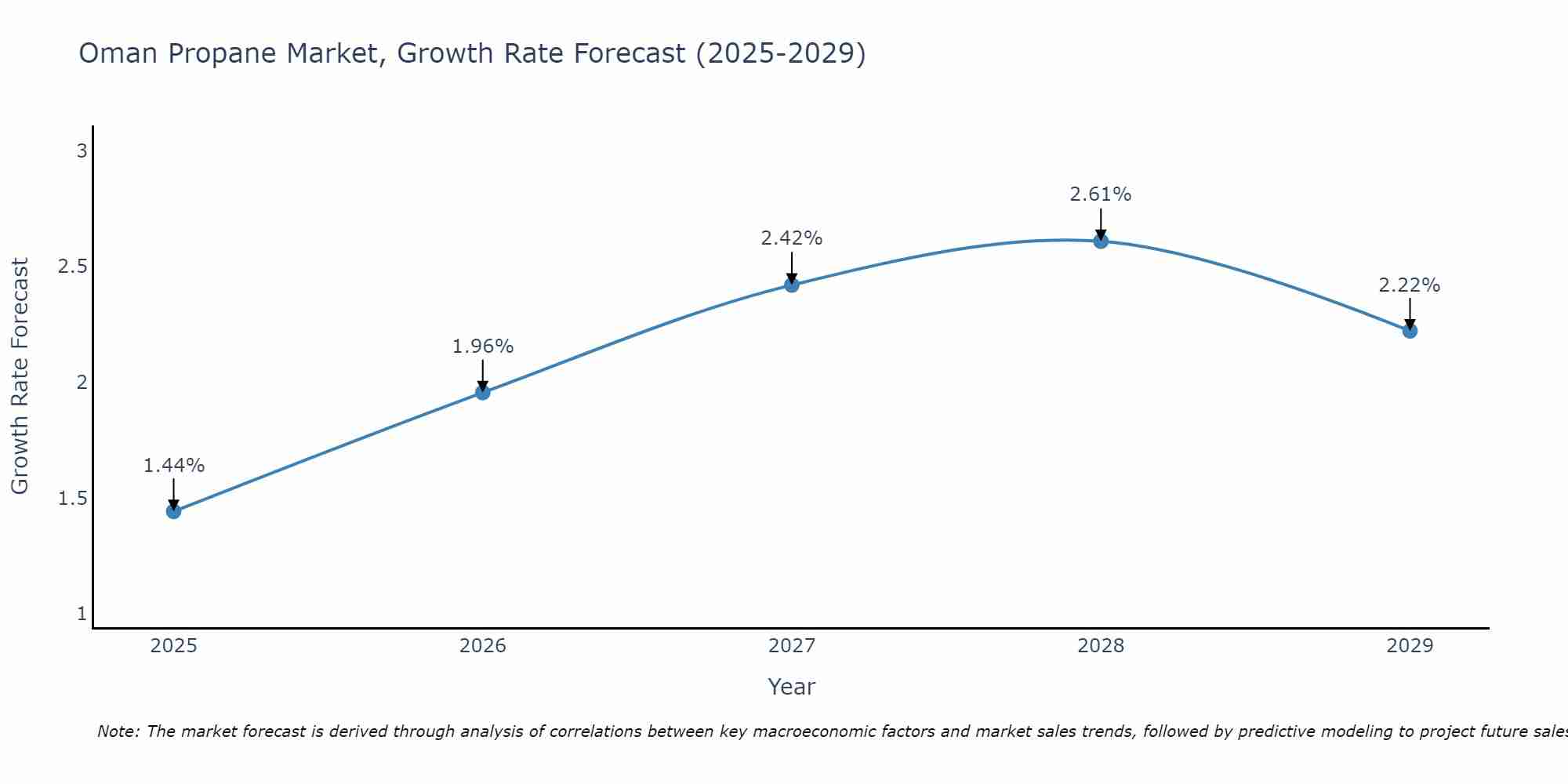
The Oman Propane Market is projected to witness mixed growth rate patterns during 2025 to 2029. Growth accelerates to 2.61% in 2028, following an initial rate of 1.44%, before easing to 2.22% at the end of the period.
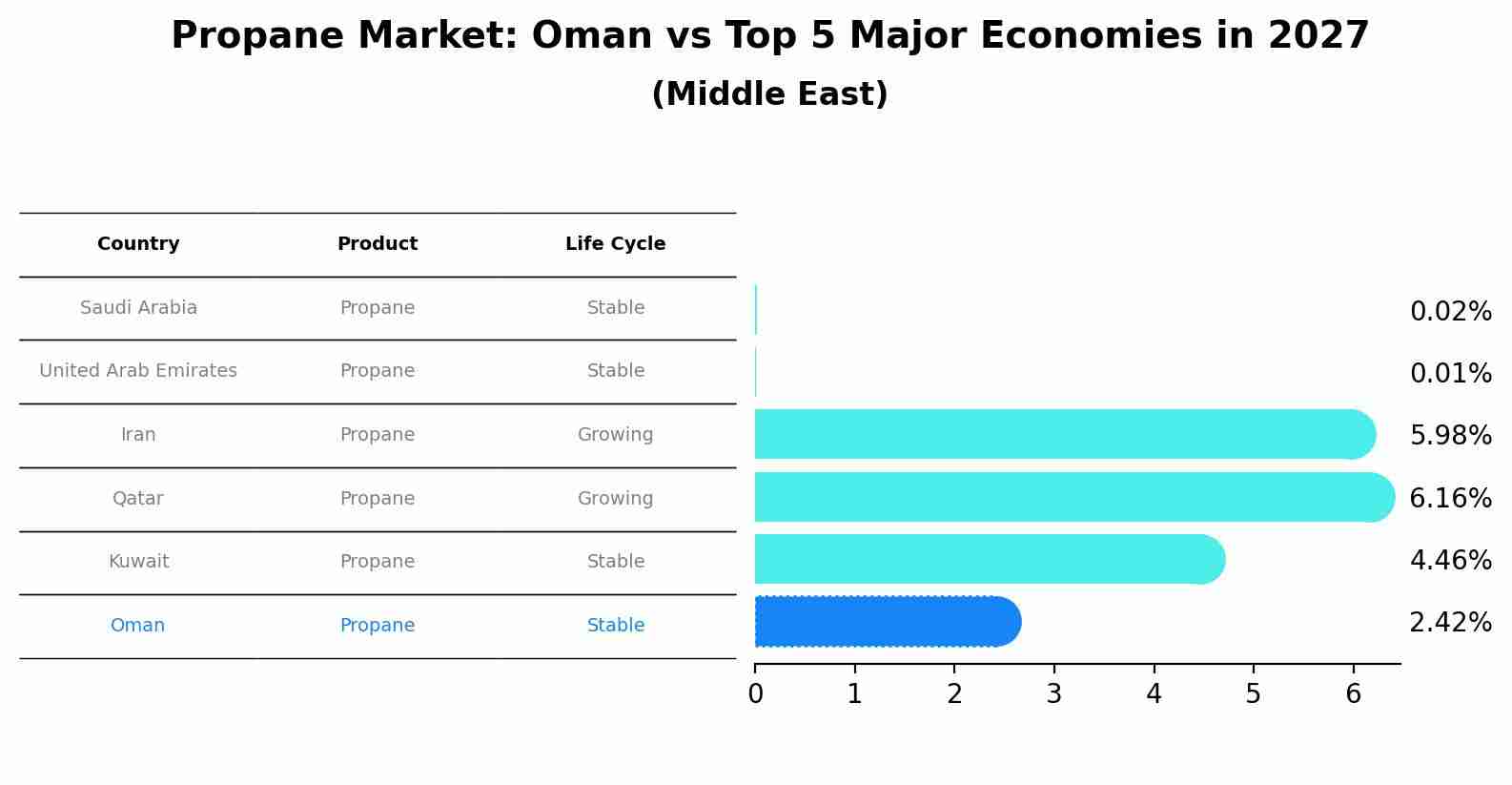
Propane Market: Oman vs Top 5 Major Economies in 2027 (Middle East)
The Propane market in Oman is projected to grow at a stable growth rate of 2.42% by 2027, within the Middle East region led by Saudi Arabia, along with other countries like United Arab Emirates, Iran, Qatar and Kuwait, collectively shaping a dynamic and evolving market environment driven by innovation and increasing adoption of emerging technologies.
Oman Propane Market Overview
The propane market in Oman is witnessing steady growth, driven by its versatile applications across residential, commercial, industrial, and agricultural sectors. The market benefits from the country`s strategic geographic location and robust distribution infrastructure.
Drivers of the market
The growing demand for clean and efficient energy sources is driving the adoption of propane in Oman. Factors such as government initiatives to promote clean energy, expansion of the residential and commercial sectors, and the versatility of propane as a fuel are driving the growth of this market.
Challenges of the market
Fluctuating prices and geopolitical uncertainties impact the stability of the propane market. Moreover, ensuring reliable supply chains and infrastructure to meet varying demand levels pose operational challenges for stakeholders.
Government Policy of the market
The government has policies regulating the import, storage, and distribution of propane, including safety standards compliance and environmental regulations. Policies also include subsidies for propane as an alternative fuel.
Key Highlights of the Report:
- Oman Propane Market Outlook
- Market Size of Oman Propane Market, 2024
- Forecast of Oman Propane Market, 2031
- Historical Data and Forecast of Oman Propane Revenues & Volume for the Period 2018 - 2031
- Oman Propane Market Trend Evolution
- Oman Propane Market Drivers and Challenges
- Oman Propane Price Trends
- Oman Propane Porter's Five Forces
- Oman Propane Industry Life Cycle
- Historical Data and Forecast of Oman Propane Market Revenues & Volume By Applications for the Period 2018 - 2031
- Historical Data and Forecast of Oman Propane Market Revenues & Volume By Industrial for the Period 2018 - 2031
- Historical Data and Forecast of Oman Propane Market Revenues & Volume By Commercial for the Period 2018 - 2031
- Historical Data and Forecast of Oman Propane Market Revenues & Volume By Residential for the Period 2018 - 2031
- Historical Data and Forecast of Oman Propane Market Revenues & Volume By Transportation for the Period 2018 - 2031
- Historical Data and Forecast of Oman Propane Market Revenues & Volume By Agriculture for the Period 2018 - 2031
- Historical Data and Forecast of Oman Propane Market Revenues & Volume By Chemicals and Refineries for the Period 2018 - 2031
- Oman Propane Import Export Trade Statistics
- Market Opportunity Assessment By Applications
- Oman Propane Top Companies Market Share
- Oman Propane Competitive Benchmarking By Technical and Operational Parameters
- Oman Propane Company Profiles
- Oman Propane Key Strategic Recommendations






































