Oman Refined Petroleum Products Market Size, Share & Growth Rate
The Oman Refined Petroleum Products Market was estimated at USD 177 Million in 2025 and is projected to reach USD 237 Million by 2032, growing at a CAGR of 4.3% from 2026 to 2032. This growth is primarily driven by increasing infrastructure development and heightened industrial activities, particularly in transportation and construction sectors. The market's expansion is further bolstered by Oman's advantageous geographical position and its abundant oil reserves, positioning it as a pivotal player in the regional energy landscape.
Oman Refined Petroleum Products Market Year-wise Growth Rate and Key Drivers
This graph highlights how the Oman Refined Petroleum Products Market has steadily grown over the years, supported by major growth factors.
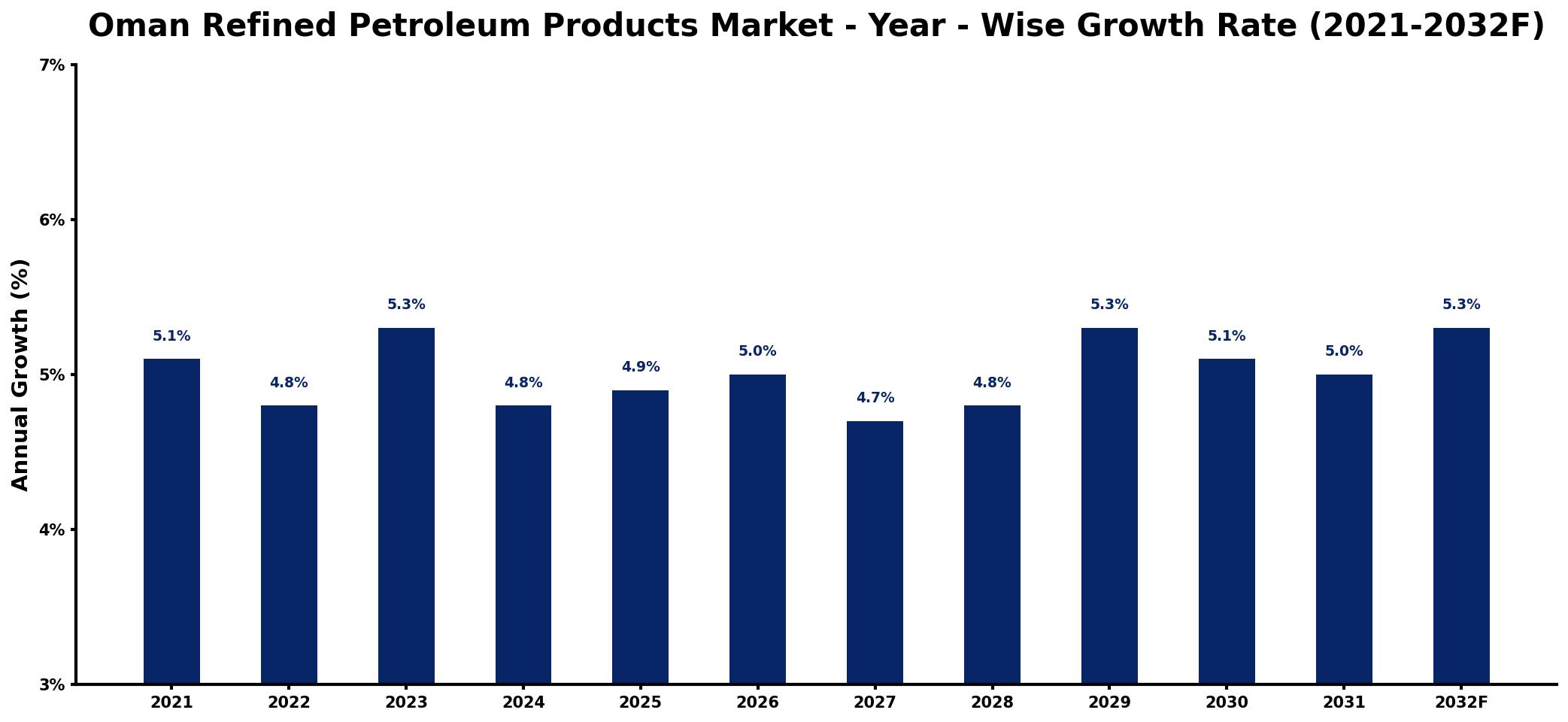
The table below presents the year‑wise growth rates along with the key drivers influencing the market
| Year | Growth Rate | Major Drivers |
| 2021 | 5.1% | Rising energy consumption trends |
| 2022 | 4.8% | Expansion of industrial operations |
| 2023 | 5.3% | Increased transportation sector demand |
| 2024 | 4.8% | Growth in construction activities |
| 2025 | 4.9% | Boost in tourism investments |
| 2026 | 5.0% | Surge in export opportunities |
| 2027 | 4.7% | Diversification of energy sources |
| 2028 | 4.8% | Adoption of cleaner technologies |
| 2029 | 5.3% | Enhanced infrastructure development projects |
| 2030 | 5.1% | Growing population and urbanization |
| 2031 | 5.0% | Strengthened regional trade agreements |
| 2032 | 5.3% | Innovations in energy efficiency |
Note: Market size estimations and growth projections presented in this report are based on 6Wresearch's proprietary forecasting methodology, utilizing the latest available industry data, government publications, and primary research inputs.
Oman Refined Petroleum Products Market Synopsis
In recent years, the Oman Refined Petroleum Products Market has shown remarkable momentum due to escalating domestic demand for fuels and refined products. As the market evolves, it is increasingly influenced by the government's strategic initiatives aimed at diversifying the economy and enhancing sustainable energy practices. The shift towards cleaner fuels is becoming more pronounced, reflecting a broader global trend towards sustainability.
While the current landscape is promising, the market is poised for a transformative phase that focuses on innovation and environmental responsibility. The adoption of alternative energy sources, such as natural gas and renewable fuels, is expected to redefine conventional fuel dynamics, creating new avenues for growth in the refined petroleum sector.
Oman Refined Petroleum Products Market Key Takeaways
- The market is projected to experience steady growth, driven by rising infrastructure projects and industrial activities.
- There is a pronounced shift towards cleaner and more sustainable fuel options.
- Investment opportunities are abundant in refinery expansions and renewable energy projects.
- Government policies are fostering a balanced approach between economic growth and environmental sustainability.
- Advancements in technology are enhancing operational efficiency and product quality across the sector.
Evaluation of Restraints in Oman Refined Petroleum Products Market
The Oman Refined Petroleum Products Market encounters several constraints that could impact its growth trajectory. Fluctuating global oil prices pose a significant threat, as they can affect profitability and investment decisions within the sector. Furthermore, increasing competition from neighboring oil-producing nations requires Omani companies to remain vigilant and adaptive. There is also a pressing need for substantial investments in technology and infrastructure to meet emerging environmental regulations, which adds an additional layer of complexity to market operations. Companies must navigate these challenges through innovative strategies and by enhancing their product portfolios to remain competitive.
Oman Refined Petroleum Products Market Trends
The refined petroleum products sector in Oman is witnessing notable trends aimed at reducing environmental impact. A growing emphasis on cleaner fuels, such as low-sulfur diesel and aviation fuels, is aligned with global regulatory requirements and consumer preferences. Additionally, advancements in refining technology are leading to higher-quality products, reducing waste and improving operational performance. As investments in infrastructure increase, the market is likely to see a surge in specialty refined products catering to evolving customer demands.
Oman Refined Petroleum Products Market Opportunities
Significant growth opportunities exist within the Oman Refined Petroleum Products Market, particularly given the countrys strategic geographical position and its robust economic framework. There are substantial prospects for refinery expansions and the development of storage and distribution networks. As Oman focuses on diversifying its economy, investment in renewable energy projects presents a unique avenue for stakeholders. Collaboration with international firms for technology and expertise can further enhance operational capabilities and drive innovation in this sector.
Government Initiatives in the Oman Refined Petroleum Products Market
The Omani government plays a crucial role in shaping the refined petroleum products market through various policy measures. These initiatives include price controls aimed at ensuring stability and affordability for consumers, along with stringent fuel quality standards to promote public health and environmental sustainability. Additionally, the government encourages investment in the petroleum sector by offering incentives to companies that establish refining and distribution networks, thereby fostering a conducive environment for growth and innovation.
Future Insights of the Oman Refined Petroleum Products Market
Looking ahead to 2026-2032, the Oman Refined Petroleum Products Market is poised for continued expansion. The combination of strategic investments in refining capacity, ongoing economic diversification efforts, and a commitment to sustainability will drive the market forward. As global demand shifts towards cleaner energy alternatives, Omans refined petroleum products sector will likely adapt to these changes, fostering innovation and attracting investment. This evolution will not only enhance Oman's role in the global energy landscape but also align with international environmental goals.
Oman Refined Petroleum Products Market Latest Developments (2025 - 2026)
Recent developments in the Oman Refined Petroleum Products Market indicate a heightened focus on sustainability and technological advancements. Companies are increasingly investing in innovations aimed at enhancing operational efficiency and reducing environmental footprints. Strategic partnerships are being formed to facilitate knowledge transfer and adoption of advanced refining technologies, which is expected to yield higher quality products and compliance with global standards. Additionally, the government continues to reinforce its commitment to diversifying energy sources and encouraging investments in alternative fuels.
Oman Refined Petroleum Products Market - Key Attractiveness of the Report
- 10 Years of Market Numbers
- Historical Data Starting from 2022 to 2025
- Base Year: 2025
- Forecast Data until 2032
- Key Performance Indicators Impacting the Market
- Major Upcoming Developments and Projects
Key Highlights of the Report:
- Oman Refined Petroleum Products Market Outlook
- Market Size of Oman Refined Petroleum Products Market, 2025
- Forecast of Oman Refined Petroleum Products Market, 2032
- Historical Data and Forecast of Oman Refined Petroleum Products Revenues & Volume for the Period 2022-2032F
- Oman Refined Petroleum Products Market Trend Evolution
- Oman Refined Petroleum Products Market Drivers and Challenges
- Oman Refined Petroleum Products Price Trends
- Oman Refined Petroleum Products Porter's Five Forces
- Oman Refined Petroleum Products Industry Life Cycle
- Historical Data and Forecast of Oman Refined Petroleum Products Market Revenues & Volume By Product Type for the Period 2022-2032F
- Historical Data and Forecast of Oman Refined Petroleum Products Market Revenues & Volume By Diesel for the Period 2022-2032F
- Historical Data and Forecast of Oman Refined Petroleum Products Market Revenues & Volume By Gasoline for the Period 2022-2032F
- Historical Data and Forecast of Oman Refined Petroleum Products Market Revenues & Volume By Fuel Oils for the Period 2022-2032F
- Historical Data and Forecast of Oman Refined Petroleum Products Market Revenues & Volume By Kerosene for the Period 2022-2032F
- Historical Data and Forecast of Oman Refined Petroleum Products Market Revenues & Volume By Others for the Period 2022-2032F
- Historical Data and Forecast of Oman Refined Petroleum Products Market Revenues & Volume By Application for the Period 2022-2032F
- Historical Data and Forecast of Oman Refined Petroleum Products Market Revenues & Volume By Fuel for the Period 2022-2032F
- Historical Data and Forecast of Oman Refined Petroleum Products Market Revenues & Volume By Chemical for the Period 2022-2032F
- Historical Data and Forecast of Oman Refined Petroleum Products Market Revenues & Volume By Others for the Period 2022-2032F
- Historical Data and Forecast of Oman Refined Petroleum Products Market Revenues & Volume By Fraction for the Period 2022-2032F
- Historical Data and Forecast of Oman Refined Petroleum Products Market Revenues & Volume By Light Distillates for the Period 2022-2032F
- Historical Data and Forecast of Oman Refined Petroleum Products Market Revenues & Volume By Middle Distillates for the Period 2022-2032F
- Historical Data and Forecast of Oman Refined Petroleum Products Market Revenues & Volume By Heavy Oils for the Period 2022-2032F
- Oman Refined Petroleum Products Import Export Trade Statistics
- Market Opportunity Assessment By Product Type
- Market Opportunity Assessment By Application
- Market Opportunity Assessment By Fraction
- Oman Refined Petroleum Products Top Companies Market Share
- Oman Refined Petroleum Products Competitive Benchmarking By Technical and Operational Parameters
- Oman Refined Petroleum Products Company Profiles
- Oman Refined Petroleum Products Key Strategic Recommendations






































