Oman Structural Steel Fabrication Market Size, Share & Growth Rate
The Oman Structural Steel Fabrication Market was estimated at USD 167 Million in 2025 and is projected to reach USD 227 Million by 2032, growing at a CAGR of 4.5% from 2026 to 2032. This growth trajectory is primarily driven by a significant rise in construction activities across various sectors, including infrastructure, oil and gas, and commercial real estate. The government's commitment to enhancing local capabilities through mega projects further supports this upward trend in demand for structural steel fabrication.
Oman Structural Steel Fabrication Market Year-wise Growth Rate and Key Drivers
This graph highlights how the Oman Structural Steel Fabrication Market has steadily grown over the years, supported by major growth factors.
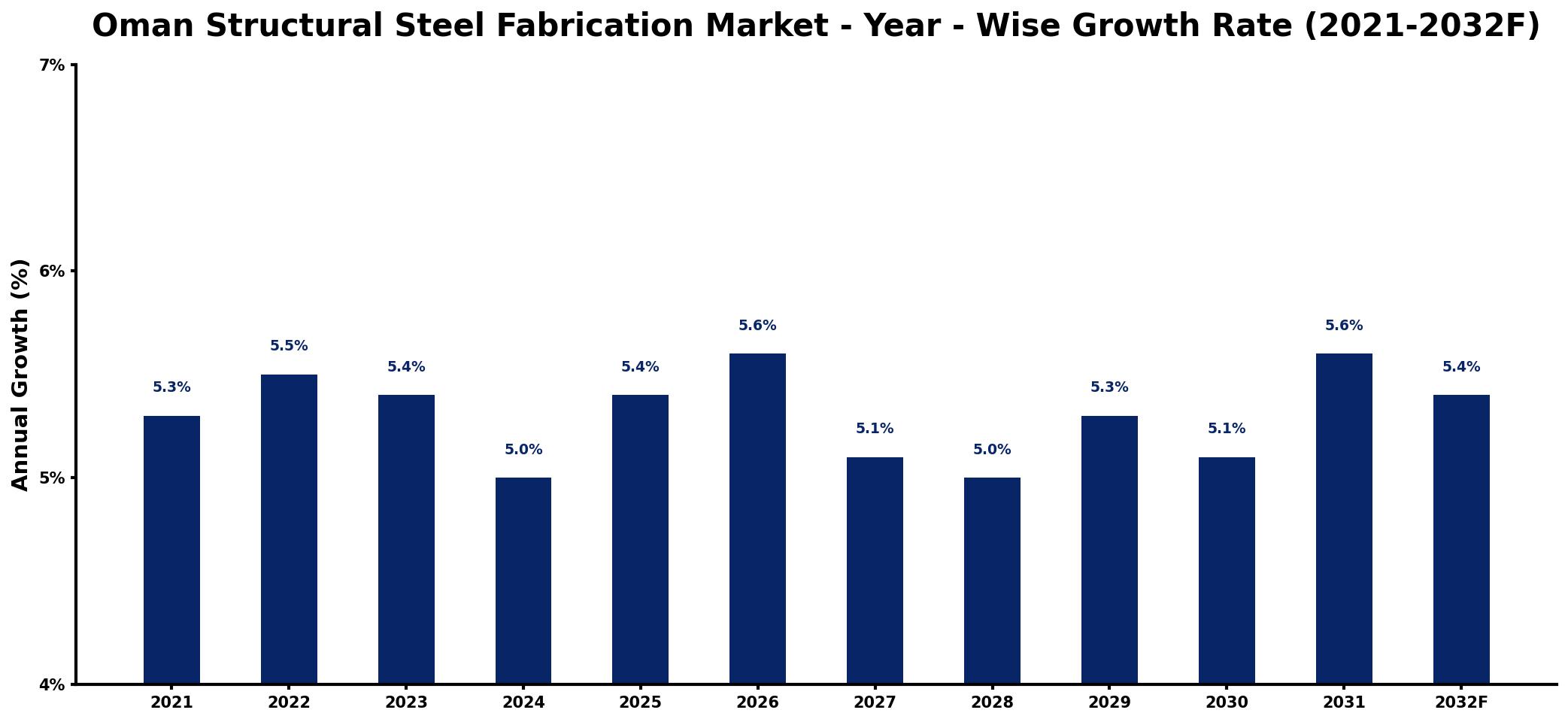
The table below presents the year‑wise growth rates along with the key drivers influencing the market
| Year | Growth Rate | Major Drivers |
| 2021 | 5.3% | Infrastructure projects drive demand |
| 2022 | 5.5% | Increased construction activities ongoing |
| 2023 | 5.4% | Government investments in development |
| 2024 | 5.0% | Rising commercial building projects |
| 2025 | 5.4% | Growing energy sector requirements |
| 2026 | 5.6% | Urbanization trends boost investments |
| 2027 | 5.1% | Transportation sector expansion planned |
| 2028 | 5.0% | Sustainability initiatives promote usage |
| 2029 | 5.3% | Public-private partnerships enhance funding |
| 2030 | 5.1% | Technological advancements attract investments |
| 2031 | 5.6% | Residential sector shows growth |
| 2032 | 5.4% | International collaborations increase projects |
Note: Market size estimations and growth projections presented in this report are based on 6Wresearch's proprietary forecasting methodology, utilizing the latest available industry data, government publications, and primary research inputs.
Oman Structural Steel Fabrication Market Synopsis
The Oman Structural Steel Fabrication Market is characterized by a strong emphasis on quality and durability, essential attributes for structural applications. As the construction landscape evolves, there is a marked increase in the use of innovative steel products that comply with contemporary architectural and engineering standards.
Moreover, the increasing adoption of sustainable practices in construction is influencing the demand for eco-friendly steel fabrication processes. Companies are increasingly focusing on adopting advanced technologies, such as automation and digital modeling, to enhance production efficiency and meet the specific needs of their clients.
Oman Structural Steel Fabrication Market Key Takeaways
- The market is driven by expanding construction activities and the government's infrastructure initiatives.
- Technological advancements are improving efficiency and accuracy in fabrication processes.
- There's a growing preference for sustainable and eco-friendly building materials.
- The market faces competition from both local and international firms, impacting pricing.
- Investment in training and development is crucial to address labor skill shortages.
Evaluation of Restraints in Oman Structural Steel Fabrication Market
Despite the positive outlook, the Oman Structural Steel Fabrication Market grapples with certain restraints. The competitive landscape intensifies the pressure on pricing, often leading to reduced profit margins for companies. Fluctuations in raw material prices, especially steel, create a volatile environment that impacts project viability. Furthermore, the industry faces a persistent shortage of skilled labor in specialized areas, such as welding and metal fabrication, which can hinder project timelines and affect overall quality. Addressing these restraints necessitates strategic investments in workforce development and supply chain management to ensure sustainability and competitiveness.
Oman Structural Steel Fabrication Market Trends
The market is witnessing a shift towards the integration of advanced technologies, including Building Information Modeling (BIM) and Computer-Aided Design (CAD), which enhance the efficiency of fabrication processes. There's a significant trend towards sustainability, with increasing interest in eco-friendly materials and practices in construction. Additionally, the growing demand for flexibility in design, driven by the rise of modern architecture, is pushing the adoption of structural steel solutions. As urbanization accelerates, the demand for innovative and adaptable building solutions continues to shape the industry.
Oman Structural Steel Fabrication Market Opportunities
Investment opportunities abound in the Oman Structural Steel Fabrication Market, particularly as the government prioritizes infrastructure development across various sectors. Opportunities exist for companies that can offer innovative solutions and integrate advanced technologies into their operations. Collaborations with local entities can facilitate market entry for foreign investors, while ongoing research and development can position companies at the forefront of emerging industry trends. The market's expansion provides a fertile ground for businesses willing to invest in quality, efficiency, and sustainability.
Government Initiatives in the Oman Structural Steel Fabrication Market
Omans government is actively fostering growth in the structural steel fabrication market through policies that emphasize local content development and economic diversification. Incentives for foreign investment, such as tax breaks and land grants, are designed to encourage partnerships with local firms. Regulatory frameworks are in place to uphold quality and safety standards, as well as promote environmentally sustainable practices in the sector. Furthermore, initiatives aimed at enhancing the skills of the local workforce are crucial for meeting industry demands and advancing technological innovation.
Future Insights of the Oman Structural Steel Fabrication Market
Looking ahead to 2026-2032, the Oman Structural Steel Fabrication Market is well-positioned for sustained growth. Continued investments in infrastructure, coupled with a strategic push towards urbanization and industrial development, are expected to drive demand for quality structural steel services. The emphasis on sustainable practices and the integration of modern technologies will likely reshape the landscape of the market. As Oman diversifies its economy and invests in innovative building designs, the structural steel fabrication sector is set to expand significantly, appealing to both local and international stakeholders.
Oman Structural Steel Fabrication Market Latest Developments (2025 - 2026)
Recent developments in the Oman Structural Steel Fabrication Market indicate a growing trend towards the adoption of automated solutions and advanced manufacturing techniques. Companies are investing in state-of-the-art machinery and software to enhance productivity and accuracy. Additionally, there is an increasing collaboration between fabrication firms and construction companies to ensure the seamless integration of steel solutions in large-scale projects. The market is also witnessing heightened interest in sustainable practices, with firms exploring eco-friendly materials and processes to align with global sustainability goals.
Oman Structural Steel Fabrication Market - Key Attractiveness of the Report
- 10 Years of Market Numbers
- Historical Data Starting from 2022 to 2025
- Base Year: 2025
- Forecast Data until 2032
- Key Performance Indicators Impacting the Market
- Major Upcoming Developments and Projects
Key Highlights of the Report:
- Oman Structural Steel Fabrication Market Outlook
- Market Size of Oman Structural Steel Fabrication Market, 2025
- Forecast of Oman Structural Steel Fabrication Market, 2032
- Historical Data and Forecast of Oman Structural Steel Fabrication Revenues & Volume for the Period 2022-2032F
- Oman Structural Steel Fabrication Market Trend Evolution
- Oman Structural Steel Fabrication Market Drivers and Challenges
- Oman Structural Steel Fabrication Price Trends
- Oman Structural Steel Fabrication Porter's Five Forces
- Oman Structural Steel Fabrication Industry Life Cycle
- Historical Data and Forecast of Oman Structural Steel Fabrication Market Revenues & Volume By End-user Industry for the Period 2022-2032F
- Historical Data and Forecast of Oman Structural Steel Fabrication Market Revenues & Volume By Manufacturing for the Period 2022-2032F
- Historical Data and Forecast of Oman Structural Steel Fabrication Market Revenues & Volume By Power and Energy for the Period 2022-2032F
- Historical Data and Forecast of Oman Structural Steel Fabrication Market Revenues & Volume By Construction for the Period 2022-2032F
- Historical Data and Forecast of Oman Structural Steel Fabrication Market Revenues & Volume By Oil and Gas for the Period 2022-2032F
- Historical Data and Forecast of Oman Structural Steel Fabrication Market Revenues & Volume By Other for the Period 2022-2032F
- Historical Data and Forecast of Oman Structural Steel Fabrication Market Revenues & Volume By Product Type for the Period 2022-2032F
- Historical Data and Forecast of Oman Structural Steel Fabrication Market Revenues & Volume By Heavy Sectional Steel for the Period 2022-2032F
- Historical Data and Forecast of Oman Structural Steel Fabrication Market Revenues & Volume By Light Sectional Steel for the Period 2022-2032F
- Historical Data and Forecast of Oman Structural Steel Fabrication Market Revenues & Volume By Other for the Period 2022-2032F
- Oman Structural Steel Fabrication Import Export Trade Statistics
- Market Opportunity Assessment By End-user Industry
- Market Opportunity Assessment By Product Type
- Oman Structural Steel Fabrication Top Companies Market Share
- Oman Structural Steel Fabrication Competitive Benchmarking By Technical and Operational Parameters
- Oman Structural Steel Fabrication Company Profiles
- Oman Structural Steel Fabrication Key Strategic Recommendations






































