Pakistan Acrylic Acid Market: Import Trend Analysis
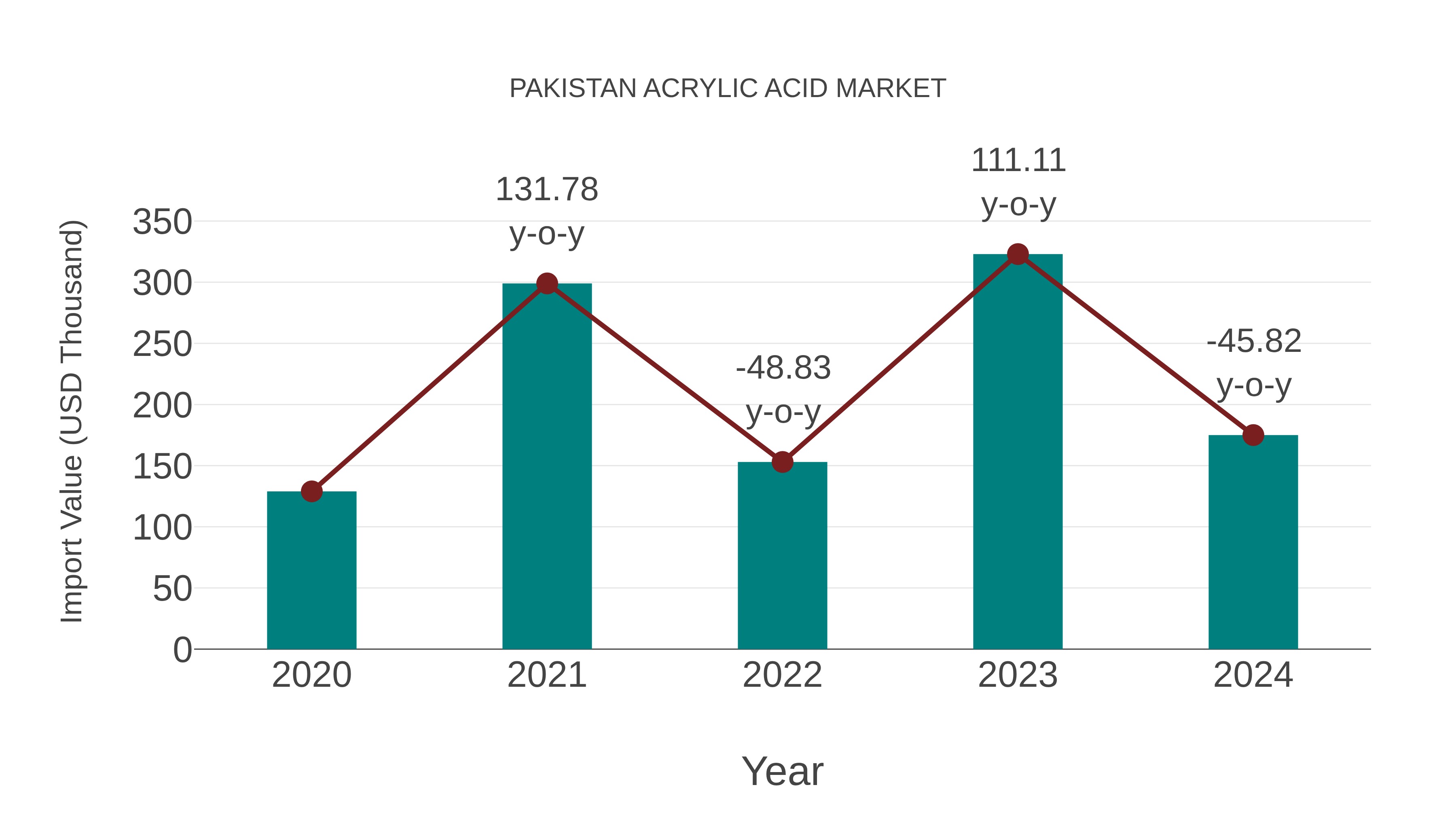
In the Pakistan acrylic acid market, the import trend experienced a notable decline from 2023 to 2024, with a growth rate of -56.61%. The compound annual growth rate (CAGR) for imports between 2020 and 2024 stood at -3.16%. This significant contraction may be attributed to shifting demand dynamics or adjustments in trade policies impacting market stability.
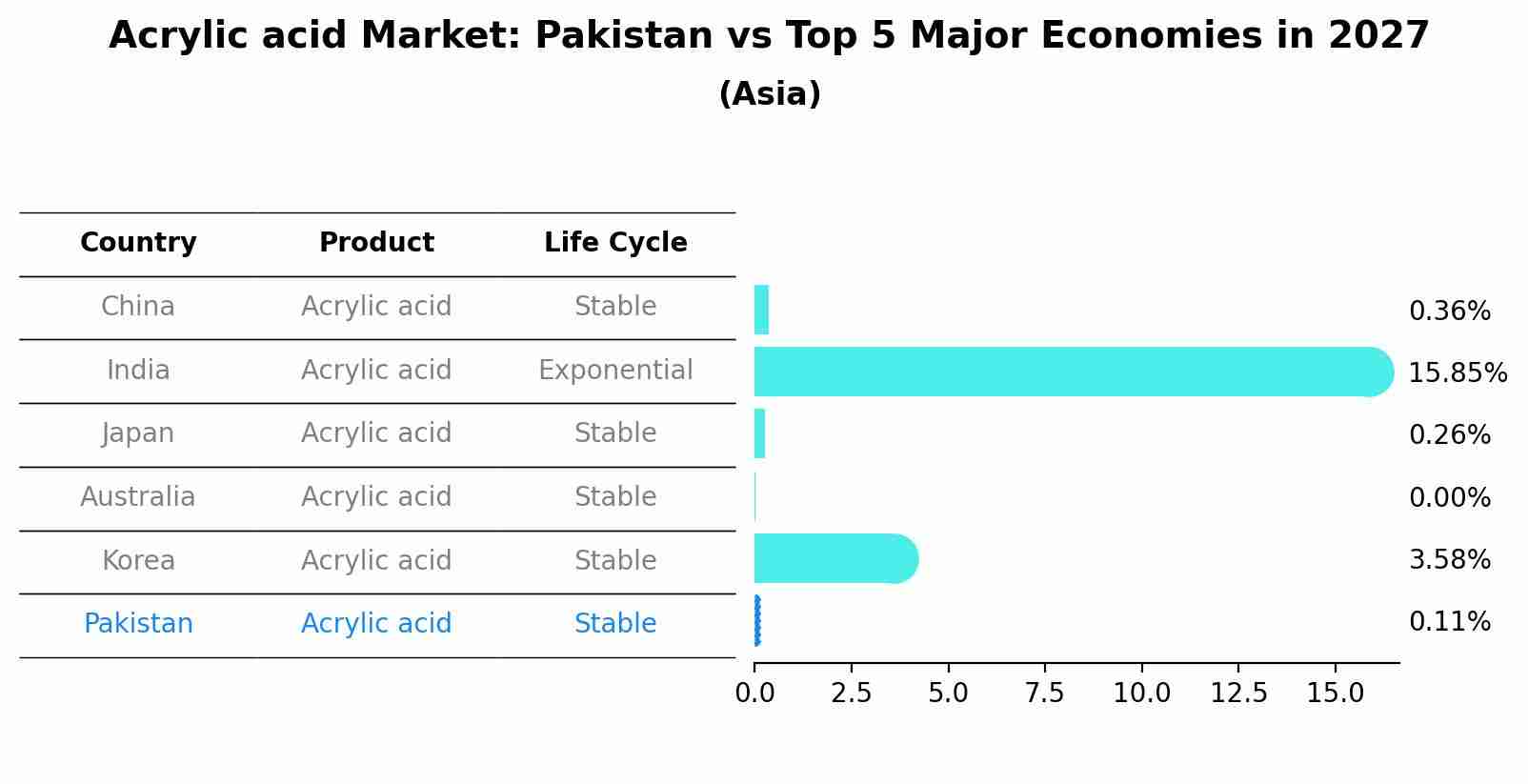
Acrylic acid Market: Pakistan vs Top 5 Major Economies in 2027 (Asia)
The Acrylic acid market in Pakistan is projected to grow at a stable growth rate of 0.11% by 2027, within the Asia region led by China, along with other countries like India, Japan, Australia and South Korea, collectively shaping a dynamic and evolving market environment driven by innovation and increasing adoption of emerging technologies.
Pakistan Acrylic acid Market Overview
The Pakistan acrylic acid market is witnessing steady growth driven by increasing demand from key end-use industries such as adhesives, textiles, and coatings. The market is primarily fueled by the construction sector`s growth, leading to rising demand for acrylic-based products in paints, sealants, and adhesives. Additionally, the automotive industry`s expansion is boosting the demand for acrylic acid in coatings and adhesives for vehicle manufacturing and maintenance. The market is also influenced by technological advancements and product innovations aimed at enhancing product performance and sustainability. However, challenges such as fluctuating raw material prices and environmental regulations pose potential constraints to market growth. Overall, the Pakistan acrylic acid market is poised for further expansion, driven by the country`s industrial development and increasing consumer demand for acrylic-based products.
Pakistan Acrylic acid Market Trends
The Pakistan acrylic acid market is experiencing steady growth driven by increasing demand from various end-use industries such as textiles, adhesives, and personal care products. Key trends in the market include a shift towards eco-friendly and sustainable acrylic acid derivatives to meet environmental regulations and consumer preferences. Additionally, the growing popularity of superabsorbent polymers (SAPs) in the hygiene industry is driving the demand for acrylic acid in Pakistan. The market is also witnessing investments in technological advancements and capacity expansions by key players to cater to the rising demand for acrylic acid-based products. Overall, the Pakistan acrylic acid market is expected to continue its growth trajectory, supported by evolving consumer preferences and industrial requirements.
Pakistan Acrylic acid Market Challenges
In the Pakistan Acrylic acid market, some of the key challenges faced include fluctuating raw material prices, limited technological advancements in production processes, and inconsistent quality standards. The country heavily relies on imports for raw materials, making the market vulnerable to price fluctuations and supply chain disruptions. Additionally, the lack of advanced technology hinders the efficiency and competitiveness of local manufacturers. The inconsistent quality standards in the industry pose a challenge for meeting international requirements and accessing export markets. Addressing these challenges will require investment in research and development, improved supply chain management, and collaboration between industry players and regulatory bodies to enhance product quality and competitiveness in the global market.
Pakistan Acrylic acid Market Investment Opportunities
The Pakistan acrylic acid market presents promising investment opportunities due to the increasing demand for acrylic acid in various industries such as textiles, adhesives, and personal care products. With a growing population and expanding industrial sector, the demand for acrylic acid is expected to rise, driving market growth. Additionally, government initiatives to promote manufacturing and industrial development in Pakistan further support the market`s potential for investment. Potential investors can consider opportunities in acrylic acid production plants, distribution networks, or partnerships with local manufacturers to capitalize on the market`s growth prospects. Conducting thorough market research and understanding the regulatory landscape will be crucial for successful investments in the Pakistan acrylic acid market.
Pakistan Acrylic acid Market Government Policy
The Pakistan government has implemented policies aimed at promoting the growth of the Acrylic acid market. These policies include providing incentives and subsidies to domestic producers, imposing tariffs on imported Acrylic acid to protect local industries, and implementing regulations to ensure environmental sustainability and product quality standards. Additionally, the government has introduced initiatives to support research and development in the sector, encourage investments in Acrylic acid production facilities, and promote exports of Acrylic acid products. Overall, these policies are designed to boost the competitiveness of the Pakistan Acrylic acid market and enhance its contribution to the country`s economy.
Pakistan Acrylic acid Market Future Outlook
The future outlook for the Pakistan Acrylic acid market appears promising, driven by factors such as increasing demand from key end-use industries like adhesives, coatings, and textiles. The growing construction sector and infrastructure development projects in the country are expected to further boost the demand for acrylic acid-based products. Additionally, rising disposable incomes and changing consumer preferences are likely to drive the demand for acrylic acid in various applications. However, challenges such as fluctuating raw material prices and regulatory constraints may pose some hurdles to market growth. Overall, with the increasing industrialization and economic development in Pakistan, the acrylic acid market is expected to witness steady growth in the coming years, presenting opportunities for market players to expand their presence and offerings in the region.
Key Highlights of the Report:
- Pakistan Acrylic acid Market Outlook
- Market Size of Pakistan Acrylic acid Market, 2021
- Forecast of Pakistan Acrylic acid Market, 2027
- Historical Data and Forecast of Pakistan Acrylic acid Revenues & Volume for the Period 2018 - 2027
- Pakistan Acrylic acid Market Trend Evolution
- Pakistan Acrylic acid Market Drivers and Challenges
- Pakistan Acrylic acid Price Trends
- Pakistan Acrylic acid Porter's Five Forces
- Pakistan Acrylic acid Industry Life Cycle
- Historical Data and Forecast of Pakistan Acrylic acid Market Revenues & Volume By Product for the Period 2018 - 2027
- Historical Data and Forecast of Pakistan Acrylic acid Market Revenues & Volume By Acrylate Esters for the Period 2018 - 2027
- Historical Data and Forecast of Pakistan Acrylic acid Market Revenues & Volume By Glacial Acrylic Acid for the Period 2018 - 2027
- Historical Data and Forecast of Pakistan Acrylic acid Market Revenues & Volume By Others for the Period 2018 - 2027
- Historical Data and Forecast of Pakistan Acrylic acid Market Revenues & Volume By End-users for the Period 2018 - 2027
- Historical Data and Forecast of Pakistan Acrylic acid Market Revenues & Volume By Surfactants and Surface Coatings for the Period 2018 - 2027
- Historical Data and Forecast of Pakistan Acrylic acid Market Revenues & Volume By Organic Chemicals for the Period 2018 - 2027
- Historical Data and Forecast of Pakistan Acrylic acid Market Revenues & Volume By Water Filtration for the Period 2018 - 2027
- Historical Data and Forecast of Pakistan Acrylic acid Market Revenues & Volume By Adhesives and Sealants for the Period 2018 - 2027
- Historical Data and Forecast of Pakistan Acrylic acid Market Revenues & Volume By Textiles for the Period 2018 - 2027
- Historical Data and Forecast of Pakistan Acrylic acid Market Revenues & Volume By Water Treatment for the Period 2018 - 2027
- Historical Data and Forecast of Pakistan Acrylic acid Market Revenues & Volume By Personal Care Products for the Period 2018 - 2027
- Historical Data and Forecast of Pakistan Acrylic acid Market Revenues & Volume By Others for the Period 2018 - 2027
- Pakistan Acrylic acid Import Export Trade Statistics
- Market Opportunity Assessment By Product
- Market Opportunity Assessment By End-users
- Pakistan Acrylic acid Top Companies Market Share
- Pakistan Acrylic acid Competitive Benchmarking By Technical and Operational Parameters
- Pakistan Acrylic acid Company Profiles
- Pakistan Acrylic acid Key Strategic Recommendations






































