Pakistan Adhesives Market Growth Rate Analysis (2025 - 2031)
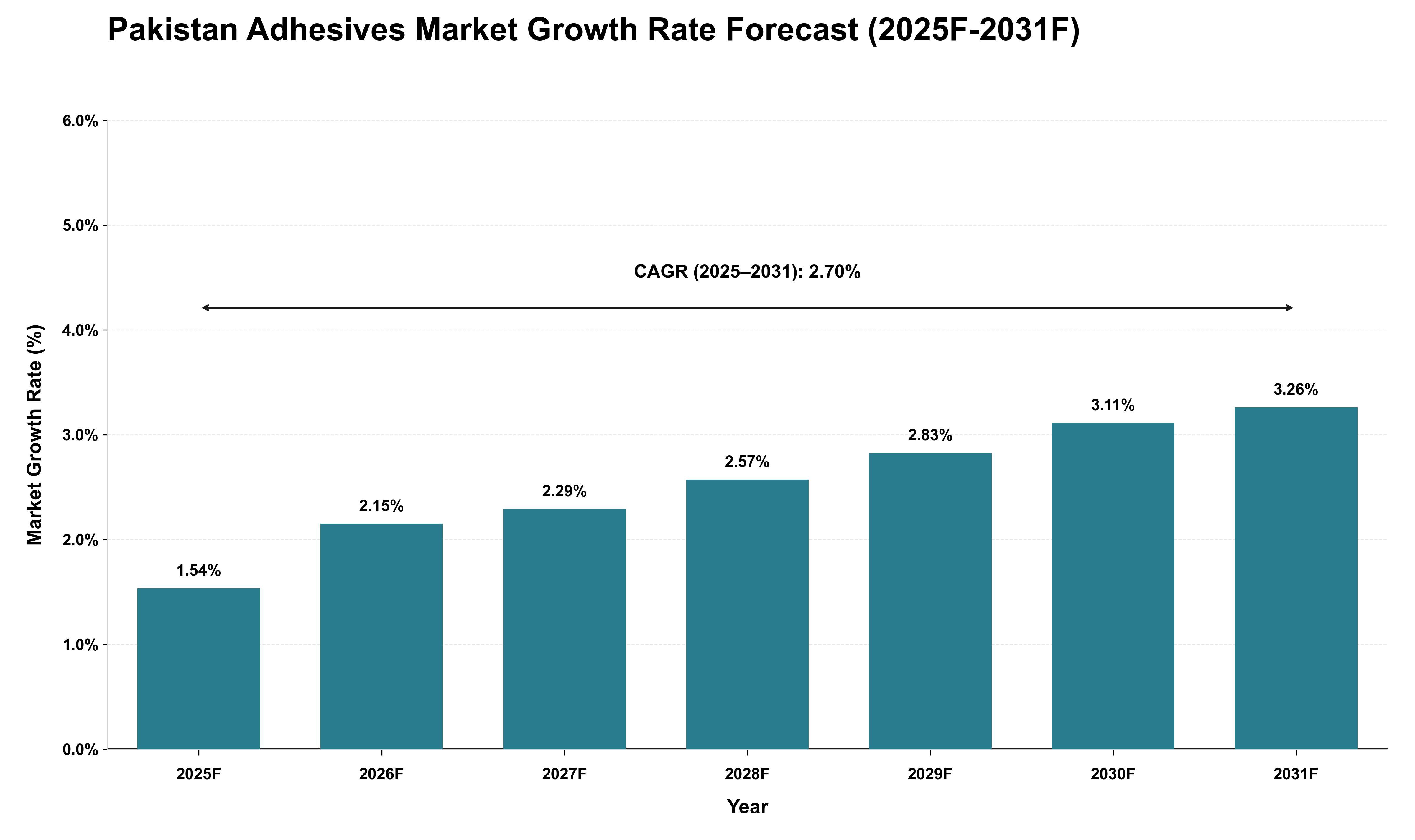
The Pakistan adhesives market will experience a gradual increase in trade flows, driven by evolving industrial demands and enhanced manufacturing capabilities. As the CAGR of 2.70% suggests, import dependencies will likely remain significant, particularly for specialized adhesive formulations that local production cannot meet efficiently. The annual growth rates indicate a progressive acceleration in demand, with 2025 starting at 1.54% and reaching 3.26% by 2031, reflecting an upward trajectory influenced by sectors such as construction and automotive manufacturing. This trend will be supported by global supply chain adjustments and potential shifts in trade policies that could facilitate smoother import processes. Additionally, cyclical trends in construction activity and consumer goods production will further bolster adhesive consumption, positioning Pakistan as a growing player in regional adhesive trade dynamics throughout the forecast period.
Key Highlights of the Report:
- Pakistan Adhesives Market Outlook
- Market Size of Pakistan Adhesives Market, 2025
- Forecast of Pakistan Adhesives Market, 2032
- Historical Data and Forecast of Pakistan Adhesives Revenues & Volume for the Period 2022 - 2032F
- Pakistan Adhesives Market Trend Evolution
- Pakistan Adhesives Market Drivers and Challenges
- Pakistan Adhesives Price Trends
- Pakistan Adhesives Porter's Five Forces
- Pakistan Adhesives Industry Life Cycle
- Historical Data and Forecast of Pakistan Adhesives Market Revenues & Volume By Types for the Period 2022 - 2032F
- Historical Data and Forecast of Pakistan Adhesives Market Revenues & Volume By Acrylic for the Period 2022 - 2032F
- Historical Data and Forecast of Pakistan Adhesives Market Revenues & Volume By Epoxy for the Period 2022 - 2032F
- Historical Data and Forecast of Pakistan Adhesives Market Revenues & Volume By Polyvinyl Acetate (PVA) for the Period 2022 - 2032F
- Historical Data and Forecast of Pakistan Adhesives Market Revenues & Volume By Polyurethane (PU) for the Period 2022 - 2032F
- Historical Data and Forecast of Pakistan Adhesives Market Revenues & Volume By Styrenic Block for the Period 2022 - 2032F
- Historical Data and Forecast of Pakistan Adhesives Market Revenues & Volume By Ethyl Vinyl Acetate (EVA) for the Period 2022 - 2032F
- Historical Data and Forecast of Pakistan Adhesives Market Revenues & Volume By Silicone & Others for the Period 2022 - 2032F
- Historical Data and Forecast of Pakistan Adhesives Market Revenues & Volume By Technology for the Period 2022 - 2032F
- Historical Data and Forecast of Pakistan Adhesives Market Revenues & Volume By Water-based for the Period 2022 - 2032F
- Historical Data and Forecast of Pakistan Adhesives Market Revenues & Volume By Solvent-based for the Period 2022 - 2032F
- Historical Data and Forecast of Pakistan Adhesives Market Revenues & Volume By Hot Melt for the Period 2022 - 2032F
- Historical Data and Forecast of Pakistan Adhesives Market Revenues & Volume By Pressure Sensitive for the Period 2022 - 2032F
- Historical Data and Forecast of Pakistan Adhesives Market Revenues & Volume By Reactive and Others for the Period 2022 - 2032F
- Pakistan Adhesives Import Export Trade Statistics
- Market Opportunity Assessment By Types
- Market Opportunity Assessment By Technology
- Pakistan Adhesives Top Companies Market Share
- Pakistan Adhesives Competitive Benchmarking By Technical and Operational Parameters
- Pakistan Adhesives Company Profiles
- Pakistan Adhesives Key Strategic Recommendations






































