Pakistan AI in Telecommunication Market Size & Growth Rate (2026-2032)
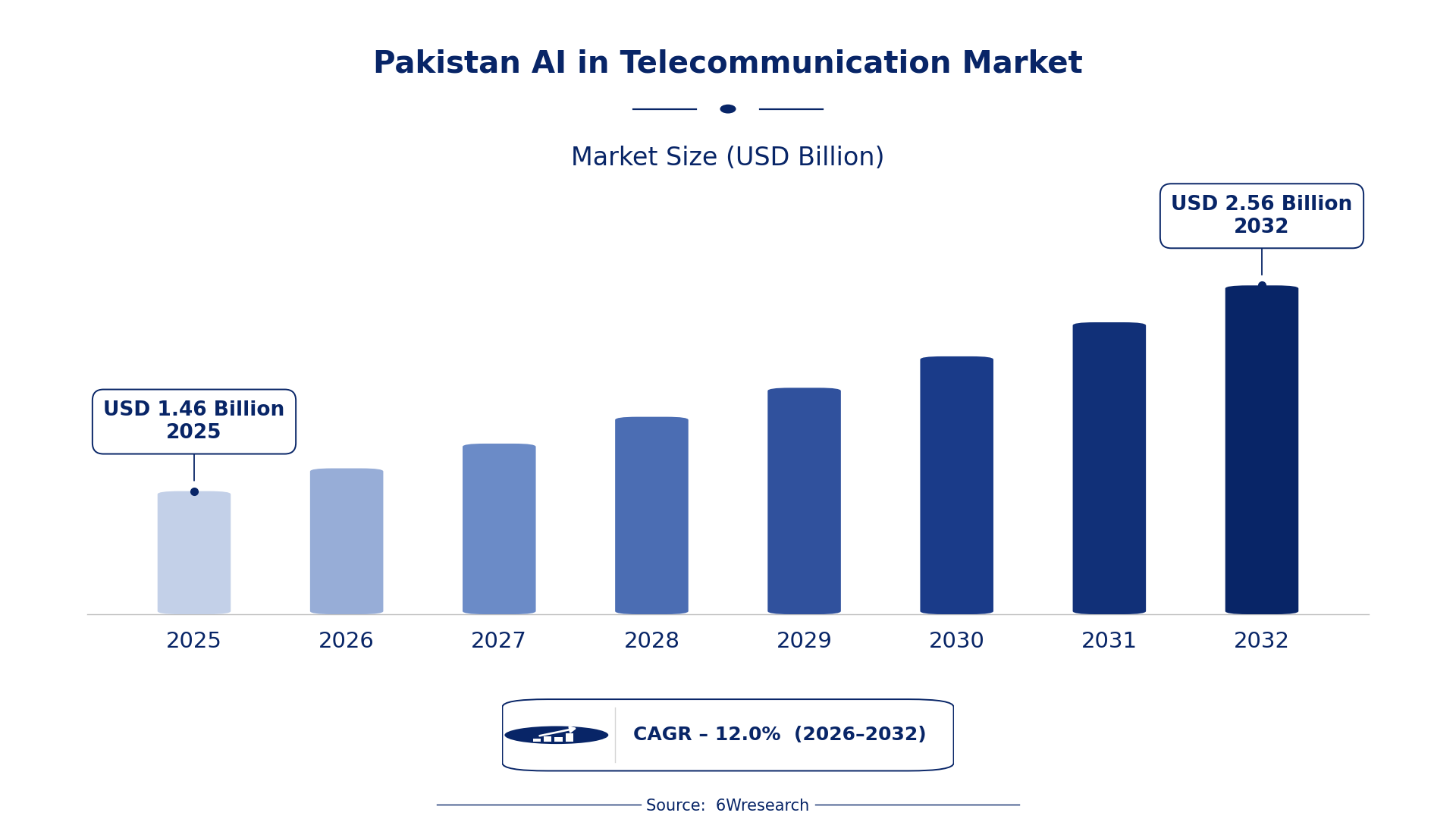
The Pakistan AI in Telecommunication Market was estimated at USD 1459 Million in 2025 and is projected to reach USD 2556 Million by 2032, growing at a CAGR of 12.0% from 2026 to 2032.
Pakistan AI in Telecommunication Market Synopsis
Recent trends indicate a surge in the integration of artificial intelligence technologies within Pakistan's telecommunication sector. This momentum reflects a broader recognition of AI's potential to transform operational efficiencies and enhance customer experiences.
As the market continues to expand, the focus is shifting toward leveraging AI for advanced applications such as predictive analytics and automated customer service solutions. These developments are not just trends; they are shaping the future of how telecom companies operate and interact with consumers.
Pakistan AI in Telecommunication Market Year-wise Growth Rate and Key Drivers
This graph illustrates the annual growth rates of the Pakistan AI in Telecommunication Market from 2021 to 2032, highlighting a steady upward trajectory and projected expansion over the forecast period.
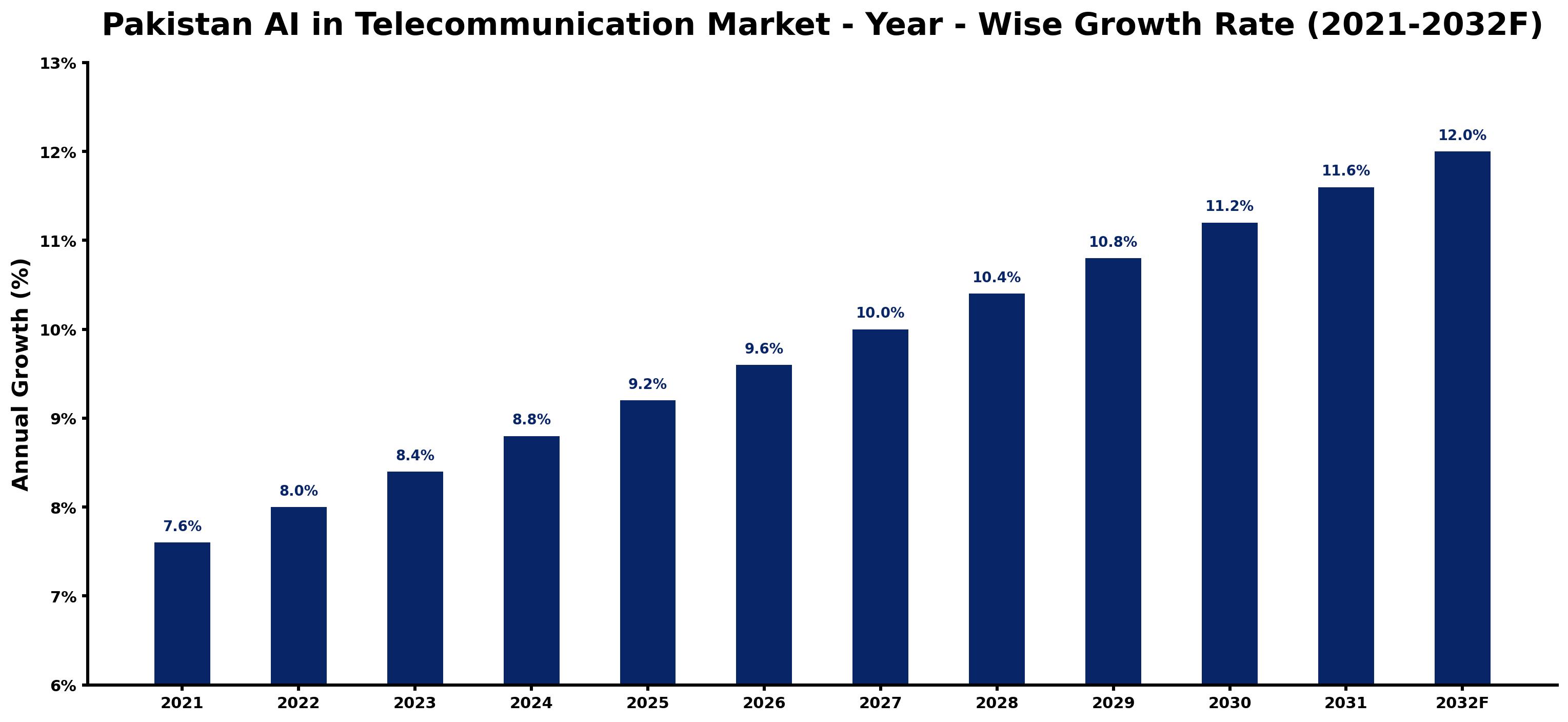
The table below presents the year‑wise growth rates along with the key drivers influencing the market
| Year | Growth Rate | Major Drivers |
| 2021 | 7.6% | Increased mobile data consumption among urban youth demographic |
| 2022 | 8.0% | Government incentives for AI talent development in telecommunications |
| 2023 | 8.4% | Rise in IoT applications boosting telecom AI adoption |
| 2024 | 8.8% | Regulatory support for AI-driven network management solutions |
| 2025 | 9.2% | Surge in AI-based customer service automation demand |
| 2026 | 9.6% | Investment in AI research from local telecom companies |
| 2027 | 10.0% | Partnerships with international tech firms enhancing local capabilities |
| 2028 | 10.4% | Emergence of data analytics startups targeting telecom efficiency |
| 2029 | 10.8% | Increased mobile apps utilizing AI for user engagement |
| 2030 | 11.2% | Government-led initiatives promoting AI integration in telecom |
| 2031 | 11.6% | Local enterprises adopting AI for operational cost reduction |
| 2032 | 12.0% | Telecom sector focus on AI for competitive differentiation |
Note: Market size estimations and growth projections presented in this report are based on 6Wresearch's proprietary forecasting methodology, utilizing the latest available industry data, government publications, and primary research inputs.
Pakistan AI in Telecommunication Market Key Takeaways
Below are some of the specific key takeaways from the market, including:
- AI technologies are being adopted for network optimization and predictive maintenance, significantly enhancing operational efficiency.
- The deployment of 5G technology is expected to further accelerate AI integration within the telecom sector.
- Telecom companies are increasingly utilizing AI for customer service automation, including AI-powered chatbots.
- Regulatory efforts by the government aim to facilitate AI adoption, providing a conducive environment for innovation.
- Investment opportunities abound in AI-powered solutions, driven by the growing demand for digital services in Pakistan.
Evaluation of Restraints in Pakistan AI in Telecommunication Market
Despite the promising growth trajectory, certain constraints impede the widespread adoption of AI technologies in Pakistan’s telecom market. The regulatory environment often struggles to keep pace with rapid technological advancements, creating uncertainty for companies eager to innovate. A notable shortage of skilled professionals proficient in AI is another critical limitation. This talent gap hinders the development and effective implementation of cutting-edge AI solutions. Additionally, concerns surrounding data privacy and security remain at the forefront, posing challenges that need to be addressed to foster a secure AI ecosystem.
Pakistan AI in Telecommunication Market Trends
A few trends are emerging that are expected to shape the AI in Telecommunication market in Pakistan. AI-powered chatbots are becoming increasingly popular for enhancing customer service, providing instant responses and support. Predictive analytics is gaining traction for optimizing network performance, allowing for proactive maintenance and minimizing service disruptions. Furthermore, the integration of AI with 5G technologies is driving innovation, particularly in areas requiring high-speed connectivity and low latency.
Pakistan AI in Telecommunication Market Opportunities
The potential for investment in the Pakistan AI in Telecommunication market is substantial. Key areas include the development of AI-driven customer support platforms, tools for network management, and predictive systems aimed at improving maintenance schedules. As demand for high-speed internet and advanced telecom services grows, opportunities for innovative solutions will increase. Investors have the chance to partner with telecom operators or develop bespoke solutions tailored to local needs, tapping into a market ready for transformation.
Government Initiatives in the Pakistan AI in Telecommunication Market
The Pakistani government is proactively shaping the AI landscape within the telecommunication sector through strategic initiatives and policies. By fostering a supportive regulatory framework, authorities are encouraging the integration of advanced technologies. These initiatives not only aim to boost innovation but also position Pakistan as a leader in the regional AI landscape.
- A recently completed initiative includes the establishment of the National Center for Artificial Intelligence (NCAI), promoting research and development in AI technologies relevant to telecommunications.
- Currently underway is the National AI Policy Framework, which provides guidance on the implementation of AI technologies across various sectors, including telecommunications.
- Planned initiatives include future incentives and tax breaks aimed at stimulating private sector investment in AI technology development.
- Long-term objectives encompass expanding digital infrastructure to support the growing demand for AI applications in telecommunications.
- Ongoing collaborations between the government and private entities are focusing on enhancing AI literacy and workforce development in the sector.
Future Insights of the Pakistan AI in Telecommunication Market
Looking ahead to 2026-2032, the Pakistan AI in Telecommunication market is set to undergo transformative changes. As AI applications become integral to telecom operations, expect to see significant improvements in service delivery, customer satisfaction, and overall business performance. The continued rollout of 5G technology will act as a catalyst for further AI adoption, enabling new services and applications that capitalize on enhanced connectivity and speed. Overall, the landscape of telecommunications in Pakistan is on the brink of a technological revolution.
Pakistan AI in Telecommunication Market Latest Developments
In recent months, activity in the Pakistan AI in Telecommunication market has accelerated, reflecting the growing interest in integrating AI technologies. Telecom companies are increasingly realizing the benefits of AI, leading to a flurry of developments aimed at enhancing operational capabilities and customer experiences.
- A major technology vendor announced the rollout of an AI-driven network optimization tool in early 2025, aimed at improving service reliability.
- A leading regional operator is currently implementing an AI-powered customer service chatbot, which is expected to enhance user interaction and support efficiency.
- An initiative to develop predictive maintenance systems for telecom infrastructure began in mid-2025 and remains ongoing, with initial deployments already in place.
- Upcoming plans include a collaboration between telecom operators to launch a shared AI platform by late 2026, aimed at streamlining services across providers.
- A pilot project focusing on AI-enhanced fraud detection systems is set to commence in Q3 2026, aimed at minimizing revenue loss across the sector.
Pakistan AI in Telecommunication Market - Key Attractiveness of the Report
- 10 Years of Market Numbers
- Historical Data Starting from 2022 to 2025
- Base Year: 2025
- Forecast Data until 2032
- Key Performance Indicators Impacting the Market
- Major Upcoming Developments and Projects
Key Highlights of the Report:
- Pakistan AI in Telecommunication Market Outlook
- Market Size of Pakistan AI in Telecommunication Market, 2025
- Forecast of Pakistan AI in Telecommunication Market, 2032
- Historical Data and Forecast of Pakistan AI in Telecommunication Revenues & Volume for the Period 2022-2032F
- Pakistan AI in Telecommunication Market Trend Evolution
- Pakistan AI in Telecommunication Market Drivers and Challenges
- Pakistan AI in Telecommunication Price Trends
- Pakistan AI in Telecommunication Porter's Five Forces
- Pakistan AI in Telecommunication Industry Life Cycle
- Historical Data and Forecast of Pakistan AI in Telecommunication Market Revenues & Volume By Application for the Period 2022-2032F
- Historical Data and Forecast of Pakistan AI in Telecommunication Market Revenues & Volume By Customer analytics for the Period 2022-2032F
- Historical Data and Forecast of Pakistan AI in Telecommunication Market Revenues & Volume By Network security for the Period 2022-2032F
- Historical Data and Forecast of Pakistan AI in Telecommunication Market Revenues & Volume By Network optimization for the Period 2022-2032F
- Historical Data and Forecast of Pakistan AI in Telecommunication Market Revenues & Volume By Self-diagnostics for the Period 2022-2032F
- Historical Data and Forecast of Pakistan AI in Telecommunication Market Revenues & Volume By Virtual assistance for the Period 2022-2032F
- Historical Data and Forecast of Pakistan AI in Telecommunication Market Revenues & Volume By Others (contact center analytics and marketing campaign analytics) for the Period 2022-2032F
- Historical Data and Forecast of Pakistan AI in Telecommunication Market Revenues & Volume By Component for the Period 2022-2032F
- Historical Data and Forecast of Pakistan AI in Telecommunication Market Revenues & Volume By Solutions for the Period 2022-2032F
- Historical Data and Forecast of Pakistan AI in Telecommunication Market Revenues & Volume By Services for the Period 2022-2032F
- Historical Data and Forecast of Pakistan AI in Telecommunication Market Revenues & Volume By Deployment Mode for the Period 2022-2032F
- Historical Data and Forecast of Pakistan AI in Telecommunication Market Revenues & Volume By Cloud for the Period 2022-2032F
- Historical Data and Forecast of Pakistan AI in Telecommunication Market Revenues & Volume By On-premises for the Period 2022-2032F
- Historical Data and Forecast of Pakistan AI in Telecommunication Market Revenues & Volume By Technology for the Period 2022-2032F
- Historical Data and Forecast of Pakistan AI in Telecommunication Market Revenues & Volume By Machine learning and deep learning for the Period 2022-2032F
- Historical Data and Forecast of Pakistan AI in Telecommunication Market Revenues & Volume By Natural Language Processing (NLP) for the Period 2022-2032F
- Pakistan AI in Telecommunication Import Export Trade Statistics
- Market Opportunity Assessment By Application
- Market Opportunity Assessment By Component
- Market Opportunity Assessment By Deployment Mode
- Market Opportunity Assessment By Technology
- Pakistan AI in Telecommunication Top Companies Market Share
- Pakistan AI in Telecommunication Competitive Benchmarking By Technical and Operational Parameters
- Pakistan AI in Telecommunication Company Profiles
- Pakistan AI in Telecommunication Key Strategic Recommendations






































