Pakistan Armored Vehicle Market Size, Share & Growth Rate
The Pakistan Armored Vehicle Market was estimated at USD 1225 Million in 2025 and is projected to reach USD 1778 Million by 2032, growing at a CAGR of 5.5% from 2026 to 2032. This growth is primarily driven by rising defense expenditures aligned with national security priorities, alongside an urgent need to bolster border security capabilities. Additionally, ongoing modernization efforts in the military underscore the demand for enhanced armored solutions capable of addressing asymmetric threats.
Pakistan Armored Vehicle Market Year-wise Growth Rate and Key Drivers
This graph highlights how the Pakistan Armored Vehicle Market has steadily grown over the years, supported by major growth factors.
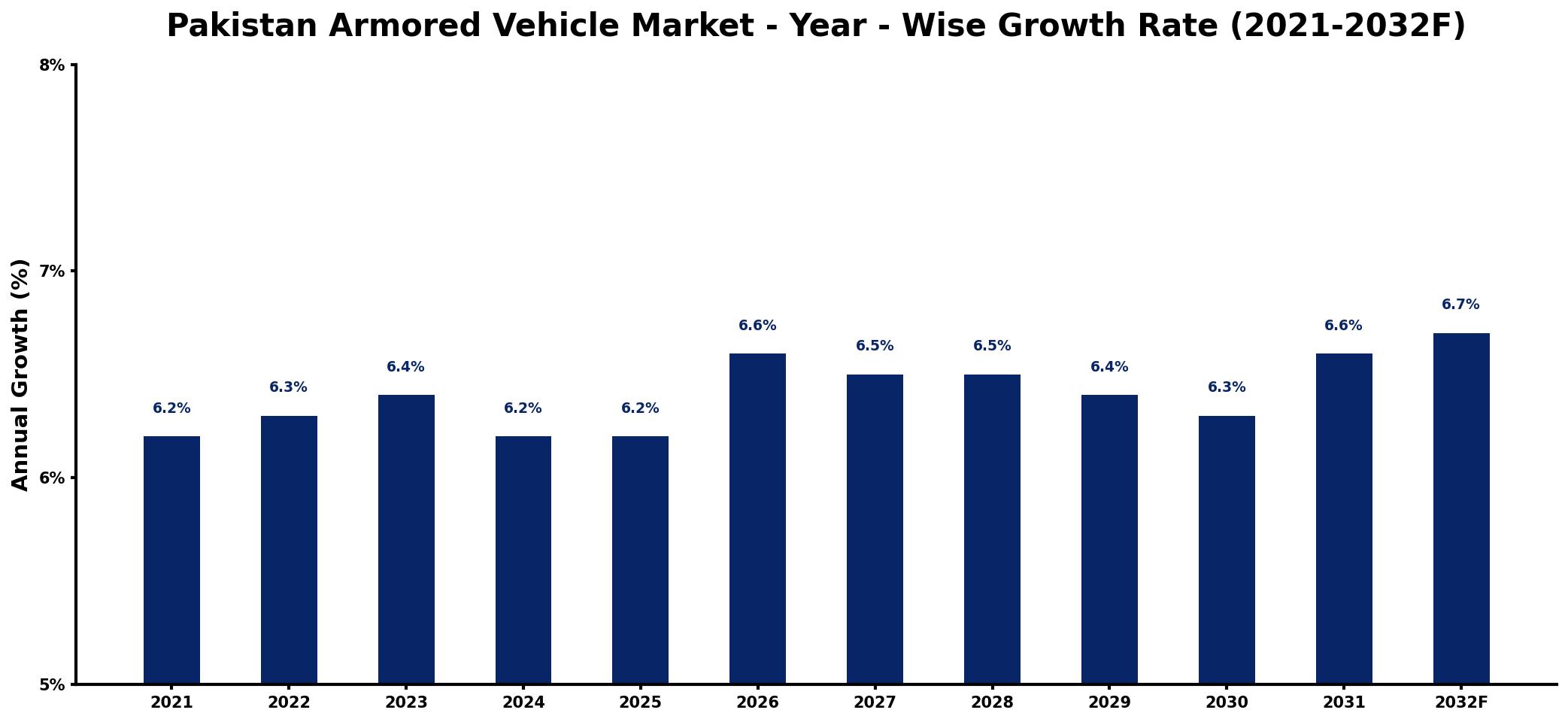
The table below presents the year‑wise growth rates along with the key drivers influencing the market
| Year | Growth Rate | Major Drivers |
| 2021 | 6.2% | increased defense spending initiatives |
| 2022 | 6.3% | rising geopolitical tensions driving demand |
| 2023 | 6.4% | growing interest in security solutions |
| 2024 | 6.2% | expansion of military modernization programs |
| 2025 | 6.2% | enhanced procurement strategies adopted |
| 2026 | 6.6% | increased collaboration with foreign partners |
| 2027 | 6.5% | growing focus on domestic production |
| 2028 | 6.5% | strengthening law enforcement capabilities |
| 2029 | 6.4% | rising demand from private sector |
| 2030 | 6.3% | investment in research and development |
| 2031 | 6.6% | emphasis on multi-role operational capabilities |
| 2032 | 6.7% | increased participation in international exercises |
Note: Market size estimations and growth projections presented in this report are based on 6Wresearch's proprietary forecasting methodology, utilizing the latest available industry data, government publications, and primary research inputs.
Pakistan Armored Vehicle Market Synopsis
The demand for armored vehicles in Pakistan has surged as security challenges become increasingly complex. The military's modernization agenda emphasizes procuring advanced armored solutions that integrate cutting-edge technology and robust defense mechanisms. Furthermore, the market's growth reflects a broader geopolitical landscape, where national defense remains a top priority.
Recent counter-terrorism operations have necessitated the acquisition of a variety of armored vehicles, including main battle tanks and mine-resistant ambush protected (MRAP) vehicles. The competitive dynamics of the market are characterized by both domestic and international players striving to innovate and deliver vehicles that meet the evolving operational needs of the Pakistani military.
Pakistan Armored Vehicle Market Key Takeaways
- Growing defense budgets are fostering increased investments in advanced armored vehicle technology.
- The market is shifting towards lighter, more mobile vehicles capable of maneuvering in diverse terrains.
- Ongoing modernization initiatives are fueling demand for sophisticated communication and surveillance systems integrated into armored vehicles.
- Government incentives promote local manufacturing while ensuring compliance with safety and quality standards.
- Strategic partnerships with international defense contractors are enhancing technological capabilities in the domestic market.
Evaluation of Restraints in Pakistan Armored Vehicle Market
Despite its growth potential, the Pakistan Armored Vehicle Market faces significant constraints. Limited defense budget allocations hinder the military's capacity to invest heavily in state-of-the-art armored solutions. Additionally, competition from international suppliers poses a challenge for local manufacturers, who may struggle to match advanced technologies. Political instability and regional security concerns further complicate procurement decisions, creating an uncertain business environment that impacts market dynamics.
Pakistan Armored Vehicle Market Trends
Current trends in the Pakistan Armored Vehicle Market reflect a clear shift towards advanced technological features aimed at improving protection and operational effectiveness. There's a growing inclination towards the development of lighter armored vehicles, which offer enhanced mobility and adaptability to difficult terrains. Moreover, as security threats evolve, there's an increasing demand for vehicles equipped with sophisticated surveillance capabilities and real-time communication systems, allowing for better situational awareness on the battlefield.
Pakistan Armored Vehicle Market Opportunities
The Pakistan Armored Vehicle Market presents a wealth of investment opportunities driven by the ongoing demand for enhanced military capabilities. There is considerable potential for supplying armored vehicles to the military, law enforcement agencies, and the growing private security sector. Additionally, the trend towards customized vehicles designed to meet specific operational requirements opens avenues for collaboration with local manufacturers and technology providers. Investing in research and development to innovate solutions tailored to Pakistan's security landscape will likely yield significant returns.
Government Initiatives in the Pakistan Armored Vehicle Market
Government policies play a crucial role in shaping the Pakistan Armored Vehicle Market, focusing on regulations and licensing for manufacturing and importing armored vehicles. To promote local production, the government offers various incentives, including tax breaks and subsidies, aimed at encouraging domestic manufacturing capabilities. Additionally, regulatory measures ensure that quality control and safety standards are upheld across the sector, thus protecting national security interests and fostering a robust defense industry.
Future Insights of the Pakistan Armored Vehicle Market
Looking ahead to 2026-2032, the Pakistan Armored Vehicle Market is poised for steady expansion, driven by ongoing security concerns and territorial conflicts. As the military continues to modernize, procurement of advanced armored vehicles will become increasingly essential to address emerging threats effectively. Opportunities for domestic and international manufacturers abound as the focus on cutting-edge solutions grows. With a strategic emphasis on strengthening defense capabilities, the market outlook is optimistic.
Pakistan Armored Vehicle Market Latest Developments (2025 - 2026)
The Pakistan Armored Vehicle Market is currently witnessing significant advancements in vehicle technology, driven by both domestic innovation and international collaborations. Recent initiatives have highlighted a focus on developing lightweight and versatile armored vehicles designed to meet the unique challenges posed by the region's security landscape. Moreover, efforts are underway to enhance local manufacturing capabilities, ensuring that defense procurement aligns with the latest technological standards.
Pakistan Armored Vehicle Market - Key Attractiveness of the Report
- 10 Years of Market Numbers
- Historical Data Starting from 2022 to 2025
- Base Year: 2025
- Forecast Data until 2032
- Key Performance Indicators Impacting the Market
- Major Upcoming Developments and Projects
Key Highlights of the Report:
- Pakistan Armored Vehicle Market Outlook
- Market Size of Pakistan Armored Vehicle Market, 2025
- Forecast of Pakistan Armored Vehicle Market, 2032
- Historical Data and Forecast of Pakistan Armored Vehicle Revenues & Volume for the Period 2022-2032F
- Pakistan Armored Vehicle Market Trend Evolution
- Pakistan Armored Vehicle Market Drivers and Challenges
- Pakistan Armored Vehicle Price Trends
- Pakistan Armored Vehicle Porter's Five Forces
- Pakistan Armored Vehicle Industry Life Cycle
- Historical Data and Forecast of Pakistan Armored Vehicle Market Revenues & Volume By Platform for the Period 2022-2032F
- Historical Data and Forecast of Pakistan Armored Vehicle Market Revenues & Volume By Combat Vehicles for the Period 2022-2032F
- Historical Data and Forecast of Pakistan Armored Vehicle Market Revenues & Volume By Combat Support Vehicles for the Period 2022-2032F
- Historical Data and Forecast of Pakistan Armored Vehicle Market Revenues & Volume By Unmanned Armored Ground Vehicles for the Period 2022-2032F
- Historical Data and Forecast of Pakistan Armored Vehicle Market Revenues & Volume By Mobility for the Period 2022-2032F
- Historical Data and Forecast of Pakistan Armored Vehicle Market Revenues & Volume By Wheeled for the Period 2022-2032F
- Historical Data and Forecast of Pakistan Armored Vehicle Market Revenues & Volume By Tracked for the Period 2022-2032F
- Historical Data and Forecast of Pakistan Armored Vehicle Market Revenues & Volume By System for the Period 2022-2032F
- Historical Data and Forecast of Pakistan Armored Vehicle Market Revenues & Volume By Engine for the Period 2022-2032F
- Historical Data and Forecast of Pakistan Armored Vehicle Market Revenues & Volume By Drive System for the Period 2022-2032F
- Historical Data and Forecast of Pakistan Armored Vehicle Market Revenues & Volume By Ballistic Armor for the Period 2022-2032F
- Historical Data and Forecast of Pakistan Armored Vehicle Market Revenues & Volume By Turret Drives for the Period 2022-2032F
- Historical Data and Forecast of Pakistan Armored Vehicle Market Revenues & Volume By Ammunition Handling System for the Period 2022-2032F
- Historical Data and Forecast of Pakistan Armored Vehicle Market Revenues & Volume By Fire Control Systems (FCS) for the Period 2022-2032F
- Historical Data and Forecast of Pakistan Armored Vehicle Market Revenues & Volume By Armaments for the Period 2022-2032F
- Historical Data and Forecast of Pakistan Armored Vehicle Market Revenues & Volume By Countermeasure System for the Period 2022-2032F
- Pakistan Armored Vehicle Import Export Trade Statistics
- Market Opportunity Assessment By Platform
- Market Opportunity Assessment By Mobility
- Market Opportunity Assessment By System
- Pakistan Armored Vehicle Top Companies Market Share
- Pakistan Armored Vehicle Competitive Benchmarking By Technical and Operational Parameters
- Pakistan Armored Vehicle Company Profiles
- Pakistan Armored Vehicle Key Strategic Recommendations






































