Pakistan Artificial Intelligence in Accounting Market Size & Growth Rate (2026-2032)
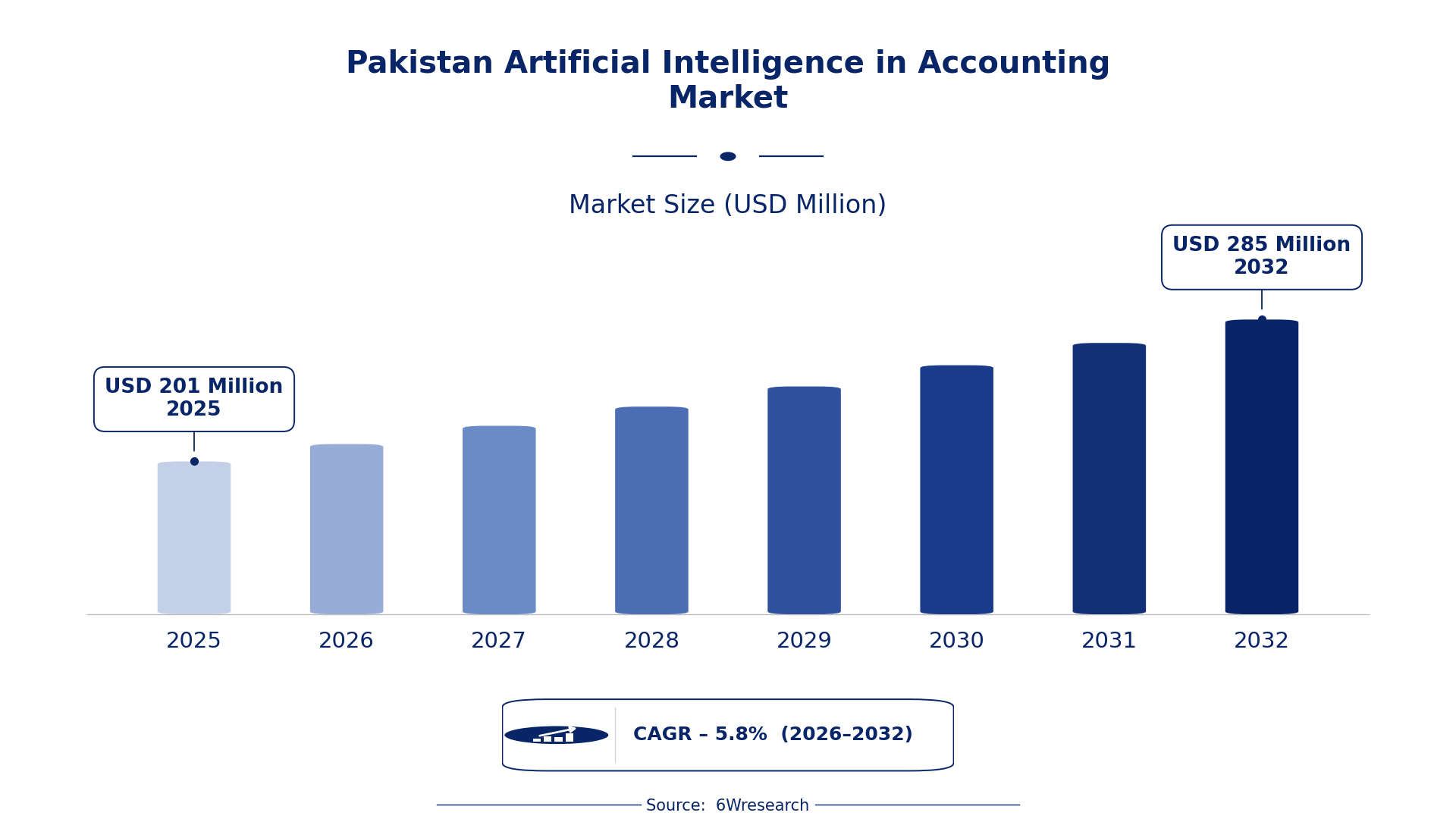
The Pakistan Artificial Intelligence in Accounting Market was estimated at USD 201 Million in 2025 and is projected to reach USD 285 Million by 2032, growing at a CAGR of 5.8% from 2026 to 2032.
Pakistan Artificial Intelligence in Accounting Market Synopsis
The integration of artificial intelligence into accounting practices in Pakistan is gaining momentum, with businesses increasingly recognizing its potential to streamline operations. AI technologies are not only transforming traditional accounting functions but are also enabling organizations to harness data for improved decision-making.
As financial professionals seek to enhance accuracy and efficiency, the demand for AI-powered accounting tools is surging. From automating data entry to advanced fraud detection, the applications of AI in accounting are diverse and impactful, positioning the market for significant growth in the coming years.
Pakistan Artificial Intelligence in Accounting Market Year-wise Growth Rate and Key Drivers
This graph illustrates the annual growth rates of the Pakistan Artificial Intelligence in Accounting Market from 2021 to 2032, highlighting a steady upward trajectory and projected expansion over the forecast period.
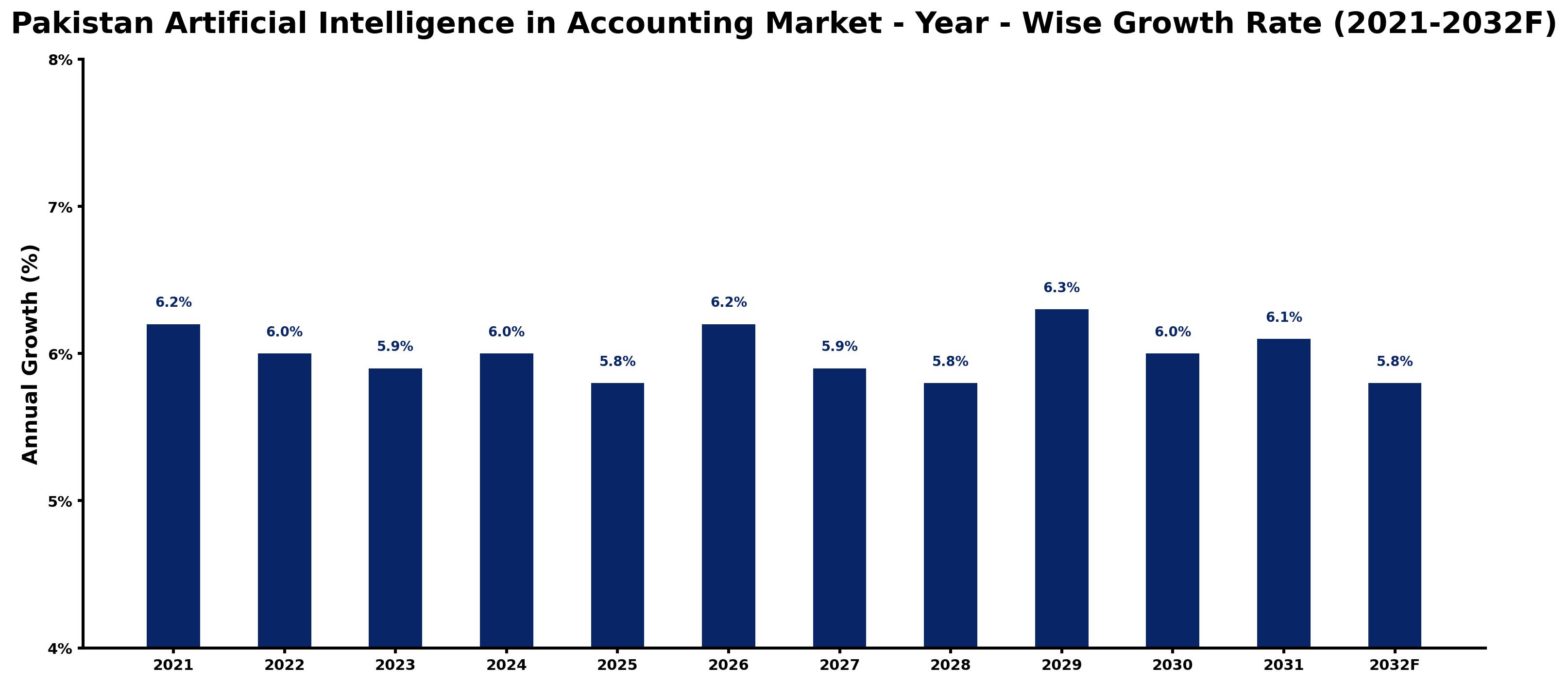
The table below presents the year‑wise growth rates along with the key drivers influencing the market
| Year | Growth Rate | Major Drivers |
| 2021 | 6.2% | Implementation of SECP's digital accounting standards framework. |
| 2022 | 6.0% | Increased adoption of AI tools by local SMEs. |
| 2023 | 5.9% | Government incentives for AI investments in fintech sector. |
| 2024 | 6.0% | Rise in technology startups utilizing AI in accounting. |
| 2025 | 5.8% | Demand for real-time financial analysis in businesses. |
| 2026 | 6.2% | Universities introducing AI-focused accounting curricula increases talent. |
| 2027 | 5.9% | Local partnership with global AI firms enhances capabilities. |
| 2028 | 5.8% | Emerging trends in data analytics transform accounting practices. |
| 2029 | 6.3% | Increased regulatory focus on data security in finance. |
| 2030 | 6.0% | Demand for automated bookkeeping among freelancers rises. |
| 2031 | 6.1% | Investment in cloud technology boosts AI adoption in accounting. |
| 2032 | 5.8% | Growing financial literacy drives interest in AI solutions. |
Note: Market size estimations and growth projections presented in this report are based on 6Wresearch's proprietary forecasting methodology, utilizing the latest available industry data, government publications, and primary research inputs.
Pakistan Artificial Intelligence in Accounting Market Key Takeaways
Below are some of the specific key takeaways from the market, including:
- The market is projected to grow from USD 201 Million in 2025 to USD 285 Million by 2032.
- AI technologies are being increasingly adopted to automate repetitive accounting tasks.
- Demand for real-time insights is driving the integration of AI with machine learning and natural language processing.
- Government initiatives are playing a crucial role in promoting AI adoption in the accounting sector.
- Key challenges include a lack of awareness and potential resistance among accounting professionals.
Evaluation of Restraints in Pakistan Artificial Intelligence in Accounting Market
The growth of the Pakistan Artificial Intelligence in Accounting market is hampered by several real constraints. A notable limitation is the prevailing lack of awareness among accounting professionals regarding the benefits of AI technologies. Many are hesitant to embrace AI, fearing job displacement and the complexities associated with new tools. Additionally, data privacy concerns linger, along with the challenge of insufficient skilled professionals who possess both AI and accounting expertise. The need for significant investment in infrastructure and training further complicates matters, while the slow pace of digital transformation in the accounting industry acts as an overarching barrier to widespread AI adoption.
Pakistan Artificial Intelligence in Accounting Market Trends
Several trends are currently shaping the Pakistan Artificial Intelligence in Accounting market. The rise of AI-driven accounting software has emerged as a prominent trend, automating tasks and enhancing accuracy. Companies are increasingly seeking solutions that offer real-time insights for data-driven decision-making. The integration of AI with other advanced technologies, such as machine learning and natural language processing, is also gaining traction, enabling more sophisticated accounting processes. As businesses strive to remain competitive in the digital age, the demand for innovative AI-powered accounting solutions is expected to grow significantly.
Pakistan Artificial Intelligence in Accounting Market Opportunities
Opportunities for growth in the Pakistan Artificial Intelligence in Accounting market are abundant. The increasing volume of financial data generated by organizations necessitates advanced tools for effective management and analysis. Vendors and service providers who can offer tailored AI solutions will find a receptive market. The ongoing digital transformation initiatives present a fertile ground for innovation, while businesses actively seeking efficiency improvements in their financial operations will drive demand for AI-powered tools. Additionally, the integration of AI with emerging technologies presents avenues for new product development and service offerings.
Government Initiatives in the Pakistan Artificial Intelligence in Accounting Market
Government policy is playing an influential role in shaping the Pakistan Artificial Intelligence in Accounting market. With a focus on fostering innovation, the government has introduced various initiatives to promote AI technologies within the accounting sector. These policies are aimed at enhancing transparency and efficiency, ensuring that businesses can leverage AI for improved financial practices.
- A National Artificial Intelligence Policy launched in 2020 aims to stimulate growth in AI technologies, including in the accounting domain.
- The Securities and Exchange Commission of Pakistan has implemented regulations requiring transparency in AI systems used for financial reporting.
- Current training programs are underway to enhance the skills of accounting professionals in AI applications.
- Funding opportunities for AI-related projects are being made available to support innovation in the accounting sector.
- Plans for future collaborations between government and private sectors are expected to promote AI integration in accounting practices.
Future Insights of the Pakistan Artificial Intelligence in Accounting Market
Looking ahead to 2026-2032, the Pakistan Artificial Intelligence in Accounting market is set for substantial growth. The ongoing digital transformation efforts will encourage broader adoption of AI tools, making them commonplace in various industries. As businesses increasingly seek to optimize their accounting processes through real-time data analysis, the demand for AI solutions will rise. Continuous advancements in technology will further enhance the capabilities of AI in accounting, paving the way for innovative applications and services that streamline operations and support data-driven decision-making.
Pakistan Artificial Intelligence in Accounting Market Latest Developments
In the past year, the Pakistan Artificial Intelligence in Accounting market has seen noteworthy developments. Companies are actively investing in AI technologies to optimize their financial operations, leading to a flurry of product launches and partnerships aimed at enhancing service offerings.
- A major technology vendor launched a new AI-powered accounting software in early 2025, designed to automate data entry processes.
- In mid-2025, a collaboration between accounting firms and AI solution providers commenced to develop tailored AI applications for the local market.
- Ongoing initiatives include workshops aimed at training accounting professionals in AI technologies, which began in late 2025.
- A rollout of cloud-based AI accounting solutions is planned for the second half of 2026, targeting small and medium-sized enterprises.
- By early 2026, a consortium of technology and accounting firms is expected to launch a public awareness campaign focused on the benefits of AI in accounting.
Pakistan Artificial Intelligence in Accounting Market - Key Attractiveness of the Report
- 10 Years of Market Numbers
- Historical Data Starting from 2022 to 2025
- Base Year: 2025
- Forecast Data until 2032
- Key Performance Indicators Impacting the Market
- Major Upcoming Developments and Projects
Key Highlights of the Report:
- Pakistan Artificial Intelligence in Accounting Market Outlook
- Market Size of Pakistan Artificial Intelligence in Accounting Market, 2025
- Forecast of Pakistan Artificial Intelligence in Accounting Market, 2032
- Historical Data and Forecast of Pakistan Artificial Intelligence in Accounting Revenues & Volume for the Period 2022-2032F
- Pakistan Artificial Intelligence in Accounting Market Trend Evolution
- Pakistan Artificial Intelligence in Accounting Market Drivers and Challenges
- Pakistan Artificial Intelligence in Accounting Price Trends
- Pakistan Artificial Intelligence in Accounting Porter's Five Forces
- Pakistan Artificial Intelligence in Accounting Industry Life Cycle
- Historical Data and Forecast of Pakistan Artificial Intelligence in Accounting Market Revenues & Volume By Application for the Period 2022-2032F
- Historical Data and Forecast of Pakistan Artificial Intelligence in Accounting Market Revenues & Volume By Automated Bookkeeping for the Period 2022-2032F
- Historical Data and Forecast of Pakistan Artificial Intelligence in Accounting Market Revenues & Volume By Invoice Classification and Approvals for the Period 2022-2032F
- Historical Data and Forecast of Pakistan Artificial Intelligence in Accounting Market Revenues & Volume By Fraud and Risk Management for the Period 2022-2032F
- Historical Data and Forecast of Pakistan Artificial Intelligence in Accounting Market Revenues & Volume By Reporting for the Period 2022-2032F
- Historical Data and Forecast of Pakistan Artificial Intelligence in Accounting Market Revenues & Volume By Others for the Period 2022-2032F
- Historical Data and Forecast of Pakistan Artificial Intelligence in Accounting Market Revenues & Volume By Component for the Period 2022-2032F
- Historical Data and Forecast of Pakistan Artificial Intelligence in Accounting Market Revenues & Volume By Solutions for the Period 2022-2032F
- Historical Data and Forecast of Pakistan Artificial Intelligence in Accounting Market Revenues & Volume By Services for the Period 2022-2032F
- Historical Data and Forecast of Pakistan Artificial Intelligence in Accounting Market Revenues & Volume By Technology for the Period 2022-2032F
- Historical Data and Forecast of Pakistan Artificial Intelligence in Accounting Market Revenues & Volume By Machine Learning (ML) and Deep Learning for the Period 2022-2032F
- Historical Data and Forecast of Pakistan Artificial Intelligence in Accounting Market Revenues & Volume By NLP for the Period 2022-2032F
- Historical Data and Forecast of Pakistan Artificial Intelligence in Accounting Market Revenues & Volume By Deployment Mode for the Period 2022-2032F
- Historical Data and Forecast of Pakistan Artificial Intelligence in Accounting Market Revenues & Volume By On-premises for the Period 2022-2032F
- Historical Data and Forecast of Pakistan Artificial Intelligence in Accounting Market Revenues & Volume By Cloud for the Period 2022-2032F
- Historical Data and Forecast of Pakistan Artificial Intelligence in Accounting Market Revenues & Volume By Enterprise Size for the Period 2022-2032F
- Historical Data and Forecast of Pakistan Artificial Intelligence in Accounting Market Revenues & Volume By Large Enterprises for the Period 2022-2032F
- Historical Data and Forecast of Pakistan Artificial Intelligence in Accounting Market Revenues & Volume By Small and Medium-Sized Enterprises (SMEs) for the Period 2022-2032F
- Pakistan Artificial Intelligence in Accounting Import Export Trade Statistics
- Market Opportunity Assessment By Application
- Market Opportunity Assessment By Component
- Market Opportunity Assessment By Technology
- Market Opportunity Assessment By Deployment Mode
- Market Opportunity Assessment By Enterprise Size
- Pakistan Artificial Intelligence in Accounting Top Companies Market Share
- Pakistan Artificial Intelligence in Accounting Competitive Benchmarking By Technical and Operational Parameters
- Pakistan Artificial Intelligence in Accounting Company Profiles
- Pakistan Artificial Intelligence in Accounting Key Strategic Recommendations






































