Pakistan Automotive Seat Belts Market Size, Share & Growth Rate
The Pakistan Automotive Seat Belts Market was estimated at USD 472 Million in 2025 and is projected to reach USD 658 Million by 2032, growing at a CAGR of 4.9% from 2026 to 2032. This growth trajectory is primarily fueled by an escalating awareness of road safety, driven by both public education initiatives and a tightening of government regulations surrounding vehicle safety standards. Furthermore, the rise in vehicle sales, spurred by a burgeoning middle class and urban development, is also playing a significant role in boosting demand for advanced seat belt technologies.
Pakistan Automotive Seat Belts Market Year-wise Growth Rate and Key Drivers
This graph highlights how the Pakistan Automotive Seat Belts Market has steadily grown over the years, supported by major growth factors.
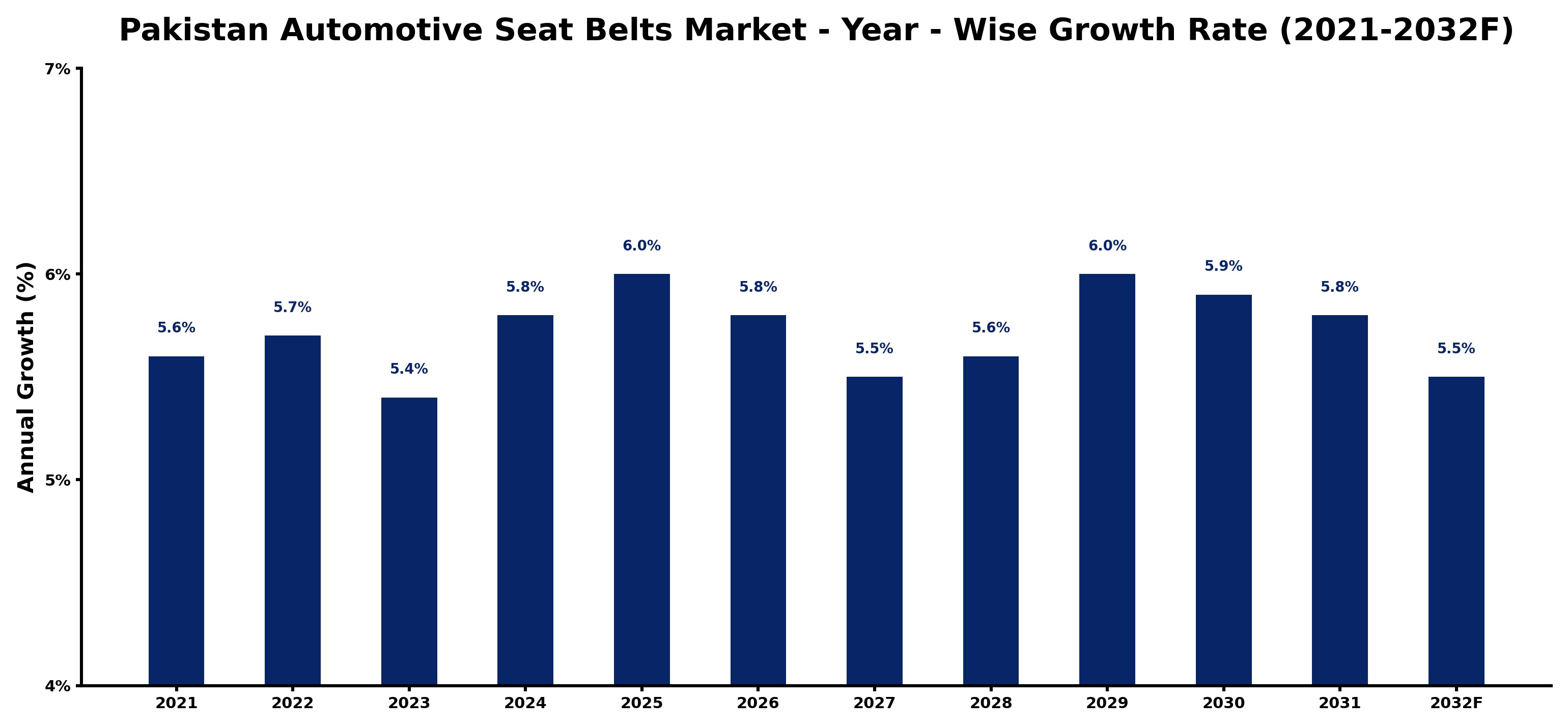
The table below presents the year‑wise growth rates along with the key drivers influencing the market
| Year | Growth Rate | Major Drivers |
| 2021 | 5.6% | Increased vehicle production rates |
| 2022 | 5.7% | Government regulations enhanced safety |
| 2023 | 5.4% | Consumer awareness of safety rising |
| 2024 | 5.8% | Technological advancements improved designs |
| 2025 | 6.0% | Export opportunities expanded significantly |
| 2026 | 5.8% | Partnerships with automakers strengthened |
| 2027 | 5.5% | Rising disposable income driving demand |
| 2028 | 5.6% | Sustainability trends influenced preferences |
| 2029 | 6.0% | Market penetration into new regions |
| 2030 | 5.9% | Innovative materials enhanced product appeal |
| 2031 | 5.8% | Safety campaigns increased consumer interest |
| 2032 | 5.5% | E-commerce growth expanded market reach |
Note - Market size estimations and growth projections presented in this report are based on 6Wresearch’s advanced forecasting approach, validated with industry datasets as of June 2026.
Pakistan Automotive Seat Belts Market Synopsis
The market for automotive seat belts in Pakistan is characterized by a dynamic blend of both domestic and international manufacturers. As vehicle ownership rises, so does the emphasis on equipping them with essential safety features, reflecting a shift towards consumer preferences that prioritize safety. This demand is further enhanced by initiatives aimed at educating the public on the importance of seat belt usage.
Notably, the growing trend of integrating smart technologies into seat belts, such as sensors and pre-tensioners, is indicative of a market that is not only evolving but is also becoming increasingly competitive. With advancements in materials and designs, manufacturers are keen to cater to a consumer base that values both safety and comfort.
Pakistan Automotive Seat Belts Market Key Takeaways
- The market shows steady growth, influenced by rising vehicle numbers and safety regulations.
- Technological innovations, such as smart seat belts, are becoming prevalent.
- A significant increase in public awareness regarding road safety is shaping consumer behavior.
- Local manufacturing presents unique investment opportunities amidst growing demand.
- Challenges include compliance and counterfeit product issues affecting consumer safety.
Evaluation of Restraints in Pakistan Automotive Seat Belts Market
Despite a promising growth outlook, the Pakistan Automotive Seat Belts Market grapples with several notable restraints. A prevalent issue is the low level of compliance among drivers and passengers regarding seat belt usage, contributing to higher accident rates. This is exacerbated by the proliferation of counterfeit and substandard seat belts that undermine consumer confidence and safety. Additionally, the lack of rigorous enforcement of existing regulations leaves gaps that hinder progress toward a safer automotive landscape. As price sensitivity influences purchasing decisions, many consumers opt for cheaper alternatives, often sacrificing quality. Addressing these challenges requires comprehensive awareness campaigns and the establishment of stricter regulatory frameworks.
Pakistan Automotive Seat Belts Market Trends
The trends shaping the Pakistan Automotive Seat Belts Market are indicative of a broader shift towards enhanced safety and innovation. Increasing regulatory pressure is leading to a significant emphasis on passenger safety, where features like pretensioners and force limiters are gaining traction. Moreover, the integration of lightweight and durable materials in seat belt manufacturing is not only addressing safety but also enhancing fuel efficiency, appealing to environmentally conscious consumers. The trend towards safety technology adoption in mid-range vehicles is expected to expand, creating a ripple effect across the market.
Pakistan Automotive Seat Belts Market Opportunities
Investors looking at the Pakistan Automotive Seat Belts Market will find ample opportunities, driven by the expansion of the local automotive industry and a growing safety-conscious consumer base. There is potential for establishing local manufacturing units to meet the rising domestic demand while also catering to export markets. The emphasis on advanced technologies in seat belt design opens pathways for partnerships with automotive manufacturers, allowing for the development of bespoke safety solutions that align with evolving consumer expectations and compliance requirements.
Government Initiatives in the Pakistan Automotive Seat Belts Market
The government of Pakistan is actively implementing policies aimed at bolstering road safety through the mandatory use of seat belts. The Motor Vehicles Ordinance imposes penalties for non-compliance, reflecting a commitment to enhance safety standards. The Pakistan Standards and Quality Control Authority (PSQCA) plays a crucial role in establishing manufacturing benchmarks, ensuring that seat belts adhere to stringent safety requirements. Furthermore, public awareness campaigns are being initiated to educate drivers and passengers on the critical importance of using seat belts, aiming to reduce the incidence of road accidents.
Future Insights of the Pakistan Automotive Seat Belts Market
Looking ahead to the period from 2026 to 2032, the Pakistan Automotive Seat Belts Market is positioned for robust growth. This optimism is bolstered by ongoing infrastructural developments, an increase in vehicle sales, and a heightened focus on road safety regulations. As technological advancements continue to revolutionize automotive safety, we can expect an increasing introduction of innovative seat belt designs that not only enhance safety but also improve user experience. The collaboration between automotive manufacturers and seat belt suppliers will be pivotal in achieving higher safety standards and driving overall market expansion.
Pakistan Automotive Seat Belts Market Latest Developments (May 2025 - June 2026)
In recent months, the Pakistan Automotive Seat Belts Market has seen a flurry of activity, with manufacturers ramping up efforts to introduce advanced safety features. Innovations such as smart seat belts equipped with integrated sensors are becoming more prevalent, reflecting a shift towards technology-driven solutions. Additionally, manufacturers are enhancing their focus on quality control to counter the challenges posed by counterfeit products, reinforcing consumer safety as a top priority. Industry stakeholders are also engaging in partnerships to improve compliance with safety standards and enhance product offerings.
Pakistan Automotive Seat Belts Market - Key Attractiveness of the Report
- 10 Years of Market Numbers
- Historical Data Starting from 2022 to 2025
- Base Year: 2025
- Forecast Data until 2032
- Key Performance Indicators Impacting the Market
- Major Upcoming Developments and Projects
Key Highlights of the Report:
- Pakistan Automotive Seat Belts Market Outlook
- Market Size of Pakistan Automotive Seat Belts Market, 2025
- Forecast of Pakistan Automotive Seat Belts Market, 2032
- Historical Data and Forecast of Pakistan Automotive Seat Belts Revenues & Volume for the Period 2022-2032F
- Pakistan Automotive Seat Belts Market Trend Evolution
- Pakistan Automotive Seat Belts Market Drivers and Challenges
- Pakistan Automotive Seat Belts Price Trends
- Pakistan Automotive Seat Belts Porter's Five Forces
- Pakistan Automotive Seat Belts Industry Life Cycle
- Historical Data and Forecast of Pakistan Automotive Seat Belts Market Revenues & Volume By Type for the Period 2022-2032F
- Historical Data and Forecast of Pakistan Automotive Seat Belts Market Revenues & Volume By 2-point Seatbelt for the Period 2022-2032F
- Historical Data and Forecast of Pakistan Automotive Seat Belts Market Revenues & Volume By 3-point Seatbelt for the Period 2022-2032F
- Historical Data and Forecast of Pakistan Automotive Seat Belts Market Revenues & Volume By Vehicle for the Period 2022-2032F
- Historical Data and Forecast of Pakistan Automotive Seat Belts Market Revenues & Volume By Passenger Cars for the Period 2022-2032F
- Historical Data and Forecast of Pakistan Automotive Seat Belts Market Revenues & Volume By Light Commercial Vehicles for the Period 2022-2032F
- Historical Data and Forecast of Pakistan Automotive Seat Belts Market Revenues & Volume By Heavy Commercial Vehicles for the Period 2022-2032F
- Historical Data and Forecast of Pakistan Automotive Seat Belts Market Revenues & Volume By Component for the Period 2022-2032F
- Historical Data and Forecast of Pakistan Automotive Seat Belts Market Revenues & Volume By Webbing strap for the Period 2022-2032F
- Historical Data and Forecast of Pakistan Automotive Seat Belts Market Revenues & Volume By Retractor for the Period 2022-2032F
- Historical Data and Forecast of Pakistan Automotive Seat Belts Market Revenues & Volume By Buckle for the Period 2022-2032F
- Historical Data and Forecast of Pakistan Automotive Seat Belts Market Revenues & Volume By Tongue for the Period 2022-2032F
- Historical Data and Forecast of Pakistan Automotive Seat Belts Market Revenues & Volume By Pillar Loop for the Period 2022-2032F
- Historical Data and Forecast of Pakistan Automotive Seat Belts Market Revenues & Volume By Distribution Channels for the Period 2022-2032F
- Historical Data and Forecast of Pakistan Automotive Seat Belts Market Revenues & Volume By OEM for the Period 2022-2032F
- Historical Data and Forecast of Pakistan Automotive Seat Belts Market Revenues & Volume By Aftermarket for the Period 2022-2032F
- Pakistan Automotive Seat Belts Import Export Trade Statistics
- Market Opportunity Assessment By Type
- Market Opportunity Assessment By Vehicle
- Market Opportunity Assessment By Component
- Market Opportunity Assessment By Distribution Channels
- Pakistan Automotive Seat Belts Top Companies Market Share
- Pakistan Automotive Seat Belts Competitive Benchmarking By Technical and Operational Parameters
- Pakistan Automotive Seat Belts Company Profiles
- Pakistan Automotive Seat Belts Key Strategic Recommendations






































