Pakistan Big Data Market Size & Growth Rate (2026-2032)
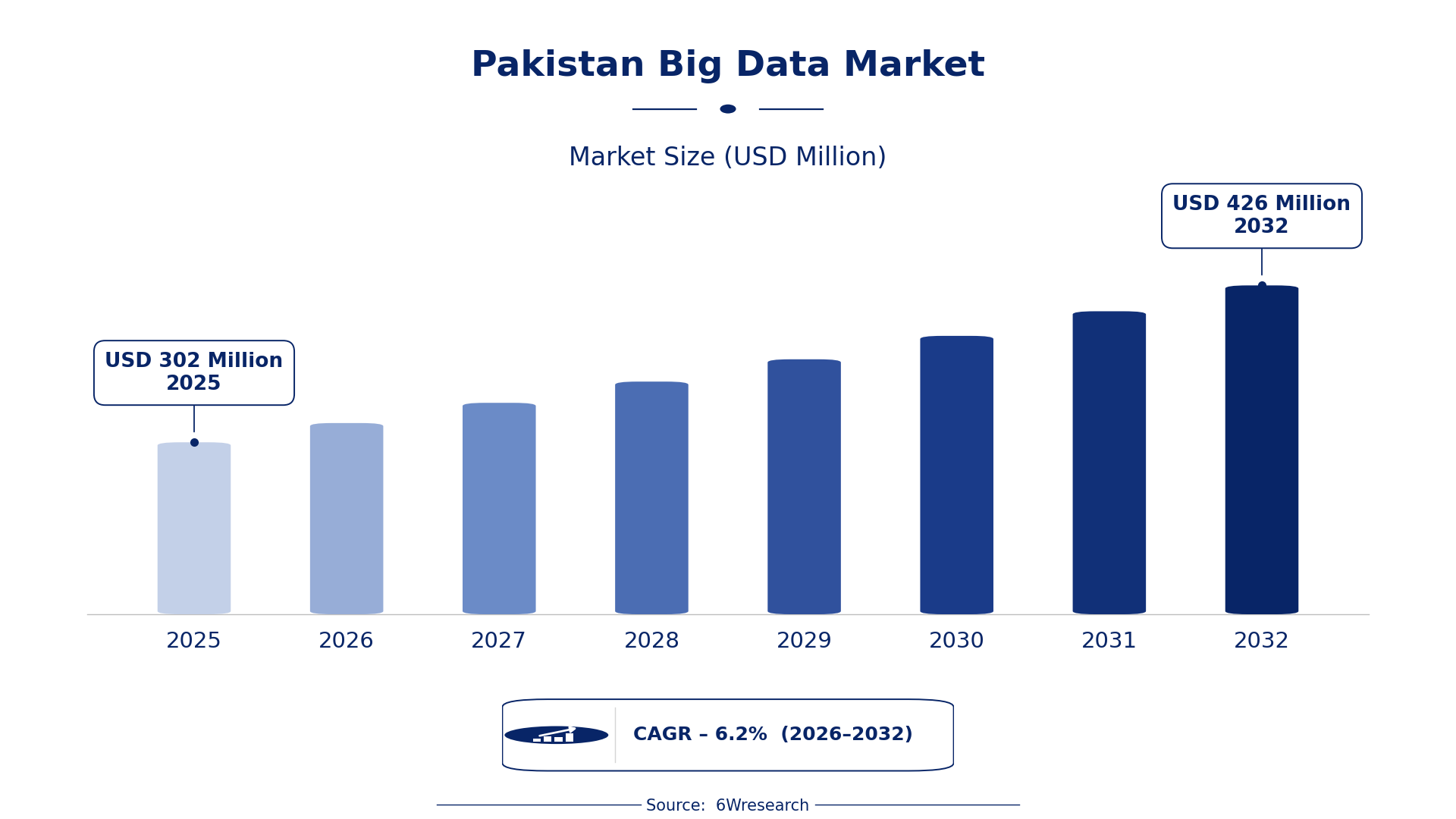
The Pakistan Big Data Market was estimated at USD 302 Million in 2025 and is projected to reach USD 426 Million by 2032, growing at a CAGR of 6.2% from 2026 to 2032.
Pakistan Big Data Market Synopsis
In recent years, the Pakistan Big Data market has seen a surge in interest, driven by the increasing need for data-driven decision-making across various sectors. As organizations recognize the potential of big data analytics, momentum has shifted from mere curiosity to proactive adoption, particularly in industries like banking and telecommunications.
Looking ahead, the market is set to expand further as technological advancements continue to reshape how businesses operate. With government backing and a growing emphasis on digital transformation, the demand for big data solutions is anticipated to escalate, presenting abundant opportunities for both local and international vendors.
Pakistan Big Data Market Year-wise Growth Rate and Key Drivers
This graph illustrates the annual growth rates of the Pakistan Big Data Market from 2021 to 2032, highlighting a steady upward trajectory and projected expansion over the forecast period.
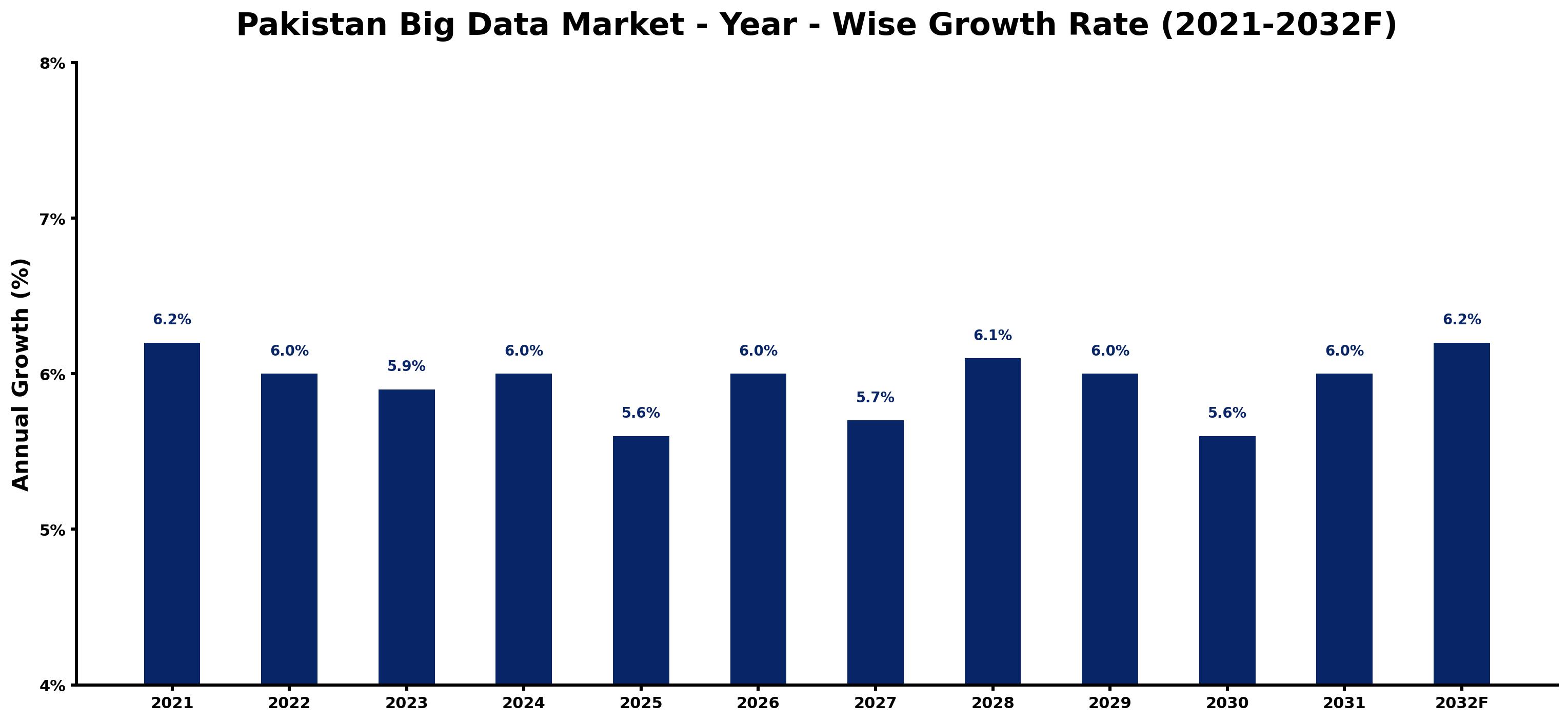
The table below presents the year‑wise growth rates along with the key drivers influencing the market
| Year | Growth Rate | Major Drivers |
| 2021 | 6.2% | Government's Digital Pakistan initiative boosting data utilization. |
| 2022 | 6.0% | Increased funding for IT and data analytics startups. |
| 2023 | 5.9% | Growing e-commerce sector driving demand for consumer insights. |
| 2024 | 6.0% | Adoption of big data in agriculture for yield enhancement. |
| 2025 | 5.6% | Increased digital literacy enhancing data analytics capabilities. |
| 2026 | 6.0% | Emergence of local data regulations supporting market growth. |
| 2027 | 5.7% | Collaboration between universities and tech firms on big data. |
| 2028 | 6.1% | Rise in fintech solutions requiring advanced data analytics. |
| 2029 | 6.0% | Government incentives for businesses adopting big data technologies. |
| 2030 | 5.6% | Improving internet penetration enabling data-driven initiatives. |
| 2031 | 6.0% | Increased investments in AI fueling big data applications. |
| 2032 | 6.2% | Local firms leveraging big data to enhance customer experience. |
Note: Market size estimations and growth projections presented in this report are based on 6Wresearch's proprietary forecasting methodology, utilizing the latest available industry data, government publications, and primary research inputs.
Pakistan Big Data Market Key Takeaways
Below are some of the specific key takeaways from the market, including:
- The market is rapidly evolving, fueled by heightened data analytics adoption across various sectors.
- Cloud-based solutions are increasingly favored for their scalability and cost-effectiveness.
- Government initiatives are playing a crucial role in fostering a conducive environment for big data growth.
- Challenges such as limited awareness and infrastructure gaps continue to hinder market potential.
- Emerging technologies, including AI and machine learning, are expected to drive future market dynamics.
Evaluation of Restraints in Pakistan Big Data Market
Despite the promising outlook, the Pakistan Big Data market faces notable constraints. A key issue is the lack of awareness among businesses regarding the advantages of big data technologies. Many organizations still operate under traditional decision-making frameworks, limiting the uptake of advanced analytics. Additionally, there’s a shortage of skilled professionals capable of interpreting complex data sets, which further slows progress.
Data privacy and security concerns present additional hurdles, as organizations grapple with the implications of mishandling sensitive information. on top of that, inadequate infrastructure for data storage and processing stifles potential growth. Addressing these challenges will require a concerted effort from both the private sector and government to enhance skills training, improve data governance, and cultivate a culture of data-driven decision-making.
Pakistan Big Data Market Trends
A few key trends are currently shaping the Pakistan Big Data market. First, there’s a noticeable shift towards cloud-based analytics solutions, driven by their flexibility and lower entry costs. Organizations are increasingly opting for Software as a Service (SaaS) models, allowing them to scale their data operations without hefty upfront investments.
Second, the integration of AI and machine learning into big data analytics is gaining traction. Businesses are leveraging these technologies to enhance customer experiences and optimize operations. Additionally, a growing focus on data governance and compliance will influence how organizations manage their data assets.
Pakistan Big Data Market Opportunities
There are several avenues for growth within the Pakistan Big Data market. The demand for advanced analytics tools tailored to specific industries presents a compelling opportunity for technology providers. on top of that, as businesses prioritize data governance and security, there’s a pressing need for solutions that address these concerns comprehensively.
Another key area for investment is in the development of local talent. By fostering educational initiatives aimed at upskilling professionals in data analytics, the industry can create a sustainable ecosystem. The government’s continued push for digital transformation will also support the expansion of big data solutions across various sectors.
Government Initiatives in the Pakistan Big Data Market
The Pakistani government recognizes the importance of big data in driving economic growth and innovation. Its policies are focused on enhancing digital infrastructure, promoting public-private partnerships, and establishing a regulatory framework that supports data utilization while ensuring privacy. This proactive approach is essential for encouraging businesses to invest in big data technologies.
- A national digital infrastructure upgrade programme, initiated recently, aims to enhance connectivity and data access across urban and rural areas.
- The National Center for Big Data and Cloud Computing has been established to facilitate research and innovation in big data technologies.
- Current initiatives are underway to develop regulations that ensure data protection and compliance with international standards.
- Future plans include launching digital literacy programs aimed at educating the workforce on data analytics and its applications.
- Ongoing public-private collaborations are focused on leveraging big data for improved public service delivery.
Future Insights of the Pakistan Big Data Market
Looking ahead, the Pakistan Big Data market is expected to flourish, driven by the increasing integration of advanced analytics and AI technologies across industries. Organizations will continue to seek data-driven insights to refine their business strategies and improve customer engagement. With the government's support and a shift towards a more data-centric culture, the market is well-positioned for robust growth through 2032.
Pakistan Big Data Market Latest Developments
Recent activity in the Pakistan Big Data market indicates a strong momentum as businesses and government agencies ramp up their data initiatives. The focus on enhancing data analytics capabilities has led to significant investments in technology and infrastructure. Companies are increasingly collaborating to innovate and address specific industry challenges.
- A major technology vendor launched a new big data analytics platform in Q1 2025, aimed at streamlining data processing for local enterprises.
- An initiative began in early 2025 to promote data literacy among high school students, preparing the next generation for careers in data analytics.
- In mid-2025, a regional operator announced a partnership with a leading analytics firm to enhance its data management services.
- Plans are underway for a national conference on big data innovation, expected to take place in late 2026, focusing on industry best practices.
Pakistan Big Data Market - Key Attractiveness of the Report
- 10 Years of Market Numbers
- Historical Data Starting from 2022 to 2025
- Base Year: 2025
- Forecast Data until 2032
- Key Performance Indicators Impacting the Market
- Major Upcoming Developments and Projects
Key Highlights of the Report:
- Pakistan Big Data Market Outlook
- Market Size of Pakistan Big Data Market, 2025
- Forecast of Pakistan Big Data Market, 2032
- Historical Data and Forecast of Pakistan Big Data Revenues & Volume for the Period 2022-2032F
- Pakistan Big Data Market Trend Evolution
- Pakistan Big Data Market Drivers and Challenges
- Pakistan Big Data Price Trends
- Pakistan Big Data Porter's Five Forces
- Pakistan Big Data Industry Life Cycle
- Historical Data and Forecast of Pakistan Big Data Market Revenues & Volume By Business Function for the Period 2022-2032F
- Historical Data and Forecast of Pakistan Big Data Market Revenues & Volume By Finance for the Period 2022-2032F
- Historical Data and Forecast of Pakistan Big Data Market Revenues & Volume By Marketing and Sales for the Period 2022-2032F
- Historical Data and Forecast of Pakistan Big Data Market Revenues & Volume By Human Resources for the Period 2022-2032F
- Historical Data and Forecast of Pakistan Big Data Market Revenues & Volume By Operations for the Period 2022-2032F
- Historical Data and Forecast of Pakistan Big Data Market Revenues & Volume By Industry Vertical for the Period 2022-2032F
- Historical Data and Forecast of Pakistan Big Data Market Revenues & Volume By BFSI for the Period 2022-2032F
- Historical Data and Forecast of Pakistan Big Data Market Revenues & Volume By Government and Defense for the Period 2022-2032F
- Historical Data and Forecast of Pakistan Big Data Market Revenues & Volume By Healthcare and Life Sciences for the Period 2022-2032F
- Historical Data and Forecast of Pakistan Big Data Market Revenues & Volume By Manufacturing for the Period 2022-2032F
- Historical Data and Forecast of Pakistan Big Data Market Revenues & Volume By Retail and Consumer Goods for the Period 2022-2032F
- Historical Data and Forecast of Pakistan Big Data Market Revenues & Volume By Media and Entertainment for the Period 2022-2032F
- Historical Data and Forecast of Pakistan Big Data Market Revenues & Volume By Telecommunications and IT for the Period 2022-2032F
- Historical Data and Forecast of Pakistan Big Data Market Revenues & Volume By Transportation and Logistics for the Period 2022-2032F
- Historical Data and Forecast of Pakistan Big Data Market Revenues & Volume By Component for the Period 2022-2032F
- Historical Data and Forecast of Pakistan Big Data Market Revenues & Volume By Solutions for the Period 2022-2032F
- Historical Data and Forecast of Pakistan Big Data Market Revenues & Volume By Big Data Analytics for the Period 2022-2032F
- Historical Data and Forecast of Pakistan Big Data Market Revenues & Volume By Data Discovery for the Period 2022-2032F
- Historical Data and Forecast of Pakistan Big Data Market Revenues & Volume By Data Visualization for the Period 2022-2032F
- Historical Data and Forecast of Pakistan Big Data Market Revenues & Volume By Data Management for the Period 2022-2032F
- Historical Data and Forecast of Pakistan Big Data Market Revenues & Volume By Services for the Period 2022-2032F
- Historical Data and Forecast of Pakistan Big Data Market Revenues & Volume By Deployment Mode for the Period 2022-2032F
- Historical Data and Forecast of Pakistan Big Data Market Revenues & Volume By Cloud for the Period 2022-2032F
- Historical Data and Forecast of Pakistan Big Data Market Revenues & Volume By Public Cloud for the Period 2022-2032F
- Historical Data and Forecast of Pakistan Big Data Market Revenues & Volume By Private Cloud for the Period 2022-2032F
- Historical Data and Forecast of Pakistan Big Data Market Revenues & Volume By Hybrid Cloud for the Period 2022-2032F
- Historical Data and Forecast of Pakistan Big Data Market Revenues & Volume By On-premises for the Period 2022-2032F
- Historical Data and Forecast of Pakistan Big Data Market Revenues & Volume By Organization Size for the Period 2022-2032F
- Historical Data and Forecast of Pakistan Big Data Market Revenues & Volume By Small and Medium-Sized Enterprises for the Period 2022-2032F
- Historical Data and Forecast of Pakistan Big Data Market Revenues & Volume By Large Enterprises for the Period 2022-2032F
- Pakistan Big Data Import Export Trade Statistics
- Market Opportunity Assessment By Business Function
- Market Opportunity Assessment By Industry Vertical
- Market Opportunity Assessment By Component
- Market Opportunity Assessment By Deployment Mode
- Market Opportunity Assessment By Organization Size
- Pakistan Big Data Top Companies Market Share
- Pakistan Big Data Competitive Benchmarking By Technical and Operational Parameters
- Pakistan Big Data Company Profiles
- Pakistan Big Data Key Strategic Recommendations






































