Pakistan Cellulose ethers Market Size Growth Rate
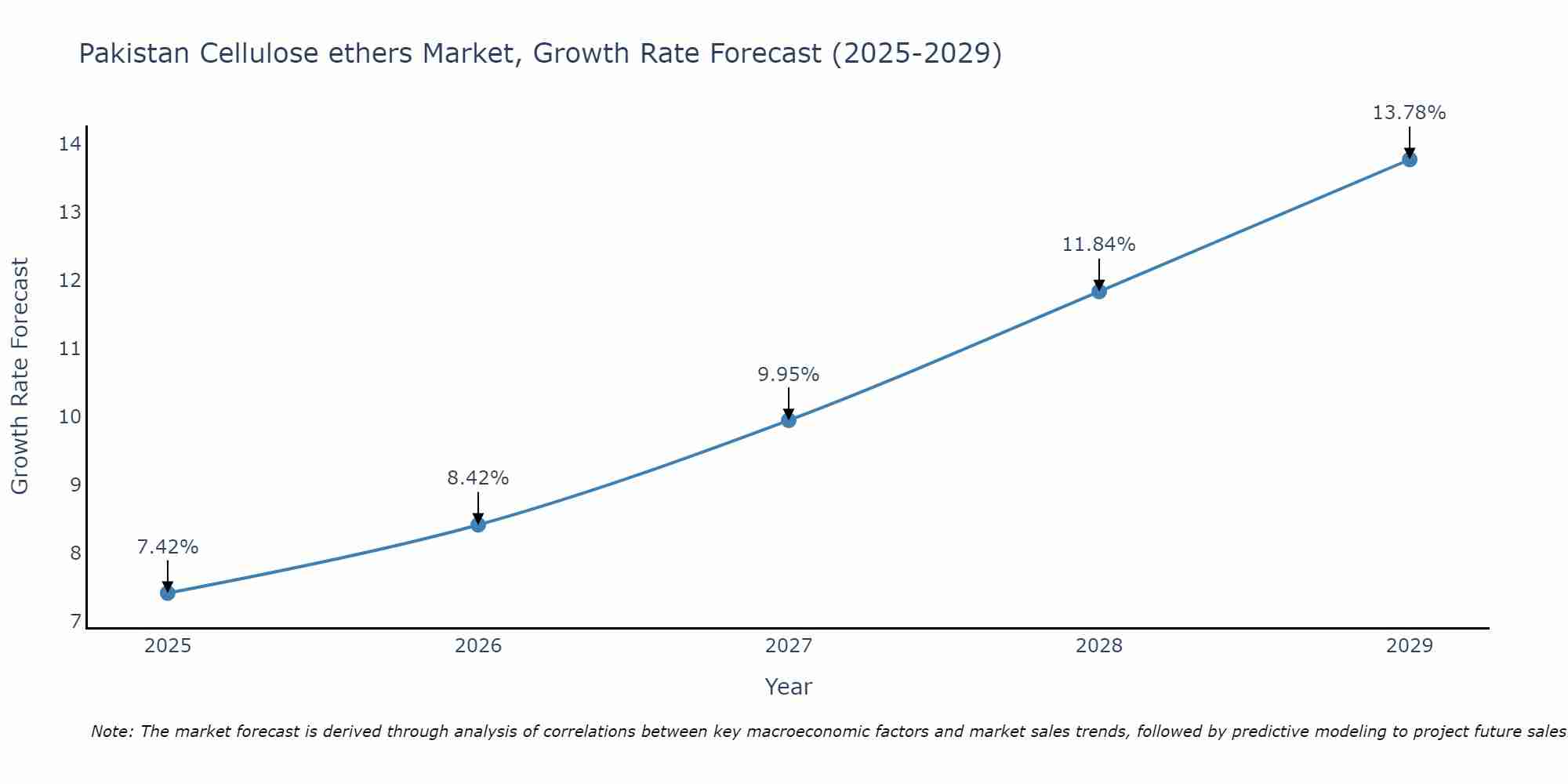
The Pakistan Cellulose ethers Market is likely to experience consistent growth rate gains over the period 2025 to 2029. The growth rate starts at 7.42% in 2025 and reaches 13.78% by 2029.
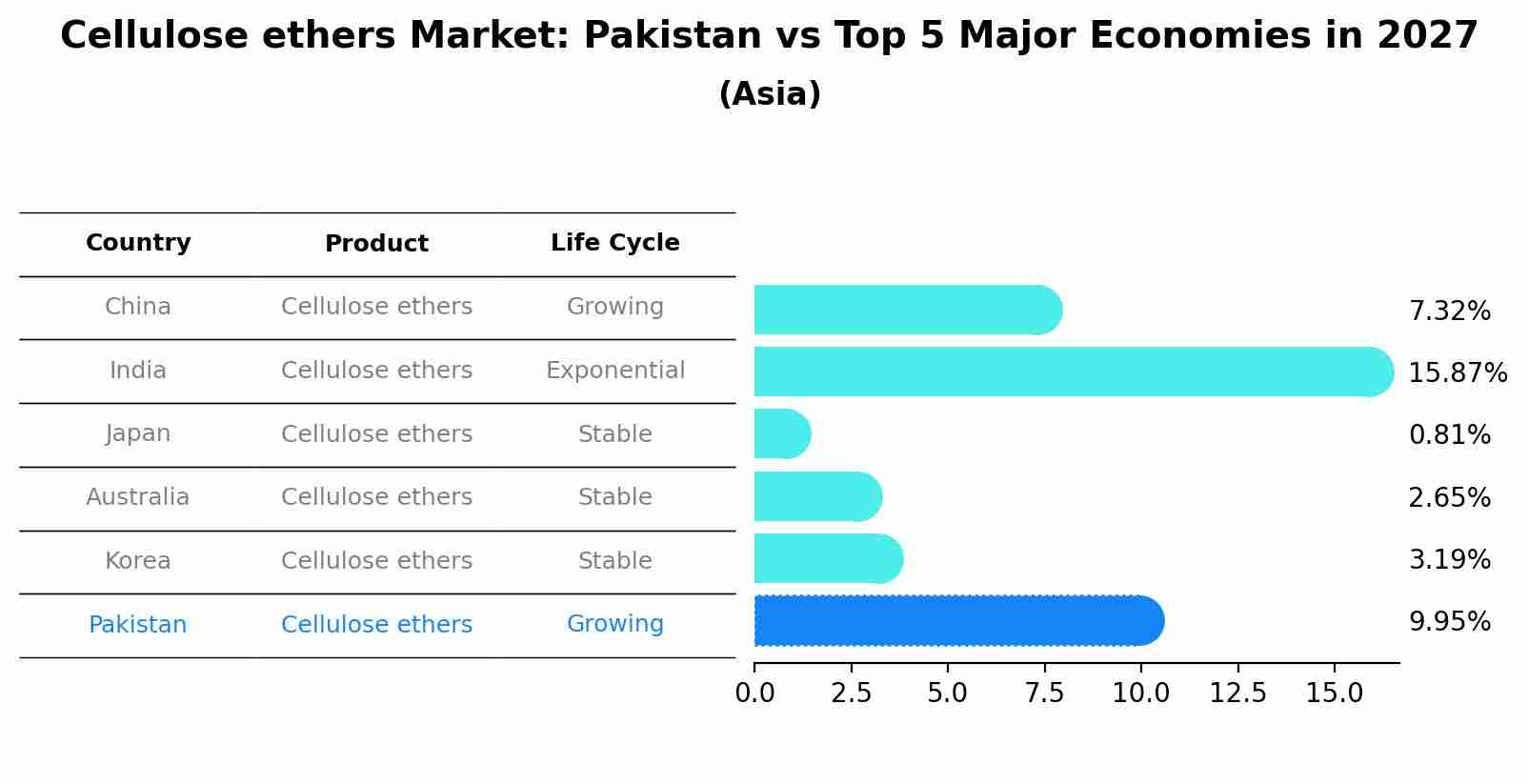
Cellulose ethers Market: Pakistan vs Top 5 Major Economies in 2027 (Asia)
In the Asia region, the Cellulose ethers market in Pakistan is projected to expand at a growing growth rate of 9.95% by 2027. The largest economy is China, followed by India, Japan, Australia and South Korea.
Pakistan Cellulose ethers Market Overview
The Pakistan cellulose ethers market is witnessing robust growth due to their extensive use as thickeners, stabilizers, and film formers in various industries including pharmaceuticals, construction, and personal care. Cellulose ethers offer advantages such as water retention, viscosity modification, and improved adhesion, driving their demand across diverse applications. Technological advancements in manufacturing processes are further propelling market expansion.
Drivers of the market
The Pakistan cellulose ethers market is experiencing growth due to the expanding construction and pharmaceutical industries. Cellulose ethers are widely used as thickeners, stabilizers, and film-forming agents in construction materials, personal care products, and pharmaceutical formulations. Increasing urbanization, infrastructure development, and the demand for environmentally friendly products are driving the market`s expansion.
Challenges of the market
The Pakistan cellulose ethers market is challenged by the need for advanced production technologies, quality consistency concerns, and regulatory compliance issues. Market growth is also hindered by the limited availability of raw materials and fluctuations in supply chain logistics.
Government Policy of the market
The government has formulated policies to support the growth of the cellulose ethers industry, which produces versatile and environmentally friendly materials used in various applications such as pharmaceuticals, construction, personal care, and food products. Initiatives such as tax incentives, subsidies, and research grants are provided to promote investment in manufacturing facilities, technology development, and product innovation. Additionally, regulations are in place to ensure the quality and safety of cellulose ether products, including standards for material purity, performance characteristics, and environmental impact. The government also fosters collaboration between industry stakeholders, research institutions, and end-users to address challenges and explore new opportunities in the cellulose ethers market.
Key Highlights of the Report:
- Pakistan Cellulose ethers Market Outlook
- Market Size of Pakistan Cellulose ethers Market, 2024
- Forecast of Pakistan Cellulose ethers Market, 2031
- Historical Data and Forecast of Pakistan Cellulose ethers Revenues & Volume for the Period 2021-2031
- Pakistan Cellulose ethers Market Trend Evolution
- Pakistan Cellulose ethers Market Drivers and Challenges
- Pakistan Cellulose ethers Price Trends
- Pakistan Cellulose ethers Porter's Five Forces
- Pakistan Cellulose ethers Industry Life Cycle
- Historical Data and Forecast of Pakistan Cellulose ethers Market Revenues & Volume By Product Type for the Period 2021-2031
- Historical Data and Forecast of Pakistan Cellulose ethers Market Revenues & Volume By Carboxymethyl Cellulose for the Period 2021-2031
- Historical Data and Forecast of Pakistan Cellulose ethers Market Revenues & Volume By Methyl Cellulose & Derivatives for the Period 2021-2031
- Historical Data and Forecast of Pakistan Cellulose ethers Market Revenues & Volume By Hydroxyethyl Cellulose for the Period 2021-2031
- Historical Data and Forecast of Pakistan Cellulose ethers Market Revenues & Volume By Others for the Period 2021-2031
- Historical Data and Forecast of Pakistan Cellulose ethers Market Revenues & Volume By Application for the Period 2021-2031
- Historical Data and Forecast of Pakistan Cellulose ethers Market Revenues & Volume By Food and Beverage for the Period 2021-2031
- Historical Data and Forecast of Pakistan Cellulose ethers Market Revenues & Volume By Pharmaceuticals and Healthcare for the Period 2021-2031
- Historical Data and Forecast of Pakistan Cellulose ethers Market Revenues & Volume By Construction for the Period 2021-2031
- Historical Data and Forecast of Pakistan Cellulose ethers Market Revenues & Volume By Cosmetics for the Period 2021-2031
- Historical Data and Forecast of Pakistan Cellulose ethers Market Revenues & Volume By Personal Care for the Period 2021-2031
- Historical Data and Forecast of Pakistan Cellulose ethers Market Revenues & Volume By Others for the Period 2021-2031
- Pakistan Cellulose ethers Import Export Trade Statistics
- Market Opportunity Assessment By Product Type
- Market Opportunity Assessment By Application
- Pakistan Cellulose ethers Top Companies Market Share
- Pakistan Cellulose ethers Competitive Benchmarking By Technical and Operational Parameters
- Pakistan Cellulose ethers Company Profiles
- Pakistan Cellulose ethers Key Strategic Recommendations






































