Pakistan Cloud Applications Market Size & Growth Rate (2026-2032)
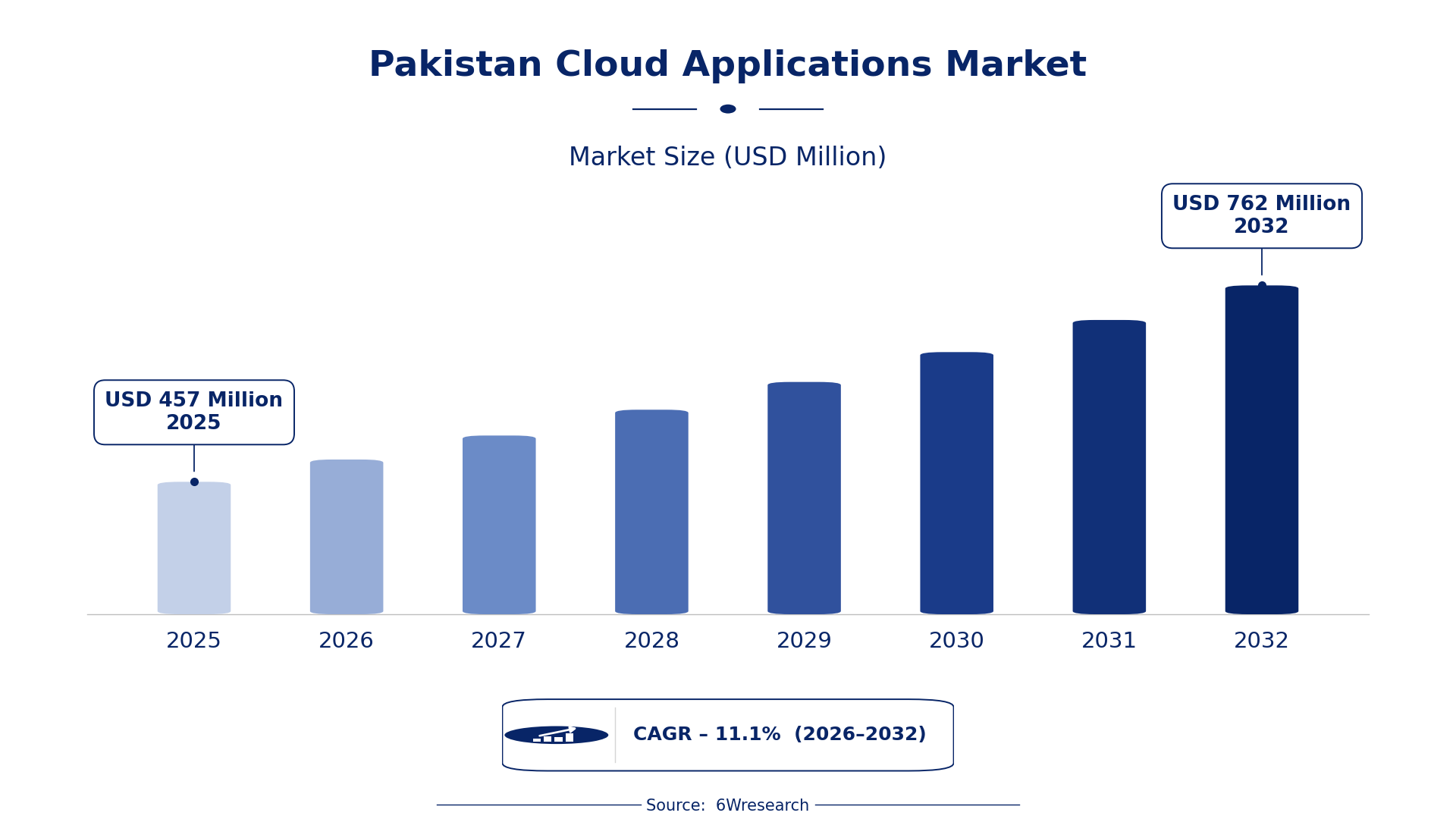
The Pakistan Cloud Applications Market was estimated at USD 457 Million in 2025 and is projected to reach USD 762 Million by 2032, growing at a CAGR of 11.1% from 2026 to 2032.
Pakistan Cloud Applications Market Synopsis
The Pakistan Cloud Applications Market has gained momentum as businesses increasingly recognize the value of cloud technologies. Organizations are making strides toward digital transformation, yet challenges persist in areas such as internet connectivity and technological expertise. These barriers are being addressed, albeit slowly, paving the way for broader cloud adoption.
As the demand for scalable and cost-effective solutions grows, the market is set to expand significantly. Companies are turning to cloud applications to streamline operations and enhance efficiency, particularly in the wake of shifting work paradigms that favor remote capabilities. The future looks promising, but the pace of change will depend on overcoming existing limitations.
Pakistan Cloud Applications Market Year-wise Growth Rate and Key Drivers
This graph illustrates the annual growth rates of the Pakistan Cloud Applications Market from 2021 to 2032, highlighting a steady upward trajectory and projected expansion over the forecast period.
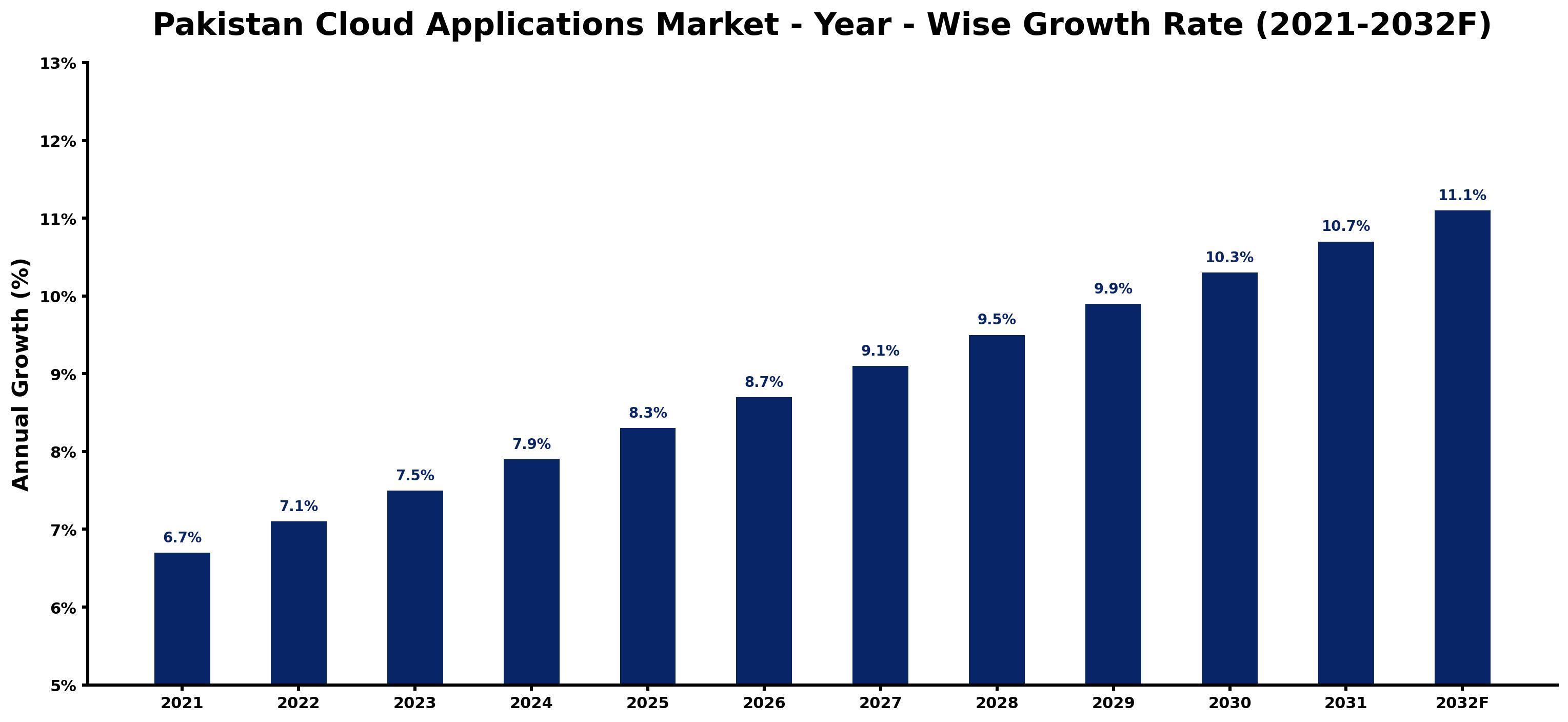
The table below presents the year‑wise growth rates along with the key drivers influencing the market
| Year | Growth Rate | Major Drivers |
| 2021 | 6.7% | Government's Digital Pakistan Initiative boosts cloud adoption. |
| 2022 | 7.1% | Growing e-commerce sector drives cloud application utilization. |
| 2023 | 7.5% | IT-specific tax incentives encourage local software development. |
| 2024 | 7.9% | Emerging startups rapidly integrate cloud solutions for scalability. |
| 2025 | 8.3% | Rising mobile app development fuels demand for cloud services. |
| 2026 | 8.7% | Increased cybersecurity regulations prompt migration to cloud platforms. |
| 2027 | 9.1% | Local universities enhance tech training focusing on cloud skills. |
| 2028 | 9.5% | Shift towards digital payment systems bolsters cloud usage. |
| 2029 | 9.9% | Enhanced broadband connectivity enables broader cloud application access. |
| 2030 | 10.3% | Growing SME sector increasingly adopts cloud-based solutions. |
| 2031 | 10.7% | Supportive government policies encourage cloud tech partnerships. |
| 2032 | 11.1% | Increasing awareness of cloud benefits among businesses drives growth. |
Note: Market size estimations and growth projections presented in this report are based on 6Wresearch's proprietary forecasting methodology, utilizing the latest available industry data, government publications, and primary research inputs.
Pakistan Cloud Applications Market Key Takeaways
Below are some of the specific key takeaways from the market, including:
- The increasing adoption of Software-as-a-Service (SaaS) models is a primary growth driver.
- Organizations are leveraging cloud applications to reduce IT infrastructure costs significantly.
- Government initiatives are actively promoting digital transformation in various sectors.
- Challenges remain, particularly in terms of internet penetration and resistance to new technologies.
- SMEs are particularly impacted by the high costs associated with advanced cloud solutions.
Evaluation of Restraints in Pakistan Cloud Applications Market
Several critical factors are holding back the growth of the Pakistan Cloud Applications Market. Limited internet penetration creates significant barriers to accessing cloud services effectively, often leading to unreliable performance. Additionally, the high costs associated with advanced cloud solutions make it difficult for small and medium-sized enterprises (SMEs) to adopt these technologies. Cultural resistance to new technology adoption and a lack of skilled workforce further exacerbate these challenges, hindering market progress.
Pakistan Cloud Applications Market Trends
A few key trends are shaping the demand for cloud applications in Pakistan. The shift towards remote work has accelerated the need for flexible cloud solutions that facilitate collaboration and productivity. on top of that, there is a growing emphasis on integrated platforms that combine various functionalities, such as ERP and CRM, into a single application. This trend is expected to continue as businesses look for ways to streamline operations and enhance user experience.
Pakistan Cloud Applications Market Opportunities
The potential for growth in the Pakistan Cloud Applications Market is substantial. Organizations are increasingly looking to invest in cloud technologies that offer scalability and cost efficiency. There is a notable opportunity for service providers to cater to SMEs by developing affordable cloud solutions. Additionally, as government initiatives promote digital literacy and infrastructure development, the market will likely attract new entrants and investments, further propelling its growth.
Government Initiatives in the Pakistan Cloud Applications Market
Government support is crucial for fostering a conducive environment for cloud adoption in Pakistan. Recent initiatives focus on enhancing digital infrastructure and creating policies that facilitate the transition to cloud-based solutions. These actions reflect a commitment to overcoming existing barriers and aligning with international standards.
- A national digital infrastructure upgrade program launched in early 2025 aims to improve internet connectivity across urban and rural areas.
- Currently ongoing is a regulatory framework initiative aimed at ensuring data privacy and compliance with international standards.
- Tax incentives for businesses adopting cloud solutions were introduced in 2026 to stimulate market growth.
- A planned public-private partnership is expected to expand access to cloud services for SMEs by 2028.
- The government is developing a comprehensive digital literacy program to enhance the technical skills of the workforce by 2027.
Future Insights of the Pakistan Cloud Applications Market
Looking ahead to 2026-2032, the Pakistan Cloud Applications Market is likely to see accelerated growth driven by increasing digital transformation efforts. Organizations will continue to seek innovative solutions to enhance operational efficiency, particularly as remote work becomes a permanent fixture. The convergence of various technologies, such as AI and machine learning with cloud applications, will create new opportunities for businesses to optimize their operations and better serve their customers.
Pakistan Cloud Applications Market Latest Developments
Recent activities in the Pakistan Cloud Applications Market reflect a proactive approach to overcoming existing challenges. Companies are launching new products and enhancing services to meet the growing demand for cloud solutions. The trend towards digital transformation is evident as organizations strive to remain competitive.
- A leading technology vendor introduced a new cloud-based ERP solution in Q1 2025, aimed at optimizing supply chain management for SMEs.
- An initiative that began in late 2025 and remains underway is focused on enhancing data security protocols for cloud applications.
- A partnership between telecom providers and cloud service companies was announced in early 2026 to improve service delivery in underserved regions.
- A rollout expected to begin in mid-2026 aims to integrate AI capabilities into existing cloud applications to enhance user experience.
- A major technology firm is planning a launch of a new cloud storage service in late 2026, targeting enterprises with high data volume needs.
Pakistan Cloud Applications Market - Key Attractiveness of the Report
- 10 Years of Market Numbers
- Historical Data Starting from 2022 to 2025
- Base Year: 2025
- Forecast Data until 2032
- Key Performance Indicators Impacting the Market
- Major Upcoming Developments and Projects
Key Highlights of the Report:
- Pakistan Cloud Applications Market Outlook
- Market Size of Pakistan Cloud Applications Market, 2025
- Forecast of Pakistan Cloud Applications Market, 2032
- Historical Data and Forecast of Pakistan Cloud Applications Revenues & Volume for the Period 2022-2032F
- Pakistan Cloud Applications Market Trend Evolution
- Pakistan Cloud Applications Market Drivers and Challenges
- Pakistan Cloud Applications Price Trends
- Pakistan Cloud Applications Porter's Five Forces
- Pakistan Cloud Applications Industry Life Cycle
- Historical Data and Forecast of Pakistan Cloud Applications Market Revenues & Volume By Application for the Period 2022-2032F
- Historical Data and Forecast of Pakistan Cloud Applications Market Revenues & Volume By ERP for the Period 2022-2032F
- Historical Data and Forecast of Pakistan Cloud Applications Market Revenues & Volume By CRM for the Period 2022-2032F
- Historical Data and Forecast of Pakistan Cloud Applications Market Revenues & Volume By HCM for the Period 2022-2032F
- Historical Data and Forecast of Pakistan Cloud Applications Market Revenues & Volume By SCM for the Period 2022-2032F
- Historical Data and Forecast of Pakistan Cloud Applications Market Revenues & Volume By Content Management for the Period 2022-2032F
- Historical Data and Forecast of Pakistan Cloud Applications Market Revenues & Volume By BI for the Period 2022-2032F
- Historical Data and Forecast of Pakistan Cloud Applications Market Revenues & Volume By Analytics for the Period 2022-2032F
- Historical Data and Forecast of Pakistan Cloud Applications Market Revenues & Volume By Vertical for the Period 2022-2032F
- Historical Data and Forecast of Pakistan Cloud Applications Market Revenues & Volume By Banking, Financial Services, and Insurance (BFSI) for the Period 2022-2032F
- Historical Data and Forecast of Pakistan Cloud Applications Market Revenues & Volume By Energy and Utilities for the Period 2022-2032F
- Historical Data and Forecast of Pakistan Cloud Applications Market Revenues & Volume By Government and Public Sector for the Period 2022-2032F
- Historical Data and Forecast of Pakistan Cloud Applications Market Revenues & Volume By Healthcare and Life Sciences for the Period 2022-2032F
- Historical Data and Forecast of Pakistan Cloud Applications Market Revenues & Volume By Manufacturing for the Period 2022-2032F
- Historical Data and Forecast of Pakistan Cloud Applications Market Revenues & Volume By Retail and Consumer Goods for the Period 2022-2032F
- Historical Data and Forecast of Pakistan Cloud Applications Market Revenues & Volume By Telecommunications for the Period 2022-2032F
- Historical Data and Forecast of Pakistan Cloud Applications Market Revenues & Volume By Transportation and Logistics for the Period 2022-2032F
- Historical Data and Forecast of Pakistan Cloud Applications Market Revenues & Volume By Organization Size for the Period 2022-2032F
- Historical Data and Forecast of Pakistan Cloud Applications Market Revenues & Volume By Small and Medium-sized Enterprises (SMEs) for the Period 2022-2032F
- Historical Data and Forecast of Pakistan Cloud Applications Market Revenues & Volume By Large Enterprises for the Period 2022-2032F
- Pakistan Cloud Applications Import Export Trade Statistics
- Market Opportunity Assessment By Application
- Market Opportunity Assessment By Vertical
- Market Opportunity Assessment By Organization Size
- Pakistan Cloud Applications Top Companies Market Share
- Pakistan Cloud Applications Competitive Benchmarking By Technical and Operational Parameters
- Pakistan Cloud Applications Company Profiles
- Pakistan Cloud Applications Key Strategic Recommendations






































