Global Cloud Applications Market Highlights
| Market Size (2025) | USD 168.9 Billion |
| Forecast Size (2032) | USD 374.5 Billion |
| CAGR | 17.60% |
| Base Year | 2025 |
| Forecast Period | 2026-2032 |
| Largest Region | North America |
| Fastest Growing Region | Asia |
| Largest Segment | Customer Relationship Management (CRM) |
| Fastest Growing Segment | Enterprise Resource Planning (ERP) |
| Leading Companies | Salesforce, SAP, Microsoft, Adobe, Oracle |
Global Cloud Applications Market Size & Growth Rate (2026-2032)
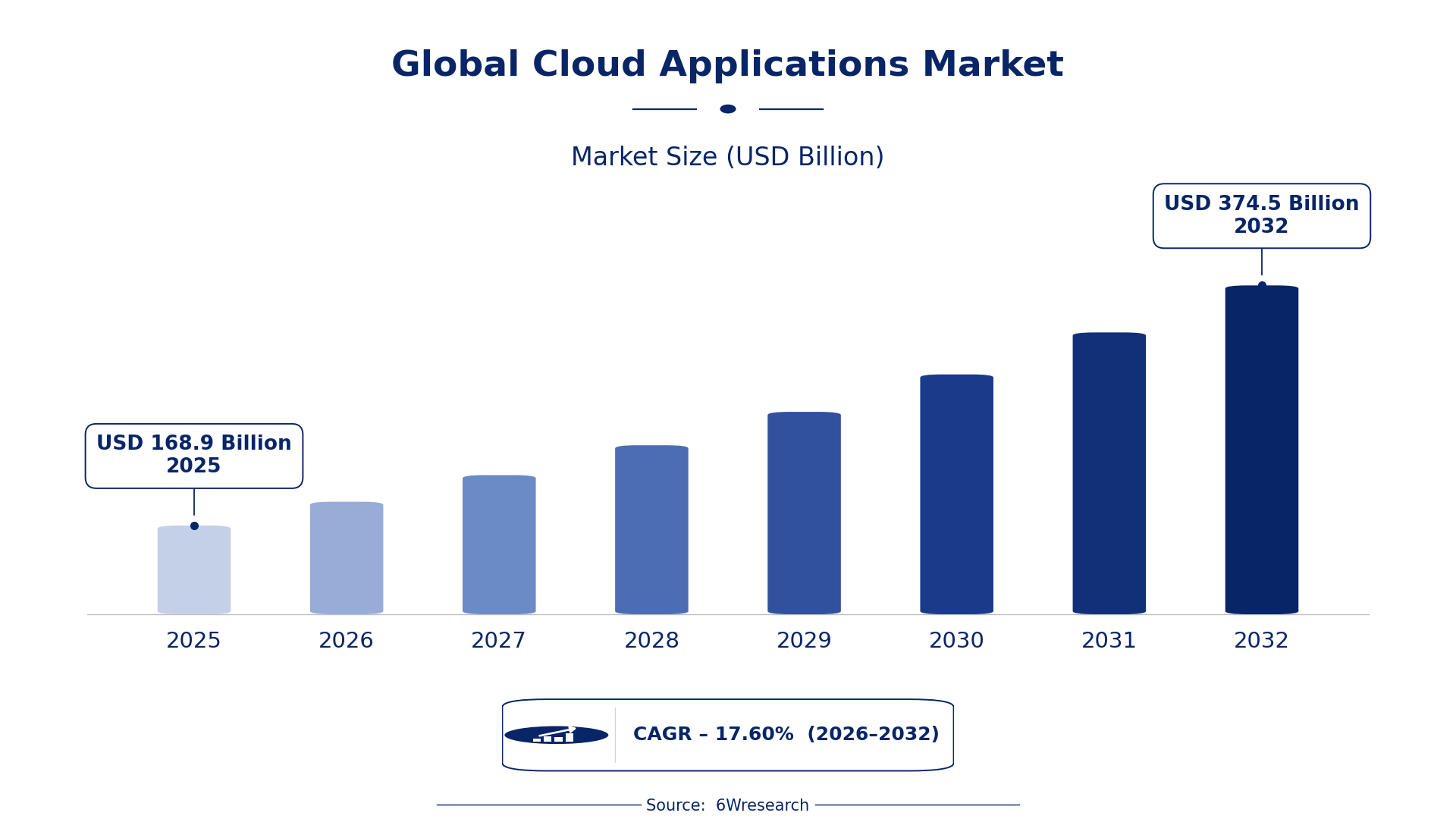
The Global Cloud Applications Market was estimated at USD 168.9 Billion in 2025 and is projected to reach USD 374.5 Billion by 2032, growing at a CAGR of 17.60% from 2026 to 2032.
Global Cloud Applications Market Synopsis
The Global Cloud Applications Market is currently undergoing a pivotal transformation. Companies in diverse sectors are increasingly opting for cloud-based solutions due to their cost efficiency and enhanced flexibility, shifting dynamics in both supply and demand. This transition is fueled by organizations prioritizing digital-first strategies, which allows for rapid scalability in response to market fluctuations.
A noteworthy characteristic of this market is the integration of advanced technologies, such as AI and machine learning, directly into cloud applications. Unlike adjacent markets, this sector stands out by not only providing operational advantages but also enhancing customer engagement and experience, thereby reshaping how enterprises interact with their users.
Global Cloud Applications Market Year-wise Growth Rate and Key Drivers
This graph illustrates the annual growth rates of the Global Cloud Applications Market from 2022 to 2032, highlighting a steady upward trajectory and projected expansion over the forecast period.
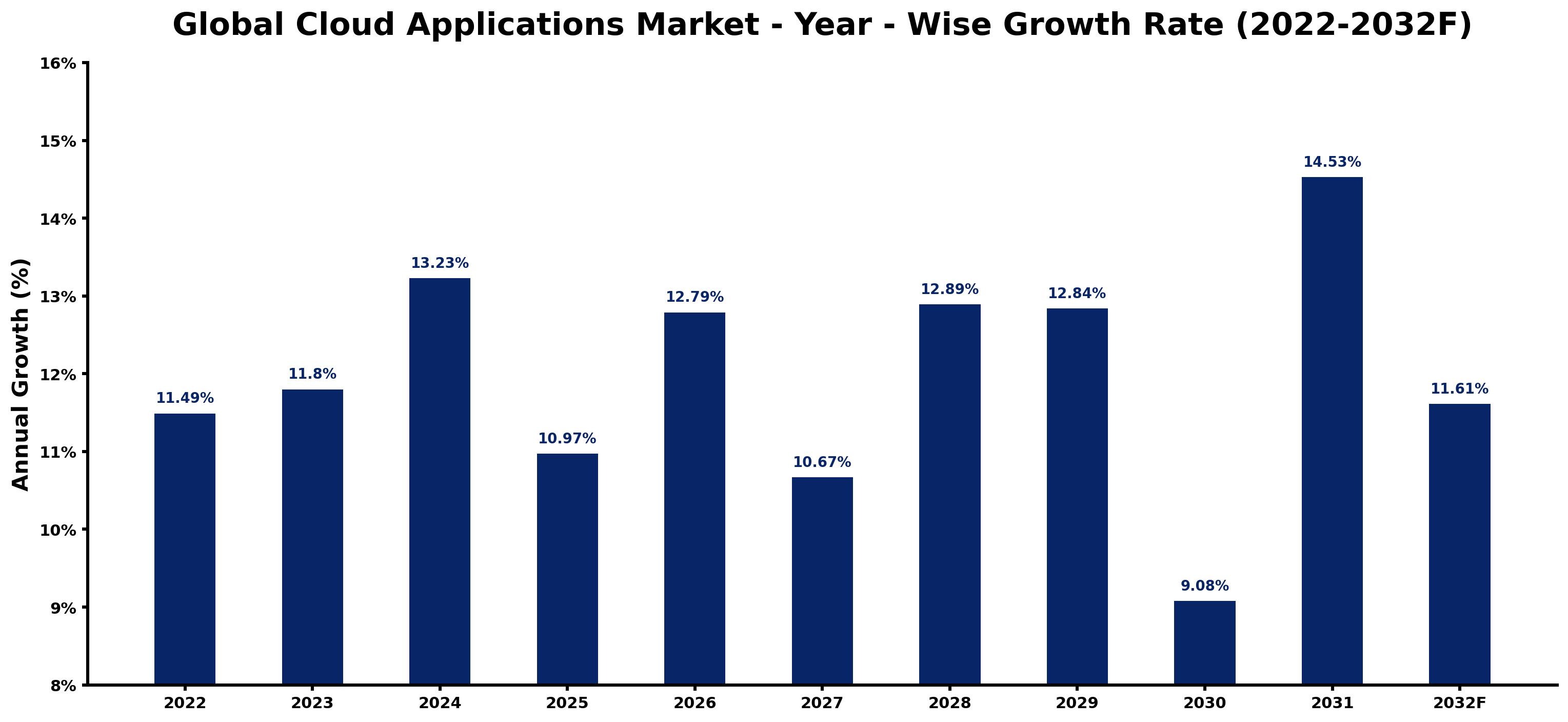
The table below presents the year‑wise growth rates along with the key drivers influencing the market
| Year | Growth Rate (%) | Major Drivers |
| 2022 | 11.49 | Telecom operators are expanding their cloud applications to reach new regional markets. |
| 2023 | 11.8 | Cloud service providers are engaging in mergers to enhance application offerings. |
| 2024 | 13.23 | Enterprises are increasingly adopting cloud applications to improve operational efficiency. |
| 2025 | 10.97 | A growing need for scalable cloud infrastructure is shaping user preferences significantly. |
| 2026 | 12.79 | A transition toward edge computing is changing cloud application deployment strategies. |
| 2027 | 10.67 | Investing in skilled labor enhances the development of innovative cloud applications. |
| 2028 | 12.89 | While data center costs remain volatile, cloud application growth persists in the sector. |
| 2029 | 12.84 | In the European region, sustainability initiatives are driving enhanced cloud application strategies. |
| 2030 | 9.08 | Regulatory changes in data protection are influencing cloud application compliance requirements. |
| 2031 | 14.53 | Artificial intelligence technologies are transforming cloud applications for enhanced analytics. |
| 2032 | 11.61 | Supply chain disruptions in tech components cause delays in cloud application rollouts. |
Note - Market size estimations and growth projections presented in this report are based on 6Wresearch's proprietary research methodology, combining internal industry data, secondary research, and primary validation, updated periodically to reflect current market conditions. As markets evolve rapidly, figures for certain industries may vary slightly and are intended as informed estimates rather than absolute figures. For the most current market sizing, we recommend validating figures with a 6Wresearch analyst.
Global Cloud Applications Market Key Takeaways
Below are some of the specific key takeaways from the market, including:
- By 2025, CRM applications are anticipated to command a share of nearly 31% within the market.
- In 2026, the ERP segment is expected to experience a CAGR of 20%, reflecting increased investments in integrated solutions.
- Salesforce reported a revenue of around USD 26.5 Billion in 2023, solidifying its position as a market leader.
- The Asia Pacific region is projected to drive approximately 45% of the market growth by 2032, indicating a significant geographical shift.
Evaluation of Restraints in Global Cloud Applications Market
Despite robust growth, the Global Cloud Applications Market faces specific challenges that hinder faster adoption. For instance, data security remains a pressing concern; organizations typically allocate up to 30% of their IT budgets on preventing cyber threats. Furthermore, the complexity of integrating new cloud solutions with existing legacy systems can lead to noticeable project delays and increased costs. For example, a survey indicated that 62% of companies experience significant delays due to integration challenges, which adversely impacts their cloud adoption journey.
Global Cloud Applications Market Trends
Several defining trends are shaping the Global Cloud Applications Market today. A significant move towards Software as a Service (SaaS) models has emerged, with companies like Adobe leading the charge, demonstrating a shift in software delivery methods. In fact, Adobe's cloud services revenue reached approximately USD 14 Billion in 2023, showcasing the adoption of subscription-based access.
Increasingly, organizations are integrating AI capabilities into their cloud applications. Notably, in 2023, Oracle launched an AI-enhanced ERP solution aimed at improving operational efficiency. Additionally, the pursuit of hybrid cloud environments is gaining traction as businesses seek agility and resilience amid market fluctuations. A report states that 70% of enterprises are redirecting their IT strategies to incorporate hybrid cloud functionalities, indicating a significant operational shift.
Global Cloud Applications Market Opportunities
The Global Cloud Applications Market is ripe with opportunities that forward-thinking companies can capitalize on. The expansion into emerging markets such as India and Brazil becomes increasingly attractive as these regions demonstrate surging demands for cloud-based solutions. For instance, Microsoft has expressed intentions to invest approximately USD 15 Billion toward developing cloud infrastructure in India by 2025.
Moreover, the rise of industry-specific applications presents a lucrative avenue. Companies are actively working on tailored solutions in health care and finance sectors. For example, SAP is focusing on developing cloud applications for the healthcare sector, with projected revenues targeting the USD 5 Billion mark by 2025, addressing the unique needs of this vertical in the cloud space.
Global Cloud Applications Market by Application
In the Global Cloud Applications Market, Customer Relationship Management (CRM) applications dominate, holding approximately 31% share in 2025. Meanwhile, Enterprise Resource Planning (ERP) applications are emerging as the fastest-growing segment, expected to achieve a CAGR of 20% from 2026 to 2032. This preference for CRM is due to its crucial role in enhancing customer engagement and supporting sales processes, while the burgeoning ERP segment reflects the increasing demand for integrated solutions that streamline operations across different departments.
Global Cloud Applications Market by Vertical
Within the Global Cloud Applications Market, Banking, Financial Services, and Insurance (BFSI) command the largest share, estimated at around 25% in 2025. Conversely, the healthcare segment is forecasted to be the fastest-growing, with an impressive CAGR of 22% from 2026 to 2032. The BFSI sector's leading position is attributed to the increasing reliance on cloud solutions for regulatory compliance and customer service, while the healthcare segment’s rapid growth is driven by the urgent need for data management and patient engagement solutions.
Global Cloud Applications Market by Organization Size
In terms of organization size, Small and Medium-sized Enterprises (SMEs) hold the largest share of the Global Cloud Applications Market, accounting for about 45% in 2025. In contrast, large enterprises represent the fastest-growing segment, projected to achieve a CAGR of 19% from 2026 to 2032. The substantial share held by SMEs is driven by their need for cost-effective and scalable solutions, whereas, large enterprises are increasingly adopting advanced cloud applications for enhanced operational efficiency and data analytics capabilities.
Global Cloud Applications Market by Region
North America remains the leading region in the Global Cloud Applications Market, holding an estimated 40% share in 2025. However, the Asia region is expected to be the fastest-growing, with a CAGR of 23% from 2026 to 2032. This surge in the Asian market is facilitated by increasing digital transformation efforts, significant investments in cloud infrastructure, and a growing number of technology startups, which collectively indicate a rising trend in cloud applications adoption across various sectors.
Government Initiatives in the Global Cloud Applications Market
The regulatory landscape surrounding the Global Cloud Applications Market is intensifying as governments recognize the necessity for robust cloud infrastructure. Various initiatives aim to bolster this growth, targeting specific sectors while fostering innovation and compliance. These governmental actions are designed to enhance the competitiveness of local firms in the increasingly global cloud market.
- U.S. Department of Commerce, “Cloud Adoption Strategy”, March 2022 - This initiative provides funding of up to USD 10 million to small businesses adopting cloud solutions, enhancing their technological capabilities.
- European Commission, “Digital Europe Programme”, September 2021 - This program allocates EUR 1 billion to promote cloud services among public administrations and SMEs, improving digital public services.
- Indian Ministry of Electronics and Information Technology, “Cloud Infrastructure Policy”, January 2023 - This upcoming policy aims to establish a regulatory framework for cloud services by 2025, fostering growth in the sector.
- Canadian Government, “Accelerated Digital Adoption Program”, August 2021 - This initiative offers CAD 1.5 billion to support companies transitioning to digital platforms, including cloud services, thereby enhancing their digital infrastructure.
Future Insights of the Global Cloud Applications Market
The Global Cloud Applications Market is set to undergo transformative shifts influenced by rising demand for industry-specific applications and increased emphasis on data security. By 2032, investments in hybrid cloud environments are projected to surpass USD 100 billion, indicating a strategic pivot among enterprises toward optimizing flexibility while maintaining compliance. Major players like Microsoft are actively enhancing solution capabilities to adapt to regulatory changes, creating differentiated offerings that strengthen their competitive position in emerging markets.
Global Cloud Applications Market Latest Developments
Recent advancements within the Global Cloud Applications Market highlight significant actions taken by leading companies aiming to solidify their market positioning and enhance technology adoption.
- In July 2023, Salesforce launched a new AI-driven customer service platform, enhancing response times and customer engagement, thereby consolidating its market leadership.
- SAP announced in August 2023 its expansion of cloud services into the Asia Pacific region, aiming to capture the growing demand for ERP solutions that integrate with local regulations.
- Microsoft is currently scaling its Azure cloud application offerings with a strategic emphasis on security features, responding to heightened concerns among enterprises regarding data protection.
- Oracle recently completed the rollout of its advanced cloud infrastructure in Europe, which supports high-capacity computing needs for enterprises focused on data analytics and compliance.
Global Cloud Applications Market Key Players and Industry Positioning
The Global Cloud Applications Market exhibits a fragmented competitive structure with several key players jockeying for market share through differentiated strategies. Companies are investing in tailored offerings to meet sector-specific needs while striving to enhance customer satisfaction and operational efficiencies.
| Leading Company | Core Strength | Strategic Focus |
|---|---|---|
| Salesforce | Leader in CRM solutions | Expanding AI capabilities |
| SAP | Stronghold in ERP solutions | Focus on integrating regional compliance |
| Microsoft | Robust cloud infrastructure | Emphasis on hybrid cloud strategies |
| Adobe | Innovative marketing cloud services | Enhancing creative application offerings |
| Oracle | Strong data analytics capabilities | Investing in AI and compliance solutions |
As competition intensifies, successful players will not only focus on expanding their technological capabilities but also seek to foster partnerships that enhance their value propositions, thereby driving further market growth.
Key Attractiveness of the Report
- 10 Years of Market Numbers
- Historical Data Starting from 2022 to 2025
- Base Year: 2025
- Forecast Data until 2032
- Key Performance Indicators Impacting the Market
- Major Upcoming Developments and Projects
Key Highlights of the Report:
- Global Cloud Applications Market Outlook
- Market Size of Global Cloud Applications Market, 2025
- Forecast of Global Cloud Applications Market, 2032
- Historical Data and Forecast of Global Cloud Applications Revenues & Volume for the Period 2022-2032
- Global Cloud Applications Market Trend Evolution
- Global Cloud Applications Market Drivers and Challenges
- Global Cloud Applications Price Trends
- Global Cloud Applications Porter's Five Forces
- Global Cloud Applications Industry Life Cycle
- Historical Data and Forecast of Global Cloud Applications Market Revenues & Volume
- Historical Data and Forecast of Global Cloud Applications Market Revenues & Volume By Application for the Period 2022-2032
- Historical Data and Forecast of Global Cloud Applications Market Revenues & Volume By ERP for the Period 2022-2032
- Historical Data and Forecast of Global Cloud Applications Market Revenues & Volume By CRM for the Period 2022-2032
- Historical Data and Forecast of Global Cloud Applications Market Revenues & Volume By HCM for the Period 2022-2032
- Historical Data and Forecast of Global Cloud Applications Market Revenues & Volume By SCM for the Period 2022-2032
- Historical Data and Forecast of Global Cloud Applications Market Revenues & Volume By Content Management for the Period 2022-2032
- Historical Data and Forecast of Global Cloud Applications Market Revenues & Volume By BI for the Period 2022-2032
- Historical Data and Forecast of Global Cloud Applications Market Revenues & Volume By Analytics for the Period 2022-2032
- Historical Data and Forecast of Global Cloud Applications Market Revenues & Volume By Vertical for the Period 2022-2032
- Historical Data and Forecast of Global Cloud Applications Market Revenues & Volume By Banking, Financial Services, and Insurance (BFSI) for the Period 2022-2032
- Historical Data and Forecast of Global Cloud Applications Market Revenues & Volume By Energy and Utilities for the Period 2022-2032
- Historical Data and Forecast of Global Cloud Applications Market Revenues & Volume By Government and Public Sector for the Period 2022-2032
- Historical Data and Forecast of Global Cloud Applications Market Revenues & Volume By Healthcare and Life Sciences for the Period 2022-2032
- Historical Data and Forecast of Global Cloud Applications Market Revenues & Volume By Manufacturing for the Period 2022-2032
- Historical Data and Forecast of Global Cloud Applications Market Revenues & Volume By Retail and Consumer Goods for the Period 2022-2032
- Historical Data and Forecast of Global Cloud Applications Market Revenues & Volume By Telecommunications for the Period 2022-2032
- Historical Data and Forecast of Global Banking, Financial Services, and Insurance (BFSI) Cloud Applications Market Revenues & Volume By Transportation and Logistics for the Period 2022-2032
- Historical Data and Forecast of Global Cloud Applications Market Revenues & Volume By Organization Size for the Period 2022-2032
- Historical Data and Forecast of Global Cloud Applications Market Revenues & Volume By Small and Medium-sized Enterprises (SMEs) for the Period 2022-2032
- Historical Data and Forecast of Global Cloud Applications Market Revenues & Volume By Large Enterprises for the Period 2022-2032
- Historical Data and Forecast of North America Cloud Applications Market Revenues & Volume By Application for the Period 2022-2032
- Historical Data and Forecast of North America Cloud Applications Market Revenues & Volume By ERP for the Period 2022-2032
- Historical Data and Forecast of North America Cloud Applications Market Revenues & Volume By CRM for the Period 2022-2032
- Historical Data and Forecast of North America Cloud Applications Market Revenues & Volume By HCM for the Period 2022-2032
- Historical Data and Forecast of North America Cloud Applications Market Revenues & Volume By SCM for the Period 2022-2032
- Historical Data and Forecast of North America Cloud Applications Market Revenues & Volume By Content Management for the Period 2022-2032
- Historical Data and Forecast of North America Cloud Applications Market Revenues & Volume By BI for the Period 2022-2032
- Historical Data and Forecast of North America Cloud Applications Market Revenues & Volume By Analytics for the Period 2022-2032
- Historical Data and Forecast of North America Cloud Applications Market Revenues & Volume By Vertical for the Period 2022-2032
- Historical Data and Forecast of North America Cloud Applications Market Revenues & Volume By Banking, Financial Services, and Insurance (BFSI) for the Period 2022-2032
- Historical Data and Forecast of North America Cloud Applications Market Revenues & Volume By Energy and Utilities for the Period 2022-2032
- Historical Data and Forecast of North America Cloud Applications Market Revenues & Volume By Government and Public Sector for the Period 2022-2032
- Historical Data and Forecast of North America Cloud Applications Market Revenues & Volume By Healthcare and Life Sciences for the Period 2022-2032
- Historical Data and Forecast of North America Cloud Applications Market Revenues & Volume By Manufacturing for the Period 2022-2032
- Historical Data and Forecast of North America Cloud Applications Market Revenues & Volume By Retail and Consumer Goods for the Period 2022-2032
- Historical Data and Forecast of North America Cloud Applications Market Revenues & Volume By Telecommunications for the Period 2022-2032
- Historical Data and Forecast of North America Banking, Financial Services, and Insurance (BFSI) Cloud Applications Market Revenues & Volume By Transportation and Logistics for the Period 2022-2032
- Historical Data and Forecast of North America Cloud Applications Market Revenues & Volume By Organization Size for the Period 2022-2032
- Historical Data and Forecast of North America Cloud Applications Market Revenues & Volume By Small and Medium-sized Enterprises (SMEs) for the Period 2022-2032
- Historical Data and Forecast of North America Cloud Applications Market Revenues & Volume By Large Enterprises for the Period 2022-2032
- Historical Data and Forecast of United States of America Cloud Applications Market Revenues & Volume for the Period 2022-2032
- Historical Data and Forecast of Canada Cloud Applications Market Revenues & Volume for the Period 2022-2032
- Historical Data and Forecast of Rest of North America Cloud Applications Market Revenues & Volume for the Period 2022-2032
- Historical Data and Forecast of Latin America (LATAM) Cloud Applications Market Revenues & Volume By Application for the Period 2022-2032
- Historical Data and Forecast of Latin America (LATAM) Cloud Applications Market Revenues & Volume By ERP for the Period 2022-2032
- Historical Data and Forecast of Latin America (LATAM) Cloud Applications Market Revenues & Volume By CRM for the Period 2022-2032
- Historical Data and Forecast of Latin America (LATAM) Cloud Applications Market Revenues & Volume By HCM for the Period 2022-2032
- Historical Data and Forecast of Latin America (LATAM) Cloud Applications Market Revenues & Volume By SCM for the Period 2022-2032
- Historical Data and Forecast of Latin America (LATAM) Cloud Applications Market Revenues & Volume By Content Management for the Period 2022-2032
- Historical Data and Forecast of Latin America (LATAM) Cloud Applications Market Revenues & Volume By BI for the Period 2022-2032
- Historical Data and Forecast of Latin America (LATAM) Cloud Applications Market Revenues & Volume By Analytics for the Period 2022-2032
- Historical Data and Forecast of Latin America (LATAM) Cloud Applications Market Revenues & Volume By Vertical for the Period 2022-2032
- Historical Data and Forecast of Latin America (LATAM) Cloud Applications Market Revenues & Volume By Banking, Financial Services, and Insurance (BFSI) for the Period 2022-2032
- Historical Data and Forecast of Latin America (LATAM) Cloud Applications Market Revenues & Volume By Energy and Utilities for the Period 2022-2032
- Historical Data and Forecast of Latin America (LATAM) Cloud Applications Market Revenues & Volume By Government and Public Sector for the Period 2022-2032
- Historical Data and Forecast of Latin America (LATAM) Cloud Applications Market Revenues & Volume By Healthcare and Life Sciences for the Period 2022-2032
- Historical Data and Forecast of Latin America (LATAM) Cloud Applications Market Revenues & Volume By Manufacturing for the Period 2022-2032
- Historical Data and Forecast of Latin America (LATAM) Cloud Applications Market Revenues & Volume By Retail and Consumer Goods for the Period 2022-2032
- Historical Data and Forecast of Latin America (LATAM) Cloud Applications Market Revenues & Volume By Telecommunications for the Period 2022-2032
- Historical Data and Forecast of Latin America (LATAM) Banking, Financial Services, and Insurance (BFSI) Cloud Applications Market Revenues & Volume By Transportation and Logistics for the Period 2022-2032
- Historical Data and Forecast of Latin America (LATAM) Cloud Applications Market Revenues & Volume By Organization Size for the Period 2022-2032
- Historical Data and Forecast of Latin America (LATAM) Cloud Applications Market Revenues & Volume By Small and Medium-sized Enterprises (SMEs) for the Period 2022-2032
- Historical Data and Forecast of Latin America (LATAM) Cloud Applications Market Revenues & Volume By Large Enterprises for the Period 2022-2032
- Historical Data and Forecast of Brazil Cloud Applications Market Revenues & Volume for the Period 2022-2032
- Historical Data and Forecast of Mexico Cloud Applications Market Revenues & Volume for the Period 2022-2032
- Historical Data and Forecast of Argentina Cloud Applications Market Revenues & Volume for the Period 2022-2032
- Historical Data and Forecast of Rest of LATAM Cloud Applications Market Revenues & Volume for the Period 2022-2032
- Historical Data and Forecast of Asia Cloud Applications Market Revenues & Volume By Application for the Period 2022-2032
- Historical Data and Forecast of Asia Cloud Applications Market Revenues & Volume By ERP for the Period 2022-2032
- Historical Data and Forecast of Asia Cloud Applications Market Revenues & Volume By CRM for the Period 2022-2032
- Historical Data and Forecast of Asia Cloud Applications Market Revenues & Volume By HCM for the Period 2022-2032
- Historical Data and Forecast of Asia Cloud Applications Market Revenues & Volume By SCM for the Period 2022-2032
- Historical Data and Forecast of Asia Cloud Applications Market Revenues & Volume By Content Management for the Period 2022-2032
- Historical Data and Forecast of Asia Cloud Applications Market Revenues & Volume By BI for the Period 2022-2032
- Historical Data and Forecast of Asia Cloud Applications Market Revenues & Volume By Analytics for the Period 2022-2032
- Historical Data and Forecast of Asia Cloud Applications Market Revenues & Volume By Vertical for the Period 2022-2032
- Historical Data and Forecast of Asia Cloud Applications Market Revenues & Volume By Banking, Financial Services, and Insurance (BFSI) for the Period 2022-2032
- Historical Data and Forecast of Asia Cloud Applications Market Revenues & Volume By Energy and Utilities for the Period 2022-2032
- Historical Data and Forecast of Asia Cloud Applications Market Revenues & Volume By Government and Public Sector for the Period 2022-2032
- Historical Data and Forecast of Asia Cloud Applications Market Revenues & Volume By Healthcare and Life Sciences for the Period 2022-2032
- Historical Data and Forecast of Asia Cloud Applications Market Revenues & Volume By Manufacturing for the Period 2022-2032
- Historical Data and Forecast of Asia Cloud Applications Market Revenues & Volume By Retail and Consumer Goods for the Period 2022-2032
- Historical Data and Forecast of Asia Cloud Applications Market Revenues & Volume By Telecommunications for the Period 2022-2032
- Historical Data and Forecast of Asia Banking, Financial Services, and Insurance (BFSI) Cloud Applications Market Revenues & Volume By Transportation and Logistics for the Period 2022-2032
- Historical Data and Forecast of Asia Cloud Applications Market Revenues & Volume By Organization Size for the Period 2022-2032
- Historical Data and Forecast of Asia Cloud Applications Market Revenues & Volume By Small and Medium-sized Enterprises (SMEs) for the Period 2022-2032
- Historical Data and Forecast of Asia Cloud Applications Market Revenues & Volume By Large Enterprises for the Period 2022-2032
- Historical Data and Forecast of China Cloud Applications Market Revenues & Volume for the Period 2022-2032
- Historical Data and Forecast of India Cloud Applications Market Revenues & Volume for the Period 2022-2032
- Historical Data and Forecast of Japan Cloud Applications Market Revenues & Volume for the Period 2022-2032
- Historical Data and Forecast of Rest of Asia Cloud Applications Market Revenues & Volume for the Period 2022-2032
- Historical Data and Forecast of Africa Cloud Applications Market Revenues & Volume By Application for the Period 2022-2032
- Historical Data and Forecast of Africa Cloud Applications Market Revenues & Volume By ERP for the Period 2022-2032
- Historical Data and Forecast of Africa Cloud Applications Market Revenues & Volume By CRM for the Period 2022-2032
- Historical Data and Forecast of Africa Cloud Applications Market Revenues & Volume By HCM for the Period 2022-2032
- Historical Data and Forecast of Africa Cloud Applications Market Revenues & Volume By SCM for the Period 2022-2032
- Historical Data and Forecast of Africa Cloud Applications Market Revenues & Volume By Content Management for the Period 2022-2032
- Historical Data and Forecast of Africa Cloud Applications Market Revenues & Volume By BI for the Period 2022-2032
- Historical Data and Forecast of Africa Cloud Applications Market Revenues & Volume By Analytics for the Period 2022-2032
- Historical Data and Forecast of Africa Cloud Applications Market Revenues & Volume By Vertical for the Period 2022-2032
- Historical Data and Forecast of Africa Cloud Applications Market Revenues & Volume By Banking, Financial Services, and Insurance (BFSI) for the Period 2022-2032
- Historical Data and Forecast of Africa Cloud Applications Market Revenues & Volume By Energy and Utilities for the Period 2022-2032
- Historical Data and Forecast of Africa Cloud Applications Market Revenues & Volume By Government and Public Sector for the Period 2022-2032
- Historical Data and Forecast of Africa Cloud Applications Market Revenues & Volume By Healthcare and Life Sciences for the Period 2022-2032
- Historical Data and Forecast of Africa Cloud Applications Market Revenues & Volume By Manufacturing for the Period 2022-2032
- Historical Data and Forecast of Africa Cloud Applications Market Revenues & Volume By Retail and Consumer Goods for the Period 2022-2032
- Historical Data and Forecast of Africa Cloud Applications Market Revenues & Volume By Telecommunications for the Period 2022-2032
- Historical Data and Forecast of Africa Banking, Financial Services, and Insurance (BFSI) Cloud Applications Market Revenues & Volume By Transportation and Logistics for the Period 2022-2032
- Historical Data and Forecast of Africa Cloud Applications Market Revenues & Volume By Organization Size for the Period 2022-2032
- Historical Data and Forecast of Africa Cloud Applications Market Revenues & Volume By Small and Medium-sized Enterprises (SMEs) for the Period 2022-2032
- Historical Data and Forecast of Africa Cloud Applications Market Revenues & Volume By Large Enterprises for the Period 2022-2032
- Historical Data and Forecast of South Africa Cloud Applications Market Revenues & Volume for the Period 2022-2032
- Historical Data and Forecast of Nigeria Cloud Applications Market Revenues & Volume for the Period 2022-2032
- Historical Data and Forecast of Egypt Cloud Applications Market Revenues & Volume for the Period 2022-2032
- Historical Data and Forecast of Rest of Africa Cloud Applications Market Revenues & Volume for the Period 2022-2032
- Historical Data and Forecast of Europe Cloud Applications Market Revenues & Volume By Application for the Period 2022-2032
- Historical Data and Forecast of Europe Cloud Applications Market Revenues & Volume By ERP for the Period 2022-2032
- Historical Data and Forecast of Europe Cloud Applications Market Revenues & Volume By CRM for the Period 2022-2032
- Historical Data and Forecast of Europe Cloud Applications Market Revenues & Volume By HCM for the Period 2022-2032
- Historical Data and Forecast of Europe Cloud Applications Market Revenues & Volume By SCM for the Period 2022-2032
- Historical Data and Forecast of Europe Cloud Applications Market Revenues & Volume By Content Management for the Period 2022-2032
- Historical Data and Forecast of Europe Cloud Applications Market Revenues & Volume By BI for the Period 2022-2032
- Historical Data and Forecast of Europe Cloud Applications Market Revenues & Volume By Analytics for the Period 2022-2032
- Historical Data and Forecast of Europe Cloud Applications Market Revenues & Volume By Vertical for the Period 2022-2032
- Historical Data and Forecast of Europe Cloud Applications Market Revenues & Volume By Banking, Financial Services, and Insurance (BFSI) for the Period 2022-2032
- Historical Data and Forecast of Europe Cloud Applications Market Revenues & Volume By Energy and Utilities for the Period 2022-2032
- Historical Data and Forecast of Europe Cloud Applications Market Revenues & Volume By Government and Public Sector for the Period 2022-2032
- Historical Data and Forecast of Europe Cloud Applications Market Revenues & Volume By Healthcare and Life Sciences for the Period 2022-2032
- Historical Data and Forecast of Europe Cloud Applications Market Revenues & Volume By Manufacturing for the Period 2022-2032
- Historical Data and Forecast of Europe Cloud Applications Market Revenues & Volume By Retail and Consumer Goods for the Period 2022-2032
- Historical Data and Forecast of Europe Cloud Applications Market Revenues & Volume By Telecommunications for the Period 2022-2032
- Historical Data and Forecast of Europe Banking, Financial Services, and Insurance (BFSI) Cloud Applications Market Revenues & Volume By Transportation and Logistics for the Period 2022-2032
- Historical Data and Forecast of Europe Cloud Applications Market Revenues & Volume By Organization Size for the Period 2022-2032
- Historical Data and Forecast of Europe Cloud Applications Market Revenues & Volume By Small and Medium-sized Enterprises (SMEs) for the Period 2022-2032
- Historical Data and Forecast of Europe Cloud Applications Market Revenues & Volume By Large Enterprises for the Period 2022-2032
- Historical Data and Forecast of United Kingdom Cloud Applications Market Revenues & Volume for the Period 2022-2032
- Historical Data and Forecast of France Cloud Applications Market Revenues & Volume for the Period 2022-2032
- Historical Data and Forecast of Germany Cloud Applications Market Revenues & Volume for the Period 2022-2032
- Historical Data and Forecast of Rest of Europe Cloud Applications Market Revenues & Volume for the Period 2022-2032
- Historical Data and Forecast of Middle East Cloud Applications Market Revenues & Volume By Application for the Period 2022-2032
- Historical Data and Forecast of Middle East Cloud Applications Market Revenues & Volume By ERP for the Period 2022-2032
- Historical Data and Forecast of Middle East Cloud Applications Market Revenues & Volume By CRM for the Period 2022-2032
- Historical Data and Forecast of Middle East Cloud Applications Market Revenues & Volume By HCM for the Period 2022-2032
- Historical Data and Forecast of Middle East Cloud Applications Market Revenues & Volume By SCM for the Period 2022-2032
- Historical Data and Forecast of Middle East Cloud Applications Market Revenues & Volume By Content Management for the Period 2022-2032
- Historical Data and Forecast of Middle East Cloud Applications Market Revenues & Volume By BI for the Period 2022-2032
- Historical Data and Forecast of Middle East Cloud Applications Market Revenues & Volume By Analytics for the Period 2022-2032
- Historical Data and Forecast of Middle East Cloud Applications Market Revenues & Volume By Vertical for the Period 2022-2032
- Historical Data and Forecast of Middle East Cloud Applications Market Revenues & Volume By Banking, Financial Services, and Insurance (BFSI) for the Period 2022-2032
- Historical Data and Forecast of Middle East Cloud Applications Market Revenues & Volume By Energy and Utilities for the Period 2022-2032
- Historical Data and Forecast of Middle East Cloud Applications Market Revenues & Volume By Government and Public Sector for the Period 2022-2032
- Historical Data and Forecast of Middle East Cloud Applications Market Revenues & Volume By Healthcare and Life Sciences for the Period 2022-2032
- Historical Data and Forecast of Middle East Cloud Applications Market Revenues & Volume By Manufacturing for the Period 2022-2032
- Historical Data and Forecast of Middle East Cloud Applications Market Revenues & Volume By Retail and Consumer Goods for the Period 2022-2032
- Historical Data and Forecast of Middle East Cloud Applications Market Revenues & Volume By Telecommunications for the Period 2022-2032
- Historical Data and Forecast of Middle East Banking, Financial Services, and Insurance (BFSI) Cloud Applications Market Revenues & Volume By Transportation and Logistics for the Period 2022-2032
- Historical Data and Forecast of Middle East Cloud Applications Market Revenues & Volume By Organization Size for the Period 2022-2032
- Historical Data and Forecast of Middle East Cloud Applications Market Revenues & Volume By Small and Medium-sized Enterprises (SMEs) for the Period 2022-2032
- Historical Data and Forecast of Middle East Cloud Applications Market Revenues & Volume By Large Enterprises for the Period 2022-2032
- Historical Data and Forecast of Saudi Arabia Cloud Applications Market Revenues & Volume for the Period 2022-2032
- Historical Data and Forecast of UAE Cloud Applications Market Revenues & Volume for the Period 2022-2032
- Historical Data and Forecast of Turkey Cloud Applications Market Revenues & Volume for the Period 2022-2032
- Historical Data and Forecast of Rest of Middle East Cloud Applications Market Revenues & Volume for the Period 2022-2032
- Global Cloud Applications Market - Key Performance Indicators
- Global Cloud Applications Market - Import Export Trade Statistics
- Global Cloud Applications Market - Opportunity Assessment By Countries
- Global Cloud Applications Market - Opportunity Assessment By Application
- Global Cloud Applications Market - Opportunity Assessment By Vertical
- Global Cloud Applications Market - Opportunity Assessment By Organization Size
- Global Cloud Applications Market - Top Companies Market Share
- Global Cloud Applications Market - Top Companies Profiles
- Global Cloud Applications Market - Comparison of Players in Technical and Operating Parameters
- Global Cloud Applications Market - Strategic Recommendations
Markets Covered
The Global Cloud Applications Market report provides a detailed analysis of the following market segments:
By Regions and Countries:
- North America
- Europe
- LATAM
- Middle East
- Asia
- Africa
By Application:
- ERP
- CRM
- HCM
- SCM
- Content Management
- BI
- Analytics
By Vertical:
- Banking
- Financial Services
- Insurance (BFSI)
- Energy
- Utilities
- Government
- Public Sector
- Healthcare
- Life Sciences
- Manufacturing
- Retail
- Consumer Goods
- Telecommunications
- Transportation
- Logistics
By Organization Size:
- Small
- Medium-sized Enterprises (SMEs)
- Large Enterprises






































