Japan Cloud Applications Market Size & Growth Rate (2026-2032)
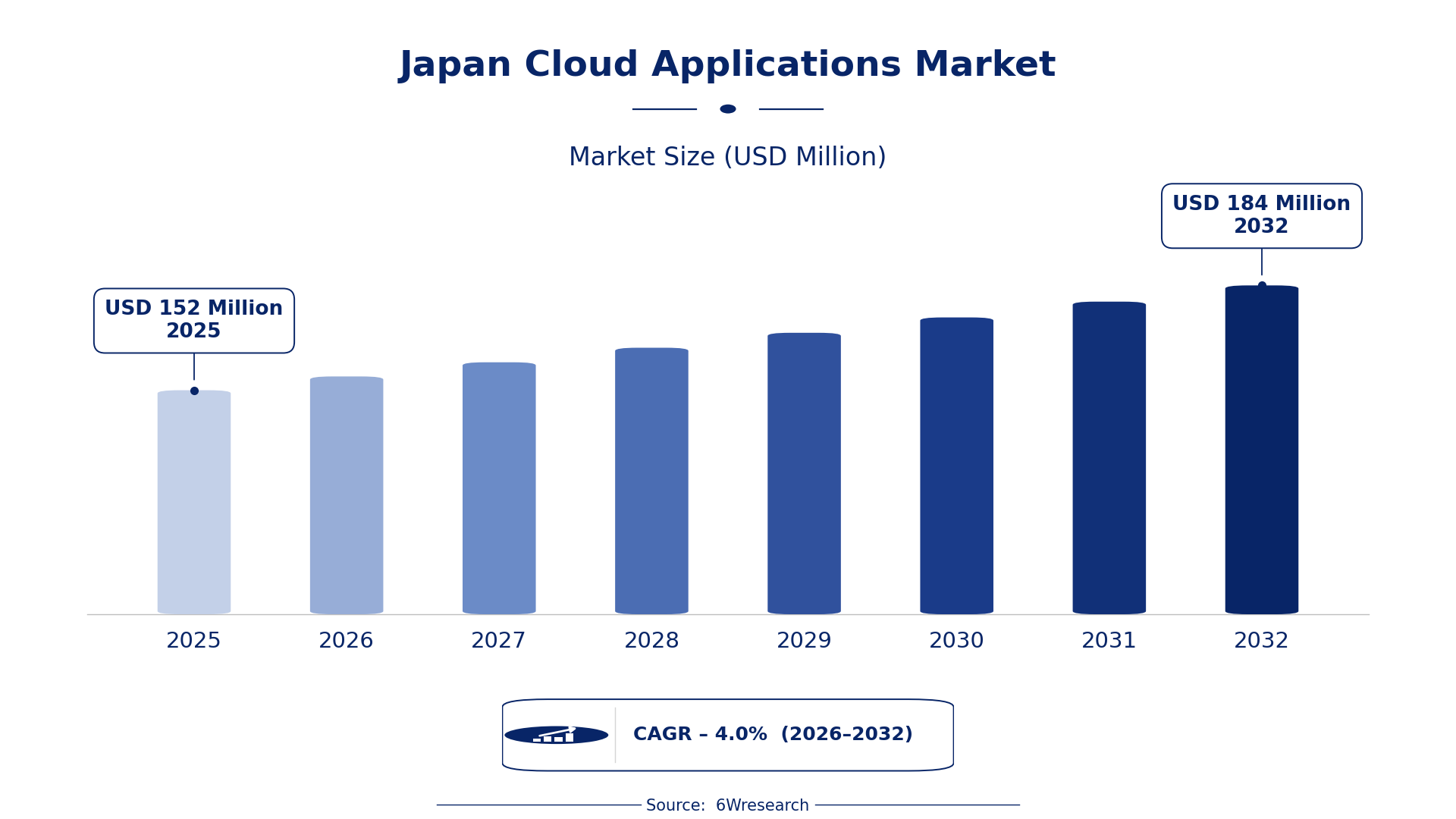
The Japan Cloud Applications Market was estimated at USD 152 Million in 2025 and is projected to reach USD 184 Million by 2032, growing at a CAGR of 4.0% from 2026 to 2032.
Japan Cloud Applications Market Synopsis
The Japan Cloud Applications Market is undergoing a transformative period, driven by a robust demand for cloud-based solutions across multiple sectors. As businesses increasingly prioritize operational efficiency and flexibility, cloud applications are becoming essential tools for companies ranging from healthcare to retail.
Recent advancements in technology, particularly the integration of AI and machine learning, are enhancing the capabilities of cloud applications. This trend is not just about adopting new software; it's about fundamentally changing how organizations operate and innovate in a competitive environment.
Japan Cloud Applications Market Year-wise Growth Rate and Key Drivers
This graph illustrates the annual growth rates of the Japan Cloud Applications Market from 2021 to 2032, highlighting a steady upward trajectory and projected expansion over the forecast period.
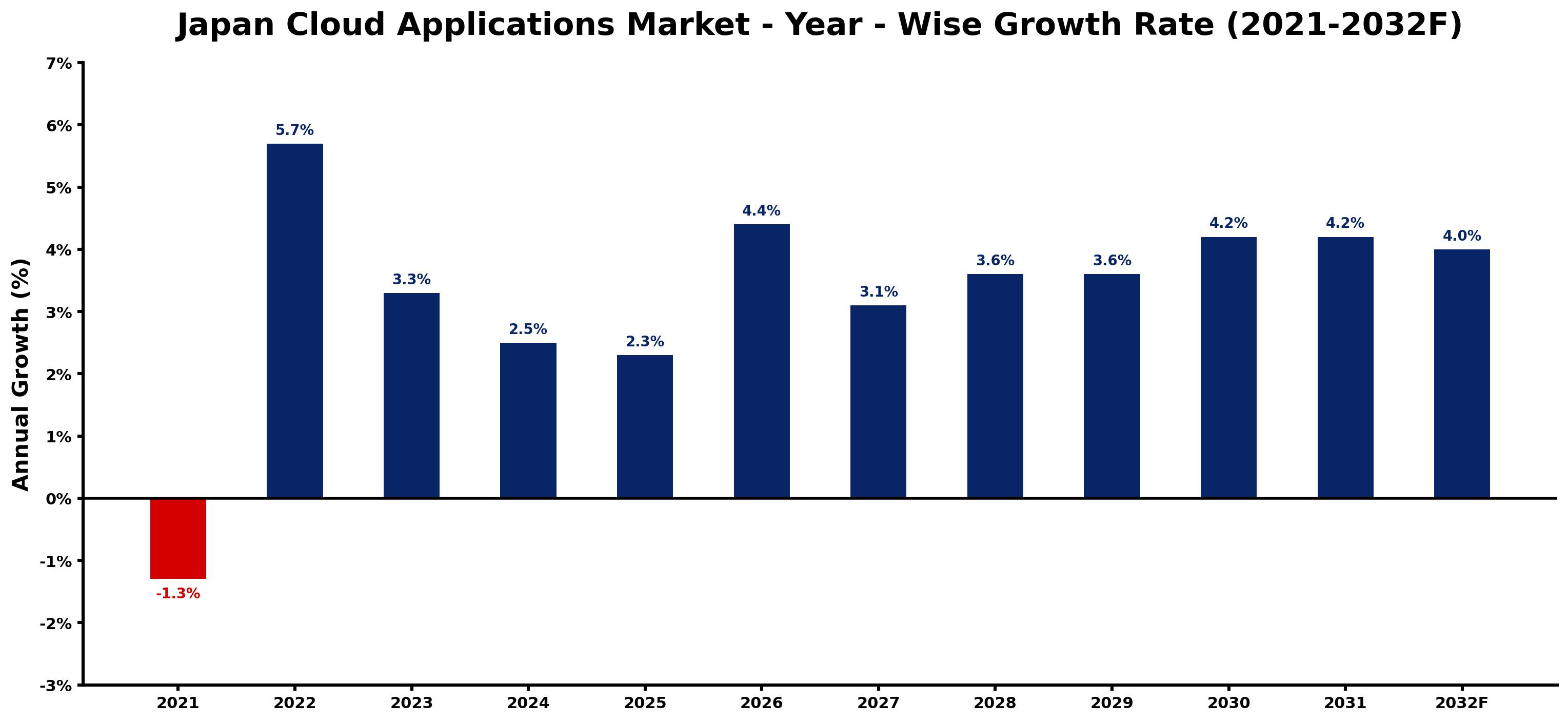
The table below presents the year‑wise growth rates along with the key drivers influencing the market
| Year | Growth Rate | Major Drivers |
| 2021 | -1.3% | Decreased investment due to Japan's strict data localization laws. |
| 2022 | 5.7% | Accelerated remote work culture driving cloud application usage. |
| 2023 | 3.3% | Increased investment in cybersecurity regulations enhancing cloud trust. |
| 2024 | 2.5% | Growing interest in hybrid cloud solutions among Japanese companies. |
| 2025 | 2.3% | Digital-first policies by METI boosting cloud application adoption. |
| 2026 | 4.4% | Aging population necessitating healthcare cloud application deployment. |
| 2027 | 3.1% | Significant rise in e-commerce platforms utilizing cloud applications. |
| 2028 | 3.6% | SMEs increasingly adopting cloud solutions for operational efficiency. |
| 2029 | 3.6% | Expanding fintech sector leveraging cloud for scalability. |
| 2030 | 4.2% | Local startups driving innovation in cloud application services. |
| 2031 | 4.2% | Increased focus on sustainable business practices boosting cloud use. |
| 2032 | 4.0% | Enhanced collaboration tools in cloud aiding workplace productivity. |
Note: Market size estimations and growth projections presented in this report are based on 6Wresearch's proprietary forecasting methodology, utilizing the latest available industry data, government publications, and primary research inputs.
Japan Cloud Applications Market Key Takeaways
Below are some of the specific key takeaways from the market, including:
- The increasing adoption of Software as a Service (SaaS) is reshaping business processes across industries.
- AI and machine learning are significantly enhancing data analytics capabilities within cloud applications.
- Government initiatives are fostering an environment conducive to cloud technology adoption.
- Concerns around data security are influencing purchasing decisions among Japanese businesses.
- Partnerships with local tech providers are becoming a strategic focus for cloud application developers.
Evaluation of Restraints in Japan Cloud Applications Market
Despite the growth potential, the Japan Cloud Applications Market faces notable restraints. A strong cultural inclination towards on-premise solutions stems from deep-seated concerns regarding data privacy and control. Many businesses remain hesitant to fully embrace cloud solutions due to stringent regulations surrounding data security, which complicates the compliance landscape for providers. This creates a challenging environment for market penetration and limits the speed at which cloud adoption can occur.
Japan Cloud Applications Market Trends
A few trends are particularly noteworthy in the Japan Cloud Applications Market. The shift toward SaaS continues to gain momentum, with applications for customer relationship management (CRM) and enterprise resource planning (ERP) leading the charge. Additionally, the growing intersection of AI and cloud technology is enabling businesses to harness data more effectively, improving decision-making processes.
Remote work arrangements are also influencing demand, as organizations seek cloud solutions that support collaboration and seamless access to data from anywhere. This trend is likely to persist, driving further investment in cloud applications.
Japan Cloud Applications Market Opportunities
The Japan Cloud Applications Market presents a wealth of opportunities for growth. Companies that can develop industry-specific solutions tailored to the unique needs of sectors like healthcare and finance are likely to see significant demand. Additionally, building partnerships with local technology providers can enhance market penetration and foster trust among businesses wary of cloud adoption.
Addressing data security and privacy concerns is crucial for building confidence in cloud solutions. Vendors that prioritize transparency and compliance with local regulations will find themselves well-positioned to capture market share.
Government Initiatives in the Japan Cloud Applications Market
The Japanese government is actively shaping the cloud applications market through various initiatives aimed at promoting digital transformation. With a strong emphasis on efficiency and innovation, public policy is designed to foster a favorable environment for cloud adoption among businesses. This includes regulatory frameworks that prioritize data security while encouraging the integration of cloud technologies.
- A recently completed initiative is the "Cloud First" policy, which mandates government agencies to choose cloud solutions for IT projects, enhancing operational efficiency.
- Currently underway is the Act on the Protection of Personal Information, which ensures that cloud service providers adhere to strict data security protocols.
- A planned public-private initiative is expected to enhance cloud infrastructure capabilities by 2028, facilitating broader access to cloud services.
- The Japan Revitalization Strategy includes ongoing efforts to support businesses in adopting cloud technologies, driving innovation across sectors.
- Regulatory updates are expected to be introduced in 2026 to streamline compliance requirements for cloud application providers, aiming to simplify the operational landscape.
Future Insights of the Japan Cloud Applications Market
Looking ahead to 2026-2032, the Japan Cloud Applications Market is set for substantial growth. The increasing emphasis on digital transformation will continue to drive demand for cloud-based solutions. As businesses of all sizes adapt to new operational models, the need for scalable and cost-effective cloud applications will only intensify. Additionally, government support and a growing awareness of the benefits of cloud technology will facilitate market expansion.
Japan Cloud Applications Market Latest Developments
In the past year, the Japan Cloud Applications Market has witnessed a flurry of activity. Companies are increasingly focusing on integrating advanced technologies into their offerings, responding to the demand for more sophisticated cloud solutions. There has been a notable uptick in partnerships aimed at enhancing service delivery and expanding market reach.
- A major technology vendor launched a new suite of AI-integrated cloud applications in early 2025, enhancing analytics capabilities for businesses.
- An ongoing initiative began in mid-2025 to upgrade cloud infrastructure across public sector organizations, improving service accessibility.
- A regional operator is planning a rollout of enhanced cloud security features expected to begin in the second half of 2026.
- By late 2025, a collaboration between local tech firms resulted in the development of tailored cloud solutions for the healthcare sector, addressing specific industry needs.
- A comprehensive training program for cloud adoption launched in Q1 2025 aims to equip businesses with the skills necessary to effectively implement cloud technologies.
Japan Cloud Applications Market - Key Attractiveness of the Report
- 10 Years of Market Numbers
- Historical Data Starting from 2022 to 2025
- Base Year: 2025
- Forecast Data until 2032
- Key Performance Indicators Impacting the Market
- Major Upcoming Developments and Projects
Key Highlights of the Report:
- Japan Cloud Applications Market Outlook
- Market Size of Japan Cloud Applications Market, 2025
- Forecast of Japan Cloud Applications Market, 2032
- Historical Data and Forecast of Japan Cloud Applications Revenues & Volume for the Period 2022-2032F
- Japan Cloud Applications Market Trend Evolution
- Japan Cloud Applications Market Drivers and Challenges
- Japan Cloud Applications Price Trends
- Japan Cloud Applications Porter's Five Forces
- Japan Cloud Applications Industry Life Cycle
- Historical Data and Forecast of Japan Cloud Applications Market Revenues & Volume By Application for the Period 2022-2032F
- Historical Data and Forecast of Japan Cloud Applications Market Revenues & Volume By ERP for the Period 2022-2032F
- Historical Data and Forecast of Japan Cloud Applications Market Revenues & Volume By CRM for the Period 2022-2032F
- Historical Data and Forecast of Japan Cloud Applications Market Revenues & Volume By HCM for the Period 2022-2032F
- Historical Data and Forecast of Japan Cloud Applications Market Revenues & Volume By SCM for the Period 2022-2032F
- Historical Data and Forecast of Japan Cloud Applications Market Revenues & Volume By Content Management for the Period 2022-2032F
- Historical Data and Forecast of Japan Cloud Applications Market Revenues & Volume By BI for the Period 2022-2032F
- Historical Data and Forecast of Japan Cloud Applications Market Revenues & Volume By Analytics for the Period 2022-2032F
- Historical Data and Forecast of Japan Cloud Applications Market Revenues & Volume By Vertical for the Period 2022-2032F
- Historical Data and Forecast of Japan Cloud Applications Market Revenues & Volume By Banking, Financial Services, and Insurance (BFSI) for the Period 2022-2032F
- Historical Data and Forecast of Japan Cloud Applications Market Revenues & Volume By Energy and Utilities for the Period 2022-2032F
- Historical Data and Forecast of Japan Cloud Applications Market Revenues & Volume By Government and Public Sector for the Period 2022-2032F
- Historical Data and Forecast of Japan Cloud Applications Market Revenues & Volume By Healthcare and Life Sciences for the Period 2022-2032F
- Historical Data and Forecast of Japan Cloud Applications Market Revenues & Volume By Manufacturing for the Period 2022-2032F
- Historical Data and Forecast of Japan Cloud Applications Market Revenues & Volume By Retail and Consumer Goods for the Period 2022-2032F
- Historical Data and Forecast of Japan Cloud Applications Market Revenues & Volume By Telecommunications for the Period 2022-2032F
- Historical Data and Forecast of Japan Cloud Applications Market Revenues & Volume By Transportation and Logistics for the Period 2022-2032F
- Historical Data and Forecast of Japan Cloud Applications Market Revenues & Volume By Organization Size for the Period 2022-2032F
- Historical Data and Forecast of Japan Cloud Applications Market Revenues & Volume By Small and Medium-sized Enterprises (SMEs) for the Period 2022-2032F
- Historical Data and Forecast of Japan Cloud Applications Market Revenues & Volume By Large Enterprises for the Period 2022-2032F
- Japan Cloud Applications Import Export Trade Statistics
- Market Opportunity Assessment By Application
- Market Opportunity Assessment By Vertical
- Market Opportunity Assessment By Organization Size
- Japan Cloud Applications Top Companies Market Share
- Japan Cloud Applications Competitive Benchmarking By Technical and Operational Parameters
- Japan Cloud Applications Company Profiles
- Japan Cloud Applications Key Strategic Recommendations






































