Germany Cloud Applications Market Size & Growth Rate (2026-2032)
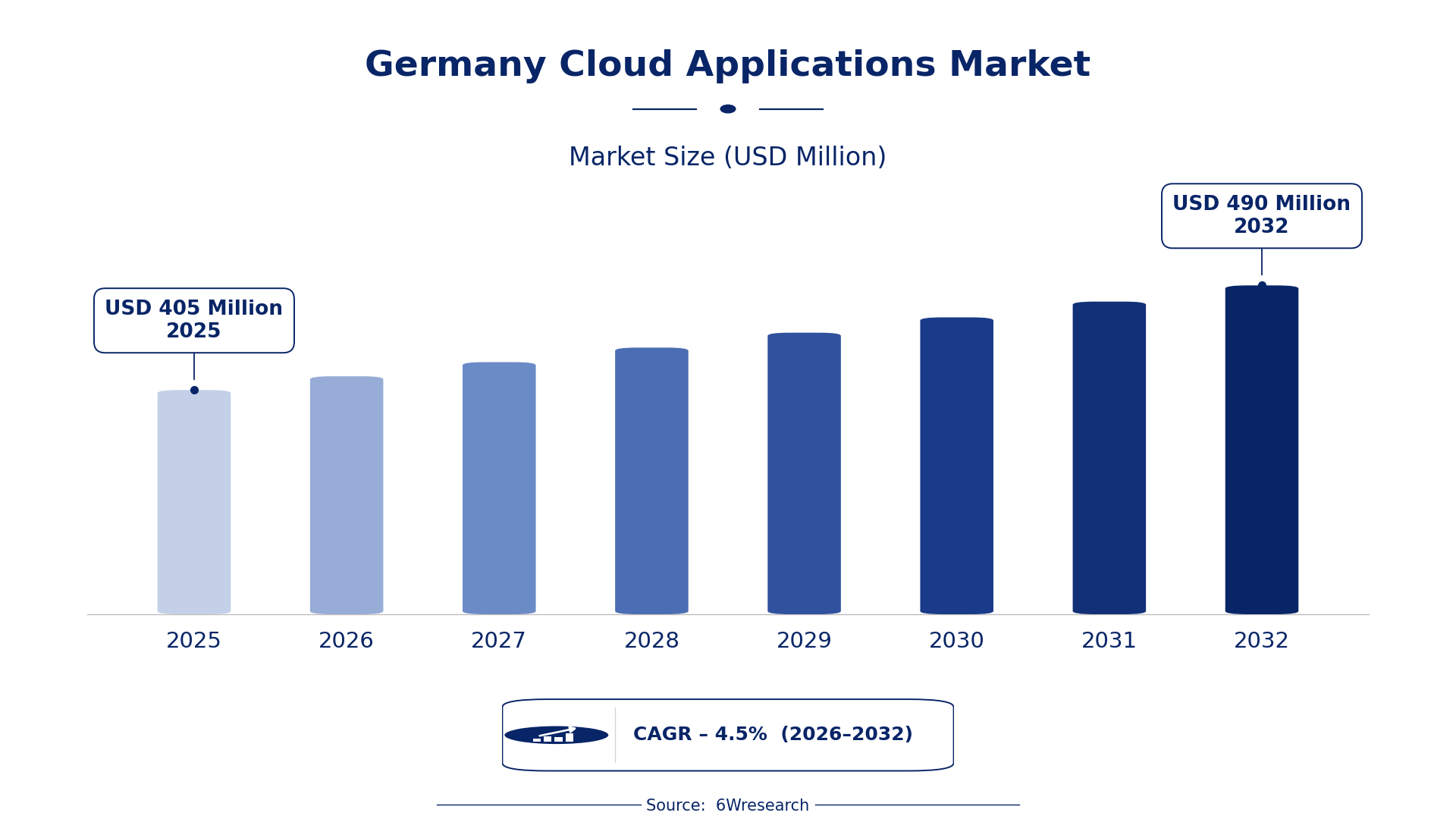
The Germany Cloud Applications Market was estimated at USD 405 Million in 2025 and is projected to reach USD 490 Million by 2032, growing at a CAGR of 4.5% from 2026 to 2032.
Germany Cloud Applications Market Synopsis
The urgency to adopt cloud applications in Germany has surged, as organizations seek to enhance operational efficiency and embrace digital transformation. Cloud-based solutions, particularly in productivity suites and ERP systems, are becoming critical tools for enterprises aiming to modernize their IT frameworks.
The shift from traditional on-premises systems to cloud applications is not merely a trend but a necessity for many German businesses. The flexibility of accessing applications from any location and device empowers teams and fosters collaboration, making cloud adoption indispensable for competitive advantage.
Germany Cloud Applications Market Year-wise Growth Rate and Key Drivers
This graph illustrates the annual growth rates of the Germany Cloud Applications Market from 2021 to 2032, highlighting a steady upward trajectory and projected expansion over the forecast period.
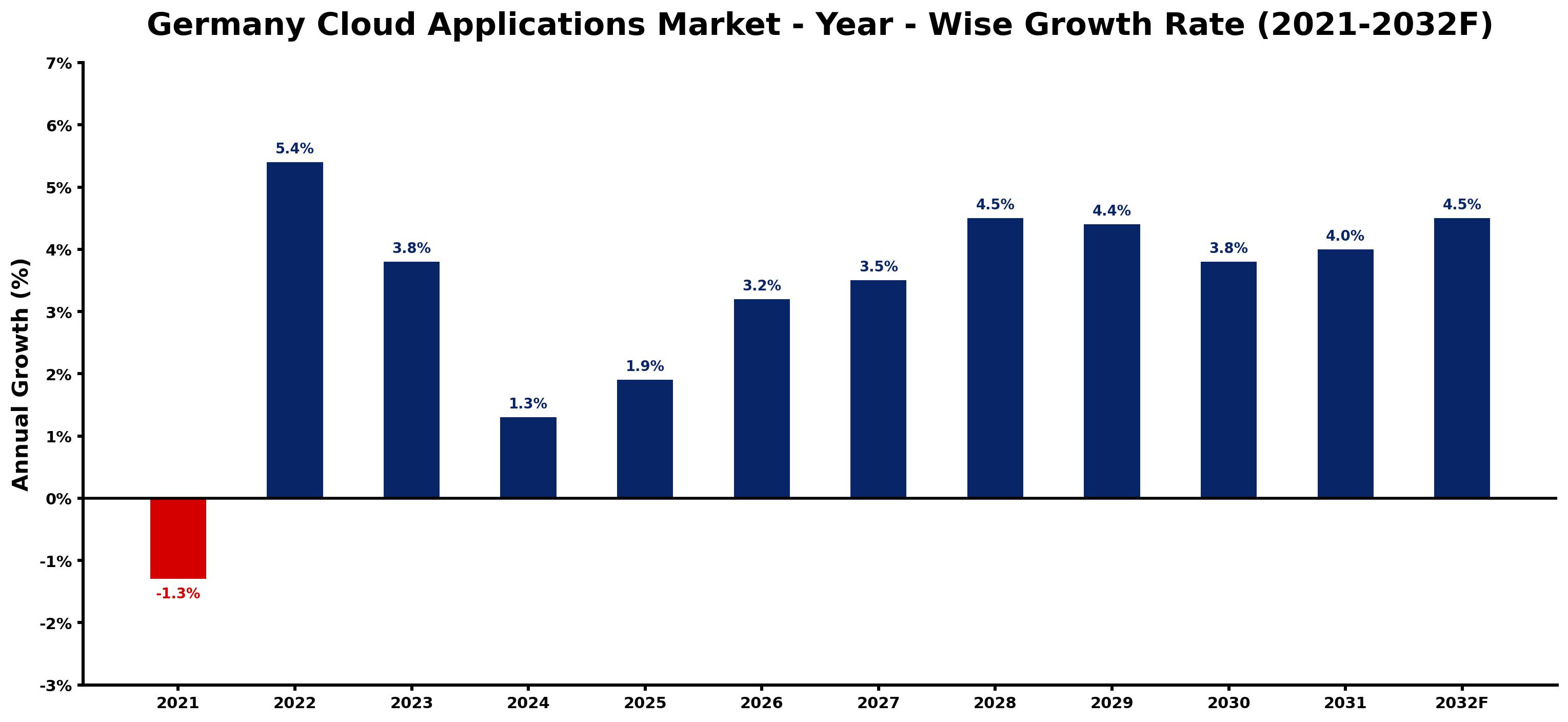
The table below presents the year‑wise growth rates along with the key drivers influencing the market
| Year | Growth Rate | Major Drivers |
| 2021 | -1.3% | German Data Protection Regulation limits cloud adoption. |
| 2022 | 5.4% | Data Protection Regulation enforcing cloud compliance standards. |
| 2023 | 3.8% | Growing adoption of AI-based applications in enterprises. |
| 2024 | 1.3% | Increased SME investment in digital transformation strategies. |
| 2025 | 1.9% | Government funding for tech startups boosting cloud usage. |
| 2026 | 3.2% | Rising interest in environmentally sustainable cloud solutions. |
| 2027 | 3.5% | Collaboration between German tech firms and universities. |
| 2028 | 4.5% | Increasing cybersecurity threats driving cloud service demand. |
| 2029 | 4.4% | Strong demand for localized data centers boosting adoption. |
| 2030 | 3.8% | Emerging trends in e-commerce requiring scalable cloud solutions. |
| 2031 | 4.0% | National cloud strategy aiming for digital sovereignty advancements. |
| 2032 | 4.5% | Increased focus on hybrid cloud models among enterprises. |
Note: Market size estimations and growth projections presented in this report are based on 6Wresearch's proprietary forecasting methodology, utilizing the latest available industry data, government publications, and primary research inputs.
Germany Cloud Applications Market Key Takeaways
Below are some of the specific key takeaways from the market, including:
- The market is driven by the demand for scalable and cost-effective software solutions.
- Enterprises are increasingly migrating to cloud-based applications for improved collaboration and productivity.
- Data migration and training challenges persist as organizations transition to cloud systems.
- Government initiatives are actively promoting digitalization and cloud adoption across sectors.
- The competitive landscape is intensifying with emerging technologies enhancing cloud capabilities.
Evaluation of Restraints in Germany Cloud Applications Market
Despite the positive momentum in cloud adoption, several challenges are hindering the market's growth. The migration process from traditional systems to cloud solutions often proves complex, with companies facing hurdles such as data transfer issues and integration with legacy systems. Additionally, employee resistance to adopting new technologies can stall implementation, making change management a crucial aspect for organizations aiming to successfully transition to cloud-based applications.
Germany Cloud Applications Market Trends
Several trends are shaping the future of cloud applications in Germany. There's a noticeable shift toward integration of AI and machine learning capabilities within cloud platforms, enhancing analytics and decision-making processes. Businesses are also prioritizing security and compliance, leading to the rise of specialized cloud solutions that address these concerns. on top of that, the demand for multi-cloud strategies is increasing as organizations aim to avoid vendor lock-in and leverage the best solutions available.
Germany Cloud Applications Market Opportunities
With the growing emphasis on digital transformation, numerous opportunities exist within the Germany Cloud Applications Market. Companies can capitalize on the demand for tailored cloud solutions, particularly in sectors like finance and healthcare, where regulatory compliance is paramount. As businesses increasingly recognize the need for data-driven insights, there is potential for significant investment in analytics-driven cloud applications, offering a pathway for growth and innovation.
Government Initiatives in the Germany Cloud Applications Market
The German government is actively engaged in promoting digitalization across industries, which is crucial for advancing the cloud applications market. Policies aimed at enhancing infrastructure and supporting businesses in their digital transitions reflect a commitment to fostering innovation. This regulatory environment plays a significant role in shaping market dynamics, ensuring that enterprises are encouraged to adopt cloud technologies.
- A recently completed initiative focused on the upgrade of national digital infrastructure to improve connectivity for cloud services.
- A current program is underway to provide financial incentives for small and medium-sized enterprises (SMEs) adopting cloud technologies.
- A planned initiative expected to launch in 2026 aims to establish a regulatory framework enhancing data security for cloud applications.
- Ongoing public-private partnerships are being developed to foster innovation in cloud computing solutions across various sectors.
Future Insights of the Germany Cloud Applications Market
Looking ahead to 2026-2032, the Germany Cloud Applications Market is set to experience significant advancements. As businesses continue to prioritize agility and scalability, demand for cloud solutions will likely intensify. Innovations in technology, particularly in AI integration and enhanced security measures, will drive further adoption, making cloud applications essential for modern enterprises. Companies that adapt swiftly to these trends will be well-positioned for success in an increasingly digital economy.
Germany Cloud Applications Market Latest Developments
In the past year, the Germany Cloud Applications Market has seen dynamic developments reflecting the increasing commitment to cloud adoption. Organizations are embracing new technologies and solutions to meet evolving business needs, marking a pivotal period for the market.
- A major technology vendor announced a comprehensive update to its cloud productivity suite in early 2025, enhancing user experience and functionality.
- An initiative that began in mid-2025 is currently underway, focusing on improving cloud integration capabilities for enterprises transitioning from legacy systems.
- A regional operator is expected to launch a new cloud service aimed at SMEs in Q4 2025, designed to simplify digital transformations.
- A partnership between leading firms was established in early 2025 to develop innovative cloud solutions tailored for the healthcare sector.
Germany Cloud Applications Market - Key Attractiveness of the Report
- 10 Years of Market Numbers
- Historical Data Starting from 2022 to 2025
- Base Year: 2025
- Forecast Data until 2032
- Key Performance Indicators Impacting the Market
- Major Upcoming Developments and Projects
Key Highlights of the Report:
- Germany Cloud Applications Market Outlook
- Market Size of Germany Cloud Applications Market, 2025
- Forecast of Germany Cloud Applications Market, 2032
- Historical Data and Forecast of Germany Cloud Applications Revenues & Volume for the Period 2022-2032F
- Germany Cloud Applications Market Trend Evolution
- Germany Cloud Applications Market Drivers and Challenges
- Germany Cloud Applications Price Trends
- Germany Cloud Applications Porter's Five Forces
- Germany Cloud Applications Industry Life Cycle
- Historical Data and Forecast of Germany Cloud Applications Market Revenues & Volume By Application for the Period 2022-2032F
- Historical Data and Forecast of Germany Cloud Applications Market Revenues & Volume By ERP for the Period 2022-2032F
- Historical Data and Forecast of Germany Cloud Applications Market Revenues & Volume By CRM for the Period 2022-2032F
- Historical Data and Forecast of Germany Cloud Applications Market Revenues & Volume By HCM for the Period 2022-2032F
- Historical Data and Forecast of Germany Cloud Applications Market Revenues & Volume By SCM for the Period 2022-2032F
- Historical Data and Forecast of Germany Cloud Applications Market Revenues & Volume By Content Management for the Period 2022-2032F
- Historical Data and Forecast of Germany Cloud Applications Market Revenues & Volume By BI for the Period 2022-2032F
- Historical Data and Forecast of Germany Cloud Applications Market Revenues & Volume By Analytics for the Period 2022-2032F
- Historical Data and Forecast of Germany Cloud Applications Market Revenues & Volume By Vertical for the Period 2022-2032F
- Historical Data and Forecast of Germany Cloud Applications Market Revenues & Volume By Banking, Financial Services, and Insurance (BFSI) for the Period 2022-2032F
- Historical Data and Forecast of Germany Cloud Applications Market Revenues & Volume By Energy and Utilities for the Period 2022-2032F
- Historical Data and Forecast of Germany Cloud Applications Market Revenues & Volume By Government and Public Sector for the Period 2022-2032F
- Historical Data and Forecast of Germany Cloud Applications Market Revenues & Volume By Healthcare and Life Sciences for the Period 2022-2032F
- Historical Data and Forecast of Germany Cloud Applications Market Revenues & Volume By Manufacturing for the Period 2022-2032F
- Historical Data and Forecast of Germany Cloud Applications Market Revenues & Volume By Retail and Consumer Goods for the Period 2022-2032F
- Historical Data and Forecast of Germany Cloud Applications Market Revenues & Volume By Telecommunications for the Period 2022-2032F
- Historical Data and Forecast of Germany Cloud Applications Market Revenues & Volume By Transportation and Logistics for the Period 2022-2032F
- Historical Data and Forecast of Germany Cloud Applications Market Revenues & Volume By Organization Size for the Period 2022-2032F
- Historical Data and Forecast of Germany Cloud Applications Market Revenues & Volume By Small and Medium-sized Enterprises (SMEs) for the Period 2022-2032F
- Historical Data and Forecast of Germany Cloud Applications Market Revenues & Volume By Large Enterprises for the Period 2022-2032F
- Germany Cloud Applications Import Export Trade Statistics
- Market Opportunity Assessment By Application
- Market Opportunity Assessment By Vertical
- Market Opportunity Assessment By Organization Size
- Germany Cloud Applications Top Companies Market Share
- Germany Cloud Applications Competitive Benchmarking By Technical and Operational Parameters
- Germany Cloud Applications Company Profiles
- Germany Cloud Applications Key Strategic Recommendations






































