Pakistan Diesel Engine Market Year-wise Growth Rate (2021-2031F)
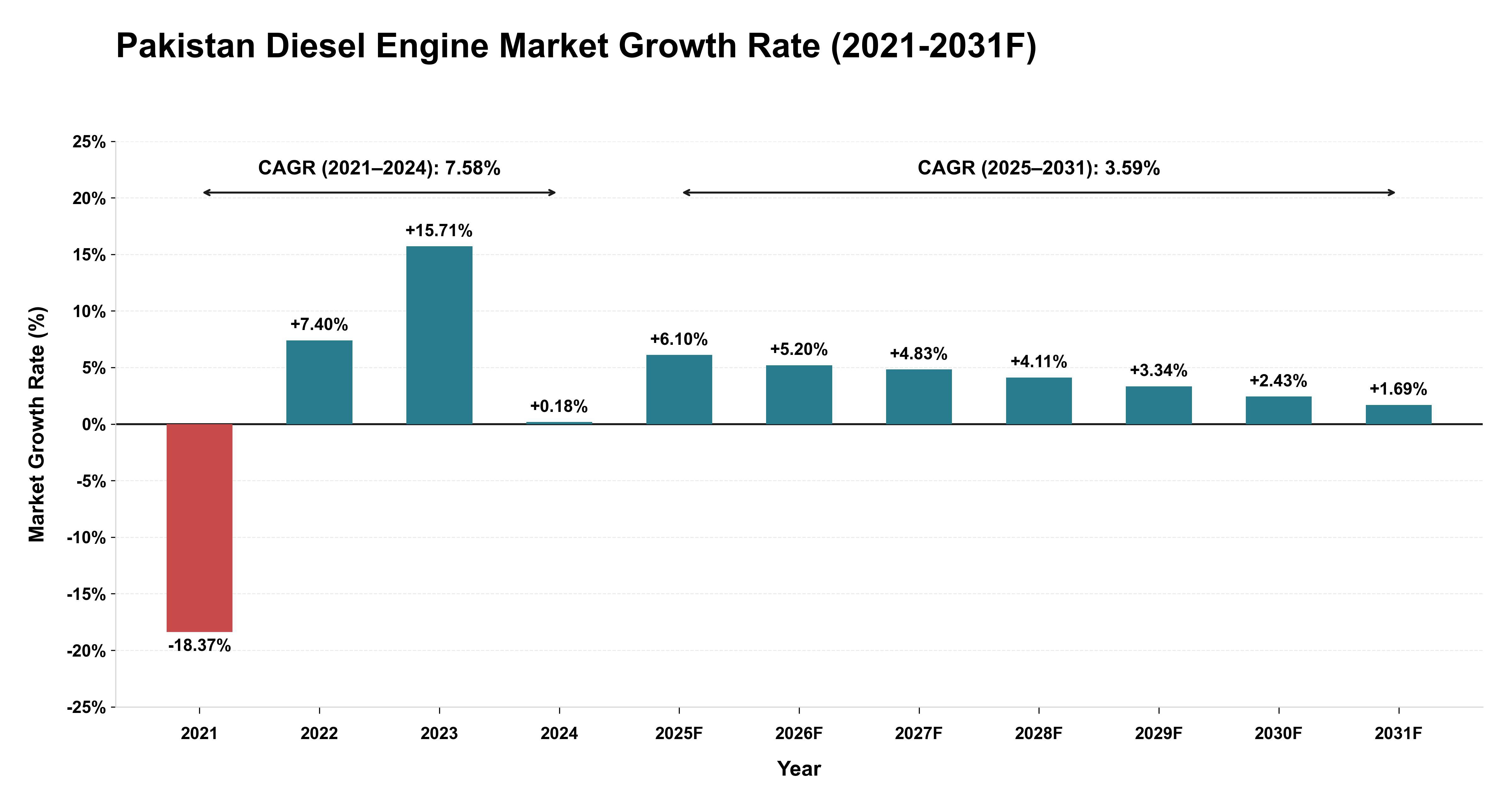
The Pakistan Diesel Engine Market witnessed a tumultuous period from 2021 to 2024, marked by a sharp decline in 2021 followed by a strong rebound in subsequent years, with a CAGR of 7.58%. The negative growth in 2021 was likely influenced by external shocks or regulatory changes affecting the demand for diesel engines. The following years saw robust growth, indicating resilience and potential recovery in end-use industries like agriculture, transportation, and construction. Looking ahead to 2025-2031, the market is expected to stabilize with a forecasted CAGR of 3.59%, reflecting a more mature phase characterized by steady but slower growth rates. This trajectory suggests a shift towards sustainable demand patterns, possibly driven by technological advancements, evolving regulatory frameworks, and changing consumer preferences towards more efficient and environmentally friendly diesel engine options.
Pakistan Diesel Engine Market Overview
The diesel engine market in Pakistan is experiencing growth due to its applications in transportation, power generation, and industrial machinery. Diesel engines are known for their efficiency, durability, and high power output. The market is driven by the increasing demand for reliable and efficient power solutions in various sectors, including automotive, construction, and agriculture.
Drivers of the market
The diesel engine market in Pakistan is driven by its widespread use in various industries, including transportation, construction, and power generation. Diesel engines offer high torque, fuel efficiency, and durability, making them suitable for heavy-duty applications. The growth of infrastructure projects and the expansion of the transportation sector support market demand.
Challenges of the market
The Diesel Engine Market in Pakistan is grappling with multiple challenges, including fluctuating fuel prices and stringent emission regulations. The volatility of diesel prices can make it difficult for businesses and consumers to predict operating costs, affecting market stability. Moreover, increasing environmental concerns and the push for cleaner technologies have led to stricter emission standards, requiring manufacturers to invest heavily in research and development to produce compliant engines. These factors, combined with competition from alternative energy sources, such as electric and hybrid engines, pose significant obstacles to the markets growth.
Government Policy of the market
To support industrial and transportation sectors, the government provides incentives for the production and import of diesel engines. Policies include subsidies for local manufacturers, standards for emissions and fuel efficiency, and research grants for developing advanced diesel technologies.
Key Highlights of the Report:
- Pakistan Diesel Engine Market Outlook
- Market Size of Pakistan Diesel Engine Market, 2024
- Forecast of Pakistan Diesel Engine Market, 2031
- Historical Data and Forecast of Pakistan Diesel Engine Revenues & Volume for the Period 2018 - 2031
- Pakistan Diesel Engine Market Trend Evolution
- Pakistan Diesel Engine Market Drivers and Challenges
- Pakistan Diesel Engine Price Trends
- Pakistan Diesel Engine Porter's Five Forces
- Pakistan Diesel Engine Industry Life Cycle
- Historical Data and Forecast of Pakistan Diesel Engine Market Revenues & Volume By Power Rating for the Period 2018 - 2031
- Historical Data and Forecast of Pakistan Diesel Engine Market Revenues & Volume By 0.5 MW 1 MW for the Period 2018 - 2031
- Historical Data and Forecast of Pakistan Diesel Engine Market Revenues & Volume By Up to 0.5 MW for the Period 2018 - 2031
- Historical Data and Forecast of Pakistan Diesel Engine Market Revenues & Volume By 2 MW 5 MW for the Period 2018 - 2031
- Historical Data and Forecast of Pakistan Diesel Engine Market Revenues & Volume By 1 MW 2 MW for the Period 2018 - 2031
- Historical Data and Forecast of Pakistan Diesel Engine Market Revenues & Volume By Above 5 MW for the Period 2018 - 2031
- Historical Data and Forecast of Pakistan Diesel Engine Market Revenues & Volume By for the Period 2018 - 2031
- Historical Data and Forecast of Pakistan Diesel Engine Market Revenues & Volume By End User for the Period 2018 - 2031
- Historical Data and Forecast of Pakistan Diesel Engine Market Revenues & Volume By Automotive for the Period 2018 - 2031
- Historical Data and Forecast of Pakistan Diesel Engine Market Revenues & Volume By Non-Automotive for the Period 2018 - 2031
- Pakistan Diesel Engine Import Export Trade Statistics
- Market Opportunity Assessment By Power Rating
- Market Opportunity Assessment By End User
- Pakistan Diesel Engine Top Companies Market Share
- Pakistan Diesel Engine Competitive Benchmarking By Technical and Operational Parameters
- Pakistan Diesel Engine Company Profiles
- Pakistan Diesel Engine Key Strategic Recommendations






































