Pakistan Edge Data Center Market Size & Growth Rate (2026-2032)
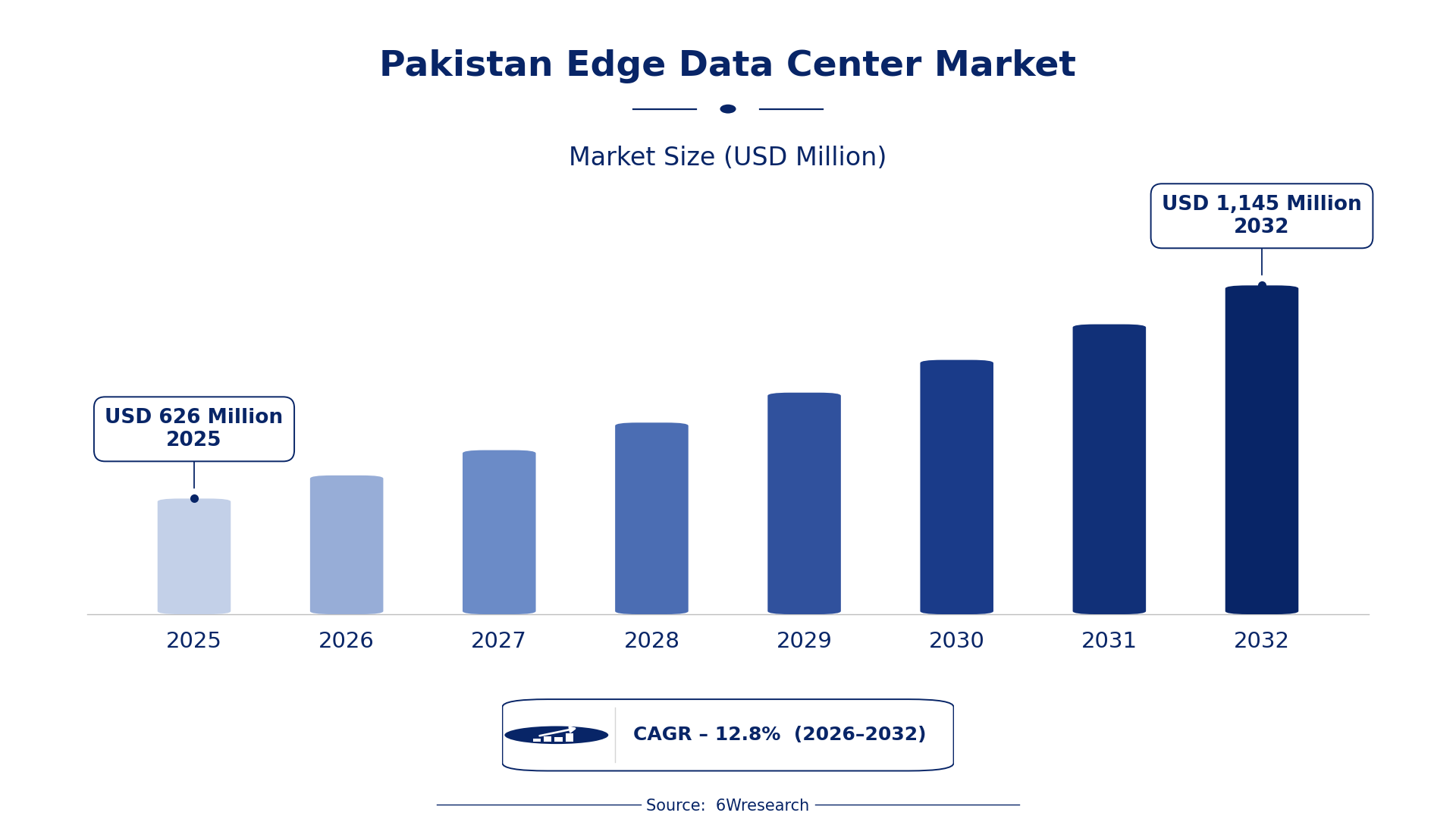
The Pakistan Edge Data Center Market was estimated at USD 626 Million in 2025 and is projected to reach USD 1145 Million by 2032, growing at a CAGR of 12.8% from 2026 to 2032.
Pakistan Edge Data Center Market Synopsis
The surge in digital transformation across sectors is driving the growth of the Pakistan Edge Data Center Market. With businesses increasingly relying on cloud services and IoT technologies, the demand for low-latency data processing is rising sharply, positioning edge data centers as vital components of the digital infrastructure.
As urban centers expand and technology adoption accelerates, companies are investing in localized data solutions. This trend is not just about improving performance; it’s also about ensuring security and reliability in data management, which are critical for sectors like finance and healthcare.
Pakistan Edge Data Center Market Year-wise Growth Rate and Key Drivers
This graph illustrates the annual growth rates of the Pakistan Edge Data Center Market from 2021 to 2032, highlighting a steady upward trajectory and projected expansion over the forecast period.
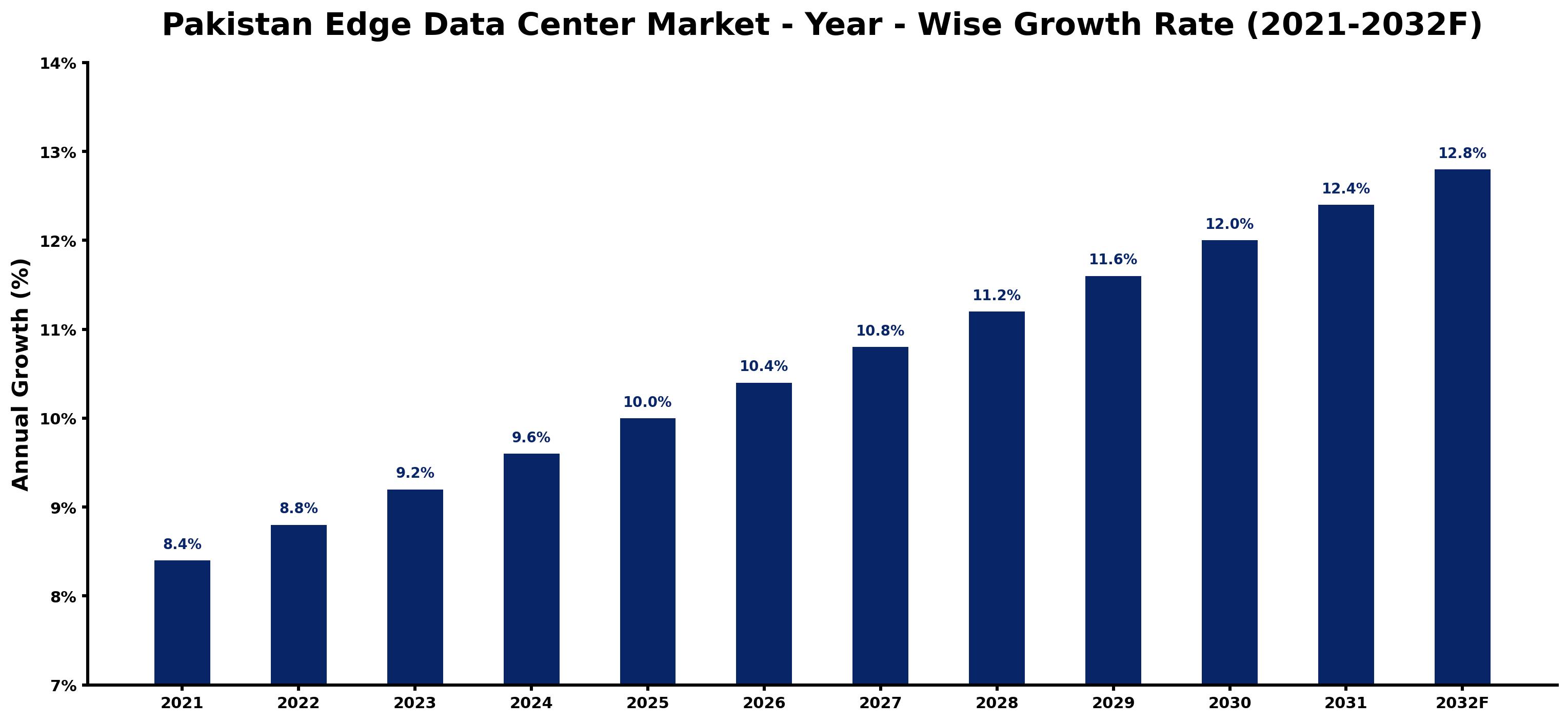
The table below presents the year‑wise growth rates along with the key drivers influencing the market
| Year | Growth Rate | Major Drivers |
| 2021 | 8.4% | Emergence of digital payment systems driving data demand. |
| 2022 | 8.8% | Growing e-commerce adoption enhancing edge computing needs. |
| 2023 | 9.2% | Pakistan's telecom upgrades increasing cloud service utilization. |
| 2024 | 9.6% | Government-supported tech hubs boosting local data center investments. |
| 2025 | 10.0% | Rise in remote work boosting data traffic requirements. |
| 2026 | 10.4% | Telecommunication Authority's regulations improving data security standards. |
| 2027 | 10.8% | Increased smartphone penetration expanding internet access for users. |
| 2028 | 11.2% | Local startups leveraging edge computing for innovative solutions. |
| 2029 | 11.6% | Surge in AI applications driving demand for edge analytics. |
| 2030 | 12.0% | Rising cybersecurity concerns prompting investments in local data centers. |
| 2031 | 12.4% | Government initiatives fostering digital transformation across industries. |
| 2032 | 12.8% | Growth in IOT devices creating data processing opportunities. |
Note: Market size estimations and growth projections presented in this report are based on 6Wresearch's proprietary forecasting methodology, utilizing the latest available industry data, government publications, and primary research inputs.
Pakistan Edge Data Center Market Key Takeaways
Below are some of the specific key takeaways from the market, including:
- The market is witnessing a substantial shift towards localized data processing to reduce latency.
- Government initiatives are enhancing the regulatory framework, fostering growth in the edge data center sector.
- Investment in energy-efficient and secure infrastructure is becoming a priority for service providers.
- The rise of 5G technology is expected to further drive demand for edge data centers.
- Challenges related to power supply and skilled labor need to be addressed for sustained growth.
Evaluation of Restraints in Pakistan Edge Data Center Market
The Pakistan Edge Data Center Market faces several obstacles that could hinder its progress. Infrastructure limitations are a primary concern, with many areas lacking the necessary facilities to support high-performance data operations. This is compounded by an unreliable power supply, which poses serious risks to data security and operational continuity.
Additionally, network connectivity issues can severely impact the efficiency of data centers, preventing them from meeting the growing demands of businesses. A shortage of skilled IT professionals further complicates matters, as the lack of expertise can affect the management and maintenance of these critical facilities.
Pakistan Edge Data Center Market Trends
Several trends are shaping the Pakistan Edge Data Center Market. The increasing adoption of cloud services is pushing companies to seek edge solutions that provide faster data access and processing. As IoT devices proliferate, the need for localized data centers that can handle real-time analytics is becoming more pronounced.
on top of that, the ongoing rollout of 5G technology is a game changer. This advancement not only boosts connectivity but also enhances the capacity for edge computing, allowing businesses to process data at unprecedented speeds. Providers that focus on energy efficiency and security are likely to gain a competitive edge.
Pakistan Edge Data Center Market Opportunities
The market is ripe with opportunities for growth and investment. As the digital economy expands, businesses in sectors such as finance, healthcare, and manufacturing are looking for solutions that can support their data needs efficiently. This opens doors for edge data center providers to develop tailored services that cater to these industries.
on top of that, with government policies favoring digitalization, there is potential for public-private partnerships to emerge. These collaborations can enhance infrastructure and connectivity, providing a conducive environment for the edge data center market to thrive.
Government Initiatives in the Pakistan Edge Data Center Market
The government of Pakistan has been proactive in shaping the Edge Data Center Market through various initiatives aimed at bolstering digital infrastructure. These efforts are vital for fostering a competitive environment and encouraging investment in data center development.
- A regulatory framework introduced in early 2023 aims to streamline the establishment of data centers, reducing bureaucratic hurdles.
- Current initiatives include tax incentives for infrastructure development, which are attracting both local and foreign investments.
- A national digital infrastructure upgrade program is underway, focusing on enhancing internet connectivity across urban and rural areas.
- Recent cybersecurity measures implemented in mid-2023 are aimed at protecting sensitive data handled by edge data centers.
- Planned initiatives include a public-private partnership expected to launch in 2025, aimed at expanding data center capabilities nationwide.
Future Insights of the Pakistan Edge Data Center Market
Looking ahead, the Pakistan Edge Data Center Market is on track for substantial growth through 2032. The convergence of increased cloud adoption, the proliferation of IoT, and enhanced digital infrastructure will drive demand for localized data processing solutions.
Providers that focus on innovation and energy-efficient technologies will likely stand out in a competitive market. The necessity for real-time data analytics will further solidify the role of edge data centers as essential to business strategies across various sectors.
Pakistan Edge Data Center Market Latest Developments
In the past year, the Pakistan Edge Data Center Market has seen a surge in activity, driven by technological advancements and increased investment. Companies are stepping up their efforts to enhance infrastructure and service offerings to meet the growing demands of the digital economy.
- A major technology vendor announced the launch of a new energy-efficient edge data center solution in Q2 2023.
- A leading regional operator is currently expanding its service capabilities with an ongoing project aimed at enhancing cooling efficiencies, set to be completed by late 2024.
- In Q1 2024, a partnership between two local firms was formed to develop advanced data management solutions tailored for healthcare applications.
- Plans are in motion for a rollout of a new edge data center facility expected to begin in early 2025, targeting key urban areas.
- A regional player successfully completed an upgrade of their existing data center infrastructure in mid-2023, improving overall performance and reliability.
Pakistan Edge Data Center Market - Key Attractiveness of the Report
- 10 Years of Market Numbers
- Historical Data Starting from 2022 to 2025
- Base Year: 2025
- Forecast Data until 2032
- Key Performance Indicators Impacting the Market
- Major Upcoming Developments and Projects
Key Highlights of the Report:
- Pakistan Edge Data Center Market Outlook
- Market Size of Pakistan Edge Data Center Market, 2025
- Forecast of Pakistan Edge Data Center Market, 2032
- Historical Data and Forecast of Pakistan Edge Data Center Revenues & Volume for the Period 2022-2032F
- Pakistan Edge Data Center Market Trend Evolution
- Pakistan Edge Data Center Market Drivers and Challenges
- Pakistan Edge Data Center Price Trends
- Pakistan Edge Data Center Porter's Five Forces
- Pakistan Edge Data Center Industry Life Cycle
- Historical Data and Forecast of Pakistan Edge Data Center Market Revenues & Volume By Component for the Period 2022-2032F
- Historical Data and Forecast of Pakistan Edge Data Center Market Revenues & Volume By Solutions for the Period 2022-2032F
- Historical Data and Forecast of Pakistan Edge Data Center Market Revenues & Volume By Services for the Period 2022-2032F
- Historical Data and Forecast of Pakistan Edge Data Center Market Revenues & Volume By for the Period 2022-2032F
- Historical Data and Forecast of Pakistan Edge Data Center Market Revenues & Volume By APAC for the Period 2022-2032F
- Historical Data and Forecast of Pakistan Edge Data Center Market Revenues & Volume By Facility Size for the Period 2022-2032F
- Historical Data and Forecast of Pakistan Edge Data Center Market Revenues & Volume By Small for the Period 2022-2032F
- Historical Data and Forecast of Pakistan Edge Data Center Market Revenues & Volume By Medium Facilities for the Period 2022-2032F
- Historical Data and Forecast of Pakistan Edge Data Center Market Revenues & Volume By Large Facility for the Period 2022-2032F
- Historical Data and Forecast of Pakistan Edge Data Center Market Revenues & Volume By Vertical for the Period 2022-2032F
- Historical Data and Forecast of Pakistan Edge Data Center Market Revenues & Volume By IT and Telecom for the Period 2022-2032F
- Historical Data and Forecast of Pakistan Edge Data Center Market Revenues & Volume By BFSI for the Period 2022-2032F
- Historical Data and Forecast of Pakistan Edge Data Center Market Revenues & Volume By Healthcare and Lifesciences for the Period 2022-2032F
- Historical Data and Forecast of Pakistan Edge Data Center Market Revenues & Volume By Manufacturing for the Period 2022-2032F
- Historical Data and Forecast of Pakistan Edge Data Center Market Revenues & Volume By Government for the Period 2022-2032F
- Historical Data and Forecast of Pakistan Edge Data Center Market Revenues & Volume By Automotive for the Period 2022-2032F
- Historical Data and Forecast of Pakistan Edge Data Center Market Revenues & Volume By Gaming and Entertainment for the Period 2022-2032F
- Historical Data and Forecast of Pakistan Edge Data Center Market Revenues & Volume By Retail and E-commerce for the Period 2022-2032F
- Pakistan Edge Data Center Import Export Trade Statistics
- Market Opportunity Assessment By Component
- Market Opportunity Assessment By
- Market Opportunity Assessment By Facility Size
- Market Opportunity Assessment By Vertical
- Pakistan Edge Data Center Top Companies Market Share
- Pakistan Edge Data Center Competitive Benchmarking By Technical and Operational Parameters
- Pakistan Edge Data Center Company Profiles
- Pakistan Edge Data Center Key Strategic Recommendations






































