Pakistan Educational Toys Market Size, Share & Growth Rate
The Pakistan Educational Toys Market was estimated at USD 619 Million in 2025 and is projected to reach USD 880 Million by 2032, growing at a CAGR of 5.2% from 2026 to 2032. This growth trajectory is fueled by a rising awareness among parents regarding the critical role of educational toys in fostering cognitive and emotional development in children. As more families prioritize holistic learning experiences, the demand for innovative and culturally relevant educational toys continues to surge.
Pakistan Educational Toys Market Year-wise Growth Rate and Key Drivers
This graph highlights how the Pakistan Educational Toys Market has steadily grown over the years, supported by major growth factors.
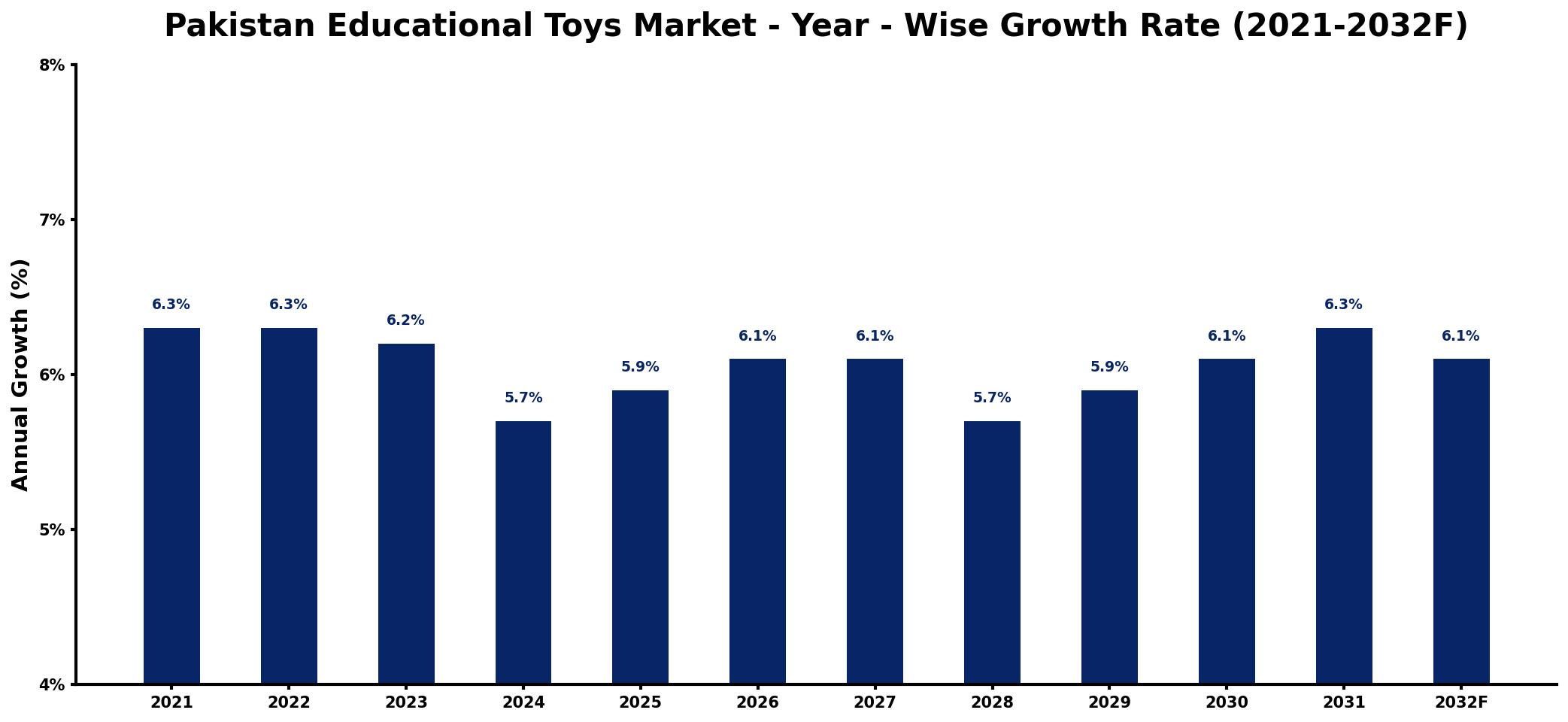
The table below presents the year‑wise growth rates along with the key drivers influencing the market
| Year | Growth Rate | Major Drivers |
| 2021 | 6.3% | Increased investment in child development |
| 2022 | 6.3% | Growing awareness of learning methods |
| 2023 | 6.2% | Rising disposable income among families |
| 2024 | 5.7% | Expanding distribution channels online |
| 2025 | 5.9% | Increased focus on STEM education |
| 2026 | 6.1% | Heightened demand for innovative products |
| 2027 | 6.1% | Strengthened partnerships with schools |
| 2028 | 5.7% | Emerging trends in interactive learning |
| 2029 | 5.9% | Growing popularity of eco-friendly options |
| 2030 | 6.1% | Increased parental involvement in education |
| 2031 | 6.3% | Rising interest in multicultural resources |
| 2032 | 6.1% | Enhanced marketing strategies for engagement |
Note: Market size estimations and growth projections presented in this report are based on 6Wresearch's proprietary forecasting methodology, utilizing the latest available industry data, government publications, and primary research inputs.
Pakistan Educational Toys Market Synopsis
The landscape of the Pakistan Educational Toys Market reflects a dynamic shift towards integrating play with learning. Increasingly, parents are seeking toys that not only entertain their children but also enhance critical skills like problem-solving, creativity, and emotional intelligence. Products ranging from STEM kits to culturally inspired games are carving out significant niches within the market.
A notable trend is the embrace of technology-driven educational toys that offer interactive experiences. Digital apps that accompany physical toys are becoming popular, providing tailored learning journeys for children while promoting engagement and retention. This evolution in the educational toys sector is essential in meeting modern educational needs and preferences.
Pakistan Educational Toys Market Key Takeaways
- The market is witnessing a paradigm shift towards STEM and interactive toys that cater to children's cognitive development.
- There is a growing emphasis on culturally relevant educational toys, fostering a sense of identity and heritage.
- E-commerce platforms are significantly expanding the reach of educational toys across diverse regions in Pakistan.
- Government initiatives are actively supporting the promotion of educational toys in early childhood education settings.
- Increasing disposable income among families is driving the demand for high-quality educational toys.
Evaluation of Restraints in Pakistan Educational Toys Market
Despite the promising growth, the Pakistan Educational Toys Market faces several restraints that could hinder its potential. A primary concern is the prevalent lack of awareness among parents regarding the benefits of educational toys, often leading them to prefer traditional methods of learning over play-based approaches. Additionally, the high cost associated with quality educational toys creates accessibility issues for lower-income families, which may limit market penetration. Limited distribution channels further complicate access to a broader customer base, affecting overall sales and market growth.
Pakistan Educational Toys Market Trends
Emerging trends within the Pakistan Educational Toys Market highlight an increasing demand for toys that facilitate personalized learning experiences. Parents are gravitating towards toys that encourage children to explore their creativity and critical thinking abilities. Furthermore, the incorporation of local cultural themes into educational products is gaining traction, allowing children to connect with their heritage while learning. Additionally, digital educational platforms and mobile apps are becoming integral to the modern educational experience, blending physical and digital play.
Pakistan Educational Toys Market Opportunities
The investment landscape in the Pakistan Educational Toys Market is replete with opportunities. There is a significant demand for locally produced educational toys that align with the national curriculum. The rising trend of e-commerce presents an avenue for businesses to expand their customer reach, capitalizing on the growing online shopping culture in the country. Collaborations with educational institutions can further enhance product relevance, while innovations like augmented reality features in toys are likely to attract tech-savvy parents.
Government Initiatives in the Pakistan Educational Toys Market
The Pakistani government has taken proactive steps to bolster the educational toys market, underscoring its commitment to early childhood education. Efforts include promoting the integration of educational toys in schools and childcare facilities, which is essential for improving learning outcomes. Additionally, local manufacturers are encouraged through various policies aimed at enhancing the quality and safety standards of educational products available in the market. These initiatives reflect a broader aim to uplift the education sector in the country.
Future Insights of the Pakistan Educational Toys Market
Looking ahead to 2026-2032, the Pakistan Educational Toys Market is expected to grow significantly as parental awareness of the value of educational toys continues to rise. The demand for innovative, culturally appropriate, and technology-enhanced toys will likely drive market expansion. Moreover, with shifting consumer preferences leaning towards interactive and experiential learning, companies that adapt to these trends will find favorable conditions for growth. Collaborations between educational institutions and toy manufacturers will also pave the way for the development of targeted educational solutions.
Pakistan Educational Toys Market Latest Developments (2025 - 2026)
Recent developments in the Pakistan Educational Toys Market indicate a surge in companies focusing on innovative product designs that emphasize learning through play. The increasing incorporation of technology into toys is notable, with many brands now launching interactive toys that sync with mobile applications. Furthermore, educational toy fairs have been organized to highlight local products, thereby raising awareness and fostering consumer interest.
Pakistan Educational Toys Market - Key Attractiveness of the Report
- 10 Years of Market Numbers
- Historical Data Starting from 2022 to 2025
- Base Year: 2025
- Forecast Data until 2032
- Key Performance Indicators Impacting the Market
- Major Upcoming Developments and Projects
Key Highlights of the Report:
- Pakistan Educational Toys Market Outlook
- Market Size of Pakistan Educational Toys Market, 2025
- Forecast of Pakistan Educational Toys Market, 2032
- Historical Data and Forecast of Pakistan Educational Toys Revenues & Volume for the Period 2022-2032F
- Pakistan Educational Toys Market Trend Evolution
- Pakistan Educational Toys Market Drivers and Challenges
- Pakistan Educational Toys Price Trends
- Pakistan Educational Toys Porter's Five Forces
- Pakistan Educational Toys Industry Life Cycle
- Historical Data and Forecast of Pakistan Educational Toys Market Revenues & Volume By Product Type for the Period 2022-2032F
- Historical Data and Forecast of Pakistan Educational Toys Market Revenues & Volume By Academic toys for the Period 2022-2032F
- Historical Data and Forecast of Pakistan Educational Toys Market Revenues & Volume By Cognitive toys for the Period 2022-2032F
- Historical Data and Forecast of Pakistan Educational Toys Market Revenues & Volume By Motor skills toys for the Period 2022-2032F
- Historical Data and Forecast of Pakistan Educational Toys Market Revenues & Volume By Others for the Period 2022-2032F
- Historical Data and Forecast of Pakistan Educational Toys Market Revenues & Volume By Age Group for the Period 2022-2032F
- Historical Data and Forecast of Pakistan Educational Toys Market Revenues & Volume By 1 ?? 4 years for the Period 2022-2032F
- Historical Data and Forecast of Pakistan Educational Toys Market Revenues & Volume By 4 ?? 8 years for the Period 2022-2032F
- Historical Data and Forecast of Pakistan Educational Toys Market Revenues & Volume By Above 8 years for the Period 2022-2032F
- Historical Data and Forecast of Pakistan Educational Toys Market Revenues & Volume By Others for the Period 2022-2032F
- Historical Data and Forecast of Pakistan Educational Toys Market Revenues & Volume By End-Users for the Period 2022-2032F
- Historical Data and Forecast of Pakistan Educational Toys Market Revenues & Volume By Residential for the Period 2022-2032F
- Historical Data and Forecast of Pakistan Educational Toys Market Revenues & Volume By Commercial for the Period 2022-2032F
- Pakistan Educational Toys Import Export Trade Statistics
- Market Opportunity Assessment By Product Type
- Market Opportunity Assessment By Age Group
- Market Opportunity Assessment By End-Users
- Pakistan Educational Toys Top Companies Market Share
- Pakistan Educational Toys Competitive Benchmarking By Technical and Operational Parameters
- Pakistan Educational Toys Company Profiles
- Pakistan Educational Toys Key Strategic Recommendations






































