Pakistan Electrical and electronics Market Summary
The pakistan electrical and electronics market was estimated at USD 1425 Million in 2025 and is projected to reach USD 2039 Million by 2032, growing at a CAGR of 6.3% from 2026 to 2032.
Pakistan Electrical and electronics Market Year-wise Growth Rate and Key Drivers
This graph highlights how the Pakistan Electrical and electronics Market has steadily grown over the past five years, supported by major growth factors.
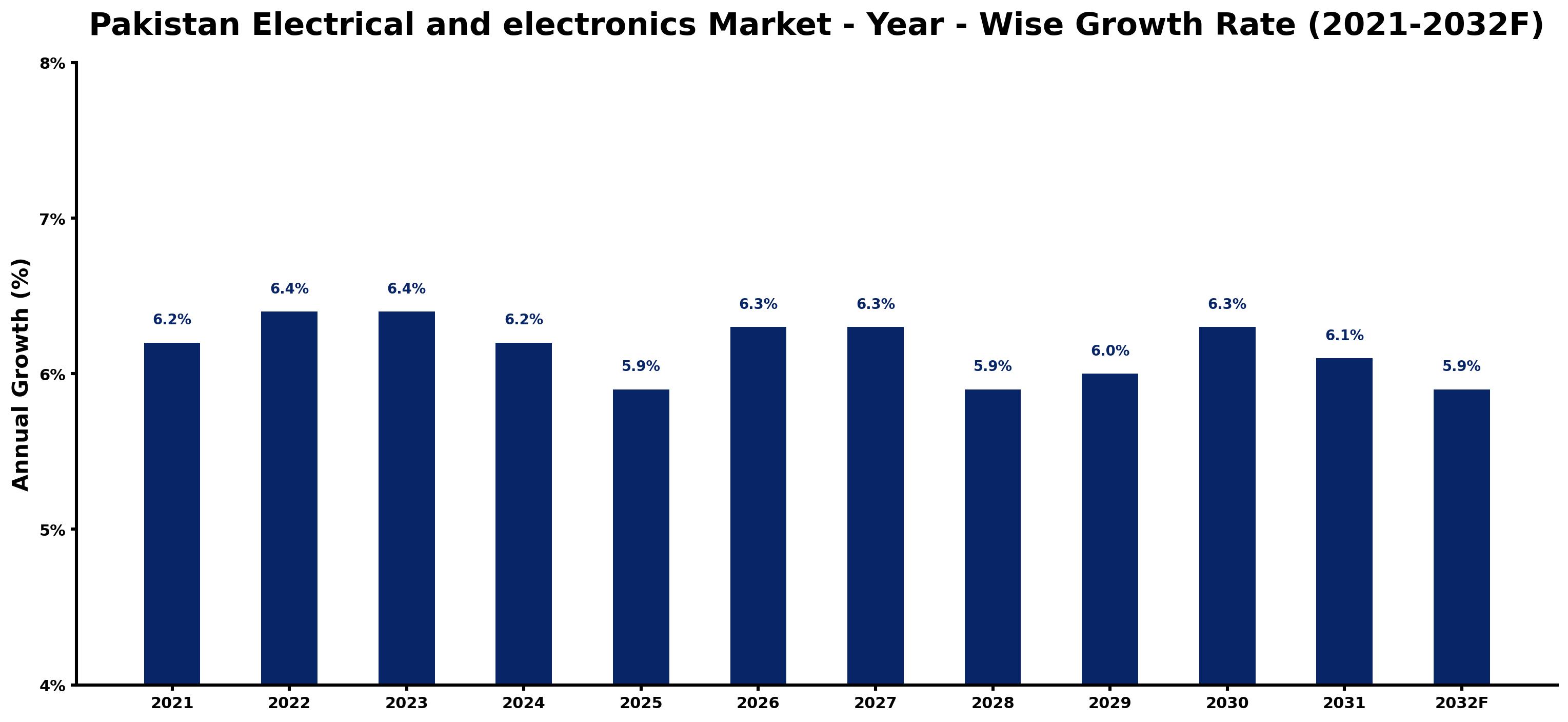
The table below presents the year wise growth rates along with the key drivers influencing the market
| Year | Growth Rate | Major Drivers |
| 2021 | 6.2% | Post-lockdown retail projects sparked interest in consumer electronics across urban centers. |
| 2022 | 6.4% | Manufacturers initiated local assembly to reduce import tariffs and enhance market access. |
| 2023 | 6.4% | Emerging middle class increasingly demands affordable energy-efficient appliances for homes. |
| 2024 | 6.2% | Urbanization trends create a need for smart city solutions and integrated technologies. |
| 2025 | 5.9% | E-commerce platforms gain traction, reshaping consumer purchasing behaviors in electronics. |
| 2026 | 6.3% | Government interest in renewable energy drives investments in solar-powered electronic devices. |
| 2027 | 6.3% | Rural electrification projects boost market potential for basic electronic appliances significantly. |
| 2028 | 5.9% | Local startups innovate in smart home technology, gaining traction among tech-savvy consumers. |
| 2029 | 6.0% | Regional collaborations enhance supply chain efficiency, reducing costs in electronic manufacturing. |
| 2030 | 6.3% | Consumer demand for sustainable products influences manufacturers to adopt eco-friendly practices. |
| 2031 | 6.1% | Technological advancements in production streamline operations, increasing output capacity for firms. |
| 2032 | 5.9% | Expanding infrastructure investments accelerate access to modern electrical systems nationwide. |
Note - Market size estimations and growth projections presented in this report are based on 6Wresearch's advanced forecasting approach, validated with industry datasets as of June 2026.
Pakistan Electrical and electronics Market Synopsis
The Pakistan Electrical and electronics Market is projected to reach 6.3% and witness significant growth during the forecast period (2026-2032). This dynamic sector is influenced by several factors including rapid urbanization, increased industrialization, and an expanding middle class. With a broad spectrum of offerings ranging from consumer electronics to industrial machinery, the market reflects both local manufacturing initiatives and the presence of international brands. Additionally, government policies aimed at enhancing infrastructure and energy access are playing a pivotal role in propelling market growth, leading to numerous opportunities for investors.
Pakistan Electrical and electronics Market Growth Drivers
The growth of the Pakistan Electrical and electronics Market is underpinned by various key drivers that are fostering a conducive environment for expansion. Firstly, the accelerating pace of urbanization is leading to higher demand for electrical appliances and consumer electronics in urban areas. Secondly, the industrial sector's growth necessitates the adoption of advanced industrial machinery and equipment, fueling overall market demand. Thirdly, the rise of the middle-class population is contributing to increased purchasing power, which is driving consumer spending on electronics and home appliances. Fourthly, government initiatives to support renewable energy solutions are opening up new avenues for products such as solar panels and energy-efficient devices. Finally, technological advancements in smart home technologies are reshaping consumer preferences, encouraging the adoption of innovative electrical solutions.
Pakistan Electrical and electronics Market Trends and Opportunities
In the evolving landscape of the Pakistan Electrical and electronics Market, notable trends are emerging that highlight both challenges and opportunities. The increasing consumer preference for energy-efficient appliances is evident, with heightened demand for air conditioners, refrigerators, and LED lighting solutions. Moreover, the integration of smart technologies into daily life is creating a surge in demand for smart home products, such as automated lighting systems and security devices. Another significant trend is the burgeoning interest in renewable energy products, underpinned by sustainability goals to reduce dependence on fossil fuels. This sector is witnessing advancements in solar technology and energy storage systems, aligning with global trends of sustainable energy consumption. Furthermore, the focus on digital transformation is prompting local industries to invest in Internet of Things (IoT) devices, which are expected to proliferate in both residential and commercial settings.
Pakistan Electrical and electronics Market Challenges and Restraints
The Pakistan Electrical and electronics Market encounters several challenges that may hinder its growth trajectory. One of the primary concerns is inconsistent government policy, which can create uncertainty for investors and affect long-term planning. Frequent power shortages disrupt manufacturing processes, leading to supply chain inefficiencies. High import duties and taxes on electronic components impose additional financial burdens on manufacturers, adversely impacting production costs. The limited availability of advanced technology and a skilled workforce pose further hurdles for innovation within the sector. Additionally, counterfeiting of electrical products raises significant safety concerns among consumers, undermining trust and reliability in the market. Addressing these challenges will necessitate strategic collaboration among stakeholders to foster a stable and supportive environment for the industry.
Pakistan Electrical and electronics Market Investment Opportunities
Investment opportunities in the Pakistan Electrical and electronics Market are burgeoning, driven by various factors including urbanization, infrastructure development, and technological advancements. One promising area for investment lies in renewable energy solutions. As demand for solar panels and wind turbines escalates, opportunities for companies specializing in these sectors are becoming increasingly viable. Additionally, the rise in consumer interest in smart devices and home automation technologies presents significant prospects for businesses in the production of innovative products designed to enhance convenience and efficiency. The government's commitment to improving power generation and distribution infrastructure offers further chances for investment in electrical equipment manufacturing and related sectors. Overall, these dynamics position the market as a fertile ground for growth and profitability for both local and international investors.
Pakistan Electrical and electronics Market Government Investment and Initiatives
The government of Pakistan has rolled out several initiatives aimed at bolstering the electrical and electronics market. These initiatives align with national goals to enhance local manufacturing capabilities while ensuring quality standards. The government offers incentives such as tax breaks and subsidies to attract foreign investment in the sector, facilitating essential technology transfers that bolster domestic production. Furthermore, regulations have been established to promote the safety and reliability of electrical products, imposing certification requirements on both imports and local manufacturers. Additionally, research and development efforts are encouraged, aimed at fostering innovation within the market. Collectively, these government policies strive to create an environment conducive to sustainable growth and attract further investments into the Pakistan Electrical and electronics Market.
Pakistan Electrical and electronics Market Latest Developments (May 2025 - June 2026)
Recent developments in the Pakistan Electrical and electronics Market between May 2025 and June 2026 reflect a dynamic shift driven by technological advancements and regulatory changes. There has been a noticeable increase in initiatives focused on promoting renewable energy solutions, highlighting the government's commitment to reducing carbon emissions and fossil fuel dependence. The market is also observing a rise in partnerships aimed at advancing smart technology adoption, particularly in urban centers where consumer demand for automation is growing. Additionally, efforts to improve industrial infrastructure continue to advance, with a focus on enhancing supply chain efficiencies and reducing production disruptions. Regulatory reforms are being introduced to simplify processes and promote fair competition, fostering a more investor-friendly environment. Collectively, these trends indicate a vibrant and evolving market landscape, paving the way for future growth.
Pakistan Electrical and electronics Market - Key Attractiveness of the Report
- 10 Years of Market Numbers
- Historical Data Starting from 2022 to 2025
- Base Year: 2025
- Forecast Data until 2032
- Key Performance Indicators Impacting the Market
- Major Upcoming Developments and Projects
Key Highlights of the Report:
- Pakistan Electrical and electronics Market Outlook
- Market Size of Pakistan Electrical and electronics Market, 2025
- Forecast of Pakistan Electrical and electronics Market, 2032F
- Historical Data and Forecast of Pakistan Electrical and electronics Revenues & Volume for the Period 2022-2032F
- Pakistan Electrical and electronics Market Trend Evolution
- Pakistan Electrical and electronics Market Drivers and Challenges
- Pakistan Electrical and electronics Price Trends
- Pakistan Electrical and electronics Porter's Five Forces
- Pakistan Electrical and electronics Industry Life Cycle
- Historical Data and Forecast of Pakistan Electrical and electronics Market Revenues & Volume By Type for the Period 2022-2032F
- Historical Data and Forecast of Pakistan Electrical and electronics Market Revenues & Volume By Electric Motors for the Period 2022-2032F
- Historical Data and Forecast of Pakistan Electrical and electronics Market Revenues & Volume By Primary And Storage Batteries for the Period 2022-2032F
- Historical Data and Forecast of Pakistan Electrical and electronics Market Revenues & Volume By Generators for the Period 2022-2032F
- Historical Data and Forecast of Pakistan Electrical and electronics Market Revenues & Volume By Semiconductors for the Period 2022-2032F
- Historical Data and Forecast of Pakistan Electrical and electronics Market Revenues & Volume By Household Appliances for the Period 2022-2032F
- Historical Data and Forecast of Pakistan Electrical and electronics Market Revenues & Volume By Applications for the Period 2022-2032F
- Historical Data and Forecast of Pakistan Electrical and electronics Market Revenues & Volume By Online for the Period 2022-2032F
- Historical Data and Forecast of Pakistan Electrical and electronics Market Revenues & Volume By Offline for the Period 2022-2032F
- Pakistan Electrical and electronics Import Export Trade Statistics
- Market Opportunity Assessment By Type
- Market Opportunity Assessment By Applications
- Pakistan Electrical and electronics Top Companies Market Share
- Pakistan Electrical and electronics Competitive Benchmarking By Technical and Operational Parameters
- Pakistan Electrical and electronics Company Profiles
- Pakistan Electrical and electronics Key Strategic Recommendations






































