Pakistan Industrial Vacuum Cleaner Market Size, Share & Growth Rate
The Pakistan Industrial Vacuum Cleaner Market was estimated at USD 245 Million in 2025 and is projected to reach USD 268 Million by 2032, growing at a CAGR of 1.3% from 2026 to 2032. This modest growth trajectory reflects an increasing awareness of hygiene and cleanliness in industrial settings, driven largely by stringent safety regulations in sectors such as food processing and pharmaceuticals. Additionally, the rising demand for efficient cleaning solutions across various industries is propelling investments in high-performance vacuum technology.
Pakistan Industrial Vacuum Cleaner Market Year-wise Growth Rate and Key Drivers
This graph highlights how the Pakistan Industrial Vacuum Cleaner Market has steadily grown over the years, supported by major growth factors.
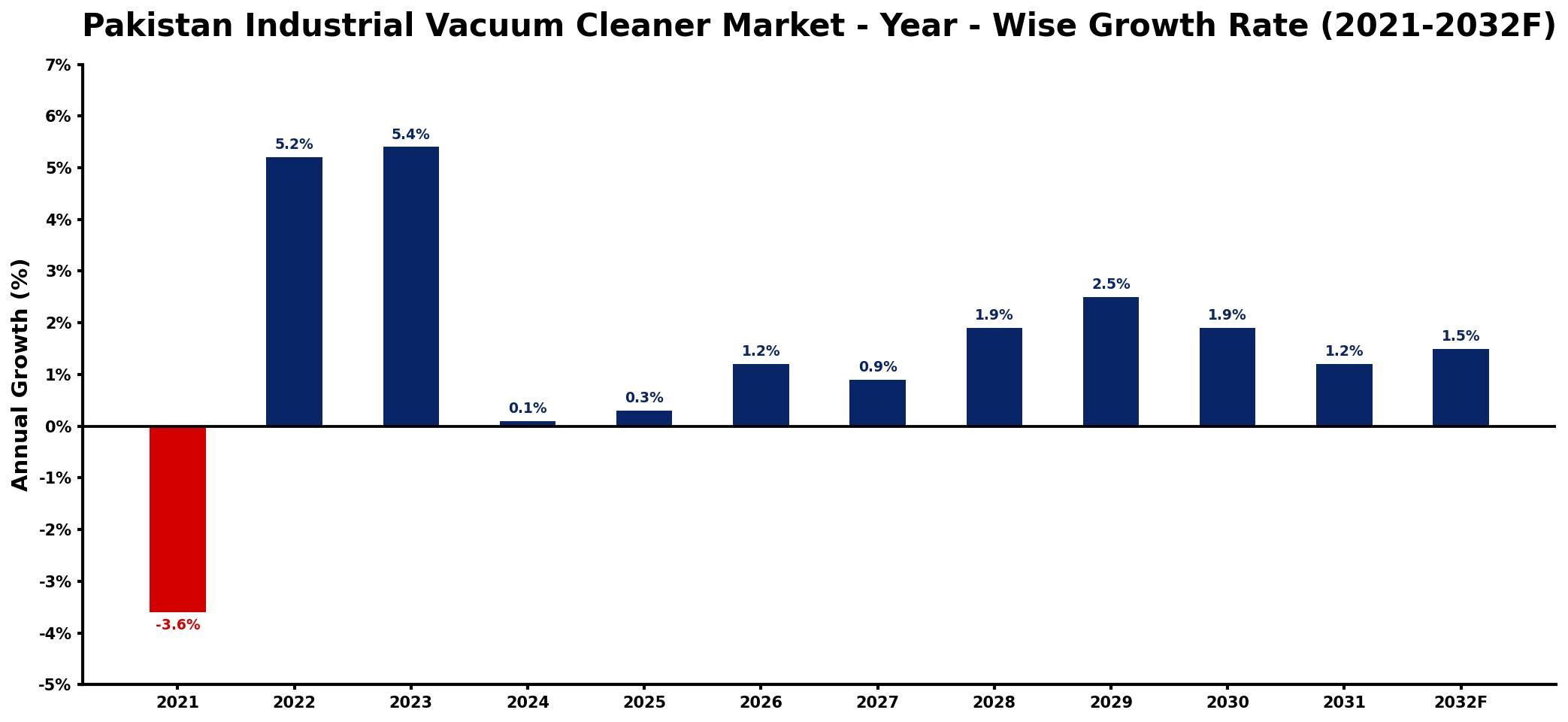
The table below presents the year‑wise growth rates along with the key drivers influencing the market
| Year | Growth Rate | Major Drivers |
| 2021 | -3.6% | decrease in manufacturing output |
| 2022 | 5.2% | increased investment in automation |
| 2023 | 5.4% | growing demand from construction sector |
| 2024 | 0.1% | expansion of logistics facilities |
| 2025 | 0.3% | rising focus on hygiene standards |
| 2026 | 1.2% | growth in food processing industry |
| 2027 | 0.9% | enhanced warehouse management systems |
| 2028 | 1.9% | emergence of new retail spaces |
| 2029 | 2.5% | increased environmental regulations compliance |
| 2030 | 1.9% | development of smart factories |
| 2031 | 1.2% | increased domestic production output |
| 2032 | 1.5% | improved processing technologies adoption |
Note: Market size estimations and growth projections presented in this report are based on 6Wresearch's proprietary forecasting methodology, utilizing the latest available industry data, government publications, and primary research inputs.
Pakistan Industrial Vacuum Cleaner Market Synopsis
In Pakistan, the necessity for industrial vacuum cleaners has surged as organizations prioritize maintaining high cleanliness standards in their operations. This trend is particularly significant in the food processing sector, where hygiene directly impacts product safety and compliance with local and international regulations.
Moreover, the growing emphasis on workplace safety has led industries to adopt advanced cleaning equipment that not only enhances cleanliness but also contributes to overall employee well-being. As organizations evolve, there is a clear shift towards eco-friendly vacuum options, aligning with global sustainability trends.
Pakistan Industrial Vacuum Cleaner Market Key Takeaways
- The market is experiencing growth due to heightened hygiene awareness in industrial operations.
- Key sectors driving demand include manufacturing, food processing, and pharmaceuticals.
- Innovations in vacuum cleaner technology are addressing performance and reliability challenges.
- Government policies favor energy-efficient and environmentally friendly cleaning solutions.
- Emerging market segments include eco-conscious businesses investing in sustainable cleaning equipment.
Evaluation of Restraints in Pakistan Industrial Vacuum Cleaner Market
The Pakistan Industrial Vacuum Cleaner Market faces several limitations that could impede its growth. A significant challenge lies in the performance requirements expected from vacuum cleaners, especially in demanding environments such as construction sites or large manufacturing plants. Durability remains a concern, as industrial equipment must withstand heavy use. Moreover, the need for vacuum cleaners that offer exceptional suction power and high filtration efficiency is imperative, complicating the design and manufacturing processes for suppliers. These challenges require a careful balance of cost, performance, and reliability.
Pakistan Industrial Vacuum Cleaner Market Trends
Current trends in the Pakistan Industrial Vacuum Cleaner Market reveal a movement towards smart technology integration. Manufacturers are increasingly focusing on developing vacuum cleaners with IoT capabilities, allowing for real-time monitoring and maintenance alerts, thereby optimizing cleaning efficiency. Additionally, the growth of e-commerce platforms is expanding the accessibility of various vacuum models, enabling businesses to find tailored solutions more conveniently.
Furthermore, the shift toward environmentally friendly practices is gaining traction, prompting manufacturers to innovate with sustainable materials and energy-efficient models. This trend aligns well with global sustainability initiatives and resonates with eco-conscious consumers and businesses.
Pakistan Industrial Vacuum Cleaner Market Opportunities
The industrial vacuum cleaner market in Pakistan presents lucrative growth opportunities, particularly in the realm of customization. Companies looking for specific cleaning solutions can drive demand for specialized vacuum cleaners tailored to niche sectors. Moreover, as urbanization accelerates and industries expand, there is a growing potential for introducing advanced cleaning technologies across emerging manufacturing hubs.
Investments in research and development focused on enhancing product durability and filtration efficiency will also open new avenues. The development of energy-efficient models aligns with government incentives, providing manufacturers with a competitive edge while catering to eco-conscious clients.
Government Initiatives in the Pakistan Industrial Vacuum Cleaner Market
The Pakistani government is actively promoting the adoption of eco-friendly technologies in the industrial sector. Recent initiatives include enforcing stringent performance standards for industrial cleaning equipment, ensuring safety and effectiveness. Additionally, incentives for manufacturers producing energy-efficient models encourage innovation and investment in cleaner technologies, further supporting the market's growth.
Future Insights of the Pakistan Industrial Vacuum Cleaner Market
Looking forward, from 2026 to 2032, the Pakistan Industrial Vacuum Cleaner Market is expected to evolve significantly. As industries continue to prioritize cleanliness and sustainability, demand for high-efficiency vacuum systems will rise. The integration of smart technologies and the ongoing shift towards eco-friendly models will likely dominate the future landscape, positioning manufacturers who embrace innovation at the forefront of the market.
Pakistan Industrial Vacuum Cleaner Market Latest Developments (2025 - 2026)
Recent developments in the Pakistan Industrial Vacuum Cleaner Market have indicated a greater emphasis on digital transformation. Companies are adopting cloud-based technologies for better operational efficiency and integrating advanced filtration systems into new models. Additionally, there is an increase in collaborative initiatives between industry stakeholders aimed at enhancing product standards and encouraging sustainable practices.
Pakistan Industrial Vacuum Cleaner Market - Key Attractiveness of the Report
- 10 Years of Market Numbers
- Historical Data Starting from 2022 to 2025
- Base Year: 2025
- Forecast Data until 2032
- Key Performance Indicators Impacting the Market
- Major Upcoming Developments and Projects
Key Highlights of the Report:
- Pakistan Industrial Vacuum Cleaner Market Outlook
- Market Size of Pakistan Industrial Vacuum Cleaner Market, 2025
- Forecast of Pakistan Industrial Vacuum Cleaner Market, 2032
- Historical Data and Forecast of Pakistan Industrial Vacuum Cleaner Revenues & Volume for the Period 2022-2032F
- Pakistan Industrial Vacuum Cleaner Market Trend Evolution
- Pakistan Industrial Vacuum Cleaner Market Drivers and Challenges
- Pakistan Industrial Vacuum Cleaner Price Trends
- Pakistan Industrial Vacuum Cleaner Porter's Five Forces
- Pakistan Industrial Vacuum Cleaner Industry Life Cycle
- Historical Data and Forecast of Pakistan Industrial Vacuum Cleaner Market Revenues & Volume By Type for the Period 2022-2032F
- Historical Data and Forecast of Pakistan Industrial Vacuum Cleaner Market Revenues & Volume By Dry for the Period 2022-2032F
- Historical Data and Forecast of Pakistan Industrial Vacuum Cleaner Market Revenues & Volume By Wet & Dry for the Period 2022-2032F
- Historical Data and Forecast of Pakistan Industrial Vacuum Cleaner Market Revenues & Volume By Power Source for the Period 2022-2032F
- Historical Data and Forecast of Pakistan Industrial Vacuum Cleaner Market Revenues & Volume By Electric for the Period 2022-2032F
- Historical Data and Forecast of Pakistan Industrial Vacuum Cleaner Market Revenues & Volume By Pneumatic for the Period 2022-2032F
- Historical Data and Forecast of Pakistan Industrial Vacuum Cleaner Market Revenues & Volume By Industry for the Period 2022-2032F
- Historical Data and Forecast of Pakistan Industrial Vacuum Cleaner Market Revenues & Volume By Food & Beverages for the Period 2022-2032F
- Historical Data and Forecast of Pakistan Industrial Vacuum Cleaner Market Revenues & Volume By Metalworking for the Period 2022-2032F
- Historical Data and Forecast of Pakistan Industrial Vacuum Cleaner Market Revenues & Volume By Pharmaceuticals for the Period 2022-2032F
- Historical Data and Forecast of Pakistan Industrial Vacuum Cleaner Market Revenues & Volume By Manufacturing for the Period 2022-2032F
- Historical Data and Forecast of Pakistan Industrial Vacuum Cleaner Market Revenues & Volume By Building & Construction for the Period 2022-2032F
- Historical Data and Forecast of Pakistan Industrial Vacuum Cleaner Market Revenues & Volume By Others for the Period 2022-2032F
- Pakistan Industrial Vacuum Cleaner Import Export Trade Statistics
- Market Opportunity Assessment By Type
- Market Opportunity Assessment By Power Source
- Market Opportunity Assessment By Industry
- Pakistan Industrial Vacuum Cleaner Top Companies Market Share
- Pakistan Industrial Vacuum Cleaner Competitive Benchmarking By Technical and Operational Parameters
- Pakistan Industrial Vacuum Cleaner Company Profiles
- Pakistan Industrial Vacuum Cleaner Key Strategic Recommendations






































