Pakistan Licensed Merchandise Market Size, Share & Growth Rate
The Pakistan Licensed Merchandise Market was estimated at USD 169 Million in 2025 and is projected to reach USD 237 Million by 2032, growing at a CAGR of 4.9% from 2026 to 2032. This growth trajectory is underpinned by a burgeoning middle-class population with increasing disposable incomes, alongside a growing demand for branded merchandise across various sectors including apparel, toys, and accessories. The surge in popularity of global entertainment franchises and local icons is also fueling the market, creating a fertile environment for international and domestic collaborations.
Pakistan Licensed Merchandise Market Year-wise Growth Rate and Key Drivers
This graph highlights how the Pakistan Licensed Merchandise Market has steadily grown over the years, supported by major growth factors.
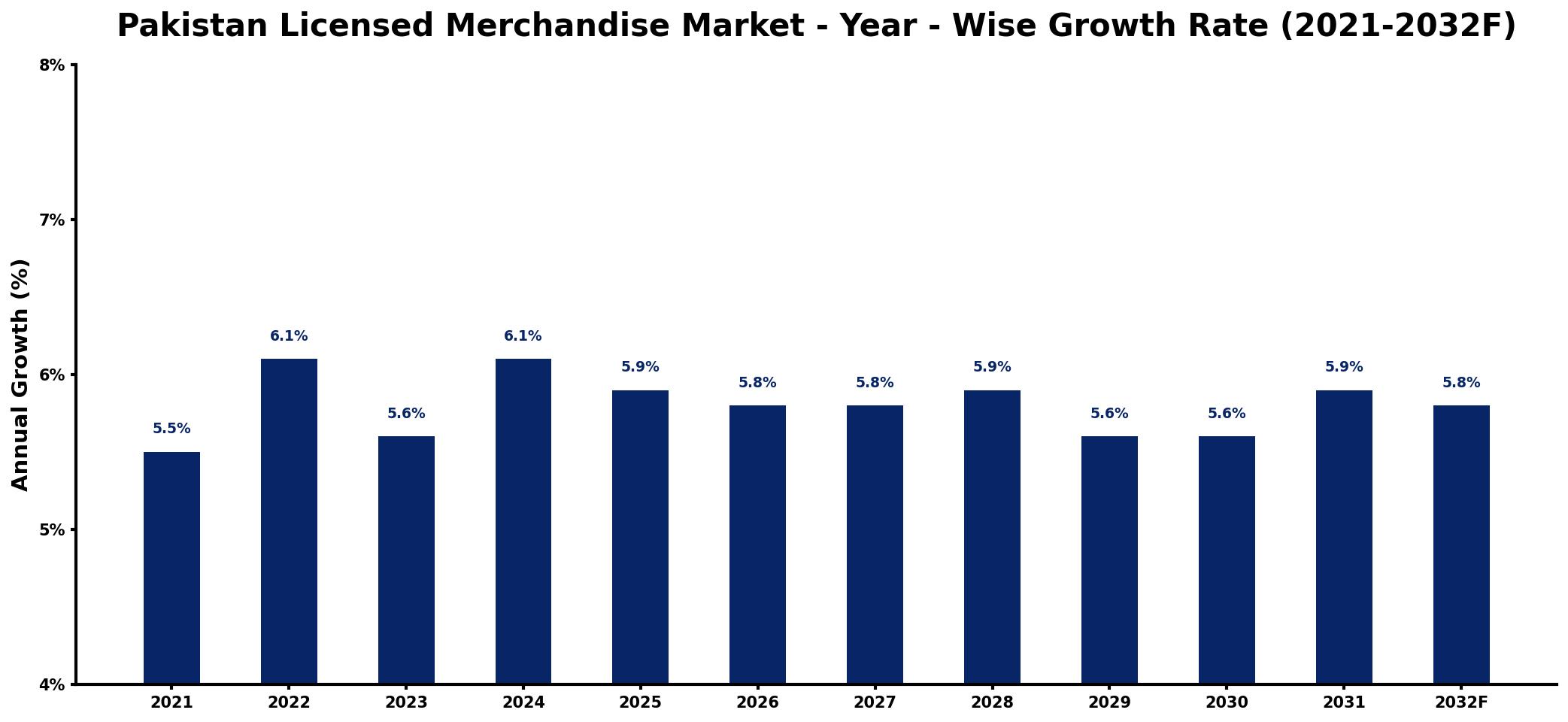
The table below presents the year‑wise growth rates along with the key drivers influencing the market
| Year | Growth Rate | Major Drivers |
| 2021 | 5.5% | Rising consumer brand engagement |
| 2022 | 6.1% | Increased retail outlet expansion |
| 2023 | 5.6% | Growing online shopping popularity |
| 2024 | 6.1% | Enhanced marketing collaborations emerging |
| 2025 | 5.9% | Diversification of product offerings |
| 2026 | 5.8% | Strengthening partnerships with influencers |
| 2027 | 5.8% | Boost in youth consumer spending |
| 2028 | 5.9% | Expansion of event sponsorship opportunities |
| 2029 | 5.6% | Increased focus on sustainability initiatives |
| 2030 | 5.6% | Growth in international collaborations |
| 2031 | 5.9% | Emergence of new distribution channels |
| 2032 | 5.8% | Rise in cultural event participation |
Note: Market size estimations and growth projections presented in this report are based on 6Wresearch's proprietary forecasting methodology, utilizing the latest available industry data, government publications, and primary research inputs.
Pakistan Licensed Merchandise Market Synopsis
In Pakistan, there is a notable increase in consumer preference for licensed merchandise, particularly among the youth demographic that actively engages with global pop culture. This shift is marked by a growing enthusiasm for products that feature characters and brands from popular media and sports.
Moreover, the expansion of e-commerce platforms has significantly enhanced accessibility to licensed products, allowing consumers from urban and rural areas alike to explore a wider range of options. This digital transformation is driving new consumer behaviors and expanding market reach across the country.
Pakistan Licensed Merchandise Market Key Takeaways
- The market is driven by a rising middle-class population with a growing inclination towards branded products.
- International brands are increasingly forming licensing agreements with local manufacturers to penetrate the market.
- There is a notable shift towards licensed merchandise that celebrates local culture and heritage.
- E-commerce is transforming how consumers access licensed merchandise, driving overall market growth.
- Investment opportunities abound in sectors such as entertainment, sports, and fashion.
Evaluation of Restraints in Pakistan Licensed Merchandise Market
Despite its potential, the Pakistan Licensed Merchandise Market faces significant challenges. A lack of consumer awareness regarding the benefits of licensed products often leads to a preference for counterfeit goods. The weak enforcement of intellectual property rights complicates brand protection efforts for licensed merchandise companies. Furthermore, limited distribution channels and high licensing costs can deter market entry and expansion. The socio-economic landscape marked by political instability also creates uncertainties that impact consumer spending and overall market demand.
Pakistan Licensed Merchandise Market Trends
Current trends in the Pakistan Licensed Merchandise Market illustrate a preference for licensed products that incorporate popular international characters, reflecting the influence of global pop culture. Simultaneously, there is a rise in demand for merchandise that resonates with local cultural narratives and national pride, appealing to the emotional sentiments of consumers.
Additionally, the evolution of shopping behaviors, primarily driven by the growth of online retail, is reshaping how consumers discover and purchase licensed products. This transition presents opportunities for brands to engage with consumers through innovative marketing strategies that capitalize on digital platforms.
Pakistan Licensed Merchandise Market Opportunities
The Pakistan Licensed Merchandise Market is brimming with investment opportunities. Given the growing demand for branded products, sectors such as entertainment, sports, and fashion are particularly lucrative for both local and international licensors. Collaborations with recognized global brands can help local businesses enhance their market appeal and leverage established brand loyalty.
Moreover, the potential for creating unique products that blend international appeal with local cultural elements can attract a diverse consumer base. By tapping into these opportunities, companies can foster innovation and drive significant growth within this dynamic market.
Government Initiatives in the Pakistan Licensed Merchandise Market
The Pakistan Licensed Merchandise Market is regulated by the Intellectual Property Organization of Pakistan (IPO-Pakistan), which aims to ensure the protection and enforcement of intellectual property rights. The government is actively collaborating with international bodies to align local laws with global standards, enhancing the framework for licensing agreements. Additionally, initiatives to strengthen intellectual property rights enforcement are underway, addressing counterfeiting and promoting a more favorable environment for legitimate licensed merchandise.
Future Insights of the Pakistan Licensed Merchandise Market
Looking ahead to 2026-2032, the Pakistan Licensed Merchandise Market is set to experience substantial expansion. Increased consumer awareness and a shift towards branded products will continue to drive market growth, particularly among the youthful demographic. The evolving landscape of digital commerce, paired with rising disposable incomes, promises to attract more international licensors seeking to engage with the burgeoning consumer base. As the market diversifies, opportunities for innovative partnerships and product offerings will further enhance competitiveness and revenue potential.
Pakistan Licensed Merchandise Market Latest Developments (2025 - 2026)
In recent months, there has been a noticeable increase in collaboration between local manufacturers and international licensors, aimed at creating a unique range of licensed products tailored for the Pakistani market. Furthermore, e-commerce platforms have been expanding their partnerships with licensed merchandise providers, enhancing product availability across the country. Initiatives to improve awareness around intellectual property rights are also gaining momentum, supported by various campaigns aimed at educating consumers on the importance of purchasing licensed products.
Pakistan Licensed Merchandise Market - Key Attractiveness of the Report
- 10 Years of Market Numbers
- Historical Data Starting from 2022 to 2025
- Base Year: 2025
- Forecast Data until 2032
- Key Performance Indicators Impacting the Market
- Major Upcoming Developments and Projects
Key Highlights of the Report:
- Pakistan Licensed Merchandise Market Outlook
- Market Size of Pakistan Licensed Merchandise Market, 2025
- Forecast of Pakistan Licensed Merchandise Market, 2032
- Historical Data and Forecast of Pakistan Licensed Merchandise Revenues & Volume for the Period 2022-2032F
- Pakistan Licensed Merchandise Market Trend Evolution
- Pakistan Licensed Merchandise Market Drivers and Challenges
- Pakistan Licensed Merchandise Price Trends
- Pakistan Licensed Merchandise Porter's Five Forces
- Pakistan Licensed Merchandise Industry Life Cycle
- Historical Data and Forecast of Pakistan Licensed Merchandise Market Revenues & Volume By Product Type for the Period 2022-2032F
- Historical Data and Forecast of Pakistan Licensed Merchandise Market Revenues & Volume By Apparel and Footwear for the Period 2022-2032F
- Historical Data and Forecast of Pakistan Licensed Merchandise Market Revenues & Volume By Accessories and Gifts for the Period 2022-2032F
- Historical Data and Forecast of Pakistan Licensed Merchandise Market Revenues & Volume By Toys and Games for the Period 2022-2032F
- Historical Data and Forecast of Pakistan Licensed Merchandise Market Revenues & Volume By Others for the Period 2022-2032F
- Historical Data and Forecast of Pakistan Licensed Merchandise Market Revenues & Volume By for the Period 2022-2032F
- Historical Data and Forecast of Pakistan Licensed Merchandise Market Revenues & Volume By Distribution Channel for the Period 2022-2032F
- Historical Data and Forecast of Pakistan Licensed Merchandise Market Revenues & Volume By Online Stores for the Period 2022-2032F
- Historical Data and Forecast of Pakistan Licensed Merchandise Market Revenues & Volume By Supermarkets and Hypermarkets for the Period 2022-2032F
- Historical Data and Forecast of Pakistan Licensed Merchandise Market Revenues & Volume By Departmental Stores for the Period 2022-2032F
- Historical Data and Forecast of Pakistan Licensed Merchandise Market Revenues & Volume By Specialty Stores for the Period 2022-2032F
- Historical Data and Forecast of Pakistan Licensed Merchandise Market Revenues & Volume By Others for the Period 2022-2032F
- Historical Data and Forecast of Pakistan Licensed Merchandise Market Revenues & Volume By for the Period 2022-2032F
- Historical Data and Forecast of Pakistan Licensed Merchandise Market Revenues & Volume By Price Range for the Period 2022-2032F
- Historical Data and Forecast of Pakistan Licensed Merchandise Market Revenues & Volume By Premium for the Period 2022-2032F
- Historical Data and Forecast of Pakistan Licensed Merchandise Market Revenues & Volume By Economic for the Period 2022-2032F
- Historical Data and Forecast of Pakistan Licensed Merchandise Market Revenues & Volume By for the Period 2022-2032F
- Historical Data and Forecast of Pakistan Licensed Merchandise Market Revenues & Volume By End-User for the Period 2022-2032F
- Historical Data and Forecast of Pakistan Licensed Merchandise Market Revenues & Volume By Men for the Period 2022-2032F
- Historical Data and Forecast of Pakistan Licensed Merchandise Market Revenues & Volume By Women for the Period 2022-2032F
- Historical Data and Forecast of Pakistan Licensed Merchandise Market Revenues & Volume By Children for the Period 2022-2032F
- Pakistan Licensed Merchandise Import Export Trade Statistics
- Market Opportunity Assessment By Product Type
- Market Opportunity Assessment By Distribution Channel
- Market Opportunity Assessment By Price Range
- Market Opportunity Assessment By End-User
- Pakistan Licensed Merchandise Top Companies Market Share
- Pakistan Licensed Merchandise Competitive Benchmarking By Technical and Operational Parameters
- Pakistan Licensed Merchandise Company Profiles
- Pakistan Licensed Merchandise Key Strategic Recommendations






































