Pakistan Penicillin Market: Import Trend Analysis
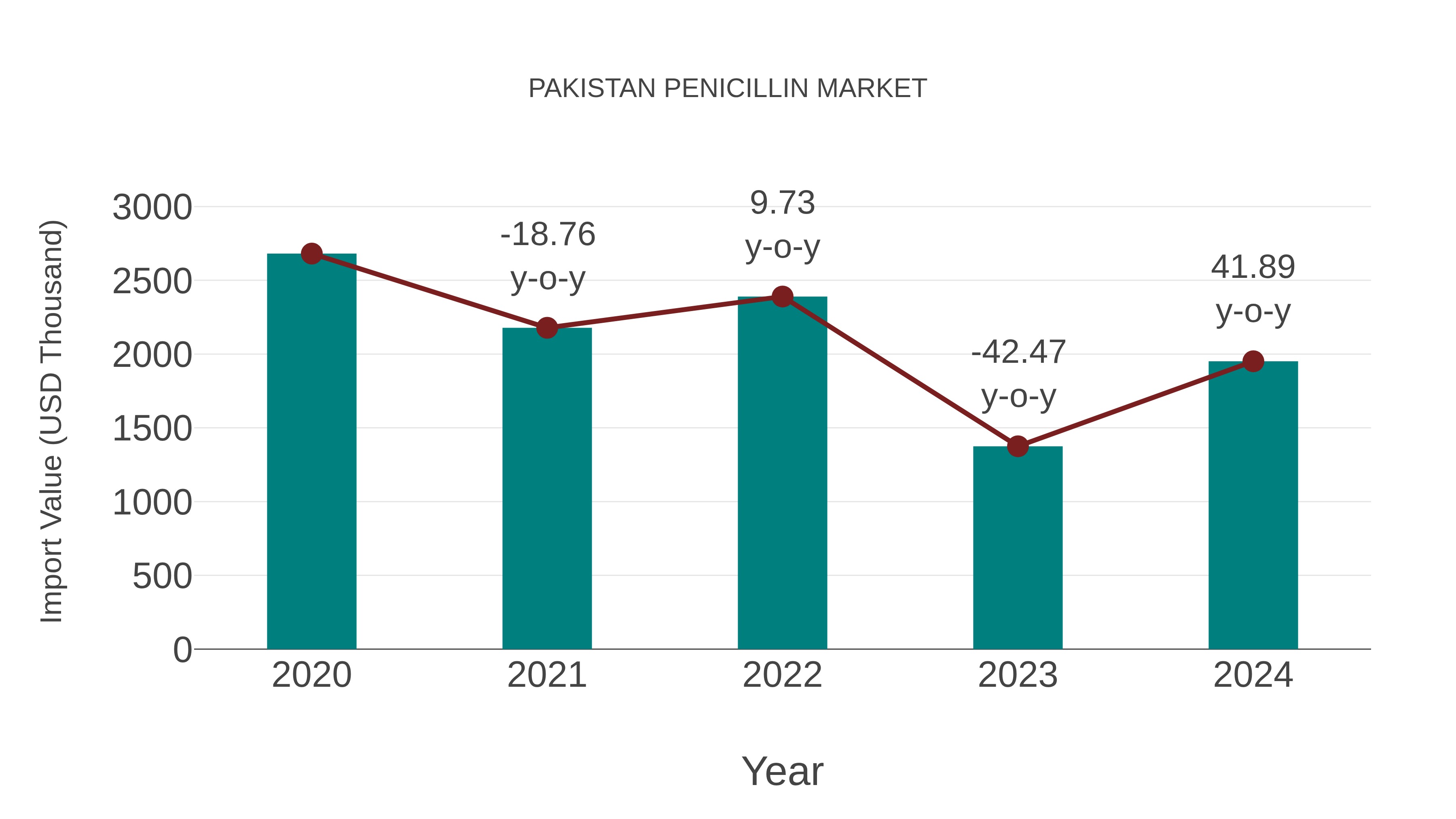
Pakistan import trend for the penicillin market saw a notable growth rate of 41.89% from 2023 to 2024, while the compound annual growth rate (CAGR) for 2020-2024 stood at -7.64%. This shift could be attributed to evolving healthcare needs or changes in trade policies impacting imports.
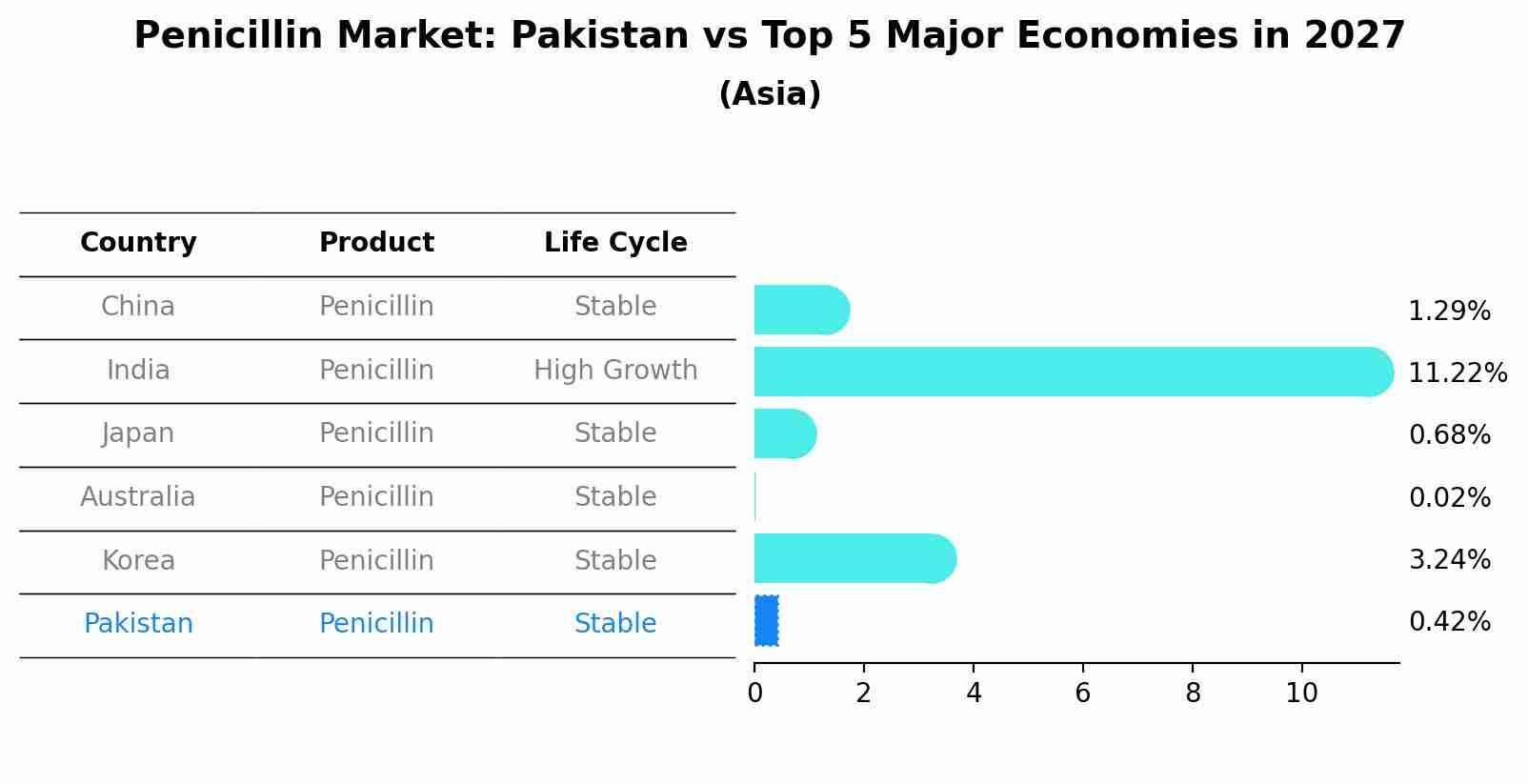
Penicillin Market: Pakistan vs Top 5 Major Economies in 2027 (Asia)
By 2027, the Penicillin market in Pakistan is anticipated to reach a growth rate of 0.42%, as part of an increasingly competitive Asia region, where China remains at the forefront, supported by India, Japan, Australia and South Korea, driving innovations and market adoption across sectors.
Pakistan Penicillin Market Overview
The Pakistan Penicillin market is experiencing steady growth driven by factors such as the increasing prevalence of bacterial infections, growing awareness about the benefits of penicillin antibiotics, and the expanding healthcare infrastructure in the country. The market is dominated by key players offering a wide range of penicillin-based products, including oral tablets, injections, and topical formulations. Government initiatives to improve access to essential medicines and rising healthcare expenditure are further propelling market growth. However, challenges such as the emergence of antibiotic resistance and the presence of counterfeit or substandard drugs pose significant hurdles to market expansion. Overall, the Pakistan Penicillin market is poised for continued growth, with opportunities for innovation and strategic partnerships to meet the evolving healthcare needs of the population.
Pakistan Penicillin Market Trends
The Pakistan Penicillin market is witnessing a steady growth due to the increasing prevalence of bacterial infections and the rising demand for antibiotics. The market is also benefiting from the expansion of healthcare infrastructure and the growing awareness about the importance of timely and effective treatment. Generic versions of penicillin are gaining popularity due to their affordability, further driving market growth. Additionally, the government`s efforts to improve access to healthcare services and promote the use of essential medications are positively impacting the market. However, challenges such as the emergence of antibiotic resistance and stringent regulatory requirements are influencing market dynamics. Overall, the Pakistan Penicillin market is projected to continue its growth trajectory in the coming years, driven by factors such as increasing healthcare expenditure and advancements in medical technology.
Pakistan Penicillin Market Challenges
One of the key challenges faced in the Pakistan Penicillin Market is the presence of low-quality and counterfeit products. This not only poses a serious health risk to consumers but also undermines the credibility of legitimate manufacturers. The lack of stringent regulations and enforcement mechanisms further exacerbates this issue, making it difficult for consumers to distinguish between genuine and fake products. Additionally, the market faces challenges related to pricing pressures, limited access to healthcare in certain regions, and competition from alternative antibiotic medications. Addressing these challenges will require collaborative efforts from regulatory authorities, manufacturers, and healthcare providers to ensure the availability of safe and effective penicillin products in the market.
Pakistan Penicillin Market Investment Opportunities
The Pakistan Penicillin Market presents attractive investment opportunities due to the country`s rising healthcare expenditures, increasing prevalence of bacterial infections, and growing demand for antibiotics. With a large population and improving healthcare infrastructure, there is a growing need for effective and affordable antibiotics like penicillin. Investing in local pharmaceutical companies that manufacture penicillin products or partnering with international pharmaceutical companies to distribute their products in Pakistan could be lucrative strategies. Additionally, investing in research and development to improve the efficacy and safety of penicillin formulations could offer long-term growth potential in the Pakistan market. Overall, the Pakistan Penicillin Market offers promising investment prospects driven by the country`s healthcare needs and market dynamics.
Pakistan Penicillin Market Government Policy
The Pakistan Penicillin Market is regulated by government policies to ensure the safety, quality, and availability of penicillin products. The Drug Regulatory Authority of Pakistan (DRAP) governs the registration, pricing, and quality control of penicillin drugs in the country. Manufacturers are required to obtain approval from DRAP before marketing penicillin products, and pricing is regulated to ensure affordability for consumers. Additionally, quality control measures are in place to monitor the manufacturing, storage, and distribution of penicillin drugs to maintain product efficacy and safety standards. Compliance with these government policies is essential for companies operating in the Pakistan Penicillin Market to ensure the availability of high-quality and affordable penicillin products for the population.
Pakistan Penicillin Market Future Outlook
The Pakistan Penicillin Market is expected to witness steady growth in the coming years, driven by factors such as the increasing prevalence of bacterial infections, rising healthcare expenditure, and growing awareness about the benefits of antibiotic therapy. The market is likely to benefit from advancements in healthcare infrastructure and the introduction of new penicillin-based drugs. However, challenges such as the emergence of antibiotic resistance and regulatory hurdles may pose some constraints to market growth. Overall, with a growing population and improving access to healthcare services, the Pakistan Penicillin Market is poised for expansion, presenting opportunities for pharmaceutical companies to innovate and cater to the evolving healthcare needs of the population.
Key Highlights of the Report:
- Pakistan Penicillin Market Outlook
- Market Size of Pakistan Penicillin Market, 2025
- Forecast of Pakistan Penicillin Market, 2032
- Historical Data and Forecast of Pakistan Penicillin Revenues & Volume for the Period 2022 - 2032F
- Pakistan Penicillin Market Trend Evolution
- Pakistan Penicillin Market Drivers and Challenges
- Pakistan Penicillin Price Trends
- Pakistan Penicillin Porter's Five Forces
- Pakistan Penicillin Industry Life Cycle
- Historical Data and Forecast of Pakistan Penicillin Market Revenues & Volume By Product for the Period 2022 - 2032F
- Historical Data and Forecast of Pakistan Penicillin Market Revenues & Volume By Bulk for the Period 2022 - 2032F
- Historical Data and Forecast of Pakistan Penicillin Market Revenues & Volume By Dosage for the Period 2022 - 2032F
- Historical Data and Forecast of Pakistan Penicillin Market Revenues & Volume By Type for the Period 2022 - 2032F
- Historical Data and Forecast of Pakistan Penicillin Market Revenues & Volume By Aminopenicillin for the Period 2022 - 2032F
- Historical Data and Forecast of Pakistan Penicillin Market Revenues & Volume By Antipseudomonal Penicillin for the Period 2022 - 2032F
- Historical Data and Forecast of Pakistan Penicillin Market Revenues & Volume By Beta-lactamase Inhibitor for the Period 2022 - 2032F
- Historical Data and Forecast of Pakistan Penicillin Market Revenues & Volume By Natural Penicillin for the Period 2022 - 2032F
- Historical Data and Forecast of Pakistan Penicillin Market Revenues & Volume By Penicillinase-resistant Penicillin for the Period 2022 - 2032F
- Historical Data and Forecast of Pakistan Penicillin Market Revenues & Volume By Manufacturing Process for the Period 2022 - 2032F
- Historical Data and Forecast of Pakistan Penicillin Market Revenues & Volume By Synthetic Process for the Period 2022 - 2032F
- Historical Data and Forecast of Pakistan Penicillin Market Revenues & Volume By Natural Process for the Period 2022 - 2032F
- Historical Data and Forecast of Pakistan Penicillin Market Revenues & Volume By Semisynthetic Process for the Period 2022 - 2032F
- Historical Data and Forecast of Pakistan Penicillin Market Revenues & Volume By Mode of Delivery for the Period 2022 - 2032F
- Historical Data and Forecast of Pakistan Penicillin Market Revenues & Volume By Oral for the Period 2022 - 2032F
- Historical Data and Forecast of Pakistan Penicillin Market Revenues & Volume By Intramuscular for the Period 2022 - 2032F
- Historical Data and Forecast of Pakistan Penicillin Market Revenues & Volume By Intravenous for the Period 2022 - 2032F
- Historical Data and Forecast of Pakistan Penicillin Market Revenues & Volume By End User for the Period 2022 - 2032F
- Historical Data and Forecast of Pakistan Penicillin Market Revenues & Volume By Hospitals for the Period 2022 - 2032F
- Historical Data and Forecast of Pakistan Penicillin Market Revenues & Volume By Clinics for the Period 2022 - 2032F
- Historical Data and Forecast of Pakistan Penicillin Market Revenues & Volume By Research Institutes for the Period 2022 - 2032F
- Historical Data and Forecast of Pakistan Penicillin Market Revenues & Volume By Others for the Period 2022 - 2032F
- Pakistan Penicillin Import Export Trade Statistics
- Market Opportunity Assessment By Product
- Market Opportunity Assessment By Type
- Market Opportunity Assessment By Manufacturing Process
- Market Opportunity Assessment By Mode of Delivery
- Market Opportunity Assessment By End User
- Pakistan Penicillin Top Companies Market Share
- Pakistan Penicillin Competitive Benchmarking By Technical and Operational Parameters
- Pakistan Penicillin Company Profiles
- Pakistan Penicillin Key Strategic Recommendations






































