Pakistan Potassium chlorate Market Size, Share & Growth Rate
The Pakistan Potassium chlorate Market was estimated at USD 385 Million in 2025 and is projected to reach USD 536 Million by 2032, growing at a CAGR of 4.8% from 2026 to 2032. This growth trajectory is driven by the increasing applications of potassium chlorate in manufacturing safety matches and fireworks, combined with a burgeoning agricultural sector that demands effective herbicides. As industries expand, the market's potential is set to rise, highlighting the importance of this chemical in various sectors.
Pakistan Potassium chlorate Market Year-wise Growth Rate and Key Drivers
This graph highlights how the Pakistan Potassium chlorate Market has steadily grown over the years, supported by major growth factors.
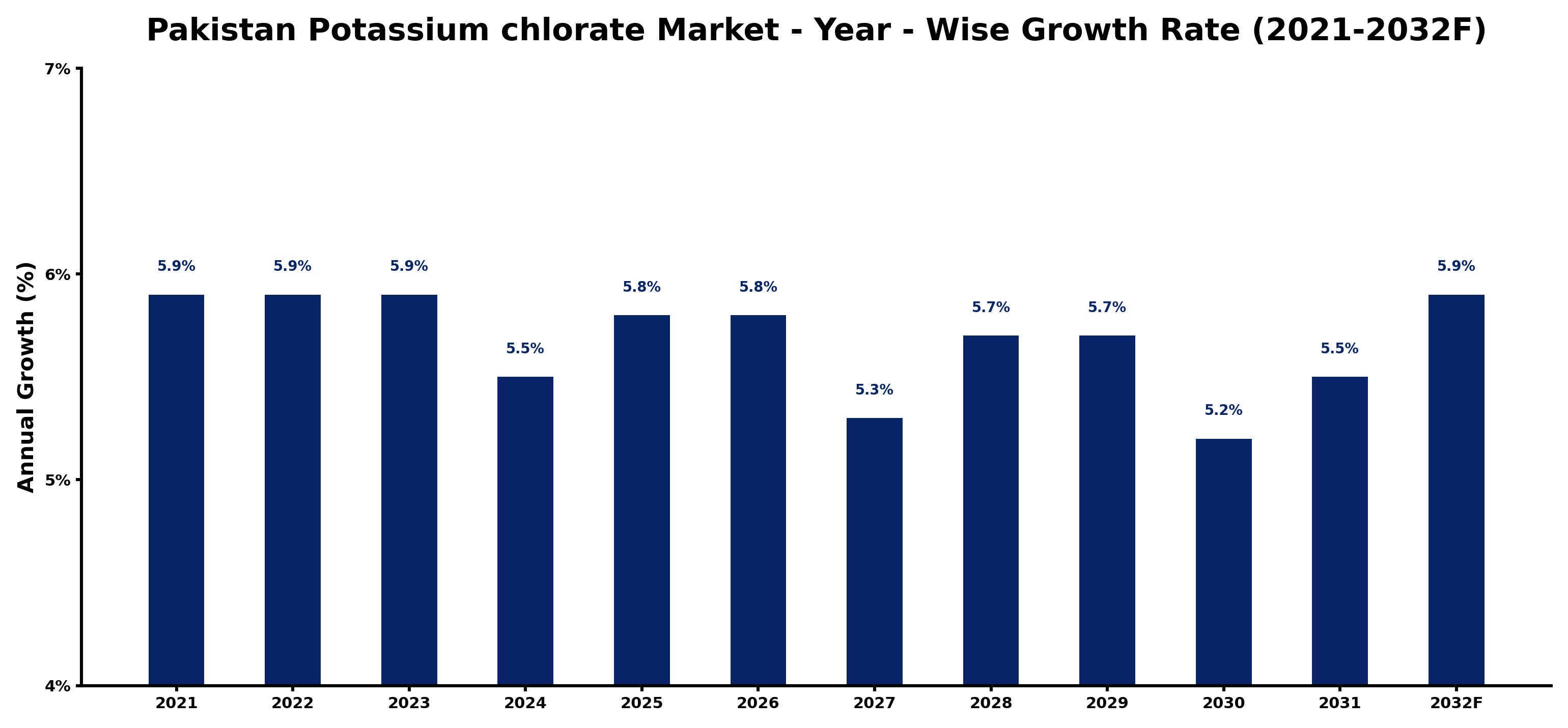
The table below presents the year‑wise growth rates along with the key drivers influencing the market
| Year | Growth Rate | Major Drivers |
| 2021 | 5.9% | Potassium chlorate production expansion supports local agricultural chemical supply |
| 2022 | 5.9% | Automation technologies streamlined potassium chlorate production processes effectively |
| 2023 | 5.9% | Advanced chemical processing technology boosted potassium chlorate production efficiency |
| 2024 | 5.5% | Manufacturing investments in potassium chlorate boost domestic production capacity |
| 2025 | 5.8% | Chemical manufacturing investments boosted potassium chlorate production capabilities |
| 2026 | 5.8% | Production line upgrades boosted potassium chlorate output efficiency |
| 2027 | 5.3% | Higher potassium chlorate production capacity met agricultural export demands |
| 2028 | 5.7% | Improved facility upgrades boosted potassium chlorate production efficiency |
| 2029 | 5.7% | Automation in potassium chlorate production boosts manufacturing efficiency |
| 2030 | 5.2% | Export driven agricultural sector demands enhanced potassium chlorate production capacity |
| 2031 | 5.5% | Manufacturing investments boosted potassium chlorate production capacity significantly |
| 2032 | 5.9% | Domestic textile production recovery boosts potassium chlorate demand |
Note - Market size estimations and growth projections presented in this report are based on 6Wresearch's advanced forecasting approach, validated with industry datasets as of June 2026.
Pakistan Potassium chlorate Market Synopsis
The current landscape of the Pakistan potassium chlorate market is significantly shaped by the increasing demand from the agricultural sector. As farmers seek more efficient herbicides, potassium chlorate's role as a weed control agent is becoming increasingly vital, contributing to its rising consumption in agricultural applications.
Additionally, the fireworks industry continues to serve as a prominent user of potassium chlorate, driving demand for this chemical in the festive season. The duality of demand from both agriculture and pyrotechnics suggests a robust market outlook, although regulatory measures continue to influence operational dynamics.
Pakistan Potassium chlorate Market Key Takeaways
- The market is witnessing an upward trend in the agricultural sector, primarily for use as herbicides.
- Regulatory restrictions present both challenges and opportunities for safe handling practices.
- There is a growing focus on the production of fireworks, enhancing the relevance of potassium chlorate.
- Investment in innovative solutions is critical for long-term sustainability in the market.
- Collaborative efforts with local producers can lead to advantageous market positioning.
Evaluation of Restraints in Pakistan Potassium chlorate Market
The Pakistan potassium chlorate market is currently constrained by several key factors. Notably, the fluctuating prices of raw materials such as potassium chloride can directly influence production costs and, by extension, profit margins. Regulatory measures aimed at curtailing safety risks associated with potassium chlorate's explosive potential add another layer of complexity. These regulations can inhibit market entry for new players and complicate operations for existing manufacturers. Moreover, competition from alternative chemicals like sodium chlorate and potassium perchlorate poses significant challenges, necessitating a strategic approach to maintain market share and profitability.
Pakistan Potassium chlorate Market Trends
Several prominent trends are shaping the Pakistan potassium chlorate market. Firstly, the increasing usage in the agriculture sector is noteworthy, particularly as the need for effective herbicides grows. Manufacturers are focusing on developing formulations that enhance efficacy and safety. Secondly, there's an uptick in the fireworks industry's demand for high-quality potassium chlorate, reflecting a trend towards premium products for festivals and celebrations. Furthermore, technological advancements in production processes are being leveraged to improve the overall quality and safety of potassium chlorate, aligning with stringent regulatory requirements.
Pakistan Potassium chlorate Market Opportunities
The opportunities for growth in the Pakistan potassium chlorate market are substantial. Investors have a unique chance to capitalize on the increasing demand from the agricultural sector by developing targeted herbicide solutions. Moreover, establishing partnerships with local producers can provide an edge in navigating regulatory landscapes while ensuring market relevance. The ongoing industrialization of Pakistan also suggests a growing appetite for potassium chlorate in chemical manufacturing and explosives, which presents additional avenues for expansion. As local manufacturers innovate and adapt, the market's potential for robust growth remains significant.
Government Initiatives in the Pakistan Potassium chlorate Market
The Pakistani government has enacted stringent policies governing the production and sale of potassium chlorate, with an emphasis on public safety. Licensing requirements for manufacturers are strictly enforced to ensure that safety standards are adhered to, particularly in industries where the chemical is prone to misuse. Additionally, there are measures in place to monitor waste disposal practices to mitigate environmental impacts. These regulatory frameworks reflect the government's commitment to balancing industrial growth with safety and environmental stewardship.
Future Insights of the Pakistan Potassium chlorate Market
Looking ahead to the period between 2026 and 2032, the Pakistan potassium chlorate market is poised for steady growth. The anticipated demand across diverse applications such as fireworks, matches, and chemicals will likely drive market expansion. Moreover, the increasing focus on agricultural development will continue to elevate potassium chlorate's role in effective weed management. However, it will be crucial for stakeholders to navigate the challenges posed by regulatory requirements and the evolving competitive landscape to fully leverage these growth opportunities.
Pakistan Potassium chlorate Market Latest Developments (May 2025 - June 2026)
Recent developments in the Pakistan potassium chlorate market have indicated a trend towards enhanced safety protocols and compliance with government regulations. Manufacturers are increasingly investing in technology that improves production efficiency while adhering to stringent safety standards. Additionally, discussions within industry circles suggest a growing collaboration among local producers aimed at streamlining supply chains and enhancing product availability. These collaborative efforts are expected to bolster market resilience in a competitive environment.
Pakistan Potassium chlorate Market - Key Attractiveness of the Report
- 10 Years of Market Numbers
- Historical Data Starting from 2022 to 2025
- Base Year: 2025
- Forecast Data until 2032
- Key Performance Indicators Impacting the Market
- Major Upcoming Developments and Projects
Key Highlights of the Report:
- Pakistan Potassium chlorate Market Outlook
- Market Size of Pakistan Potassium chlorate Market, 2025
- Forecast of Pakistan Potassium chlorate Market, 2032
- Historical Data and Forecast of Pakistan Potassium chlorate Revenues & Volume for the Period 2022-2032F
- Pakistan Potassium chlorate Market Trend Evolution
- Pakistan Potassium chlorate Market Drivers and Challenges
- Pakistan Potassium chlorate Price Trends
- Pakistan Potassium chlorate Porter's Five Forces
- Pakistan Potassium chlorate Industry Life Cycle
- Historical Data and Forecast of Pakistan Potassium chlorate Market Revenues & Volume By Product type for the Period 2022-2032F
- Historical Data and Forecast of Pakistan Potassium chlorate Market Revenues & Volume By Pharmaceutical Grade for the Period 2022-2032F
- Historical Data and Forecast of Pakistan Potassium chlorate Market Revenues & Volume By Chemical Grade for the Period 2022-2032F
- Historical Data and Forecast of Pakistan Potassium chlorate Market Revenues & Volume By End-use for the Period 2022-2032F
- Historical Data and Forecast of Pakistan Potassium chlorate Market Revenues & Volume By Explosives for the Period 2022-2032F
- Historical Data and Forecast of Pakistan Potassium chlorate Market Revenues & Volume By Matches for the Period 2022-2032F
- Historical Data and Forecast of Pakistan Potassium chlorate Market Revenues & Volume By Disinfectants for the Period 2022-2032F
- Historical Data and Forecast of Pakistan Potassium chlorate Market Revenues & Volume By Bleaches for the Period 2022-2032F
- Historical Data and Forecast of Pakistan Potassium chlorate Market Revenues & Volume By Medical for the Period 2022-2032F
- Pakistan Potassium chlorate Import Export Trade Statistics
- Market Opportunity Assessment By Product type
- Market Opportunity Assessment By End-use
- Pakistan Potassium chlorate Top Companies Market Share
- Pakistan Potassium chlorate Competitive Benchmarking By Technical and Operational Parameters
- Pakistan Potassium chlorate Company Profiles
- Pakistan Potassium chlorate Key Strategic Recommendations






































