Pakistan Process Automation And Instrumentation Market Size, Share & Growth Rate
The Pakistan Process Automation And Instrumentation Market was estimated at USD 484 Million in 2025 and is projected to reach USD 915 Million by 2032, growing at a CAGR of 9.5% from 2026 to 2032. This impressive growth trajectory is largely driven by the increasing adoption of automation technologies across key sectors. As industries strive to enhance operational efficiency and comply with stringent regulations, the demand for advanced control systems like PLCs, SCADA, and DCS is surging.
Pakistan Process Automation And Instrumentation Market Year-wise Growth Rate and Key Drivers
This graph highlights how the Pakistan Process Automation And Instrumentation Market has steadily grown over the years, supported by major growth factors.
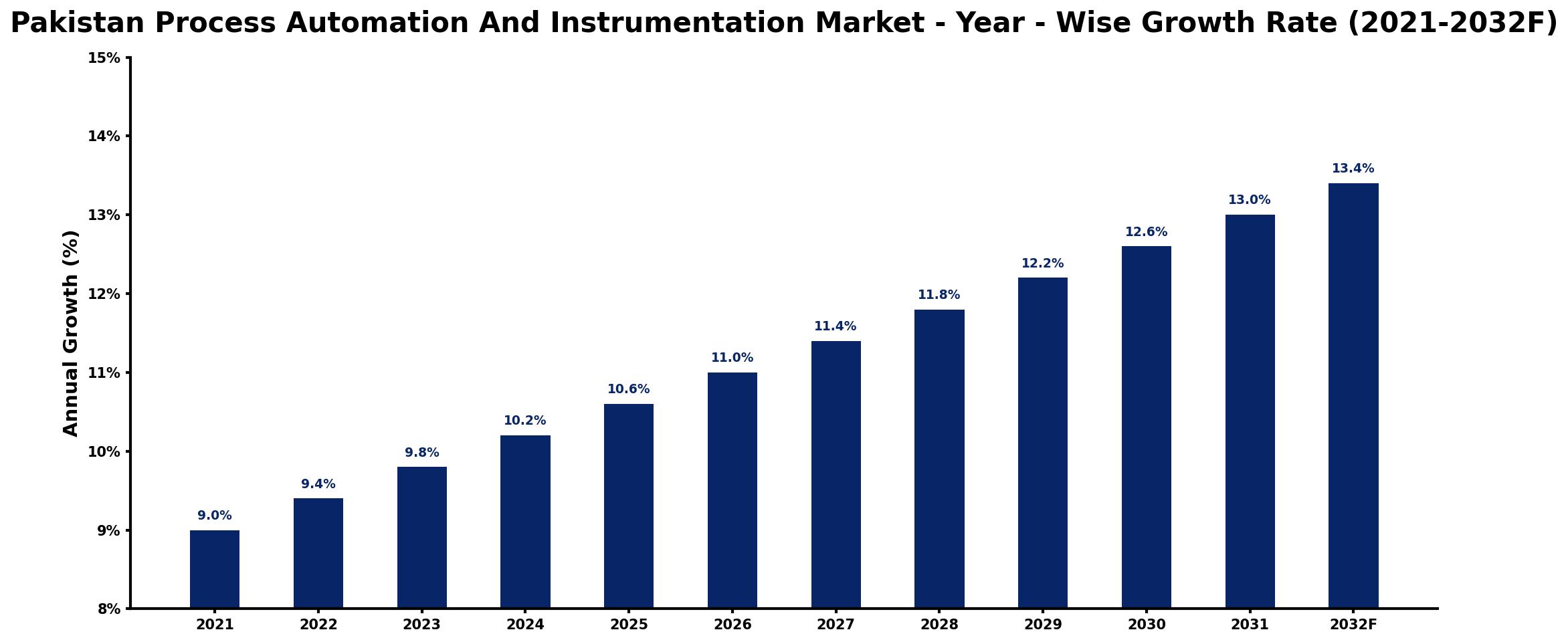
The table below presents the year‑wise growth rates along with the key drivers influencing the market
| Year | Growth Rate | Major Drivers |
| 2021 | 9.0% | Rising energy sector investments |
| 2022 | 9.4% | Increased manufacturing sector demand |
| 2023 | 9.8% | Growth in renewable energy projects |
| 2024 | 10.2% | Expansion of smart city initiatives |
| 2025 | 10.6% | Boost in industrial safety regulations |
| 2026 | 11.0% | Surge in telecommunications infrastructure |
| 2027 | 11.4% | Growing need for real-time data |
| 2028 | 11.8% | Development of advanced technologies |
| 2029 | 12.2% | Increase in urban infrastructure projects |
| 2030 | 12.6% | Demand for energy efficiency solutions |
| 2031 | 13.0% | Focus on environmental sustainability efforts |
| 2032 | 13.4% | Rising investments in digital transformation |
Note: Market size estimations and growth projections presented in this report are based on 6Wresearch's proprietary forecasting methodology, utilizing the latest available industry data, government publications, and primary research inputs.
Pakistan Process Automation And Instrumentation Market Synopsis
The strongest force currently shaping the Pakistan Process Automation And Instrumentation Market is the push for industrial modernization. Companies across manufacturing, energy, and utilities are keen to reduce downtime while optimizing resource utilization through cutting-edge automation solutions.
Furthermore, the integration of advanced sensors and seamless communication protocols plays a crucial role in enabling remote monitoring and controlling of processes. This trend not only enhances productivity but also facilitates better decision-making based on real-time data.
Pakistan Process Automation And Instrumentation Market Key Takeaways
- The market is poised for significant growth, reaching USD 915 Million by 2032.
- Automation technologies are being increasingly adopted for operational efficiency across various sectors.
- Integration of advanced sensors is enhancing connectivity and data exchange in automated systems.
- Government policies are favoring investments in automation technologies to modernize industry.
- Challenges include high costs and a shortage of technical expertise among the workforce.
Evaluation of Restraints in Pakistan Process Automation And Instrumentation Market
Despite its promising growth, the Pakistan Process Automation And Instrumentation Market faces significant restraints. The high cost associated with advanced automation technologies poses a barrier for many organizations. Additionally, a notable lack of skilled workforce hampers the effective implementation and utilization of these systems. The market also relies heavily on imported equipment, limiting the growth potential of local manufacturing capabilities. Moreover, existing regulatory and infrastructural issues further complicate the adoption of automation solutions across various industries.
Pakistan Process Automation And Instrumentation Market Trends
Emerging trends are reshaping the landscape of the Pakistan Process Automation And Instrumentation Market. The emphasis on Industry 4.0 technologies is leading to increased investments in IoT and smart manufacturing practices. Companies are gradually shifting towards predictive maintenance and data-driven decision-making approaches, driven by the need for efficiency and cost savings. Moreover, the convergence of automation with artificial intelligence is creating innovative solutions that promise to further optimize operations.
Pakistan Process Automation And Instrumentation Market Opportunities
Opportunities for growth and investment are abundant in the Pakistan Process Automation And Instrumentation Market. There is a pressing need for local manufacturing capabilities, which presents an avenue for new entrants and existing players to develop domestic solutions. Additionally, as the government incentivizes modernization efforts, companies can capitalize on financial support aimed at upgrading their automation technologies. Targeting sectors such as oil and gas, where the demand for advanced control systems is particularly pronounced, could yield significant returns.
Government Initiatives in the Pakistan Process Automation And Instrumentation Market
The Pakistani government is actively supporting the growth of the process automation and instrumentation market through various initiatives. Policies aimed at modernizing industrial processes include financial incentives for companies adopting automation technologies and subsidies for local automation solution development. Furthermore, workforce skill enhancement programs are in place to equip the labor force with the necessary expertise in automation and control systems. By promoting the integration of automation technologies across sectors, the government aims to boost productivity and operational efficiency.
Future Insights of the Pakistan Process Automation And Instrumentation Market
Looking ahead to 2026-2032, the Pakistan Process Automation And Instrumentation Market is set to experience transformative changes. As industries increasingly embrace digitalization, the focus will shift toward implementing more sophisticated automation frameworks. The growing awareness of environmental sustainability will also drive investments in green automation technologies. Additionally, partnerships between local and international firms could enhance technology transfer, further accelerating market growth.
Pakistan Process Automation And Instrumentation Market Latest Developments (2025 - 2026)
Recent developments in the Pakistan Process Automation And Instrumentation Market indicate a robust movement towards integrating IoT capabilities within existing frameworks. Companies are exploring collaborations that aim to enhance technological synergies, while advancements in machine learning and data analytics are increasingly being adopted. Moreover, regulatory frameworks are evolving to better accommodate new automation technologies, paving the way for streamlined implementations across various sectors.
Pakistan Process Automation And Instrumentation Market - Key Attractiveness of the Report
- 10 Years of Market Numbers
- Historical Data Starting from 2022 to 2025
- Base Year: 2025
- Forecast Data until 2032
- Key Performance Indicators Impacting the Market
- Major Upcoming Developments and Projects
Key Highlights of the Report:
- Pakistan Process Automation And Instrumentation Market Outlook
- Market Size of Pakistan Process Automation And Instrumentation Market, 2025
- Forecast of Pakistan Process Automation And Instrumentation Market, 2032
- Historical Data and Forecast of Pakistan Process Automation And Instrumentation Revenues & Volume for the Period 2022-2032F
- Pakistan Process Automation And Instrumentation Market Trend Evolution
- Pakistan Process Automation And Instrumentation Market Drivers and Challenges
- Pakistan Process Automation And Instrumentation Price Trends
- Pakistan Process Automation And Instrumentation Porter's Five Forces
- Pakistan Process Automation And Instrumentation Industry Life Cycle
- Historical Data and Forecast of Pakistan Process Automation And Instrumentation Market Revenues & Volume By Instrument for the Period 2022-2032F
- Historical Data and Forecast of Pakistan Process Automation And Instrumentation Market Revenues & Volume By Field Instruments for the Period 2022-2032F
- Historical Data and Forecast of Pakistan Process Automation And Instrumentation Market Revenues & Volume By Control Valve for the Period 2022-2032F
- Historical Data and Forecast of Pakistan Process Automation And Instrumentation Market Revenues & Volume By Analytical Instruments for the Period 2022-2032F
- Historical Data and Forecast of Pakistan Process Automation And Instrumentation Market Revenues & Volume By Solution for the Period 2022-2032F
- Historical Data and Forecast of Pakistan Process Automation And Instrumentation Market Revenues & Volume By Advanced Process Control (APC) for the Period 2022-2032F
- Historical Data and Forecast of Pakistan Process Automation And Instrumentation Market Revenues & Volume By Distributed Control System (DCS) for the Period 2022-2032F
- Historical Data and Forecast of Pakistan Process Automation And Instrumentation Market Revenues & Volume By Human Machine Interaction (HMI) for the Period 2022-2032F
- Historical Data and Forecast of Pakistan Process Automation And Instrumentation Market Revenues & Volume By Manufacturing Execution System (MES) for the Period 2022-2032F
- Historical Data and Forecast of Pakistan Process Automation And Instrumentation Market Revenues & Volume By Programmable Logic Controller (PLC) for the Period 2022-2032F
- Historical Data and Forecast of Pakistan Process Automation And Instrumentation Market Revenues & Volume By Safety Automation for the Period 2022-2032F
- Historical Data and Forecast of Pakistan Process Automation And Instrumentation Market Revenues & Volume By Supervisory Control and Data Acquisition (SCADA) for the Period 2022-2032F
- Historical Data and Forecast of Pakistan Process Automation And Instrumentation Market Revenues & Volume By End-user Industry for the Period 2022-2032F
- Historical Data and Forecast of Pakistan Process Automation And Instrumentation Market Revenues & Volume By Oil and Gas for the Period 2022-2032F
- Historical Data and Forecast of Pakistan Process Automation And Instrumentation Market Revenues & Volume By Food and Beverage for the Period 2022-2032F
- Historical Data and Forecast of Pakistan Process Automation And Instrumentation Market Revenues & Volume By Pharmaceutical and Biopharma for the Period 2022-2032F
- Historical Data and Forecast of Pakistan Process Automation And Instrumentation Market Revenues & Volume By Chemical and Petrochemical for the Period 2022-2032F
- Historical Data and Forecast of Pakistan Process Automation And Instrumentation Market Revenues & Volume By Other End-user Industries for the Period 2022-2032F
- Pakistan Process Automation And Instrumentation Import Export Trade Statistics
- Market Opportunity Assessment By Instrument
- Market Opportunity Assessment By Solution
- Market Opportunity Assessment By End-user Industry
- Pakistan Process Automation And Instrumentation Top Companies Market Share
- Pakistan Process Automation And Instrumentation Competitive Benchmarking By Technical and Operational Parameters
- Pakistan Process Automation And Instrumentation Company Profiles
- Pakistan Process Automation And Instrumentation Key Strategic Recommendations






































