Pakistan Synthetic Fiber Market: Import Trend Analysis
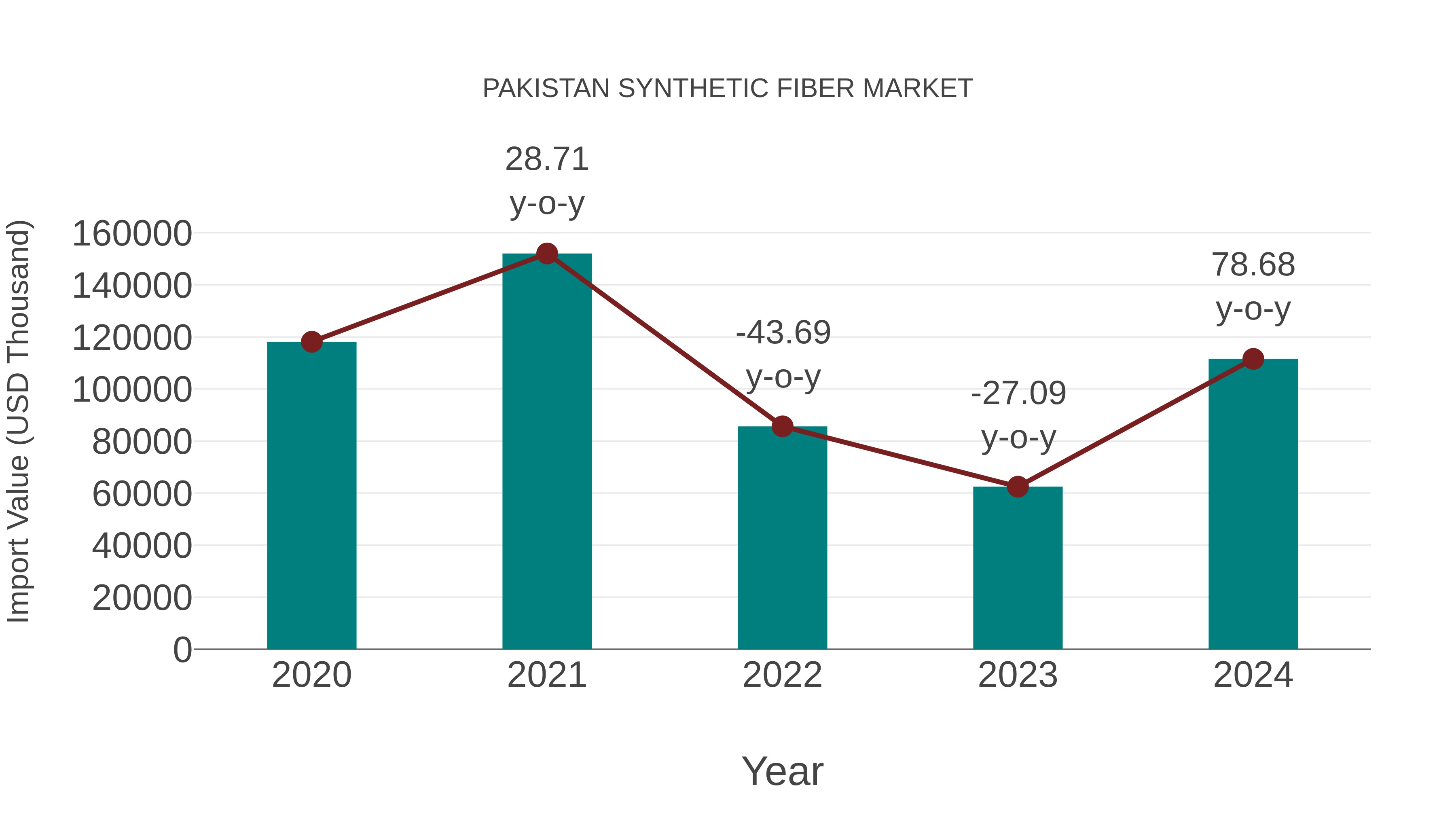
From 2023 to 2024, Pakistan synthetic fiber market witnessed a notable import growth rate of 78.68%. However, the compound annual growth rate (CAGR) for 2020-2024 stood at -1.42%. This decline could be attributed to fluctuations in global demand due to changing consumer preferences and trade policies impacting the market dynamics.
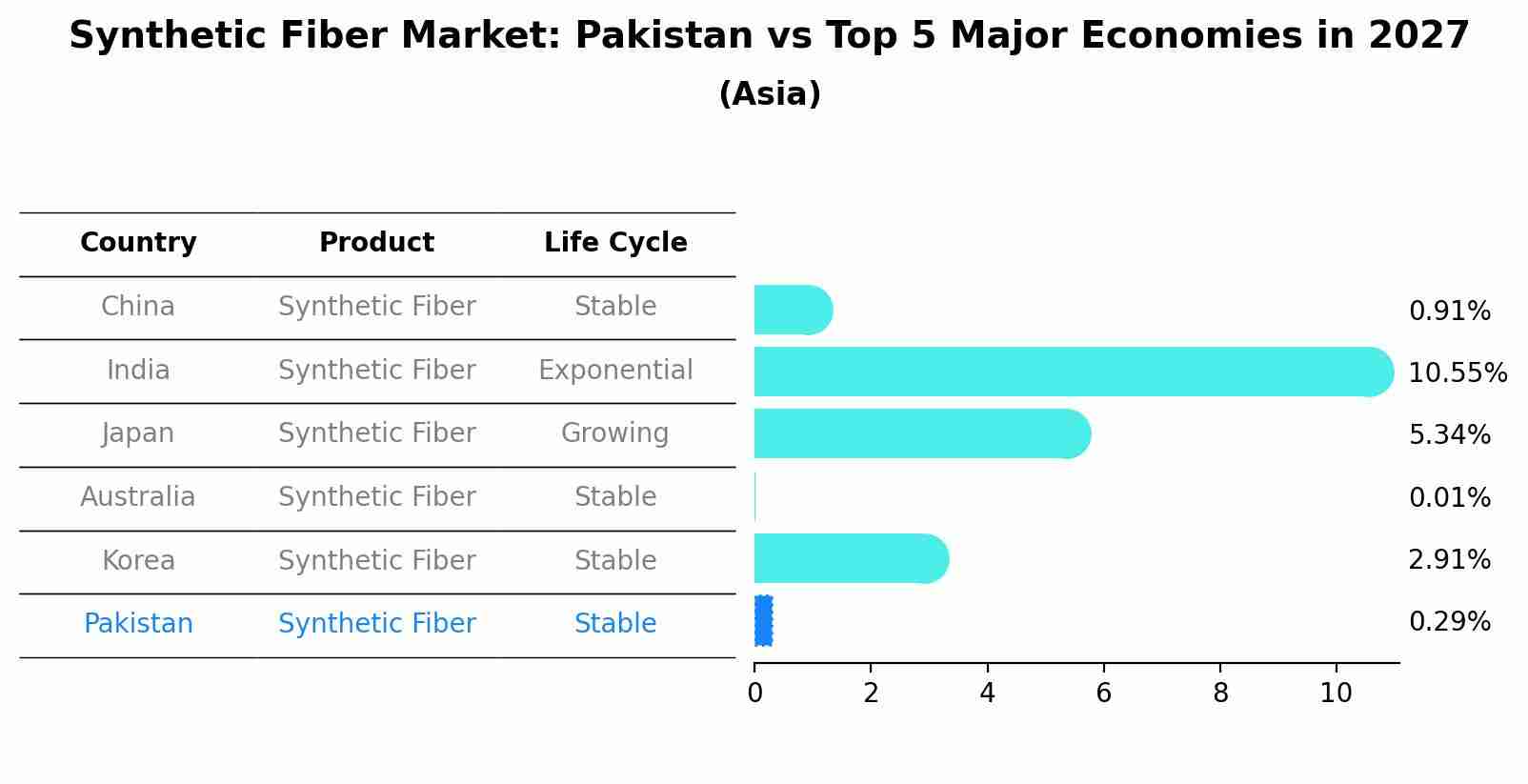
Synthetic Fiber Market: Pakistan vs Top 5 Major Economies in 2027 (Asia)
By 2027, Pakistan's Synthetic Fiber market is forecasted to achieve a stable growth rate of 0.29%, with China leading the Asia region, followed by India, Japan, Australia and South Korea.
Pakistan Synthetic Fiber Market Synopsis
The Pakistan Synthetic Fiber Market is experiencing steady growth driven by the increasing demand for textiles and clothing both domestically and for export. Polyester and nylon are the dominant synthetic fibers in the market due to their versatility and cost-effectiveness. The textile industry in Pakistan is a major contributor to the country`s economy, and the demand for synthetic fibers is expected to further rise with the growth of the fashion and apparel sector. The market is also witnessing a shift towards sustainable and eco-friendly synthetic fibers such as recycled polyester and bio-based fibers. Key players in the Pakistan Synthetic Fiber Market include Nimir Industrial Chemicals Ltd, ICI Pakistan Ltd, and AK Corporations, among others, who are focusing on innovation and product development to cater to the evolving consumer preferences and sustainability trends.
Pakistan Synthetic Fiber Market Trends
The Pakistan synthetic fiber market is experiencing a shift towards sustainable and eco-friendly materials, driven by increasing awareness of environmental issues and consumer preferences for greener products. There is a growing demand for recycled synthetic fibers and bio-based alternatives as a means to reduce carbon footprint and promote sustainability. Additionally, technological advancements in the production of synthetic fibers are leading to improved performance characteristics such as durability, moisture-wicking properties, and thermal regulation. The textile industry in Pakistan is also focusing on innovation and customization, with a trend towards specialized synthetic fibers catering to specific end-uses like sportswear, automotive textiles, and medical textiles. Overall, the market is witnessing a convergence of sustainability, innovation, and customization to meet the evolving needs of consumers and industries.
Pakistan Synthetic Fiber Market Challenges
The Pakistan Synthetic Fiber Market faces several challenges including fluctuating raw material prices, competition from imported fibers, inconsistent government policies, and a lack of technological advancements in the local industry. The industry also struggles with issues such as energy shortages, inadequate infrastructure, and limited access to finance for modernization and expansion. Additionally, the market is impacted by global economic conditions and changing consumer preferences, leading to uncertainties in demand and pricing. Overall, the Pakistan Synthetic Fiber Market needs to address these challenges by investing in research and development, improving efficiency and sustainability practices, and fostering collaboration between industry stakeholders to enhance competitiveness and ensure long-term growth.
Pakistan Synthetic Fiber Market Investment Opportunities
The Pakistan Synthetic Fiber Market presents several promising investment opportunities due to the country`s growing textile and apparel industry. With increasing demand for synthetic fibers in the production of textiles, clothing, and non-woven fabrics, investors can consider opportunities in manufacturing and supplying synthetic fibers such as polyester, nylon, and acrylic. Additionally, investing in research and development for innovative synthetic fiber technologies can provide a competitive edge in the market. Furthermore, the government`s support for the textile sector through incentives and policies aimed at boosting exports can create a favorable investment climate. Overall, investing in the Pakistan Synthetic Fiber Market offers potential for growth and profitability in line with the country`s expanding textile industry.
Jordan Agar Market Government Policies
The Pakistan government has implemented various policies to support the growth of the Synthetic Fiber Market in the country. These policies include providing subsidies and incentives to local manufacturers, promoting investment in the sector through favorable tax regimes, and encouraging research and development activities to enhance the competitiveness of the industry. Additionally, the government has taken steps to improve infrastructure and logistics to facilitate the smooth functioning of the synthetic fiber market. Overall, the government`s policies aim to boost domestic production, attract foreign investment, create employment opportunities, and enhance the country`s export potential in the synthetic fiber market.
Pakistan Synthetic Fiber Market Future Outlook
The future outlook for the Pakistan Synthetic Fiber Market appears promising, driven by factors such as increasing demand from various end-use industries including textiles, automotive, and packaging. The market is expected to witness steady growth due to the rising population, urbanization trends, and changing consumer preferences towards innovative and sustainable materials. Technological advancements in the production of synthetic fibers, coupled with government initiatives to promote the textile industry, are likely to further boost market growth. However, challenges such as fluctuating raw material prices and environmental concerns regarding the use of synthetic fibers may pose some hindrances. Overall, the Pakistan Synthetic Fiber Market is anticipated to expand in the coming years, presenting opportunities for market players to innovate and diversify their product offerings to meet evolving consumer needs.
Key Highlights of the Report:
- Pakistan Synthetic Fiber Market Outlook
- Market Size of Pakistan Synthetic Fiber Market, 2021
- Forecast of Pakistan Synthetic Fiber Market, 2031
- Historical Data and Forecast of Pakistan Synthetic Fiber Revenues & Volume for the Period 2018 - 2031
- Pakistan Synthetic Fiber Market Trend Evolution
- Pakistan Synthetic Fiber Market Drivers and Challenges
- Pakistan Synthetic Fiber Price Trends
- Pakistan Synthetic Fiber Porter's Five Forces
- Pakistan Synthetic Fiber Industry Life Cycle
- Historical Data and Forecast of Pakistan Synthetic Fiber Market Revenues & Volume By Type for the Period 2018 - 2031
- Historical Data and Forecast of Pakistan Synthetic Fiber Market Revenues & Volume By Polyester for the Period 2018 - 2031
- Historical Data and Forecast of Pakistan Synthetic Fiber Market Revenues & Volume By Nylon for the Period 2018 - 2031
- Historical Data and Forecast of Pakistan Synthetic Fiber Market Revenues & Volume By Acrylics for the Period 2018 - 2031
- Historical Data and Forecast of Pakistan Synthetic Fiber Market Revenues & Volume By Polyolefin for the Period 2018 - 2031
- Historical Data and Forecast of Pakistan Synthetic Fiber Market Revenues & Volume By Others for the Period 2018 - 2031
- Historical Data and Forecast of Pakistan Synthetic Fiber Market Revenues & Volume By Application for the Period 2018 - 2031
- Historical Data and Forecast of Pakistan Synthetic Fiber Market Revenues & Volume By Clothing for the Period 2018 - 2031
- Historical Data and Forecast of Pakistan Synthetic Fiber Market Revenues & Volume By Home Furnishing for the Period 2018 - 2031
- Historical Data and Forecast of Pakistan Synthetic Fiber Market Revenues & Volume By Automotive for the Period 2018 - 2031
- Historical Data and Forecast of Pakistan Synthetic Fiber Market Revenues & Volume By Filtration for the Period 2018 - 2031
- Historical Data and Forecast of Pakistan Synthetic Fiber Market Revenues & Volume By Others for the Period 2018 - 2031
- Pakistan Synthetic Fiber Import Export Trade Statistics
- Market Opportunity Assessment By Type
- Market Opportunity Assessment By Application
- Pakistan Synthetic Fiber Top Companies Market Share
- Pakistan Synthetic Fiber Competitive Benchmarking By Technical and Operational Parameters
- Pakistan Synthetic Fiber Company Profiles
- Pakistan Synthetic Fiber Key Strategic Recommendations






































