Pakistan Three Wheeler Market Size, Share & Growth Rate
The Pakistan Three Wheeler Market was estimated at USD 312 Million in 2025 and is projected to reach USD 411 Million by 2032, growing at a CAGR of 4.0% from 2026 to 2032. This growth trajectory is largely driven by the surging demand for cost-effective transportation solutions as urban areas expand and disposable incomes rise. Additionally, government initiatives aimed at promoting electric vehicle adoption are poised to fuel interest and investment in electric three-wheelers, reinforcing the market's upward momentum.
Pakistan Three Wheeler Market Year-wise Growth Rate and Key Drivers
This graph highlights how the Pakistan Three Wheeler Market has steadily grown over the years, supported by major growth factors.
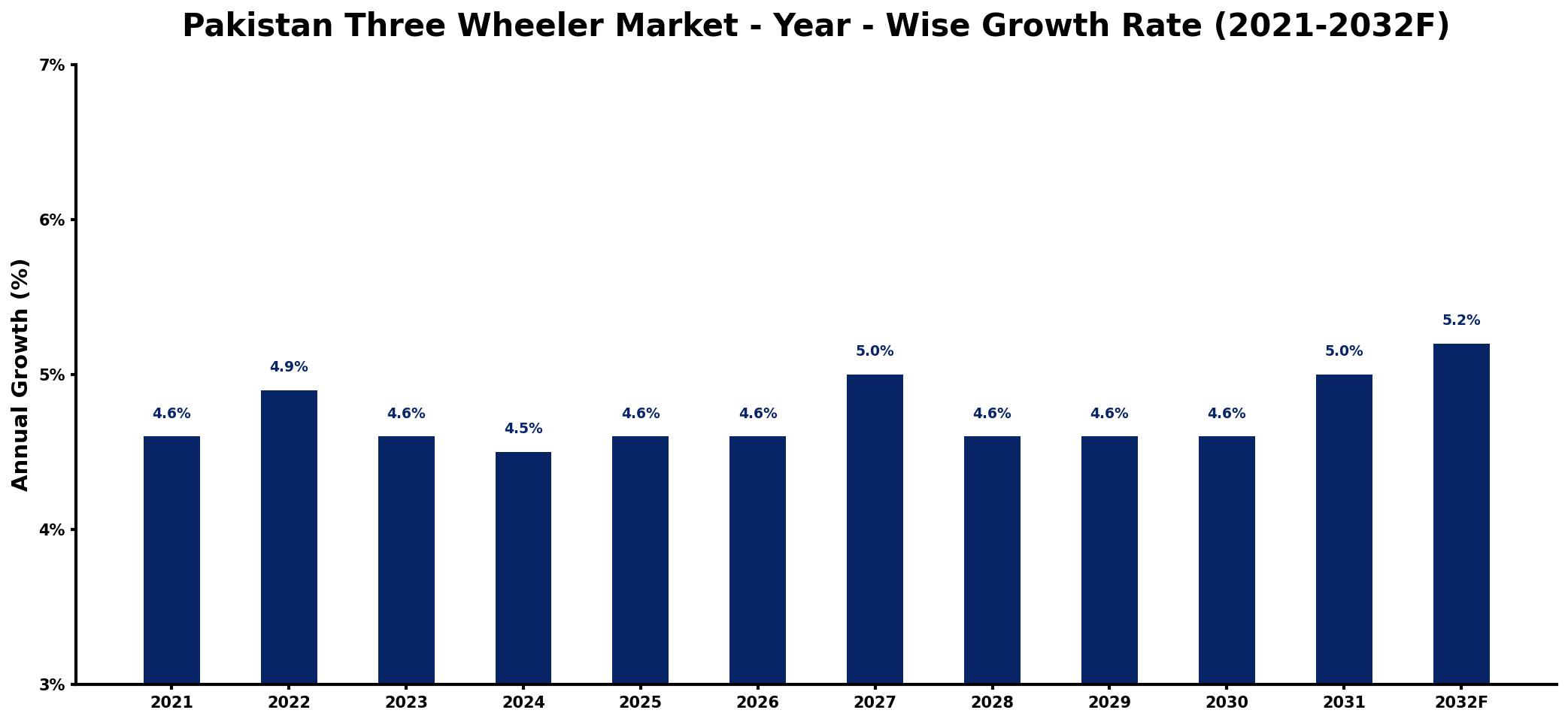
The table below presents the year‑wise growth rates along with the key drivers influencing the market
| Year | Growth Rate | Major Drivers |
| 2021 | 4.6% | Rising urban transportation demand |
| 2022 | 4.9% | Increased fuel efficiency innovations |
| 2023 | 4.6% | Expansion of ride-sharing services |
| 2024 | 4.5% | Growing youth employment opportunities |
| 2025 | 4.6% | Government incentives for production |
| 2026 | 4.6% | Emergence of electric alternatives |
| 2027 | 5.0% | Strengthened local manufacturing capabilities |
| 2028 | 4.6% | Enhanced distribution network efficiency |
| 2029 | 4.6% | Boosted tourism and travel sectors |
| 2030 | 4.6% | Growing environmental awareness initiatives |
| 2031 | 5.0% | Increased foreign direct investments |
| 2032 | 5.2% | Technological advancements in logistics |
Note: Market size estimations and growth projections presented in this report are based on 6Wresearch's proprietary forecasting methodology, utilizing the latest available industry data, government publications, and primary research inputs.
Pakistan Three Wheeler Market Synopsis
In Pakistan, three-wheelers are not just vehicles; they are integral to the daily transportation needs of millions. With a notable presence in both urban and rural landscapes, these vehicles offer an accessible means of travel for passengers and goods alike, fulfilling a vital role in the economy. The market is characterized by a blend of traditional fuel-powered rickshaws and a rising wave of electric variants, aligning with the global push towards sustainable transport.
Local manufacturers are adapting to meet consumer needs, introducing innovative features such as enhanced safety measures and technology integrations like GPS tracking. This adaptability not only appeals to a broad customer base but also showcases the industry's commitment to progress amidst evolving market demands.
Pakistan Three Wheeler Market Key Takeaways
- The market is on a solid growth trajectory, propelled by urbanization and the rising demand for affordable transportation.
- Electric three-wheelers are gaining traction, thanks to their lower operating costs and environmental benefits.
- Technological advancements are enhancing the safety and user experience of three-wheelers.
- Investment opportunities abound in local manufacturing and electric vehicle technology.
- Government policies are aimed at balancing safety, emissions control, and market competition.
Evaluation of Restraints in Pakistan Three Wheeler Market
The Pakistan Three Wheeler Market contends with several significant restraints that could hinder its growth potential. Fluctuating fuel prices have a direct impact on operating costs, making traditional three-wheelers less economically viable in the eyes of consumers. Additionally, poor road infrastructure can lead to increased wear and tear on vehicles, further complicating ownership. Regulatory challenges, including stringent emission standards and safety regulations, can place financial burdens on manufacturers, while limited financing options restrict accessibility for potential buyers.
Pakistan Three Wheeler Market Trends
A shift towards electric three-wheelers is one of the most notable trends currently shaping the market. These vehicles are becoming increasingly popular due to their reduced operational costs and minimal environmental impact. Concurrently, the demand for passenger-carrying three-wheelers is on the rise, as urban dwellers seek efficient travel options in congested city landscapes. Furthermore, technological enhancements, such as digital meters and improved safety features, are becoming essential selling points, as consumers prioritize reliability and comfort in their transportation choices.
Pakistan Three Wheeler Market Opportunities
Investors looking to enter the Pakistan Three Wheeler Market will find numerous avenues for growth. The increasing urbanization rate signals a robust demand for effective transportation solutions, presenting a prime opportunity for local manufacturing and assembly. Additionally, theres potential for investment in cutting-edge technology to enhance the performance and sustainability of three-wheelers. Collaborating with established manufacturers in the region can also create strategic partnerships that leverage local market insights and distribution networks.
Government Initiatives in the Pakistan Three Wheeler Market
The Pakistani government has implemented a range of policies to regulate the three-wheeler market, focusing on safety standards and emissions control to promote environmental sustainability. Licensing requirements ensure fair competition among operators, while initiatives aimed at boosting the adoption of electric vehicles underscore the government's commitment to greener transport solutions. These policies are crucial for fostering a balanced market environment that prioritizes safety, environmental health, and fair market practices.
Future Insights of the Pakistan Three Wheeler Market
Looking ahead to 2026-2032, the Pakistan Three Wheeler Market is set to experience sustained expansion. The increasing urban population and a collective shift toward sustainable transportation methods will drive demand for three-wheelers, particularly electric variants. Innovations in design and technology are anticipated to further enhance consumer appeal, while the governments ongoing support for cleaner transport solutions will likely propel market evolution. However, addressing infrastructure and regulatory challenges will be essential to fully realize this market's potential.
Pakistan Three Wheeler Market Latest Developments (2025 - 2026)
Recent industry developments indicate a growing focus on electric three-wheelers, with several initiatives aimed at expanding charging infrastructure across major cities. Local manufacturers are responding by introducing new electric models equipped with advanced features designed to enhance safety and user experience. Additionally, there has been an uptick in collaborations between government and private sector players to streamline regulatory processes, thereby facilitating market growth.
Pakistan Three Wheeler Market - Key Attractiveness of the Report
- 10 Years of Market Numbers
- Historical Data Starting from 2022 to 2025
- Base Year: 2025
- Forecast Data until 2032
- Key Performance Indicators Impacting the Market
- Major Upcoming Developments and Projects
Key Highlights of the Report:
- Pakistan Three Wheeler Market Outlook
- Market Size of Pakistan Three Wheeler Market, 2025
- Forecast of Pakistan Three Wheeler Market, 2032
- Historical Data and Forecast of Pakistan Three Wheeler Revenues & Volume for the Period 2022-2032F
- Pakistan Three Wheeler Market Trend Evolution
- Pakistan Three Wheeler Market Drivers and Challenges
- Pakistan Three Wheeler Price Trends
- Pakistan Three Wheeler Porter's Five Forces
- Pakistan Three Wheeler Industry Life Cycle
- Historical Data and Forecast of Pakistan Three Wheeler Market Revenues & Volume By Fuel Type for the Period 2022-2032F
- Historical Data and Forecast of Pakistan Three Wheeler Market Revenues & Volume By Petrol/CNG for the Period 2022-2032F
- Historical Data and Forecast of Pakistan Three Wheeler Market Revenues & Volume By Diesel for the Period 2022-2032F
- Historical Data and Forecast of Pakistan Three Wheeler Market Revenues & Volume By Electric for the Period 2022-2032F
- Historical Data and Forecast of Pakistan Three Wheeler Market Revenues & Volume By Vehicle Type for the Period 2022-2032F
- Historical Data and Forecast of Pakistan Three Wheeler Market Revenues & Volume By Passenger Carrier for the Period 2022-2032F
- Historical Data and Forecast of Pakistan Three Wheeler Market Revenues & Volume By Load Carrier for the Period 2022-2032F
- Pakistan Three Wheeler Import Export Trade Statistics
- Market Opportunity Assessment By Fuel Type
- Market Opportunity Assessment By Vehicle Type
- Pakistan Three Wheeler Top Companies Market Share
- Pakistan Three Wheeler Competitive Benchmarking By Technical and Operational Parameters
- Pakistan Three Wheeler Company Profiles
- Pakistan Three Wheeler Key Strategic Recommendations






































