Pakistan Tissue Imaging Market Size, Share & Growth Rate
The Pakistan Tissue Imaging Market was estimated at USD 350 Million in 2025 and is projected to reach USD 487 Million by 2032, growing at a CAGR of 4.8% from 2026 to 2032. This growth trajectory is primarily fueled by the rising prevalence of chronic diseases, particularly cancers and cardiovascular disorders, which demand precise diagnostic techniques. Additionally, ongoing advancements in imaging technologies, alongside an increasing focus on preventive healthcare, are propelling market expansion.
Pakistan Tissue Imaging Market Year-wise Growth Rate and Key Drivers
This graph highlights how the Pakistan Tissue Imaging Market has steadily grown over the years, supported by major growth factors.
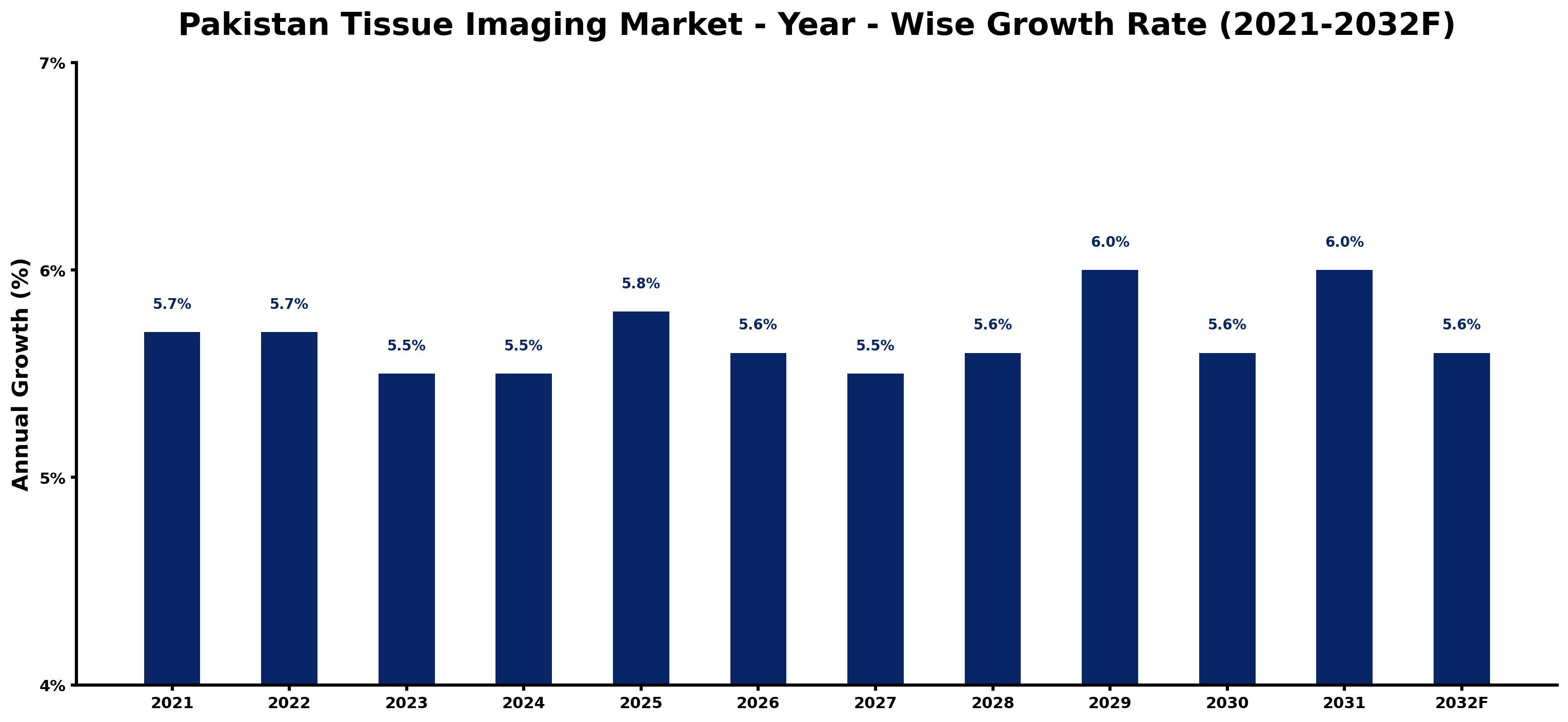
The table below presents the year‑wise growth rates along with the key drivers influencing the market
| Year | Growth Rate | Major Drivers |
| 2021 | 5.7% | Government infrastructure modernization initiatives |
| 2022 | 5.7% | Rising electricity demand across industries |
| 2023 | 5.5% | Expansion of commercial construction activities |
| 2024 | 5.5% | Growing urbanization and commercial development |
| 2025 | 5.8% | Growing urbanization and commercial development |
| 2026 | 5.6% | Expansion of commercial construction activities |
| 2027 | 5.5% | Government infrastructure modernization initiatives |
| 2028 | 5.6% | Expansion of manufacturing activities |
| 2029 | 6.0% | Rising electricity demand across industries |
| 2030 | 5.6% | Government infrastructure modernization initiatives |
| 2031 | 6.0% | Government infrastructure modernization initiatives |
| 2032 | 5.6% | Government infrastructure modernization initiatives |
Note - Market size estimations and growth projections presented in this report are based on 6Wresearch’s advanced forecasting approach, validated with industry datasets as of June 2026.
Pakistan Tissue Imaging Market Synopsis
The landscape of the Pakistan Tissue Imaging Market is rapidly evolving, driven by a heightened awareness of the importance of early disease detection. Technological innovations such as digital pathology are not just enhancing diagnostic accuracy, but also redefining workflows within healthcare facilities across the country.
As hospitals and laboratories prioritize advanced imaging solutions, there is a notable shift towards more sophisticated methodologies, including immunohistochemistry and molecular imaging. This transition underscores the vital role that tissue imaging plays in personalized medicine and targeted therapies, making it an essential component of modern healthcare.
Pakistan Tissue Imaging Market Key Takeaways
- The market is on a steady growth path, driven by increased incidences of chronic diseases requiring advanced diagnostic techniques.
- Technological advancements, including the adoption of AI and machine learning, are enhancing the efficiency of imaging processes.
- Investment opportunities abound in telepathology services, particularly in rural areas that lack advanced diagnostic facilities.
- Government policies are evolving to regulate and enhance the quality of tissue imaging services across the healthcare sector.
- The integration of digital pathology is reshaping diagnostic workflows, contributing to faster and more accurate results.
Evaluation of Restraints in Pakistan Tissue Imaging Market
Despite the promising growth prospects, the Pakistan Tissue Imaging Market faces several restraints. Limited access to advanced imaging technologies in rural regions poses a significant challenge, as healthcare providers in these areas often lack the necessary equipment and expertise to perform advanced diagnostic procedures. Additionally, the high costs associated with purchasing and maintaining sophisticated imaging systems can deter healthcare facilities from investing in these technologies. The need for better training programs for healthcare professionals is critical, as inadequate expertise in tissue imaging techniques can lead to suboptimal patient outcomes. Furthermore, regulatory hurdles and concerns around data privacy and security may impede the widespread adoption of these advanced imaging services.
Pakistan Tissue Imaging Market Trends
A significant trend within the Pakistan Tissue Imaging Market is the accelerating shift towards digital pathology solutions. This innovation not only streamlines the diagnostic process but also fosters a more collaborative environment for healthcare professionals. The increasing incorporation of artificial intelligence and machine learning technologies is set to revolutionize tissue imaging by enhancing diagnostic precision and efficiency.
Moreover, the growing emphasis on personalized medicine is driving demand for advanced imaging techniques, such as fluorescence in situ hybridization, which allow for a more detailed analysis of tissue samples. As healthcare providers increasingly recognize the value of tissue imaging in improving diagnostic accuracy and treatment efficacy, the market is poised for significant growth.
Pakistan Tissue Imaging Market Opportunities
Investment opportunities within the Pakistan Tissue Imaging Market are plentiful, particularly in light of the increasing incidence of chronic diseases. Focusing on the development of advanced imaging technologies, such as digital pathology systems and molecular imaging solutions, can yield substantial returns. Additionally, there is a burgeoning demand for telepathology services, especially in underserved areas, creating avenues for investments in both infrastructure and software development.
Collaboration with healthcare providers to enhance diagnostic accuracy through improved imaging techniques is another lucrative opportunity. As the healthcare sector continues to evolve, aligning investment strategies with emerging technologies will be crucial for capitalizing on growth potential.
Government Initiatives in the Pakistan Tissue Imaging Market
Government policies in Pakistan are increasingly supportive of the Tissue Imaging Market, with initiatives aimed at regulating healthcare services and medical devices. The Pakistan Medical and Dental Council (PMDC) plays a critical role in the licensing and accreditation of healthcare facilities, ensuring the quality and safety of tissue imaging services. Additionally, the Drug Regulatory Authority of Pakistan (DRAP) oversees the importation and sale of medical devices, including imaging equipment, to maintain high standards in public health.
These regulatory frameworks not only promote access to high-quality tissue imaging services but also aim to protect patient safety and uphold ethical standards within the healthcare industry. By fostering a conducive environment for advancements in medical imaging, the government is positioning the sector for growth.
Future Insights of the Pakistan Tissue Imaging Market
Looking ahead to the period from 2026 to 2032, the Pakistan Tissue Imaging Market is anticipated to experience sustained growth, driven by the increasing prevalence of chronic diseases and rising healthcare expenditures. As healthcare providers become more aware of the benefits that advanced imaging technologies offer for accurate diagnosis and treatment planning, demand for these services is expected to escalate.
Government initiatives to enhance healthcare infrastructure and improve access to advanced medical technologies will further catalyze market growth. Nevertheless, challenges such as the high cost of advanced imaging equipment and limited access to healthcare services in rural areas must be addressed to fully realize the potential of this burgeoning market.
Pakistan Tissue Imaging Market Latest Developments (May 2025 - June 2026)
Recent developments in the Pakistan Tissue Imaging Market reflect a growing commitment to enhancing healthcare delivery. Hospitals are increasingly investing in state-of-the-art imaging equipment, and there is a rising trend towards the integration of telepathology services to improve diagnostic access in remote regions. Additionally, collaborations between healthcare providers and technology firms are becoming more prevalent, aiming to innovate and implement advanced imaging solutions.
Pakistan Tissue Imaging Market - Key Attractiveness of the Report
- 10 Years of Market Numbers
- Historical Data Starting from 2022 to 2025
- Base Year: 2025
- Forecast Data until 2032
- Key Performance Indicators Impacting the Market
- Major Upcoming Developments and Projects
Key Highlights of the Report:
- Pakistan Tissue Imaging Market Outlook
- Market Size of Pakistan Tissue Imaging Market, 2025
- Forecast of Pakistan Tissue Imaging Market, 2032
- Historical Data and Forecast of Pakistan Tissue Imaging Revenues & Volume for the Period 2022-2032F
- Pakistan Tissue Imaging Market Trend Evolution
- Pakistan Tissue Imaging Market Drivers and Challenges
- Pakistan Tissue Imaging Price Trends
- Pakistan Tissue Imaging Porter's Five Forces
- Pakistan Tissue Imaging Industry Life Cycle
- Historical Data and Forecast of Pakistan Tissue Imaging Market Revenues & Volume By Product for the Period 2022-2032F
- Historical Data and Forecast of Pakistan Tissue Imaging Market Revenues & Volume By Anatomic Pathology for the Period 2022-2032F
- Historical Data and Forecast of Pakistan Tissue Imaging Market Revenues & Volume By In Situ Hybridization for the Period 2022-2032F
- Historical Data and Forecast of Pakistan Tissue Imaging Market Revenues & Volume By Digital Pathology for the Period 2022-2032F
- Historical Data and Forecast of Pakistan Tissue Imaging Market Revenues & Volume By Immunohistochemistry for the Period 2022-2032F
- Historical Data and Forecast of Pakistan Tissue Imaging Market Revenues & Volume By Applications for the Period 2022-2032F
- Historical Data and Forecast of Pakistan Tissue Imaging Market Revenues & Volume By Breast Cancer for the Period 2022-2032F
- Historical Data and Forecast of Pakistan Tissue Imaging Market Revenues & Volume By Prostate Cancer for the Period 2022-2032F
- Historical Data and Forecast of Pakistan Tissue Imaging Market Revenues & Volume By Gastric Cancer for the Period 2022-2032F
- Historical Data and Forecast of Pakistan Tissue Imaging Market Revenues & Volume By Other Cancers for the Period 2022-2032F
- Historical Data and Forecast of Pakistan Tissue Imaging Market Revenues & Volume By End-users for the Period 2022-2032F
- Historical Data and Forecast of Pakistan Tissue Imaging Market Revenues & Volume By Hospitals and Diagnostic Centers for the Period 2022-2032F
- Historical Data and Forecast of Pakistan Tissue Imaging Market Revenues & Volume By Research Laboratories and Academic Institutes for the Period 2022-2032F
- Historical Data and Forecast of Pakistan Tissue Imaging Market Revenues & Volume By Pharmaceutical and Biotechnology Companies for the Period 2022-2032F
- Historical Data and Forecast of Pakistan Tissue Imaging Market Revenues & Volume By Clinical Research and Organizations for the Period 2022-2032F
- Historical Data and Forecast of Pakistan Tissue Imaging Market Revenues & Volume By Forensic Laboratories for the Period 2022-2032F
- Pakistan Tissue Imaging Import Export Trade Statistics
- Market Opportunity Assessment By Product
- Market Opportunity Assessment By Applications
- Market Opportunity Assessment By End-users
- Pakistan Tissue Imaging Top Companies Market Share
- Pakistan Tissue Imaging Competitive Benchmarking By Technical and Operational Parameters
- Pakistan Tissue Imaging Company Profiles
- Pakistan Tissue Imaging Key Strategic Recommendations






































