Pakistan Trade management Market Size & Growth Rate (2026-2032)
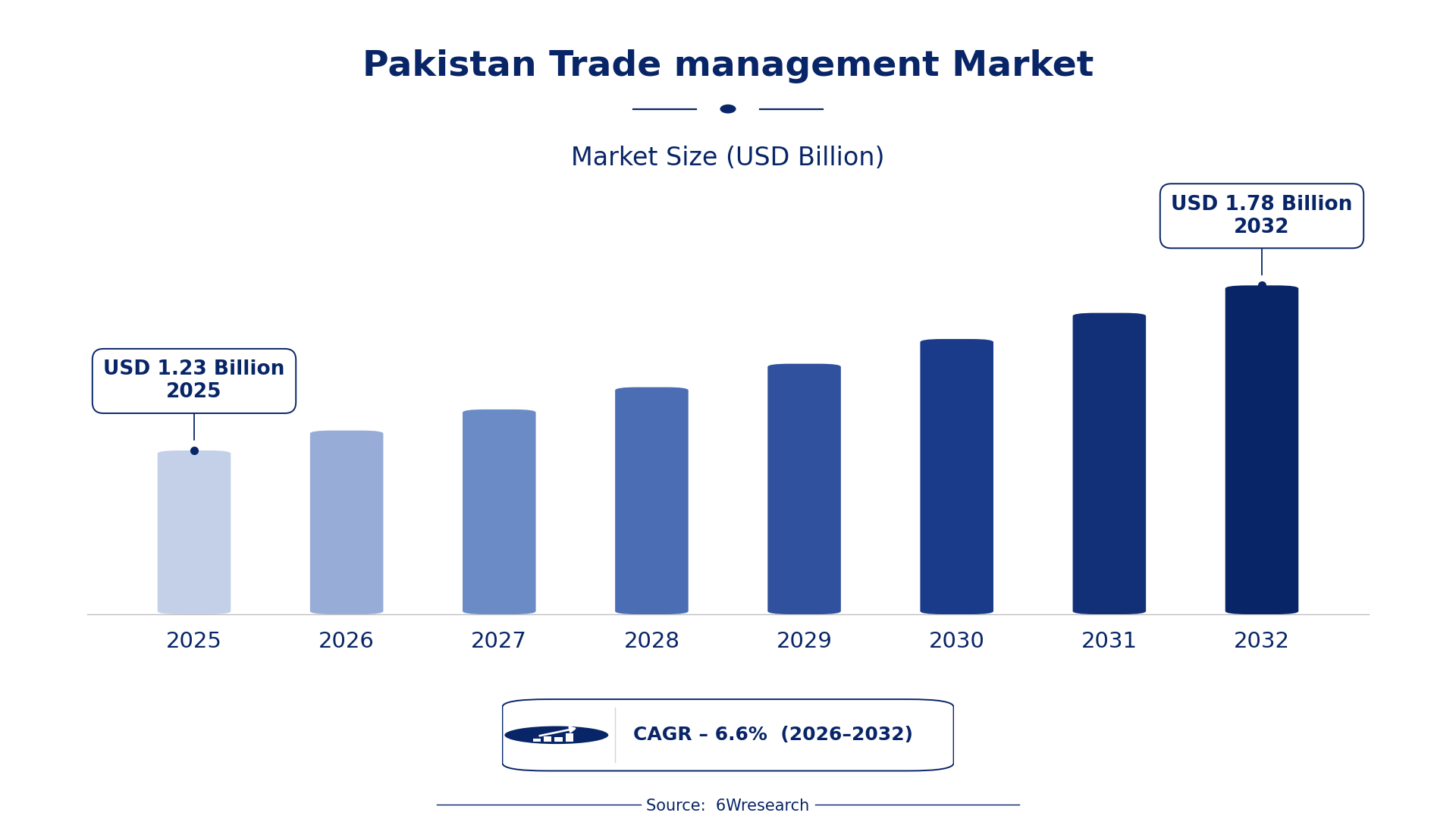
The Pakistan Trade management Market was estimated at USD 1226 Million in 2025 and is projected to reach USD 1782 Million by 2032, growing at a CAGR of 6.6% from 2026 to 2032.
Pakistan Trade management Market Synopsis
In recent years, the Pakistan trade management market has gained momentum, largely driven by increased cross-border trade and a government push towards modernization. However, as the market matures, the focus is shifting towards digital transformation and regulatory compliance, suggesting a future where efficiency and innovation will be paramount.
Looking ahead, companies must adopt advanced trade management solutions to navigate the complex regulatory environment and enhance operational efficiencies. The emphasis on cloud-based services and automation indicates that the market is not just growing but evolving, setting the stage for a more competitive landscape.
Pakistan Trade management Market Year-wise Growth Rate and Key Drivers
This graph illustrates the annual growth rates of the Pakistan Trade management Market from 2021 to 2032, highlighting a steady upward trajectory and projected expansion over the forecast period.
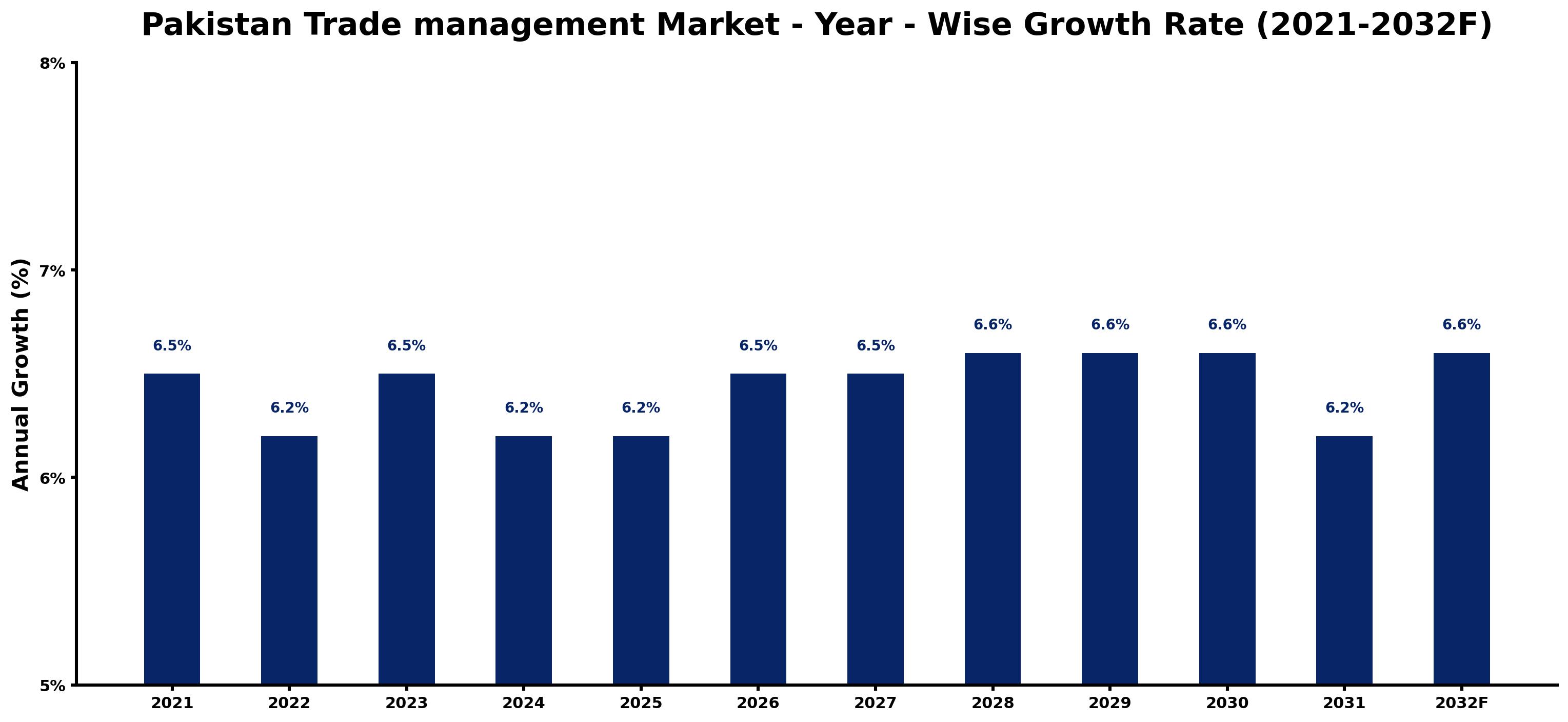
The table below presents the year‑wise growth rates along with the key drivers influencing the market
| Year | Growth Rate | Major Drivers |
| 2021 | 6.5% | Implementation of Pakistan Single Window for trade facilitation. |
| 2022 | 6.2% | Increase in e-commerce driven by digital payment solutions. |
| 2023 | 6.5% | Growth in textile exports fostering logistics advancements. |
| 2024 | 6.2% | Enhanced trade agreements with neighboring countries boosting volumes. |
| 2025 | 6.2% | Government incentives supporting customs modernization initiatives. |
| 2026 | 6.5% | Rise in foreign direct investment improving supply chain efficiency. |
| 2027 | 6.5% | Local startups innovating in trade analytics platforms. |
| 2028 | 6.6% | Increased regulatory support for cross-border trade initiatives. |
| 2029 | 6.6% | Adaptation of AI in logistics improving operational efficiencies. |
| 2030 | 6.6% | Focus on sustainable practices enhancing trade management systems. |
| 2031 | 6.2% | Development of transportation infrastructure facilitating smoother trade routes. |
| 2032 | 6.6% | Growing SMEs adoption of cloud-based trade management solutions. |
Note: Market size estimations and growth projections presented in this report are based on 6Wresearch's proprietary forecasting methodology, utilizing the latest available industry data, government publications, and primary research inputs.
Pakistan Trade management Market Key Takeaways
Below are some of the specific key takeaways from the market, including:
- The shift towards digital solutions is reshaping trade operations across various sectors.
- Cloud-based systems are becoming essential for scalability and accessibility in trade management.
- Regulatory complexities remain a hurdle, necessitating tailored compliance solutions.
- Government initiatives are actively promoting trade facilitation and infrastructure development.
- SMEs are increasingly recognized as a vital segment for growth in trade management services.
Evaluation of Restraints in Pakistan Trade management Market
Despite the promising outlook, several restraints are evident in the Pakistan trade management market. Regulatory complexities can stifle operational efficiency, as businesses often face bureaucratic hurdles that delay processes. Infrastructure shortcomings, especially in transportation and port facilities, further complicate logistics. Additionally, corruption in trade practices and fluctuating exchange rates introduce uncertainties, making it essential for firms to navigate these challenges with informed strategies and strong local partnerships.
Pakistan Trade management Market Trends
Several key trends are shaping the Pakistan trade management market. The transition to cloud-based solutions is gaining traction, enabling businesses to enhance their operational flexibility. on top of that, the integration of artificial intelligence and machine learning is streamlining decision-making processes, allowing for better risk assessment and management. There's also a growing emphasis on cybersecurity measures to protect sensitive trade data, reflecting heightened awareness of digital threats.
Pakistan Trade management Market Opportunities
Opportunities abound in the Pakistan trade management market, particularly for companies willing to innovate. Tailored solutions for small and medium-sized enterprises can tap into an underserved segment. Additionally, the expansion into e-commerce and other verticals presents lucrative prospects for service providers. As the government continues to enhance trade compliance frameworks, businesses that offer comprehensive compliance services will be well-positioned to capture a larger market share.
Government Initiatives in the Pakistan Trade management Market
The regulatory environment in Pakistan is increasingly supportive of trade management solutions, with government initiatives aimed at facilitating trade and enhancing global competitiveness. These policies focus on reducing trade barriers and improving infrastructure, making it easier for businesses to engage in international commerce.
- A national digital infrastructure upgrade programme is currently underway, aimed at modernizing trade processes.
- The government recently implemented a regulatory framework mandating more transparent customs procedures, which is expected to enhance compliance.
- Ongoing efforts are being made to improve port facilities and transportation networks to streamline logistics.
- Planned initiatives include new export promotion policies expected to be introduced by late 2026, targeting growth in key sectors.
Future Insights of the Pakistan Trade management Market
Looking towards 2026-2032, the Pakistan trade management market is likely to see continued growth, driven by technological advancements and the increasing complexity of global trade dynamics. Companies will focus on implementing advanced trade management systems that not only ensure compliance but also enhance supply chain visibility. The integration of automation and data analytics will play a critical role in streamlining operations and mitigating risks, making it essential for businesses to adapt swiftly to these changes.
Pakistan Trade management Market Latest Developments
In the past year, the Pakistan trade management market has witnessed significant activity as businesses seek to modernize operations. The emphasis on digital transformation has led to a surge in new technologies being adopted across various sectors, indicating a shift towards more efficient practices.
- A major technology vendor launched a cloud-based trade compliance solution in early 2025, enabling companies to manage regulations more effectively.
- An initiative that began in mid-2025 is currently underway to enhance trade training programs for businesses, focusing on compliance and operational efficiency.
- Upcoming in late 2026 is a rollout of an integrated customs management system designed to streamline cross-border trade processes.
- A partnership was announced in early 2025 between local businesses and international consultants to improve supply chain transparency, which is expected to be completed by late 2025.
Pakistan Trade management Market - Key Attractiveness of the Report
- 10 Years of Market Numbers
- Historical Data Starting from 2022 to 2025
- Base Year: 2025
- Forecast Data until 2032
- Key Performance Indicators Impacting the Market
- Major Upcoming Developments and Projects
Key Highlights of the Report:
- Pakistan Trade management Market Outlook
- Market Size of Pakistan Trade management Market, 2025
- Forecast of Pakistan Trade management Market, 2032
- Historical Data and Forecast of Pakistan Trade management Revenues & Volume for the Period 2022-2032F
- Pakistan Trade management Market Trend Evolution
- Pakistan Trade management Market Drivers and Challenges
- Pakistan Trade management Price Trends
- Pakistan Trade management Porter's Five Forces
- Pakistan Trade management Industry Life Cycle
- Historical Data and Forecast of Pakistan Trade management Market Revenues & Volume By Component for the Period 2022-2032F
- Historical Data and Forecast of Pakistan Trade management Market Revenues & Volume By Solutions for the Period 2022-2032F
- Historical Data and Forecast of Pakistan Trade management Market Revenues & Volume By Services for the Period 2022-2032F
- Historical Data and Forecast of Pakistan Trade management Market Revenues & Volume By Organization Size for the Period 2022-2032F
- Historical Data and Forecast of Pakistan Trade management Market Revenues & Volume By Large enterprises for the Period 2022-2032F
- Historical Data and Forecast of Pakistan Trade management Market Revenues & Volume By Small and medium-sized enterprises for the Period 2022-2032F
- Historical Data and Forecast of Pakistan Trade management Market Revenues & Volume By Deployment Mode for the Period 2022-2032F
- Historical Data and Forecast of Pakistan Trade management Market Revenues & Volume By On-Premises for the Period 2022-2032F
- Historical Data and Forecast of Pakistan Trade management Market Revenues & Volume By Cloud for the Period 2022-2032F
- Historical Data and Forecast of Pakistan Trade management Market Revenues & Volume By Vertical for the Period 2022-2032F
- Historical Data and Forecast of Pakistan Trade management Market Revenues & Volume By Transportation and Logistics for the Period 2022-2032F
- Historical Data and Forecast of Pakistan Trade management Market Revenues & Volume By Government and Public Sector for the Period 2022-2032F
- Historical Data and Forecast of Pakistan Trade management Market Revenues & Volume By Manufacturing for the Period 2022-2032F
- Historical Data and Forecast of Pakistan Trade management Market Revenues & Volume By Healthcare and Life Science for the Period 2022-2032F
- Historical Data and Forecast of Pakistan Trade management Market Revenues & Volume By Retail and Consumer Goods for the Period 2022-2032F
- Historical Data and Forecast of Pakistan Trade management Market Revenues & Volume By Energy and Utilities for the Period 2022-2032F
- Historical Data and Forecast of Pakistan Trade management Market Revenues & Volume By Other Verticals for the Period 2022-2032F
- Pakistan Trade management Import Export Trade Statistics
- Market Opportunity Assessment By Component
- Market Opportunity Assessment By Organization Size
- Market Opportunity Assessment By Deployment Mode
- Market Opportunity Assessment By Vertical
- Pakistan Trade management Top Companies Market Share
- Pakistan Trade management Competitive Benchmarking By Technical and Operational Parameters
- Pakistan Trade management Company Profiles
- Pakistan Trade management Key Strategic Recommendations






































