Paraguay Automotive Parts and Components Market Growth Rate Analysis (2025 - 2031)
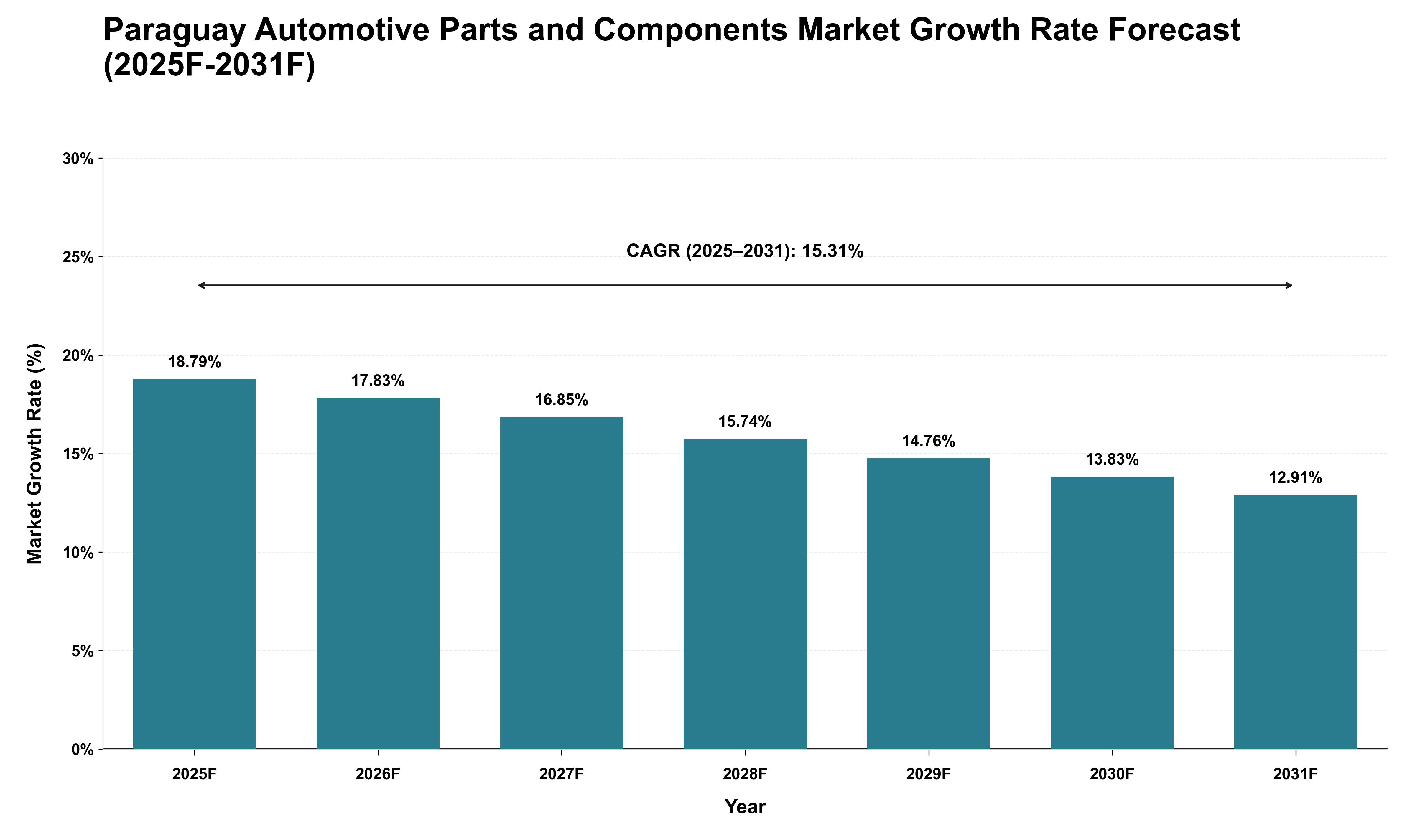
The Paraguay automotive parts and components market is projected to experience a robust compound annual growth rate of 15.31% from 2025 to 2031, driven by increasing domestic demand and expanding export opportunities. The initial surge in growth at 18.79% in 2025 indicates a strong rebound in trade flows, likely fueled by heightened vehicle production and assembly activities within the region. As import dependencies shift, local manufacturers may increasingly seek to enhance their supply chains, leading to a gradual decline in growth rates over the forecast period, with figures tapering down to 12.91% by 2031. This trend reflects typical cyclical patterns where initial rapid expansion gives way to stabilization as market players adapt to evolving consumer preferences and regulatory frameworks. Consequently, the interplay between domestic production capabilities and international trade dynamics will be crucial in shaping the trajectory of this sector throughout the forecast horizon.
Key Highlights of the Report:
- Paraguay Automotive Parts and Components Market Outlook
- Market Size of Paraguay Automotive Parts and Components Market, 2024
- Forecast of Paraguay Automotive Parts and Components Market, 2031
- Historical Data and Forecast of Paraguay Automotive Parts and Components Revenues & Volume for the Period 2021- 2031
- Paraguay Automotive Parts and Components Market Trend Evolution
- Paraguay Automotive Parts and Components Market Drivers and Challenges
- Paraguay Automotive Parts and Components Price Trends
- Paraguay Automotive Parts and Components Porter's Five Forces
- Paraguay Automotive Parts and Components Industry Life Cycle
- Historical Data and Forecast of Paraguay Automotive Parts and Components Market Revenues & Volume By Type for the Period 2021- 2031
- Historical Data and Forecast of Paraguay Automotive Parts and Components Market Revenues & Volume By Driveline and Powertrain for the Period 2021- 2031
- Historical Data and Forecast of Paraguay Automotive Parts and Components Market Revenues & Volume By Interiors and Exteriors for the Period 2021- 2031
- Historical Data and Forecast of Paraguay Automotive Parts and Components Market Revenues & Volume By Electronics for the Period 2021- 2031
- Historical Data and Forecast of Paraguay Automotive Parts and Components Market Revenues & Volume By Bodies and Chassis for the Period 2021- 2031
- Historical Data and Forecast of Paraguay Automotive Parts and Components Market Revenues & Volume By Wheel and Tires for the Period 2021- 2031
- Historical Data and Forecast of Paraguay Automotive Parts and Components Market Revenues & Volume By Other for the Period 2021- 2031
- Historical Data and Forecast of Paraguay Automotive Parts and Components Market Revenues & Volume By Application for the Period 2021- 2031
- Historical Data and Forecast of Paraguay Automotive Parts and Components Market Revenues & Volume By Original Equipment Manufacturers (OEMs) for the Period 2021- 2031
- Historical Data and Forecast of Paraguay Automotive Parts and Components Market Revenues & Volume By Aftermarket for the Period 2021- 2031
- Paraguay Automotive Parts and Components Import Export Trade Statistics
- Market Opportunity Assessment By Type
- Market Opportunity Assessment By Application
- Paraguay Automotive Parts and Components Top Companies Market Share
- Paraguay Automotive Parts and Components Competitive Benchmarking By Technical and Operational Parameters
- Paraguay Automotive Parts and Components Company Profiles
- Paraguay Automotive Parts and Components Key Strategic Recommendations






































