Paraguay Cyclohexane Market Growth Rate Analysis (2025 - 2031)
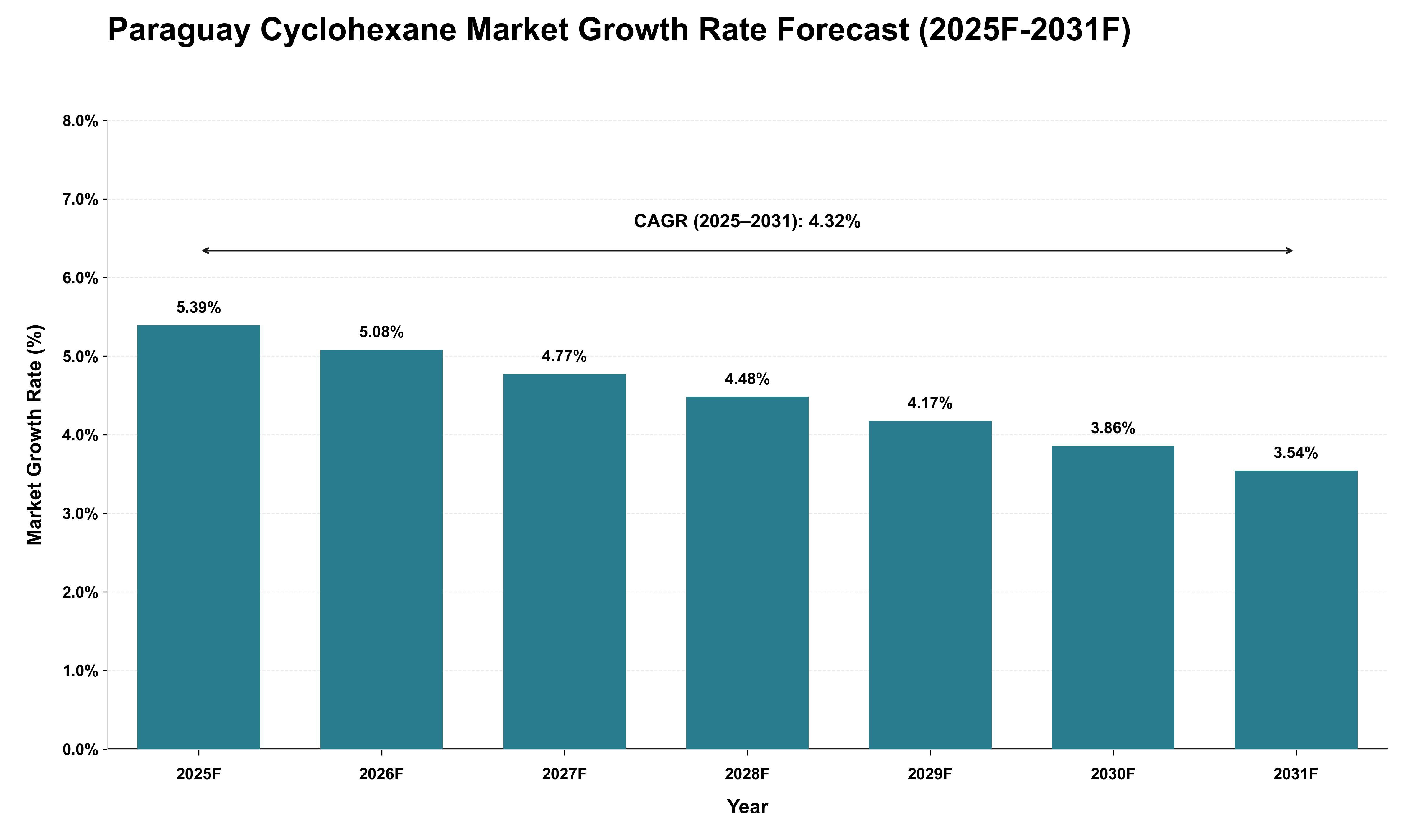
The forecasted growth trajectory for the Paraguay cyclohexane market will exhibit a gradual deceleration, as indicated by the declining annual growth rates from 5.39% in 2025 to 3.54% in 2031. This trend suggests that while demand for cyclohexane will remain robust, it will be increasingly influenced by technological advancements and product substitution dynamics within the chemical industry. As manufacturers seek more efficient processes and alternative solvents, the reliance on cyclohexane may shift, impacting import dependencies and domestic production strategies. The projected CAGR of 4.32% reflects a resilient market; however, it also underscores potential challenges as competitive products emerge and regulatory frameworks evolve. Consequently, stakeholders will need to navigate these cyclical trends carefully to optimize their positioning in an evolving landscape characterized by innovation and changing consumer preferences.
Key Highlights of the Report:
- Paraguay Cyclohexane Market Outlook
- Market Size of Paraguay Cyclohexane Market, 2024
- Forecast of Paraguay Cyclohexane Market, 2031
- Historical Data and Forecast of Paraguay Cyclohexane Revenues & Volume for the Period 2021-2031
- Paraguay Cyclohexane Market Trend Evolution
- Paraguay Cyclohexane Market Drivers and Challenges
- Paraguay Cyclohexane Price Trends
- Paraguay Cyclohexane Porter`s Five Forces
- Paraguay Cyclohexane Industry Life Cycle
- Historical Data and Forecast of Paraguay Cyclohexane Market Revenues & Volume By Application for the Period 2021-2031
- Historical Data and Forecast of Paraguay Cyclohexane Market Revenues & Volume By Adipic acid for the Period 2021-2031
- Historical Data and Forecast of Paraguay Cyclohexane Market Revenues & Volume By Caprolactam for the Period 2021-2031
- Historical Data and Forecast of Paraguay Cyclohexane Market Revenues & Volume By Others for the Period 2021-2031
- Historical Data and Forecast of Paraguay Cyclohexane Market Revenues & Volume By End-use for the Period 2021-2031
- Historical Data and Forecast of Paraguay Cyclohexane Market Revenues & Volume By Nylon 6 for the Period 2021-2031
- Historical Data and Forecast of Paraguay Cyclohexane Market Revenues & Volume By Nylon 66 for the Period 2021-2031
- Historical Data and Forecast of Paraguay Cyclohexane Market Revenues & Volume By Others for the Period 2021-2031
- Paraguay Cyclohexane Import Export Trade Statistics
- Market Opportunity Assessment By Application
- Market Opportunity Assessment By End-use
- Paraguay Cyclohexane Top Companies Market Share
- Paraguay Cyclohexane Competitive Benchmarking By Technical and Operational Parameters
- Paraguay Cyclohexane Company Profiles
- Paraguay Cyclohexane Key Strategic Recommendations






































