Paraguay Rolling Mill Components and Ancillary Equipment Market Growth Rate Analysis (2025 - 2031)
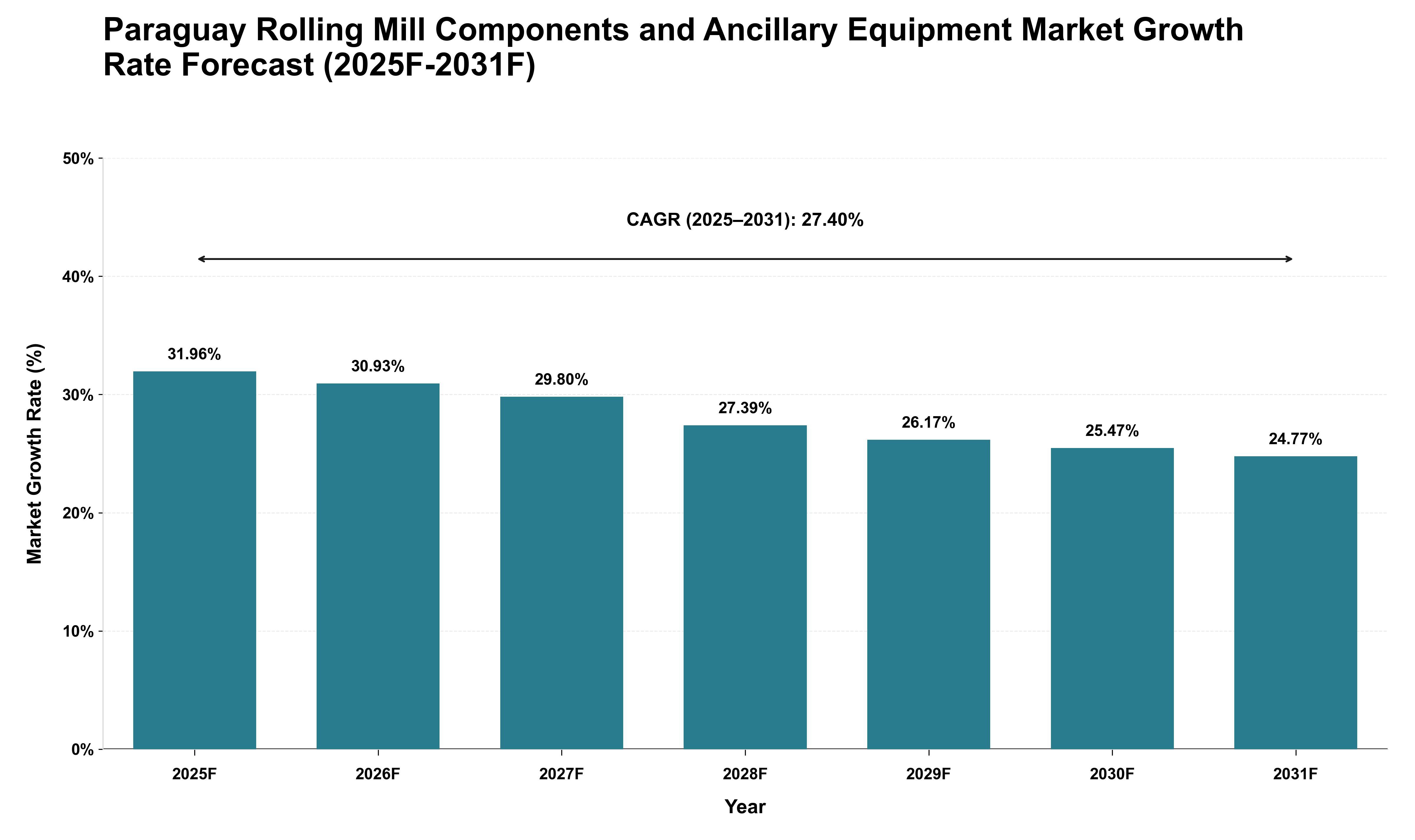
The Paraguay rolling mill components and ancillary equipment market is projected to experience a robust compound annual growth rate of 27.40% from 2025 to 2031, driven primarily by the anticipated fluctuations in raw material availability and pricing. As global demand for steel and related products continues to rise, the market will likely face increased pressure on sourcing essential inputs such as iron ore and scrap metal, which could lead to price volatility. The initial years of this forecast period will reflect significant growth rates, with 2025 expected to see an impressive increase of 31.96%. However, as supply chains adapt and import dependencies evolve, growth rates will gradually moderate, stabilizing around 24.77% by 2031. This trend underscores the cyclical nature of the industry, where initial surges in demand may prompt rapid expansions in production capabilities before adjustments in raw material costs recalibrate market dynamics.
Key Highlights of the Report:
- Paraguay Rolling Mill Components and Ancillary Equipment Market Outlook
- Market Size of Paraguay Rolling Mill Components and Ancillary Equipment Market, 2024
- Forecast of Paraguay Rolling Mill Components and Ancillary Equipment Market, 2031
- Historical Data and Forecast of Paraguay Rolling Mill Components and Ancillary Equipment Revenues & Volume for the Period 2021-2031
- Paraguay Rolling Mill Components and Ancillary Equipment Market Trend Evolution
- Paraguay Rolling Mill Components and Ancillary Equipment Market Drivers and Challenges
- Paraguay Rolling Mill Components and Ancillary Equipment Price Trends
- Paraguay Rolling Mill Components and Ancillary Equipment Porter`s Five Forces
- Paraguay Rolling Mill Components and Ancillary Equipment Industry Life Cycle
- Historical Data and Forecast of Paraguay Rolling Mill Components and Ancillary Equipment Market Revenues & Volume By Product for the Period 2021-2031
- Historical Data and Forecast of Paraguay Rolling Mill Components and Ancillary Equipment Market Revenues & Volume By Iron Rolls for the Period 2021-2031
- Historical Data and Forecast of Paraguay Rolling Mill Components and Ancillary Equipment Market Revenues & Volume By Steel Rolls for the Period 2021-2031
- Historical Data and Forecast of Paraguay Rolling Mill Components and Ancillary Equipment Market Revenues & Volume By Others for the Period 2021-2031
- Historical Data and Forecast of Paraguay Rolling Mill Components and Ancillary Equipment Market Revenues & Volume By End User for the Period 2021-2031
- Historical Data and Forecast of Paraguay Rolling Mill Components and Ancillary Equipment Market Revenues & Volume By Oil & Gas for the Period 2021-2031
- Historical Data and Forecast of Paraguay Rolling Mill Components and Ancillary Equipment Market Revenues & Volume By Industrial for the Period 2021-2031
- Historical Data and Forecast of Paraguay Rolling Mill Components and Ancillary Equipment Market Revenues & Volume By Automotive for the Period 2021-2031
- Historical Data and Forecast of Paraguay Rolling Mill Components and Ancillary Equipment Market Revenues & Volume By Mining for the Period 2021-2031
- Historical Data and Forecast of Paraguay Rolling Mill Components and Ancillary Equipment Market Revenues & Volume By Others for the Period 2021-2031
- Paraguay Rolling Mill Components and Ancillary Equipment Import Export Trade Statistics
- Market Opportunity Assessment By Product
- Market Opportunity Assessment By End User
- Paraguay Rolling Mill Components and Ancillary Equipment Top Companies Market Share
- Paraguay Rolling Mill Components and Ancillary Equipment Competitive Benchmarking By Technical and Operational Parameters
- Paraguay Rolling Mill Components and Ancillary Equipment Company Profiles
- Paraguay Rolling Mill Components and Ancillary Equipment Key Strategic Recommendations






































