Peru 5G Core Market Size, Share & Growth Rate
The Peru 5G Core Market was estimated at USD 1303 Million in 2025 and is projected to reach USD 1901 Million by 2032, growing at a CAGR of 5.5% from 2026 to 2032. This growth trajectory is primarily fueled by the burgeoning demand for high-speed connectivity, driven by advancements in IoT, smart city initiatives, and various data-intensive applications. As Peru continues to modernize its telecommunications infrastructure, the transition to 5G networks is expected to unlock new levels of efficiency and innovation across multiple sectors.
Peru 5G Core Market Year-wise Growth Rate and Key Drivers
This graph highlights how the Peru 5G Core Market has steadily grown over the years, supported by major growth factors.
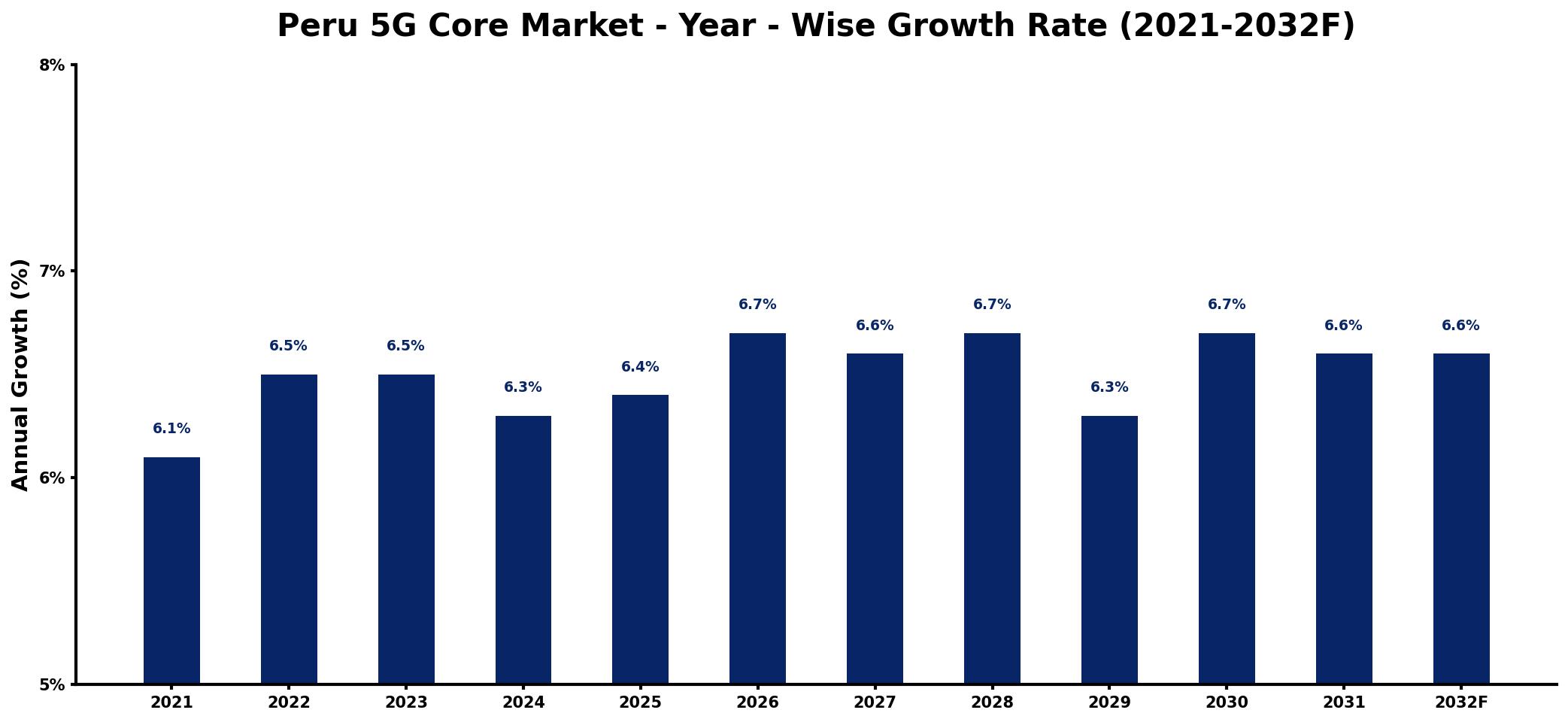
The table below presents the year‑wise growth rates along with the key drivers influencing the market
| Year | Growth Rate | Major Drivers |
| 2021 | 6.1% | increased investment in telecommunications infrastructure |
| 2022 | 6.5% | growing demand for mobile connectivity |
| 2023 | 6.5% | expansion of IoT applications market |
| 2024 | 6.3% | rising adoption of smart devices |
| 2025 | 6.4% | enhanced focus on digital transformation |
| 2026 | 6.7% | growing interest in 5G technology |
| 2027 | 6.6% | increased government support for innovation |
| 2028 | 6.7% | increased capital investment inflows |
| 2029 | 6.3% | growing regional consumption patterns |
| 2030 | 6.7% | increased focus on data analytics |
| 2031 | 6.6% | rising demand for edge computing |
| 2032 | 6.6% | increased pharmaceutical industry usage |
Note: Market size estimations and growth projections presented in this report are based on 6Wresearch's proprietary forecasting methodology, utilizing the latest available industry data, government publications, and primary research inputs.
Peru 5G Core Market Synopsis
The rapid advancement of technology has created an unprecedented demand for robust connectivity solutions in Peru. As industries like healthcare and transportation increasingly rely on real-time data and ultra-low latency communications, the significance of a solid 5G core network becomes apparent.
Key to this market's evolution is the focus on network slicing and edge computing, which allow for tailored services that meet the specific needs of various applications. Collaborations between telecom operators and technology providers are becoming more commonplace, further propelling the transition toward an advanced 5G infrastructure.
Peru 5G Core Market Key Takeaways
- The market is expected to grow significantly due to increasing investments in 5G infrastructure.
- Telecom operators are prioritizing low-latency and high-speed solutions to support diverse applications.
- Government policies are creating a conducive environment for 5G adoption and innovation.
- Cloud-native architectures and AI integration are emerging as vital components of the 5G core landscape.
- Investment opportunities are abundant, especially in IoT, smart cities, and industrial applications.
Evaluation of Restraints in Peru 5G Core Market
Despite the market's optimistic outlook, several factors present challenges that could impede growth. Geographic barriers, such as Peru's mountainous terrain, complicate infrastructure deployment and often escalate costs. Moreover, regulatory hurdles, particularly concerning spectrum availability, may hinder the swift rollout of 5G services. Limited R&D investment and a shortage of skilled professionals further exacerbate these issues, potentially delaying the realization of a fully functional 5G ecosystem.
Peru 5G Core Market Trends
The Peru 5G Core Market is increasingly characterized by a shift toward cloud-native architecture, which enhances flexibility and scalability. Network slicing has emerged as a critical trend, enabling operators to offer customized services tailored to the unique needs of various sectors. Additionally, the integration of artificial intelligence and machine learning is gaining traction for optimizing network performance and resource allocation. With the growing prevalence of applications like augmented and virtual reality, demand for low-latency solutions is also on the rise, shaping the future of connectivity in the region.
Peru 5G Core Market Opportunities
The potential for investment in the Peru 5G Core Market is vast, especially as consumer and enterprise needs for connectivity continue to evolve. With the anticipated growth in IoT devices and applications, there is a substantial demand for enhanced network infrastructure that supports high-speed connectivity. Furthermore, emerging sectors such as smart cities present lucrative avenues for companies willing to invest in innovative 5G core solutions. This growing market offers long-term growth prospects for telecommunications firms aiming to establish a competitive edge.
Government Initiatives in the Peru 5G Core Market
The Peruvian government has demonstrated strong commitment to fostering the 5G Core Market by implementing a regulatory framework aimed at promoting investment and innovation in telecommunications. Initiatives include allocating specific spectrum bands for 5G services and encouraging public-private partnerships to facilitate infrastructure development. Additionally, the government is placing significant emphasis on cybersecurity, developing guidelines to ensure data integrity and protection within 5G networks. These efforts collectively enhance the landscape for 5G adoption across the country.
Future Insights of the Peru 5G Core Market
Looking forward to 2026-2032, the Peru 5G Core Market is anticipated to expand substantially, driven by a multitude of factors. The increasing demand for smart technologies and IoT applications will necessitate robust 5G networks capable of delivering high-speed, low-latency services. As telecommunications companies continue to upgrade their infrastructure and the government reinforces its support for digital transformation initiatives, the foundation for widespread 5G adoption will be firmly established. This trajectory is expected to significantly impact various industries, facilitating enhanced operational efficiencies and innovative solutions.
Peru 5G Core Market Latest Developments (2025 - 2026)
In recent months, the Peru 5G Core Market has witnessed a flurry of activity as telecommunications firms accelerate their deployment efforts. Collaborations between tech companies and local operators have resulted in several pilot projects aimed at testing advanced 5G applications, particularly in urban areas. Additionally, discussions surrounding regulatory reforms are gaining traction, with an emphasis on expediting spectrum allocation and enhancing infrastructure support. These developments suggest a growing momentum towards realizing a robust 5G ecosystem in the region.
Peru 5G Core Market - Key Attractiveness of the Report
- 10 Years of Market Numbers
- Historical Data Starting from 2022 to 2025
- Base Year: 2025
- Forecast Data until 2032
- Key Performance Indicators Impacting the Market
- Major Upcoming Developments and Projects
Key Highlights of the Report:
- Peru 5G Core Market Outlook
- Market Size of Peru 5G Core Market, 2025
- Forecast of Peru 5G Core Market, 2032
- Historical Data and Forecast of Peru 5G Core Revenues & Volume for the Period 2022-2032F
- Peru 5G Core Market Trend Evolution
- Peru 5G Core Market Drivers and Challenges
- Peru 5G Core Price Trends
- Peru 5G Core Porter's Five Forces
- Peru 5G Core Industry Life Cycle
- Historical Data and Forecast of Peru 5G Core Market Revenues & Volume By Component for the Period 2022-2032F
- Historical Data and Forecast of Peru 5G Core Market Revenues & Volume By Solutions for the Period 2022-2032F
- Historical Data and Forecast of Peru 5G Core Market Revenues & Volume By Services for the Period 2022-2032F
- Historical Data and Forecast of Peru 5G Core Market Revenues & Volume By Network Function for the Period 2022-2032F
- Historical Data and Forecast of Peru 5G Core Market Revenues & Volume By Access for the Period 2022-2032F
- Historical Data and Forecast of Peru 5G Core Market Revenues & Volume By Mobility Management Function for the Period 2022-2032F
- Historical Data and Forecast of Peru 5G Core Market Revenues & Volume By Policy Control Function for the Period 2022-2032F
- Historical Data and Forecast of Peru 5G Core Market Revenues & Volume By Unified Data Management for the Period 2022-2032F
- Historical Data and Forecast of Peru 5G Core Market Revenues & Volume By Deployment Model for the Period 2022-2032F
- Historical Data and Forecast of Peru 5G Core Market Revenues & Volume By Cloud for the Period 2022-2032F
- Historical Data and Forecast of Peru 5G Core Market Revenues & Volume By On-premises for the Period 2022-2032F
- Historical Data and Forecast of Peru 5G Core Market Revenues & Volume By End User for the Period 2022-2032F
- Historical Data and Forecast of Peru 5G Core Market Revenues & Volume By Telecom Operators for the Period 2022-2032F
- Historical Data and Forecast of Peru 5G Core Market Revenues & Volume By Enterprises for the Period 2022-2032F
- Peru 5G Core Import Export Trade Statistics
- Market Opportunity Assessment By Component
- Market Opportunity Assessment By Network Function
- Market Opportunity Assessment By Deployment Model
- Market Opportunity Assessment By End User
- Peru 5G Core Top Companies Market Share
- Peru 5G Core Competitive Benchmarking By Technical and Operational Parameters
- Peru 5G Core Company Profiles
- Peru 5G Core Key Strategic Recommendations






































