Peru Automotive Brake Pads Market Top 5 Importing Countries and Market Competition (HHI) Analysis
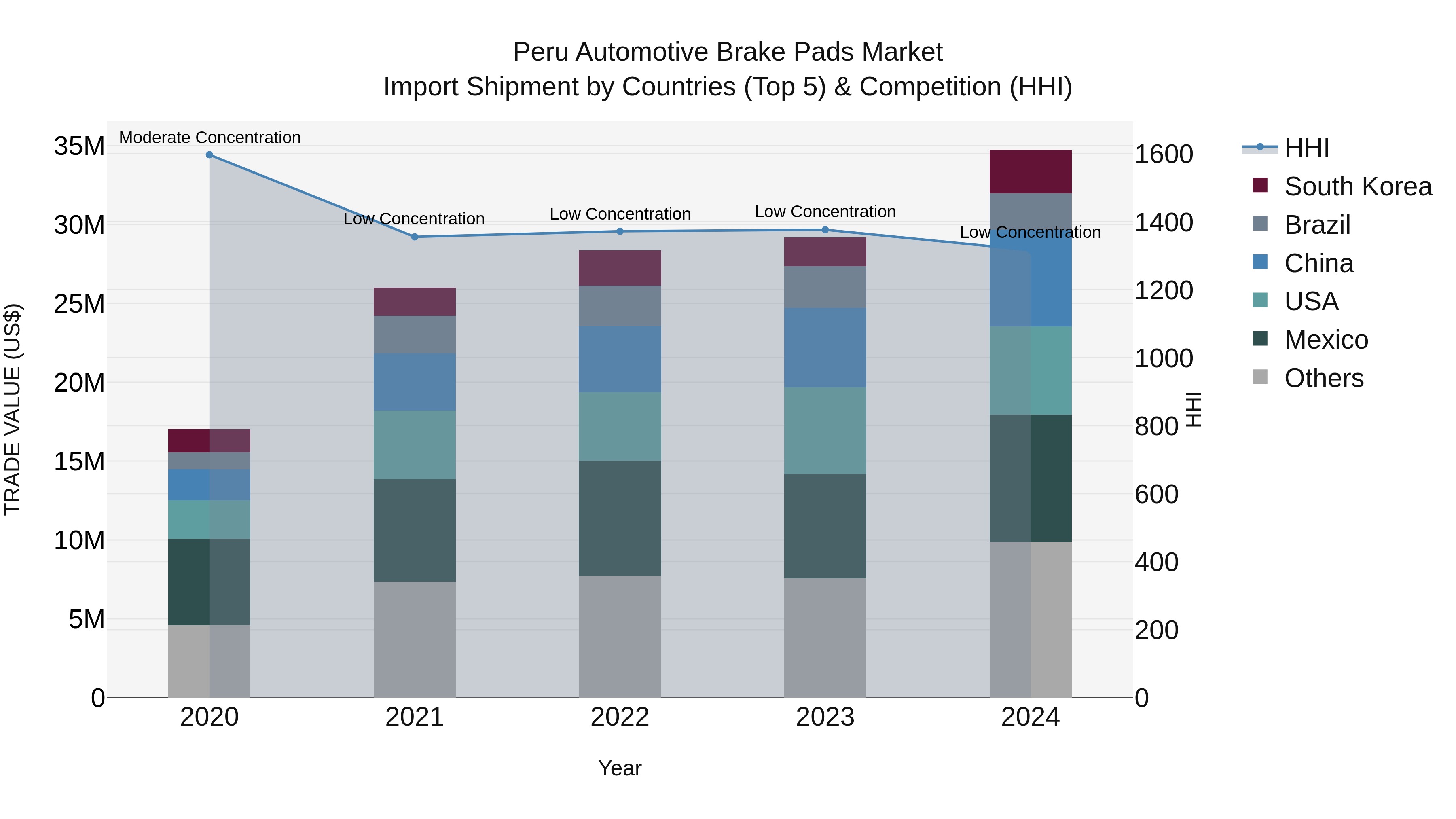
Peru`s automotive brake pads import market in 2024 saw significant growth, with top exporting countries including Mexico, China, USA, South Korea, and Brazil. The low Herfindahl-Hirschman Index (HHI) indicates a competitive market landscape. The compound annual growth rate (CAGR) from 2020 to 2024 was strong at 19.48%, with a notable growth rate of 18.98% from 2023 to 2024. This data suggests a thriving market for automotive brake pads in Peru, driven by imports from diverse international suppliers.
Automotive Brake Pads Market: Peru vs Top 5 Major Economies in 2027 (Latin America)
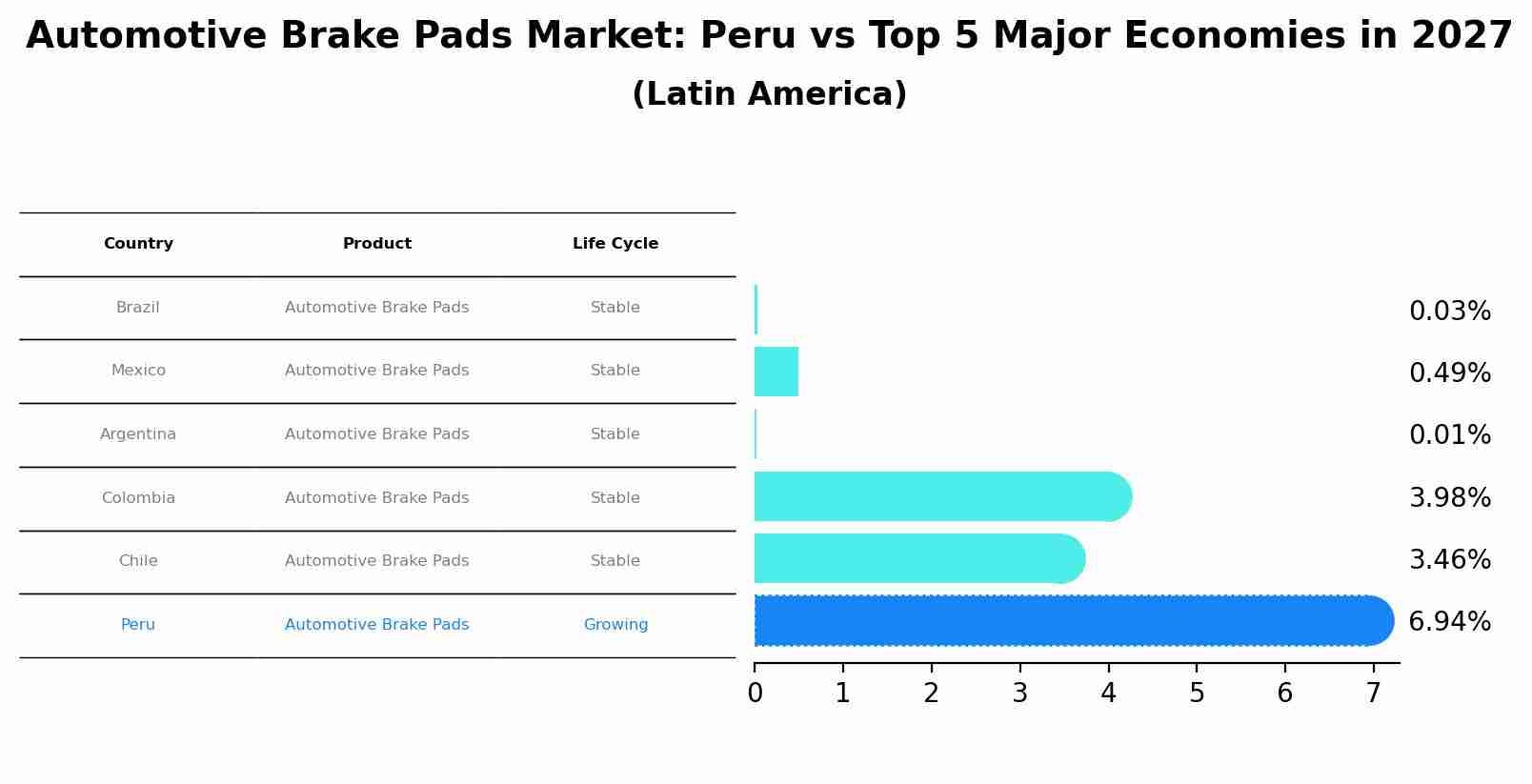
By 2027, Peru's Automotive Brake Pads market is forecasted to achieve a growing growth rate of 6.94%, with Brazil leading the Latin America region, followed by Mexico, Argentina, Colombia and Chile.
Peru Automotive Brake Pads Market Overview
The Peru Automotive Brake Pads Market is experiencing steady growth driven by increasing vehicle sales and a growing focus on vehicle safety. The market is primarily dominated by both local and international manufacturers offering a wide range of brake pad options for different vehicle types. Factors such as stringent regulations regarding vehicle safety standards, rising consumer awareness about the importance of brake maintenance, and the increasing adoption of advanced braking technologies are contributing to the market`s expansion. Key players in the market are continuously investing in research and development activities to introduce innovative brake pad solutions that offer improved performance, durability, and efficiency. Overall, the Peru Automotive Brake Pads Market is poised for further growth as the automotive industry continues to evolve and prioritize safety features.
Peru Automotive Brake Pads Market Trends
The Peru Automotive Brake Pads Market is experiencing a shift towards eco-friendly and high-performance brake pads. There is a growing demand for ceramic and low-metallic brake pads due to their superior stopping power, reduced noise, and lower dust emissions compared to traditional semi-metallic pads. Manufacturers are also focusing on developing brake pads with longer lifespan and improved durability to cater to the increasing preference for reliable and low-maintenance products. Additionally, advancements in technology such as the integration of sensors for brake pad wear monitoring are gaining traction in the market, providing drivers with real-time information on the condition of their brake pads. Overall, the market is witnessing a trend towards innovation, sustainability, and enhanced safety features in automotive brake pads.
Peru Automotive Brake Pads Market Challenges
In the Peru Automotive Brake Pads Market, one of the primary challenges faced is the presence of counterfeit and low-quality brake pads. This poses a significant risk to both consumers and legitimate manufacturers, as substandard brake pads can compromise vehicle safety and performance. Another challenge is the increasing competition from cheaper imported brake pads, particularly from Asian markets, which can lead to price wars and margin pressures for local manufacturers. Additionally, the lack of stringent regulations and enforcement mechanisms in the Peruvian market contributes to the proliferation of inferior brake pads, making it difficult for consumers to distinguish between genuine and counterfeit products. To address these challenges, industry players need to focus on quality control, innovation, and educating consumers about the importance of using genuine, high-quality brake pads for their vehicles.
Peru Automotive Brake Pads Market Investment Opportunities
The Peru Automotive Brake Pads Market presents promising investment opportunities driven by factors such as increasing vehicle sales, rising awareness about vehicle maintenance, and stringent safety regulations. With the growing demand for high-quality brake pads to ensure safe driving experiences, there is a need for innovative products that offer enhanced performance and durability. Investing in research and development to create advanced brake pad formulations, such as low-noise and high-friction materials, can help companies gain a competitive edge in the market. Additionally, partnerships with local distributors and automotive service centers can facilitate market penetration and brand visibility. Overall, investing in the Peru Automotive Brake Pads Market offers the potential for long-term growth and profitability.
Peru Automotive Brake Pads Market Government Policy
The Peruvian government has implemented various policies to regulate the automotive brake pads market. One of the key regulations is the requirement for brake pads to meet specific safety standards to ensure the protection of consumers and the environment. Additionally, there are import regulations in place to control the quality of brake pads entering the country and to prevent the sale of counterfeit products. The government also promotes the use of eco-friendly brake pads to reduce environmental impact and improve air quality. Overall, these policies aim to ensure the safety and quality of automotive brake pads in the Peruvian market while also promoting sustainability and environmental responsibility.
Peru Automotive Brake Pads Market Future Outlook
The future outlook for the Peru Automotive Brake Pads Market appears promising, driven by factors such as increasing vehicle sales, growing awareness about road safety, and technological advancements in brake pad materials. The market is expected to witness steady growth as consumers prioritize vehicle maintenance and safety. Additionally, stringent government regulations regarding vehicle safety standards are likely to boost the demand for high-quality brake pads. Market players are focusing on product innovation, such as the development of eco-friendly and long-lasting brake pads, to gain a competitive edge. Overall, the Peru Automotive Brake Pads Market is anticipated to experience a positive trajectory in the coming years, presenting opportunities for both domestic and international manufacturers to expand their presence in the market.
Key Highlights of the Report:
- Peru Automotive Brake Pads Market Outlook
- Market Size of Peru Automotive Brake Pads Market, 2021
- Forecast of Peru Automotive Brake Pads Market, 2031
- Historical Data and Forecast of Peru Automotive Brake Pads Revenues & Volume for the Period 2018 - 2031
- Peru Automotive Brake Pads Market Trend Evolution
- Peru Automotive Brake Pads Market Drivers and Challenges
- Peru Automotive Brake Pads Price Trends
- Peru Automotive Brake Pads Porter's Five Forces
- Peru Automotive Brake Pads Industry Life Cycle
- Historical Data and Forecast of Peru Automotive Brake Pads Market Revenues & Volume By Vehicle for the Period 2018 - 2031
- Historical Data and Forecast of Peru Automotive Brake Pads Market Revenues & Volume By Passenger Car for the Period 2018 - 2031
- Historical Data and Forecast of Peru Automotive Brake Pads Market Revenues & Volume By LCV for the Period 2018 - 2031
- Historical Data and Forecast of Peru Automotive Brake Pads Market Revenues & Volume By HCV for the Period 2018 - 2031
- Historical Data and Forecast of Peru Automotive Brake Pads Market Revenues & Volume By Two-wheelers for the Period 2018 - 2031
- Historical Data and Forecast of Peru Automotive Brake Pads Market Revenues & Volume By Material for the Period 2018 - 2031
- Historical Data and Forecast of Peru Automotive Brake Pads Market Revenues & Volume By Semi-metallic for the Period 2018 - 2031
- Historical Data and Forecast of Peru Automotive Brake Pads Market Revenues & Volume By Non-asbestos Organic (NAO) for the Period 2018 - 2031
- Historical Data and Forecast of Peru Automotive Brake Pads Market Revenues & Volume By Low-metallic NAO for the Period 2018 - 2031
- Historical Data and Forecast of Peru Automotive Brake Pads Market Revenues & Volume By Ceramic for the Period 2018 - 2031
- Historical Data and Forecast of Peru Automotive Brake Pads Market Revenues & Volume By Sales Outlet for the Period 2018 - 2031
- Historical Data and Forecast of Peru Automotive Brake Pads Market Revenues & Volume By OEM for the Period 2018 - 2031
- Historical Data and Forecast of Peru Automotive Brake Pads Market Revenues & Volume By Aftermarket for the Period 2018 - 2031
- Historical Data and Forecast of Peru Automotive Brake Pads Market Revenues & Volume By Position for the Period 2018 - 2031
- Historical Data and Forecast of Peru Automotive Brake Pads Market Revenues & Volume By Front for the Period 2018 - 2031
- Historical Data and Forecast of Peru Automotive Brake Pads Market Revenues & Volume By Front & Rear for the Period 2018 - 2031
- Peru Automotive Brake Pads Import Export Trade Statistics
- Market Opportunity Assessment By Vehicle
- Market Opportunity Assessment By Material
- Market Opportunity Assessment By Sales Outlet
- Market Opportunity Assessment By Position
- Peru Automotive Brake Pads Top Companies Market Share
- Peru Automotive Brake Pads Competitive Benchmarking By Technical and Operational Parameters
- Peru Automotive Brake Pads Company Profiles
- Peru Automotive Brake Pads Key Strategic Recommendations






































