Peru Botanical Supplements Market Top 5 Importing Countries and Market Competition (HHI) Analysis
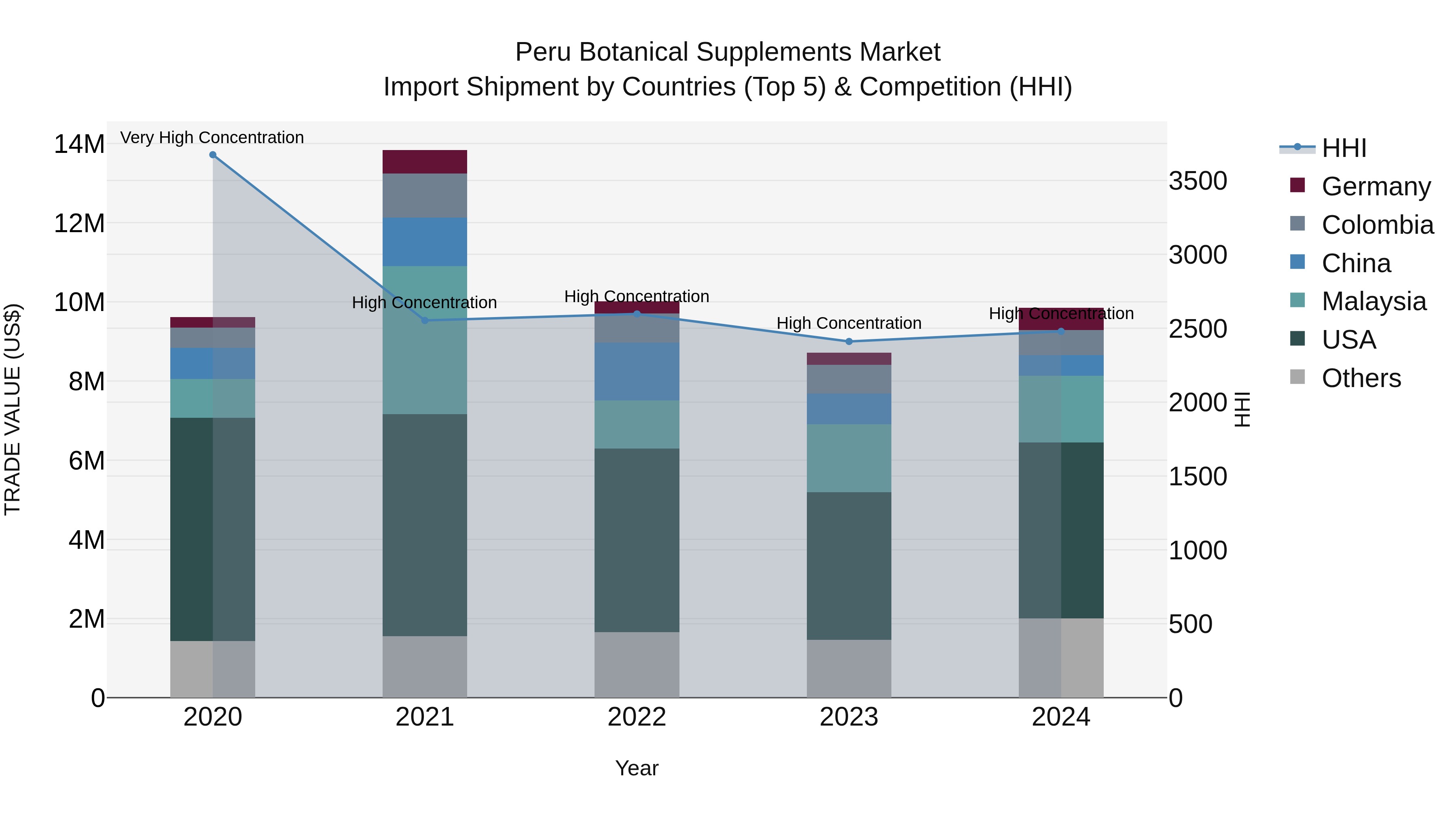
Peru`s botanical supplements import market in 2024 continues to be driven by top exporters such as the USA, Malaysia, Colombia, Germany, and China. The high Herfindahl-Hirschman Index (HHI) concentration indicates a competitive market landscape. With a steady Compound Annual Growth Rate (CAGR) of 0.61% from 2020 to 2024, the market shows resilience. The impressive growth rate of 13.01% from 2023 to 2024 suggests a surge in demand for botanical supplements in Peru, presenting opportunities for both domestic and international suppliers to capitalize on this growing market.
Botanical Supplements Market: Peru vs Top 5 Major Economies in 2027 (Latin America)
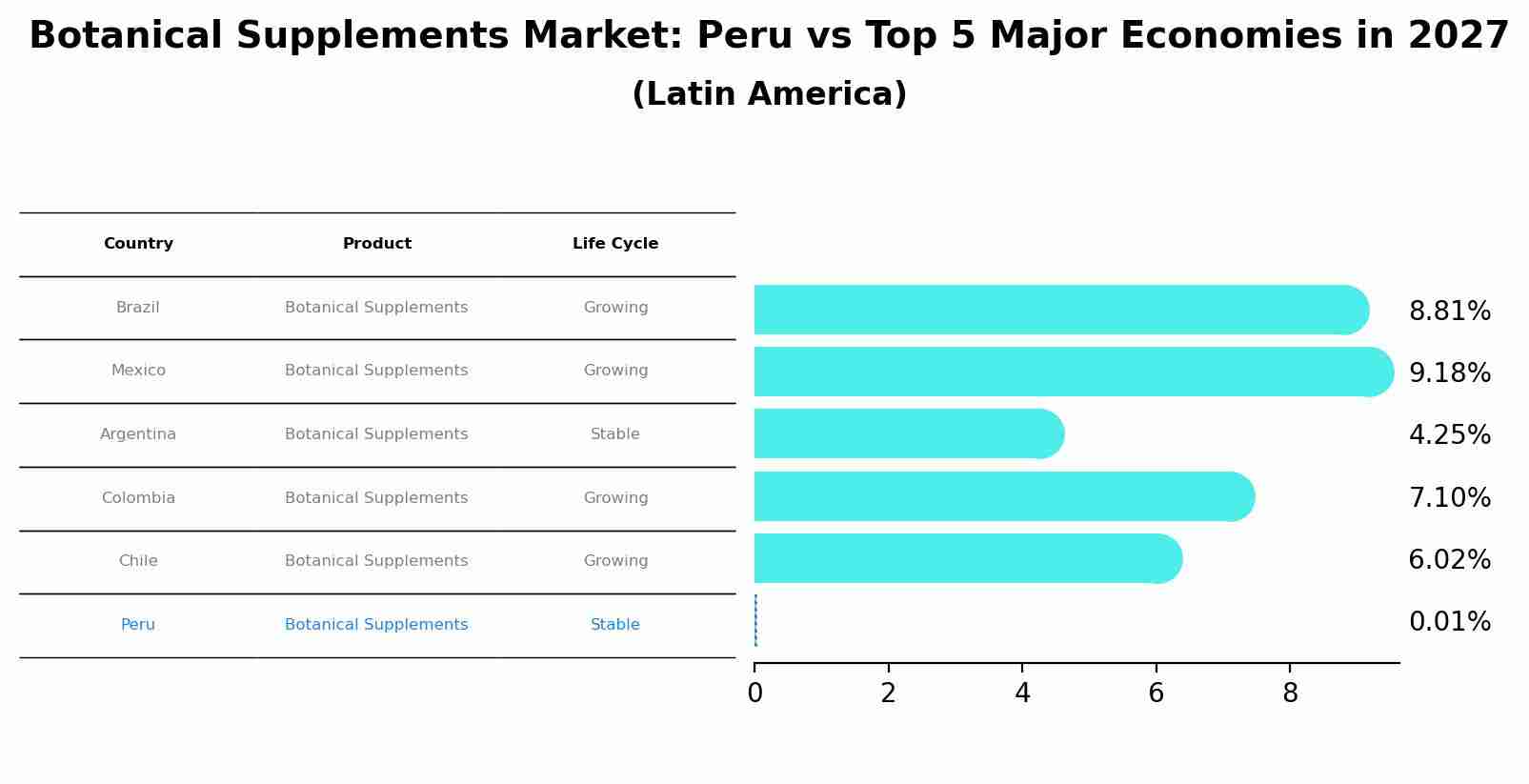
Peru's Botanical Supplements market is anticipated to experience a stable growth rate of 0.01% by 2027, reflecting trends observed in the largest economy Brazil, followed by Mexico, Argentina, Colombia and Chile.
Peru Botanical Supplements Market Synopsis
The Peru Botanical Supplements Market is experiencing steady growth driven by increasing consumer awareness of the health benefits of natural and plant-based products. The market offers a wide range of botanical supplements, including maca, quinoa, and camu camu, which are popular for their nutritional properties and traditional medicinal uses. Key factors contributing to market growth include rising disposable incomes, a growing interest in alternative medicine, and a trend towards holistic wellness. Additionally, Peru`s rich biodiversity and traditional knowledge of herbal remedies contribute to the country`s reputation as a source of high-quality botanical supplements. As consumers seek natural solutions for health and wellness, the Peru Botanical Supplements Market is expected to continue its growth trajectory in the coming years.
Peru Botanical Supplements Market Trends
Currently, the Peru Botanical Supplements Market is experiencing a growing demand for natural and traditional remedies, aligning with the global trend towards health and wellness products. Consumers are increasingly seeking botanical supplements derived from native Peruvian plants such as maca, camu camu, and sacha inchi for their perceived health benefits and natural origins. There is also a rising interest in organic and sustainably sourced botanical supplements, as consumers are becoming more environmentally conscious and mindful of the origin and production methods of the products they consume. Additionally, the market is seeing an influx of innovative product formulations that combine multiple botanical ingredients to target specific health concerns, catering to a more discerning and health-conscious consumer base.
Peru Botanical Supplements Market Challenges
In the Peru Botanical Supplements Market, several challenges exist, including regulatory issues surrounding the cultivation, harvesting, and export of botanical ingredients. Ensuring compliance with local and international quality standards and certifications can be complex and time-consuming for businesses operating in this market. Additionally, the market faces competition from traditional medicinal practices and skepticism from consumers regarding the efficacy and safety of botanical supplements. Distribution and logistics pose another challenge, particularly in reaching rural areas where demand for botanical supplements may be high. Lastly, the lack of standardized research and clinical studies on the benefits and potential side effects of botanical supplements hinders market growth and consumer acceptance. Addressing these challenges will be crucial for companies looking to succeed in the Peru Botanical Supplements Market.
Peru Botanical Supplements Market Investment Opportunities
The Peru Botanical Supplements Market presents promising investment opportunities due to the country`s rich biodiversity and traditional use of medicinal plants. With a growing global demand for natural health products, Peruvian botanical supplements have gained popularity for their unique and potent properties. Investing in this market offers potential for high returns as consumers increasingly seek organic and plant-based alternatives to traditional pharmaceuticals. Key areas for investment include research and development to identify new botanical ingredients, sustainable sourcing practices to ensure long-term supply chain stability, and marketing strategies to promote Peruvian botanical supplements in both domestic and international markets. Overall, the Peru Botanical Supplements Market offers a compelling investment landscape driven by the growing trend towards natural health and wellness products.
Jordan Agar Market Government Policies
The Peruvian government has implemented policies to regulate the botanical supplements market, aiming to ensure consumer safety and product quality. The General Directorate of Medicines, Supplies, and Drugs (DIGEMID) oversees the registration and approval of botanical supplements, requiring companies to comply with regulatory standards and labeling requirements. Additionally, the Ministry of Health collaborates with the National Institute of Health (INS) to monitor the safety and efficacy of botanical supplements through post-market surveillance. These policies aim to protect consumers from misleading claims, adulterated products, and potential health risks, promoting transparency and accountability within the Peru botanical supplements market.
Peru Botanical Supplements Market Future Outlook
The Peru botanical supplements market is expected to witness steady growth in the coming years, driven by increasing consumer awareness regarding the health benefits of natural and plant-based products. The rising demand for traditional herbal remedies and natural supplements, coupled with a growing focus on preventive healthcare, will contribute to the market expansion. Additionally, the rich biodiversity of Peru and its reputation for producing high-quality botanical ingredients will further fuel market growth as consumers seek products with authentic and ethically sourced ingredients. Key players in the industry are likely to capitalize on these trends by introducing innovative formulations and expanding their product offerings to cater to the evolving preferences of health-conscious consumers, positioning Peru as a key player in the global botanical supplements market.
Key Highlights of the Report:
- Peru Botanical Supplements Market Outlook
- Market Size of Peru Botanical Supplements Market, 2021
- Forecast of Peru Botanical Supplements Market, 2031
- Historical Data and Forecast of Peru Botanical Supplements Revenues & Volume for the Period 2018 - 2031
- Peru Botanical Supplements Market Trend Evolution
- Peru Botanical Supplements Market Drivers and Challenges
- Peru Botanical Supplements Price Trends
- Peru Botanical Supplements Porter's Five Forces
- Peru Botanical Supplements Industry Life Cycle
- Historical Data and Forecast of Peru Botanical Supplements Market Revenues & Volume By Source for the Period 2018 - 2031
- Historical Data and Forecast of Peru Botanical Supplements Market Revenues & Volume By Herbs for the Period 2018 - 2031
- Historical Data and Forecast of Peru Botanical Supplements Market Revenues & Volume By Leaves for the Period 2018 - 2031
- Historical Data and Forecast of Peru Botanical Supplements Market Revenues & Volume By Spices for the Period 2018 - 2031
- Historical Data and Forecast of Peru Botanical Supplements Market Revenues & Volume By Flowers for the Period 2018 - 2031
- Historical Data and Forecast of Peru Botanical Supplements Market Revenues & Volume By Others for the Period 2018 - 2031
- Historical Data and Forecast of Peru Botanical Supplements Market Revenues & Volume By Form for the Period 2018 - 2031
- Historical Data and Forecast of Peru Botanical Supplements Market Revenues & Volume By Powder for the Period 2018 - 2031
- Historical Data and Forecast of Peru Botanical Supplements Market Revenues & Volume By Liquid for the Period 2018 - 2031
- Historical Data and Forecast of Peru Botanical Supplements Market Revenues & Volume By Tablets for the Period 2018 - 2031
- Historical Data and Forecast of Peru Botanical Supplements Market Revenues & Volume By Capsules for the Period 2018 - 2031
- Historical Data and Forecast of Peru Botanical Supplements Market Revenues & Volume By Gummies for the Period 2018 - 2031
- Historical Data and Forecast of Peru Botanical Supplements Market Revenues & Volume By Others for the Period 2018 - 2031
- Historical Data and Forecast of Peru Botanical Supplements Market Revenues & Volume By Application for the Period 2018 - 2031
- Historical Data and Forecast of Peru Botanical Supplements Market Revenues & Volume By Energy & Weight Management for the Period 2018 - 2031
- Historical Data and Forecast of Peru Botanical Supplements Market Revenues & Volume By General Health for the Period 2018 - 2031
- Historical Data and Forecast of Peru Botanical Supplements Market Revenues & Volume By Bone & Joint Health for the Period 2018 - 2031
- Historical Data and Forecast of Peru Botanical Supplements Market Revenues & Volume By Gastrointestinal Health for the Period 2018 - 2031
- Historical Data and Forecast of Peru Botanical Supplements Market Revenues & Volume By Immunity for the Period 2018 - 2031
- Historical Data and Forecast of Peru Botanical Supplements Market Revenues & Volume By Cardiac Health for the Period 2018 - 2031
- Historical Data and Forecast of Peru Botanical Supplements Market Revenues & Volume By Diabetes for the Period 2018 - 2031
- Historical Data and Forecast of Peru Botanical Supplements Market Revenues & Volume By Anti-cancer for the Period 2018 - 2031
- Historical Data and Forecast of Peru Botanical Supplements Market Revenues & Volume By Distribution Channel for the Period 2018 - 2031
- Historical Data and Forecast of Peru Botanical Supplements Market Revenues & Volume By Offline for the Period 2018 - 2031
- Historical Data and Forecast of Peru Botanical Supplements Market Revenues & Volume By Online for the Period 2018 - 2031
- Peru Botanical Supplements Import Export Trade Statistics
- Market Opportunity Assessment By Source
- Market Opportunity Assessment By Form
- Market Opportunity Assessment By Application
- Market Opportunity Assessment By Distribution Channel
- Peru Botanical Supplements Top Companies Market Share
- Peru Botanical Supplements Competitive Benchmarking By Technical and Operational Parameters
- Peru Botanical Supplements Company Profiles
- Peru Botanical Supplements Key Strategic Recommendations






































