Peru Elevator and Escalator Market Summary
The peru elevator and escalator market was estimated at USD 464 Million in 2025 and is projected to reach USD 782 Million by 2032, growing at a CAGR of 8.9% from 2026 to 2032.
Peru Elevator and Escalator Market Year-wise Growth Rate and Key Drivers
This graph highlights how the Peru Elevator and Escalator Market has steadily grown over the past five years, supported by major growth factors.
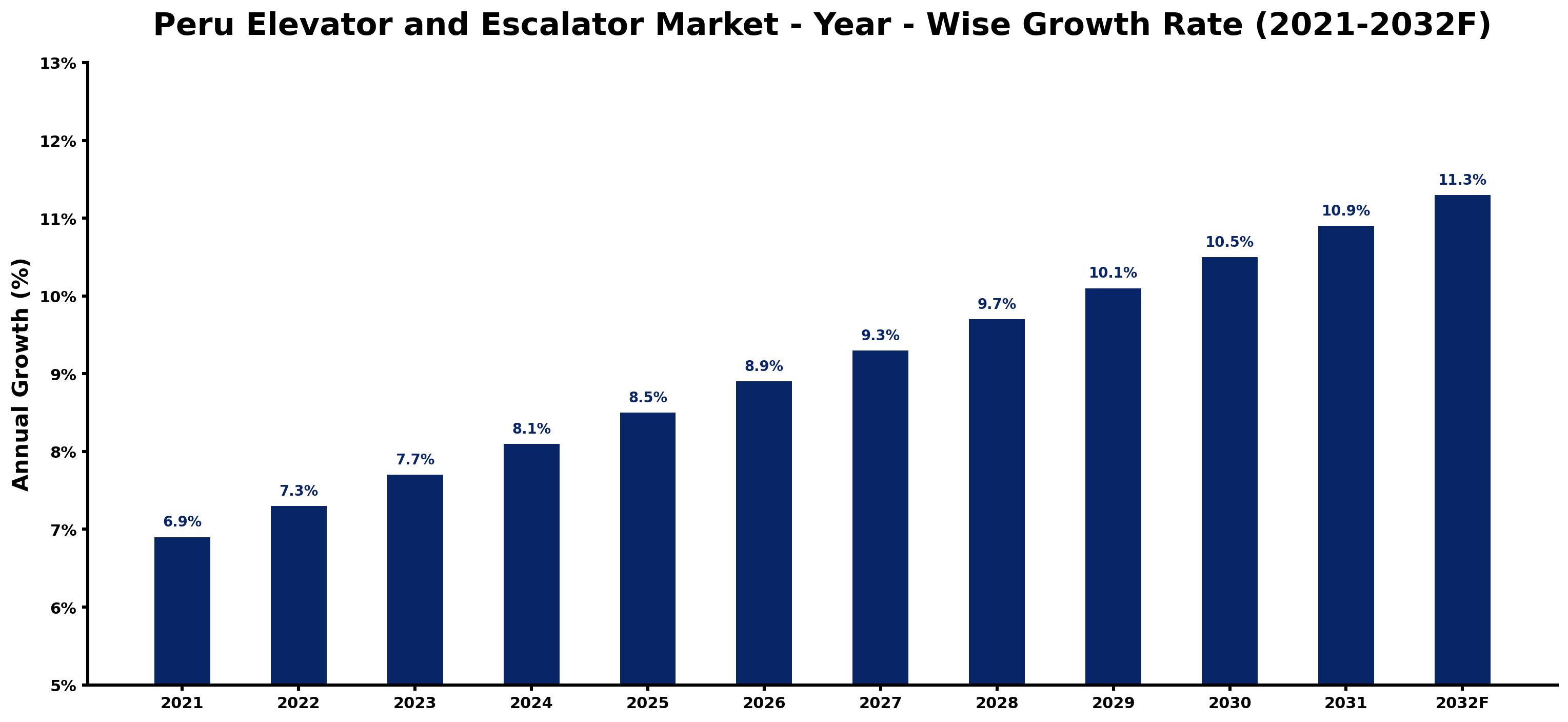
The table below presents the year wise growth rates along with the key drivers influencing the market
| Year | Growth Rate | Major Drivers |
| 2021 | 6.9% | Construction activity picked up pace as urban redevelopment projects gained traction across cities. |
| 2022 | 7.3% | Investment in infrastructure modernization revealed a growing commitment to urban mobility solutions. |
| 2023 | 7.7% | Technological innovations in elevator systems enhanced energy efficiency, attracting eco-conscious developers. |
| 2024 | 8.1% | Commercial real estate developments flourished, increasing requirements for vertical transportation systems. |
| 2025 | 8.5% | Public transportation expansions necessitated integrated escalator solutions in high-traffic areas. |
| 2026 | 8.9% | Urban population growth continued to drive demand for reliable elevator services in apartments. |
| 2027 | 9.3% | Luxury residential projects emerged, prioritizing advanced elevator technologies and user comforts. |
| 2028 | 9.7% | Sustainable building practices gained popularity, influencing elevator designs focusing on energy conservation. |
| 2029 | 10.1% | Increased tourism prompted elevator installations in hotels and entertainment venues across major cities. |
| 2030 | 10.5% | Smart city initiatives brought focus to automated systems in public infrastructure, enhancing efficiency. |
| 2031 | 10.9% | Corporate investments in ESG principles encouraged green building certifications for new constructions. |
| 2032 | 11.3% | Integration of IoT in elevator systems improved maintenance schedules, ensuring operational reliability. |
Note - Market size estimations and growth projections presented in this report are based on 6Wresearch's advanced forecasting approach, validated with industry datasets as of June 2026.
Peru Elevator and Escalator Market Synopsis
The Peru Elevator and Escalator Market is projected to reach 8.9% and witness significant growth during the forecast period (2026-2032). The growth trajectory of this market is largely influenced by urbanization, infrastructure developments, and increasing demand for advanced mobility solutions in both residential and commercial sectors. The expansion of urban areas and the rise in construction activities are key factors contributing to the rising need for effective vertical transportation systems in Peru.
Peru Elevator and Escalator Market Growth Drivers
Several drivers are shaping the future of the Peru Elevator and Escalator Market. The first key driver is the accelerated pace of urbanization, with an increasing population migrating to urban areas, leading to a higher demand for vertical transportation systems in high-rise buildings. Furthermore, the ongoing urban infrastructure projects, including commercial complexes, residential buildings, and public transport systems, are significantly propelling the demand for elevators and escalators.
- The growth of the construction industry in Peru is a major catalyst for the elevator and escalator market, as new buildings necessitate modernized vertical transport systems.
- Government initiatives aimed at improving public transportation infrastructure also contribute notably to market expansion.
- Technological advancements in elevator and escalator systems, such as smart elevators and energy-efficient models, are attracting investments and enhancing market offerings.
- There is an increasing focus on environmental sustainability, prompting the adoption of eco-friendly elevator and escalator solutions.
- The rising disposable income among consumers is leading to higher spending on premium residential facilities, indirectly boosting the demand for elevators and escalators.
Peru Elevator and Escalator Market Challenges and Restraints
Despite the favorable market conditions, the Peru Elevator and Escalator Market faces several challenges that could hinder growth. High installation and maintenance costs associated with advanced elevator systems can deter smaller construction companies from adopting such technologies. Additionally, the market is also affected by the lack of skilled labor necessary for the installation and servicing of these complex systems.
- Inconsistent regulatory frameworks can cause delays in project approvals, affecting overall market growth potential.
- Supply chain disruptions, particularly in the procurement of high-tech components, can pose significant challenges for market players.
- There is a risk of economic fluctuations affecting construction investments, which can subsequently impact the elevator and escalator market.
- Competition from alternative transportation solutions may also limit the expansion opportunities for elevators and escalators in some sectors.
- Environmental regulations that necessitate compliance can impose additional costs on manufacturers.
Peru Elevator and Escalator Market Investment Opportunities
As the Peru Elevator and Escalator Market evolves, numerous investment opportunities are emerging. Stakeholders are encouraged to explore partnerships in technology development to enhance product offerings. Investing in research and development to innovate energy-efficient and smart elevator systems can further attract environmentally conscious consumers.
- Collaboration with local construction firms presents opportunities for market penetration and project integration.
- Investment in upgrading existing elevator systems in older buildings can yield profitable returns as safety and efficiency become paramount.
- Developing tailored solutions for niche markets, such as healthcare facilities, educational institutions, and shopping malls, can open new avenues for revenue generation.
- Expansion into secondary cities experiencing growth can provide a strategic advantage for companies seeking to capitalize on urbanization trends.
- Leveraging digital marketing strategies to reach end-users and increase brand visibility can enhance market presence effectively.
Peru Elevator and Escalator Market Government Investment and Initiatives
The government of Peru has implemented various initiatives that bolster the Elevator and Escalator Market. Key policies concerning infrastructure expenditure underscore the importance of developing modern transportation systems in urban areas. Public investments focus on enhancing urban mobility through upgraded public transport facilities, which include the installation of elevators and escalators in transit stations.
- The government is committed to improving accessibility for all, encouraging the integration of elevators and escalators in public buildings to ensure compliance with disability access regulations.
- Development plans for new urban centers incorporate advanced vertical transportation solutions as a standard in architectural designs.
- Tax incentives for construction companies investing in energy-efficient elevators promote sustainability within the market.
- Public-private partnerships are being encouraged to foster innovation and efficiency in the development and maintenance of these systems.
- Ongoing training programs funded by the government aim to equip the workforce with necessary skills for installing and maintaining modern elevator technologies.
Peru Elevator and Escalator Market Latest Developments (May 2025 - June 2026)
Recent developments in the Peru Elevator and Escalator Market indicate a dynamic transformation driven by technological advancements and shifting consumer demands. During this period, the market saw an increased adoption of smart elevator systems integrating IoT technologies, enhancing user experience and operational efficiency. The rise in environmental awareness among consumers prompted several manufacturers to develop eco-friendly elevator solutions, further contributing to the market's sustainability agenda.
- Regulatory updates aimed at enhancing safety standards for elevators and escalators have been introduced, ensuring higher compliance in new installations.
- Public infrastructure projects initiated by the government have ramped up, leading to a surge in demand for modernized vertical transport solutions.
- The focus on retrofitting older buildings with advanced systems has gained momentum, reflecting changing consumer preferences.
- Collaborations between technology firms and construction companies have emerged, particularly in developing smart maintenance solutions that utilize predictive analytics.
- Industry forums have increased, facilitating discussions on best practices and the future of the elevator and escalator sector in Peru.
Peru Elevator and Escalator Market - Key Attractiveness of the Report
- 10 Years of Market Numbers
- Historical Data Starting from 2022 to 2025
- Base Year: 2025
- Forecast Data until 2032
- Key Performance Indicators Impacting the Market
- Major Upcoming Developments and Projects
Key Highlights of the Report:
- Peru Elevator and Escalator Market Outlook
- Market Size of Peru Elevator and Escalator Market, 2025
- Forecast of Peru Elevator and Escalator Market, 2032F
- Historical Data and Forecast of Peru Elevator and Escalator Revenues & Volume for the Period 2022-2032F
- Peru Elevator and Escalator Market Trend Evolution
- Peru Elevator and Escalator Market Drivers and Challenges
- Peru Elevator and Escalator Price Trends
- Peru Elevator and Escalator Porter's Five Forces
- Peru Elevator and Escalator Industry Life Cycle
- Historical Data and Forecast of Peru Elevator and Escalator Market Revenues & Volume By Types for the Period 2022-2032F
- Historical Data and Forecast of Peru Elevator and Escalator Market Revenues & Volume By Elevator for the Period 2022-2032F
- Historical Data and Forecast of Peru Elevator and Escalator Market Revenues & Volume By Escalator for the Period 2022-2032F
- Historical Data and Forecast of Peru Elevator and Escalator Market Revenues & Volume By Moving Walkways for the Period 2022-2032F
- Historical Data and Forecast of Peru Elevator and Escalator Market Revenues & Volume By Services for the Period 2022-2032F
- Historical Data and Forecast of Peru Elevator and Escalator Market Revenues & Volume By Maintenance & Repair for the Period 2022-2032F
- Historical Data and Forecast of Peru Elevator and Escalator Market Revenues & Volume By New Installation for the Period 2022-2032F
- Historical Data and Forecast of Peru Elevator and Escalator Market Revenues & Volume By Modernization for the Period 2022-2032F
- Historical Data and Forecast of Peru Elevator and Escalator Market Revenues & Volume By End-User for the Period 2022-2032F
- Historical Data and Forecast of Peru Elevator and Escalator Market Revenues & Volume By Residential for the Period 2022-2032F
- Historical Data and Forecast of Peru Elevator and Escalator Market Revenues & Volume By Commercial for the Period 2022-2032F
- Historical Data and Forecast of Peru Elevator and Escalator Market Revenues & Volume By Public for the Period 2022-2032F
- Peru Elevator and Escalator Import Export Trade Statistics
- Market Opportunity Assessment By Types
- Market Opportunity Assessment By Services
- Market Opportunity Assessment By End-User
- Peru Elevator and Escalator Top Companies Market Share
- Peru Elevator and Escalator Competitive Benchmarking By Technical and Operational Parameters
- Peru Elevator and Escalator Company Profiles
- Peru Elevator and Escalator Key Strategic Recommendations






































