Peru Food Processing & Handling Equipment Market Summary
The peru food processing & handling equipment market was estimated at USD 776 Million in 2025 and is projected to reach USD 1104 Million by 2032, growing at a CAGR of 6.1% from 2026 to 2032.
Peru Food Processing & Handling Equipment Market Year-wise Growth Rate and Key Drivers
This graph highlights how the Peru Food Processing & Handling Equipment Market has steadily grown over the past five years, supported by major growth factors.
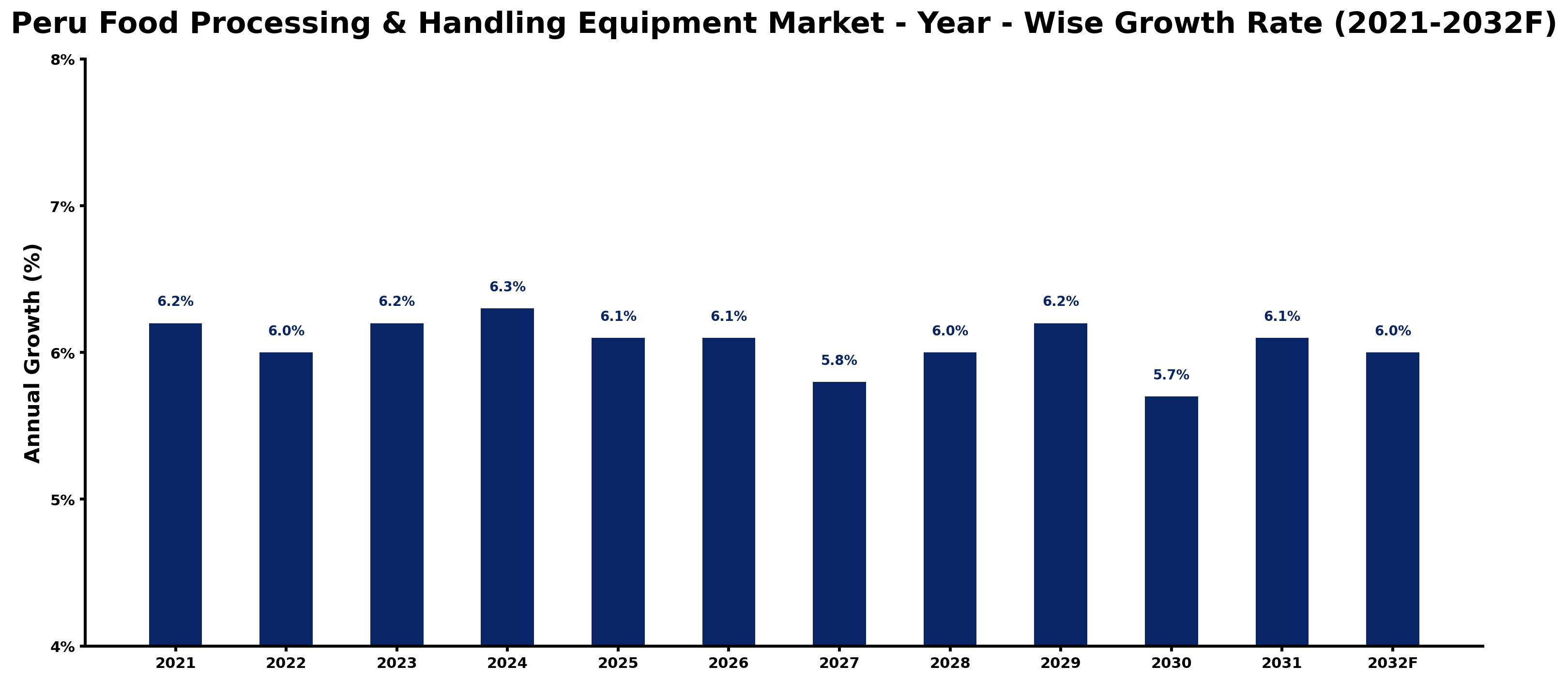
The table below presents the year wise growth rates along with the key drivers influencing the market
| Year | Growth Rate | Major Drivers |
| 2021 | 6.2% | Post-pandemic recovery ignited interest in modern food processing technologies. |
| 2022 | 6.0% | Local manufacturers sought to upgrade equipment for improved efficiency and safety. |
| 2023 | 6.2% | Sustainability concerns prompted investments in eco-friendly food handling solutions. |
| 2024 | 6.3% | Increased export opportunities encouraged local producers to enhance processing capabilities. |
| 2025 | 6.1% | Urbanization trends spurred demand for advanced food preservation and packaging methods. |
| 2026 | 6.1% | Technological innovations led to smarter inventory management systems for food products. |
| 2027 | 5.8% | Consumer preferences shifted towards organic and locally sourced food items. |
| 2028 | 6.0% | An expanding middle class influenced the growth of premium food processing equipment. |
| 2029 | 6.2% | Partnerships between local firms and global brands enhanced technology transfer initiatives. |
| 2030 | 5.7% | Increased focus on food safety regulations necessitated better processing and handling equipment. |
| 2031 | 6.1% | Emerging food trends prompted agile manufacturing solutions to address market changes. |
| 2032 | 6.0% | Investment in export-oriented food processing facilities reshaped the competitive landscape. |
Note - Market size estimations and growth projections presented in this report are based on 6Wresearch's advanced forecasting approach, validated with industry datasets as of June 2026.
Peru Food Processing & Handling Equipment Market Synopsis
The Peru Food Processing Handling Equipment Market is projected to reach 6.1% and witness significant growth during the forecast period (2026-2032). This growth is primarily driven by the expansion of the food and beverage industry within the country, which is experiencing heightened consumer demand for processed and packaged food items. The trend towards convenience foods and ready-to-eat products has further propelled the need for advanced processing and handling equipment, marking a transformative phase in the market.
Peru Food Processing & Handling Equipment Market Growth Drivers
Several factors are driving the growth of the Peru Food Processing & Handling Equipment Market. These include:
- The increasing urbanization in Peru, leading to changing lifestyles that prioritize convenience in food consumption, directly influences the demand for processed food.
- Rising disposable income levels allow consumers to spend more on processed and packaged foods, creating a robust market for equipment that facilitates such production.
- Investments in advanced technology by manufacturers aim to improve operational efficiency and meet stringent quality standards, resulting in an uplift in market capabilities.
- The growing recognition of food safety and hygiene standards compels food processors to upgrade their equipment, which drives demand for modern handling and processing solutions.
- Continued innovation in equipment design, focusing on sustainability and energy efficiency, aligns with consumer preferences for eco-friendly products, thus enhancing market growth.
Peru Food Processing & Handling Equipment Market Trends and Opportunities
Current trends within the Peru Food Processing & Handling Equipment Market reflect broader global shifts towards automation and sustainability. Key trends include:
- The adoption of automation and digital technologies is accelerating, enabling manufacturers to streamline operations and reduce costs through enhanced process management.
- There is a rising demand for advanced equipment such as robotics and sensors, which are essential for achieving higher standards of food safety and efficiency.
- Manufacturers are increasingly focusing on sustainable practices, driven by consumer inclinations toward environmentally friendly solutions, prompting innovations in design and functionality.
- Compliance with stringent food safety regulations is pushing operators to invest in sophisticated equipment that ensures adherence to these standards, thus influencing purchasing behaviors.
- A collaborative approach between equipment manufacturers and food processing companies is emerging, aimed at creating tailored solutions that meet the unique challenges of the local market.
Peru Food Processing & Handling Equipment Market Challenges and Restraints
Despite the growth potential, the Peru Food Processing & Handling Equipment Market faces several challenges:
- High initial investments required for advanced processing machinery often deter small and medium-sized enterprises from upgrading their facilities, limiting their competitiveness.
- A shortage of skilled labor capable of operating sophisticated machinery presents a significant barrier to optimal operations within food processing companies.
- Infrastructure challenges, including inadequate transportation networks and inconsistent power supply, hinder the efficient operation of processing and handling equipment.
- Stringent regulatory requirements pose additional pressures on market participants, requiring investments in compliance-related technologies and processes.
- Economic fluctuations can impact consumer spending on processed foods, which in turn affects the demand for food processing equipment.
Peru Food Processing & Handling Equipment Market Investment Opportunities
The burgeoning Peru Food Processing & Handling Equipment Market presents several investment opportunities for stakeholders:
- With the food and beverage sector expanding, there is a growing need for cutting-edge processing and packaging equipment, making this a lucrative area for investment.
- Investments in automation and smart technologies can help enhance productivity and reduce operational costs, appealing to both existing and new market entrants.
- The modernization of food processing facilities in Peru offers opportunities for strategic partnerships aimed at developing innovative equipment and solutions.
- Sustainability-focused projects can attract investment, as manufacturers and suppliers increasingly aim to align with consumer trends that favor eco-friendly products.
- Government initiatives supporting modernization and innovation within the sector create an encouraging environment for investments, enhancing competitiveness in the region.
Peru Food Processing & Handling Equipment Market Government Investment and Initiatives
Government policies in Peru regarding the food processing and handling equipment market emphasize food safety, quality assurance, and technological innovation. Initiatives include:
- The implementation of strict regulations to ensure food processing equipment adheres to rigorous hygiene and safety standards, crucial for consumer protection.
- Support programs aimed at small and medium-sized enterprises provide financial assistance and technical resources, facilitating their growth and capacity to invest in modern equipment.
- Policies encouraging investment in technology and research aim to enhance the productivity and operational efficiency of food processing businesses across the country.
- Development plans focusing on infrastructure improvement are integral to bolstering the capabilities of the food processing sector, directly impacting equipment efficiency.
- Government incentives for sustainable practices further promote innovation and competitiveness within the market, aligning with global trends towards environmental responsibility.
Peru Food Processing & Handling Equipment Market Latest Developments (May 2025 - June 2026)
From May 2025 to June 2026, the Peru Food Processing & Handling Equipment Market has experienced noteworthy developments. Industry players are increasingly focusing on automation and digital transformation to streamline processing activities. Enhanced investment in advanced technologies such as AI and Internet of Things (IoT) solutions is becoming common practice, aimed at improving operational efficiency and food safety. Additionally, sustainability has become a priority, with manufacturers seeking ways to minimize their carbon footprint through eco-friendly equipment design. Regulatory compliance continues to shape equipment purchasing decisions, as businesses strive to meet evolving food safety standards. Collaborations among industry stakeholders are emerging as companies work together to innovate and address market challenges effectively.
Peru Food Processing & Handling Equipment Market - Key Attractiveness of the Report
- 10 Years of Market Numbers
- Historical Data Starting from 2022 to 2025
- Base Year: 2025
- Forecast Data until 2032
- Key Performance Indicators Impacting the Market
- Major Upcoming Developments and Projects
Key Highlights of the Report:
- Peru Food Processing & Handling Equipment Market Outlook
- Market Size of Peru Food Processing & Handling Equipment Market, 2025
- Forecast of Peru Food Processing & Handling Equipment Market, 2032F
- Historical Data and Forecast of Peru Food Processing & Handling Equipment Revenues & Volume for the Period 2022-2032F
- Peru Food Processing & Handling Equipment Market Trend Evolution
- Peru Food Processing & Handling Equipment Market Drivers and Challenges
- Peru Food Processing & Handling Equipment Price Trends
- Peru Food Processing & Handling Equipment Porter's Five Forces
- Peru Food Processing & Handling Equipment Industry Life Cycle
- Historical Data and Forecast of Peru Food Processing & Handling Equipment Market Revenues & Volume By Equipment Type for the Period 2022-2032F
- Historical Data and Forecast of Peru Food Processing & Handling Equipment Market Revenues & Volume By Food Processing equipment for the Period 2022-2032F
- Historical Data and Forecast of Peru Food Processing & Handling Equipment Market Revenues & Volume By Foodservice equipment for the Period 2022-2032F
- Historical Data and Forecast of Peru Food Processing & Handling Equipment Market Revenues & Volume By Food Packaging equipment for the Period 2022-2032F
- Historical Data and Forecast of Peru Food Processing & Handling Equipment Market Revenues & Volume By Application for the Period 2022-2032F
- Historical Data and Forecast of Peru Food Processing & Handling Equipment Market Revenues & Volume By Bakery & confectionery products for the Period 2022-2032F
- Historical Data and Forecast of Peru Food Processing & Handling Equipment Market Revenues & Volume By Meat & poultry products for the Period 2022-2032F
- Historical Data and Forecast of Peru Food Processing & Handling Equipment Market Revenues & Volume By Dairy products for the Period 2022-2032F
- Historical Data and Forecast of Peru Food Processing & Handling Equipment Market Revenues & Volume By Alcoholic beverages for the Period 2022-2032F
- Historical Data and Forecast of Peru Food Processing & Handling Equipment Market Revenues & Volume By Non-alcoholic beverages for the Period 2022-2032F
- Historical Data and Forecast of Peru Food Processing & Handling Equipment Market Revenues & Volume By Fish & seafood products for the Period 2022-2032F
- Historical Data and Forecast of Peru Food Processing & Handling Equipment Market Revenues & Volume By Others? for the Period 2022-2032F
- Historical Data and Forecast of Peru Food Processing & Handling Equipment Market Revenues & Volume By Form for the Period 2022-2032F
- Historical Data and Forecast of Peru Food Processing & Handling Equipment Market Revenues & Volume By Solid for the Period 2022-2032F
- Historical Data and Forecast of Peru Food Processing & Handling Equipment Market Revenues & Volume By Liquid for the Period 2022-2032F
- Historical Data and Forecast of Peru Food Processing & Handling Equipment Market Revenues & Volume By Semi-solid for the Period 2022-2032F
- Peru Food Processing & Handling Equipment Import Export Trade Statistics
- Market Opportunity Assessment By Equipment Type
- Market Opportunity Assessment By Application
- Market Opportunity Assessment By Form
- Peru Food Processing & Handling Equipment Top Companies Market Share
- Peru Food Processing & Handling Equipment Competitive Benchmarking By Technical and Operational Parameters
- Peru Food Processing & Handling Equipment Company Profiles
- Peru Food Processing & Handling Equipment Key Strategic Recommendations






































