Peru Image Recognition Market Size & Growth Rate (2026-2032)
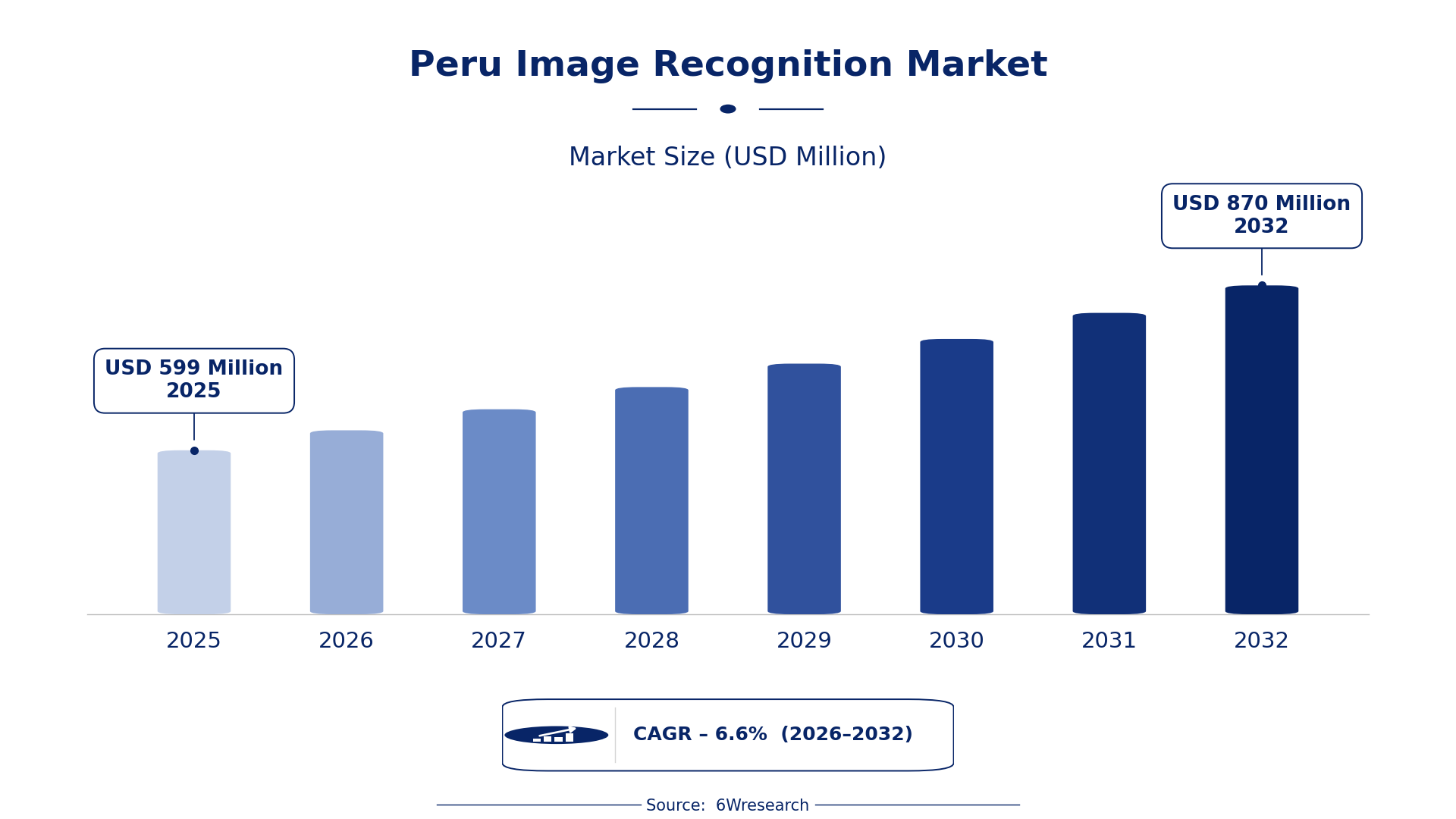
The Peru Image Recognition Market was estimated at USD 599 Million in 2025 and is projected to reach USD 870 Million by 2032, growing at a CAGR of 6.6% from 2026 to 2032.
Peru Image Recognition Market Synopsis
The Peru Image Recognition Market is experiencing a notable shift as businesses increasingly embrace cutting-edge technologies to enhance their operations. This momentum contrasts sharply with the initial hesitancy witnessed in earlier years, as firms now recognize the tangible benefits that image recognition can provide.
As sectors like healthcare, retail, and security accelerate their adoption of advanced image recognition solutions, the market is positioned for sustained expansion. The integration of artificial intelligence and machine learning into these systems further amplifies their effectiveness, making them indispensable tools for improving customer experiences and operational efficiency.
Peru Image Recognition Market Year-wise Growth Rate and Key Drivers
This graph illustrates the annual growth rates of the Peru Image Recognition Market from 2021 to 2032, highlighting a steady upward trajectory and projected expansion over the forecast period.
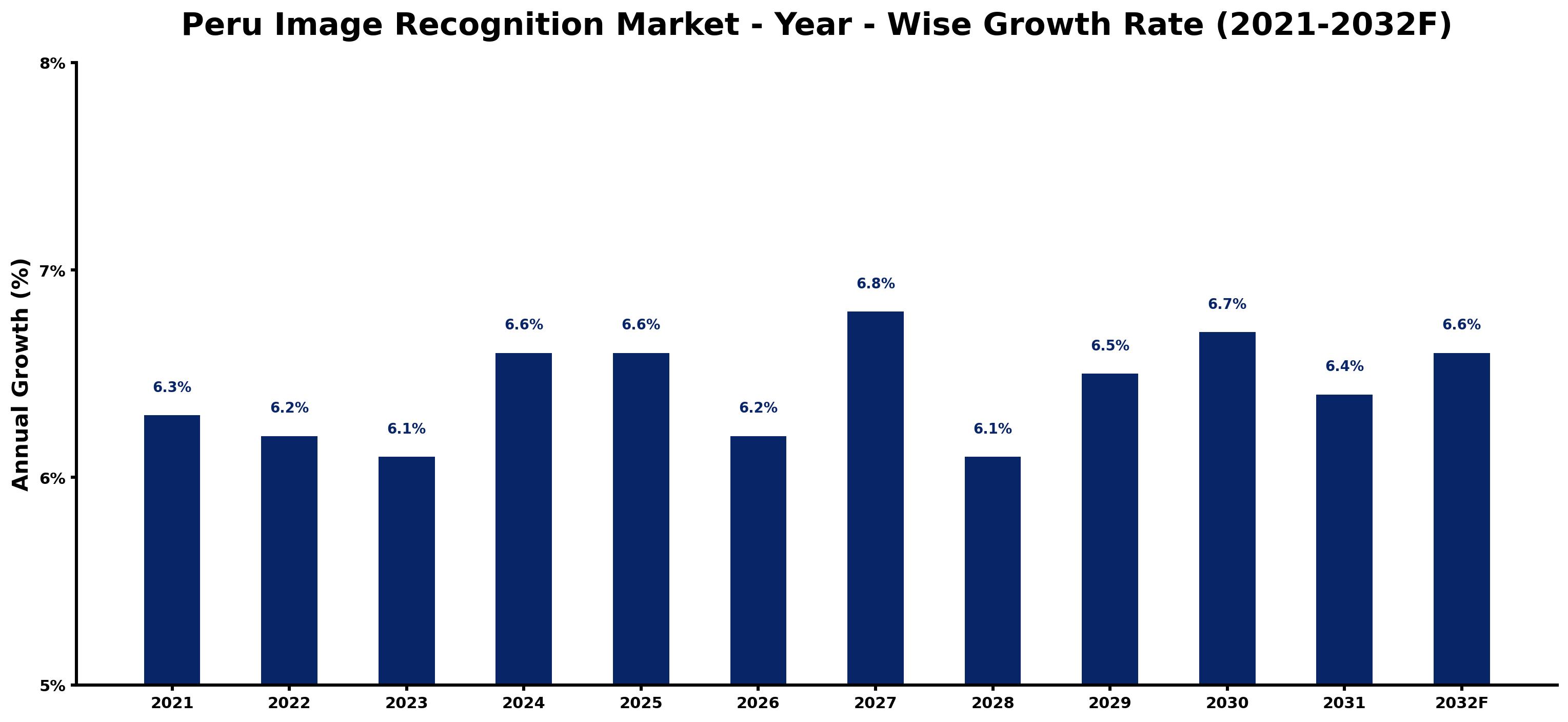
The table below presents the year‑wise growth rates along with the key drivers influencing the market
| Year | Growth Rate | Major Drivers |
| 2021 | 6.3% | Increased adoption of biometric identification by local banks. |
| 2022 | 6.2% | Rising local e-commerce growth fueling image processing needs. |
| 2023 | 6.1% | Government-sponsored digital identity programs enhancing security measures. |
| 2024 | 6.6% | Surge in retail analytics requiring advanced image recognition. |
| 2025 | 6.6% | Boost from Peru's expanding telehealth services utilizing imaging. |
| 2026 | 6.2% | Enhanced mobile app development focusing on user experience. |
| 2027 | 6.8% | Growing investment in security systems for public infrastructure. |
| 2028 | 6.1% | Implementation of AI regulations boosting software innovation. |
| 2029 | 6.5% | Local startups driving competition in image recognition technology. |
| 2030 | 6.7% | Universities promoting AI research benefiting image analysis applications. |
| 2031 | 6.4% | Increased consumer demand for personalized marketing strategies. |
| 2032 | 6.6% | Adoption of smart surveillance solutions in urban areas. |
Note: Market size estimations and growth projections presented in this report are based on 6Wresearch's proprietary forecasting methodology, utilizing the latest available industry data, government publications, and primary research inputs.
Peru Image Recognition Market Key Takeaways
Below are some of the specific key takeaways from the market, including:
- The market is seeing increased investment driven by the demand for AI-enhanced image recognition technologies.
- Healthcare, retail, and security sectors are leading the way in adopting image recognition solutions.
- Government policies are fostering a supportive environment for technological advancements in image recognition.
- Concerns regarding data privacy are prompting companies to adopt more secure practices.
- Integration with augmented reality applications is emerging as a key trend, opening new avenues for growth.
Evaluation of Restraints in Peru Image Recognition Market
Despite the promising growth trajectory, several constraints hinder the Peru Image Recognition Market. Limited awareness about the technology's capabilities among potential users leads to slower adoption rates, particularly in comparison to more developed markets. This gap is exacerbated by a shortage of skilled professionals who can implement and optimize advanced image recognition solutions. Additionally, concerns regarding data privacy and the costs associated with deploying these technologies create significant hurdles for businesses seeking to invest in image recognition. Continuous upgrades to keep pace with evolving algorithms also represent a financial burden for many companies.
Peru Image Recognition Market Trends
A few key trends are shaping the Peru Image Recognition Market. The demand for facial recognition and object detection technologies is surging, as they become vital tools for security and surveillance applications. The retail sector is increasingly utilizing image recognition for inventory management and enhancing customer engagement through personalized experiences. on top of that, the rise of e-commerce is driving the need for visual search capabilities, allowing consumers to search for products using images rather than keywords. The intersection of image recognition with augmented and virtual reality is also gaining traction, offering innovative experiences that blend the digital and physical worlds.
Peru Image Recognition Market Opportunities
Opportunities abound in the Peru Image Recognition Market. The growing e-commerce sector presents a prime area for investment, particularly in visual search technologies that enhance user experience. Public safety initiatives are pushing for advanced surveillance systems, creating demand for image recognition solutions. Additionally, as businesses seek to streamline operations and improve customer interactions, there is a significant opportunity for companies to develop tailored image recognition applications that meet the unique needs of various industries. The integration of machine learning algorithms also paves the way for more sophisticated image analysis, further opening avenues for innovation.
Government Initiatives in the Peru Image Recognition Market
The Peruvian government is actively shaping the environment for image recognition technologies through various initiatives. With a focus on enhancing digital infrastructure and fostering innovation, the government's policies are designed to support the growth of the technology sector. This proactive stance is crucial, as it encourages investment and adoption of advanced solutions in the image recognition market.
- A recently launched initiative aims to enhance digital infrastructure across major cities, facilitating faster and more reliable connectivity for image recognition applications.
- Ongoing government support for startups in the tech sector is helping to stimulate innovation in image recognition technologies.
- Current regulations are being developed to ensure data privacy and protection, addressing growing concerns about ethical data usage in image recognition.
- A planned public-private partnership is set to enhance public safety through improved surveillance systems utilizing image recognition technology, expected to roll out in the coming years.
- The government has initiated research grants aimed at developing advanced image processing algorithms, promoting local expertise in the field.
Future Insights of the Peru Image Recognition Market
Looking ahead to 2026-2032, the Peru Image Recognition Market is set for considerable growth. As businesses across various sectors continue to recognize the importance of image recognition technologies, the demand for advanced solutions is likely to increase. The rise of automation and the need for improved security measures will further drive market expansion. With advancements in artificial intelligence and machine learning, image recognition capabilities will become more sophisticated, allowing for greater accuracy and efficiency in applications. The popularity of social media and smartphones will also play a vital role in shaping the market, creating new opportunities for innovative applications.
Peru Image Recognition Market Latest Developments
In the last 12-14 months, the Peru Image Recognition Market has seen a surge in activity, with numerous developments reflecting the growing interest in this technology. Businesses are increasingly investing in image recognition solutions to streamline operations and enhance customer experiences.
- A major technology vendor launched a new facial recognition solution aimed at improving security in retail environments in Q1 2025.
- In mid-2025, a collaborative project between tech firms began focusing on integrating image recognition with augmented reality applications for enhanced user experiences.
- An initiative that commenced in early 2025 and remains underway is focused on creating standardized guidelines for ethical data usage in image recognition technologies.
- In late 2025, a regional operator announced plans to expand its image recognition capabilities within public transportation systems to enhance passenger safety.
- By the end of 2025, a rollout of new image analysis software designed for healthcare applications is expected to improve diagnostic accuracy.
Peru Image Recognition Market - Key Attractiveness of the Report
- 10 Years of Market Numbers
- Historical Data Starting from 2022 to 2025
- Base Year: 2025
- Forecast Data until 2032
- Key Performance Indicators Impacting the Market
- Major Upcoming Developments and Projects
Key Highlights of the Report:
- Peru Image Recognition Market Outlook
- Market Size of Peru Image Recognition Market, 2025
- Forecast of Peru Image Recognition Market, 2032
- Historical Data and Forecast of Peru Image Recognition Revenues & Volume for the Period 2022-2032F
- Peru Image Recognition Market Trend Evolution
- Peru Image Recognition Market Drivers and Challenges
- Peru Image Recognition Price Trends
- Peru Image Recognition Porter's Five Forces
- Peru Image Recognition Industry Life Cycle
- Historical Data and Forecast of Peru Image Recognition Market Revenues & Volume By Technology for the Period 2022-2032F
- Historical Data and Forecast of Peru Image Recognition Market Revenues & Volume By Digital Image Processing for the Period 2022-2032F
- Historical Data and Forecast of Peru Image Recognition Market Revenues & Volume By Facial Recognition for the Period 2022-2032F
- Historical Data and Forecast of Peru Image Recognition Market Revenues & Volume By Pattern Recognition for the Period 2022-2032F
- Historical Data and Forecast of Peru Image Recognition Market Revenues & Volume By Deployment Mode for the Period 2022-2032F
- Historical Data and Forecast of Peru Image Recognition Market Revenues & Volume By On-premises for the Period 2022-2032F
- Historical Data and Forecast of Peru Image Recognition Market Revenues & Volume By Cloud for the Period 2022-2032F
- Historical Data and Forecast of Peru Image Recognition Market Revenues & Volume By Component for the Period 2022-2032F
- Historical Data and Forecast of Peru Image Recognition Market Revenues & Volume By Hardware for the Period 2022-2032F
- Historical Data and Forecast of Peru Image Recognition Market Revenues & Volume By Software for the Period 2022-2032F
- Historical Data and Forecast of Peru Image Recognition Market Revenues & Volume By Services for the Period 2022-2032F
- Historical Data and Forecast of Peru Image Recognition Market Revenues & Volume By Application for the Period 2022-2032F
- Historical Data and Forecast of Peru Image Recognition Market Revenues & Volume By Scanning and Imaging for the Period 2022-2032F
- Historical Data and Forecast of Peru Image Recognition Market Revenues & Volume By Security and Surveillance for the Period 2022-2032F
- Historical Data and Forecast of Peru Image Recognition Market Revenues & Volume By Image Search for the Period 2022-2032F
- Historical Data and Forecast of Peru Image Recognition Market Revenues & Volume By Augmented Reality for the Period 2022-2032F
- Historical Data and Forecast of Peru Image Recognition Market Revenues & Volume By Marketing and Advertising for the Period 2022-2032F
- Peru Image Recognition Import Export Trade Statistics
- Market Opportunity Assessment By Technology
- Market Opportunity Assessment By Deployment Mode
- Market Opportunity Assessment By Component
- Market Opportunity Assessment By Application
- Peru Image Recognition Top Companies Market Share
- Peru Image Recognition Competitive Benchmarking By Technical and Operational Parameters
- Peru Image Recognition Company Profiles
- Peru Image Recognition Key Strategic Recommendations






































