Peru Microprocessor Market Size, Share & Growth Rate
The Peru Microprocessor Market was estimated at USD 289 Million in 2025 and is projected to reach USD 399 Million by 2032, growing at a CAGR of 4.7% from 2026 to 2032. This growth trajectory is propelled by the increasing demand for computing devices, particularly smartphones and automotive applications. As digital transformation initiatives gain momentum across various sectors, the market stands to benefit from the rising adoption of advanced technologies such as IoT and artificial intelligence.
Peru Microprocessor Market Year-wise Growth Rate and Key Drivers
This graph highlights how the Peru Microprocessor Market has steadily grown over the years, supported by major growth factors.
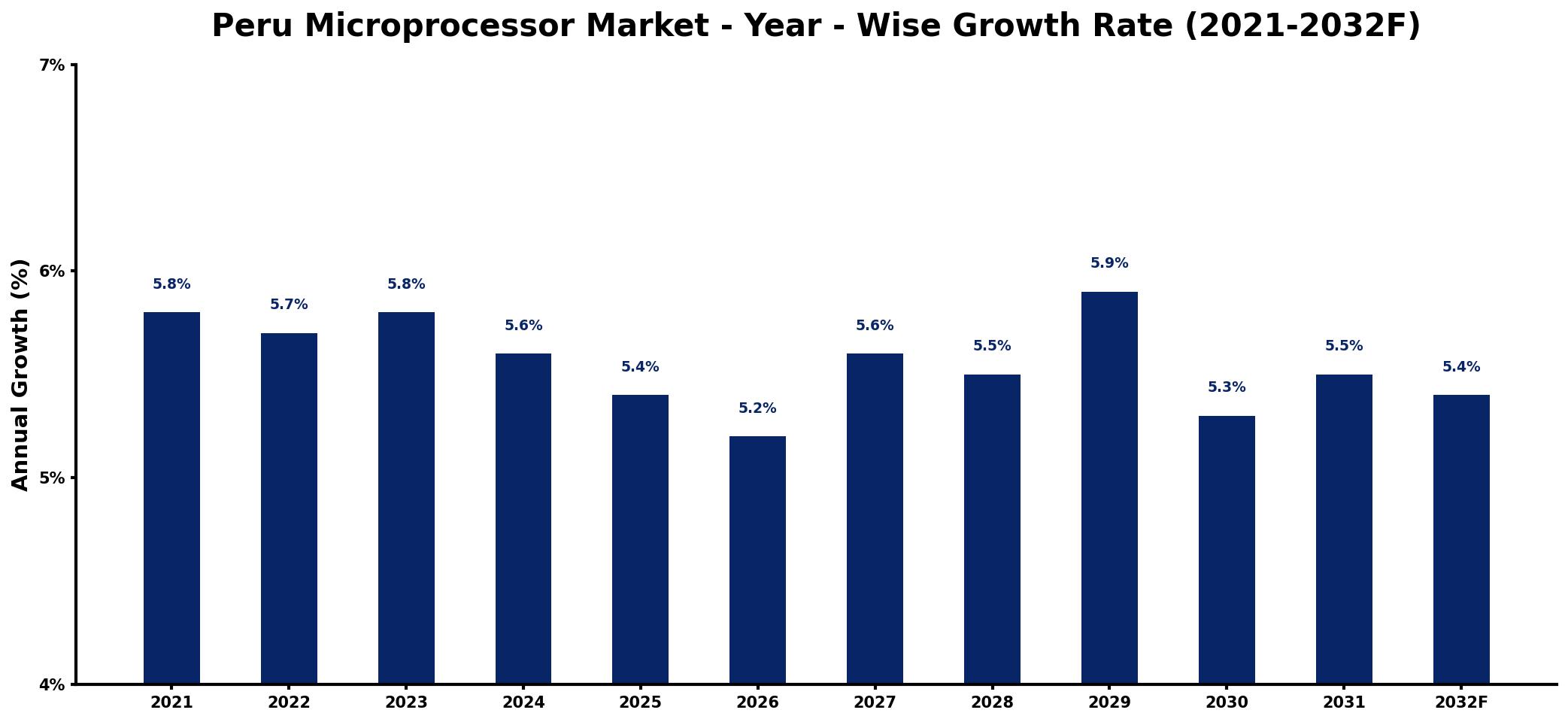
The table below presents the year‑wise growth rates along with the key drivers influencing the market
| Year | Growth Rate | Major Drivers |
| 2021 | 5.8% | Rising demand for smart devices |
| 2022 | 5.7% | Growth in cloud computing services |
| 2023 | 5.8% | Expansion of IoT applications |
| 2024 | 5.6% | Increase in renewable energy projects |
| 2025 | 5.4% | Investment in 5G infrastructure |
| 2026 | 5.2% | Surge in data center construction |
| 2027 | 5.6% | Adoption of AI technologies |
| 2028 | 5.5% | growing automotive sector requirements |
| 2029 | 5.9% | Rise in consumer electronics sales |
| 2030 | 5.3% | Development of edge computing solutions |
| 2031 | 5.5% | growing emerging market penetration |
| 2032 | 5.4% | strengthening international trade flows |
Note: Market size estimations and growth projections presented in this report are based on 6Wresearch's proprietary forecasting methodology, utilizing the latest available industry data, government publications, and primary research inputs.
Peru Microprocessor Market Synopsis
The Peru microprocessor market is currently riding a wave of momentum, primarily influenced by the proliferation of digital devices and a burgeoning middle class. This recent growth is complemented by an optimistic outlook, driven by the continued expansion of industries such as telecommunications, healthcare, and automotive, all of which are increasingly reliant on sophisticated microprocessor technology.
As the demand for high-performance and energy-efficient processors rises, the market is set for further transformation. Emerging trends indicate a shift towards more integrated and compact solutions, enhancing the capabilities of a variety of applications while addressing the critical need for security in an increasingly connected world.
Peru Microprocessor Market Key Takeaways
- The market is experiencing steady growth, driven by demand across computing devices and automotive applications.
- Major global players dominate the landscape, with local firms catering to niche segments.
- Emerging technologies such as AI and IoT are fostering the development of specialized microprocessors.
- Government initiatives are aimed at promoting technological advancement and innovation within the market.
- Investment opportunities exist in manufacturing and supplying microprocessors, particularly in response to rising digitalization.
Evaluation of Restraints in Peru Microprocessor Market
Despite the optimistic growth prospects, several constraints pose challenges for the Peru microprocessor market. The limited domestic manufacturing capabilities result in a heavy reliance on imports, which can inflate costs and hinder competitiveness. Additionally, the landscape is dominated by large international players with established brand loyalty and distribution networks, making it difficult for local manufacturers to carve out significant market share. Moreover, the rapid pace of technological change necessitates ongoing investment in research and development, adding further pressure on companies striving to keep pace with evolving consumer needs.
Peru Microprocessor Market Trends
Current trends in the Peru microprocessor market reveal a marked shift towards high-performance and energy-efficient processors. The adoption of advanced technologies—particularly artificial intelligence, machine learning, and Internet of Things applications—is driving demand for innovative microprocessor solutions. Additionally, there is a growing emphasis on compact form factors and integrated technologies, reflecting the requirements of modern electronic devices. As cybersecurity concerns rise, enhanced security features are increasingly being integrated into microprocessors, aligning with consumer expectations for data protection.
Peru Microprocessor Market Opportunities
The Peru microprocessor market is ripe with investment opportunities, particularly for those looking to leverage the country's expanding technological landscape. As the middle class grows and digital infrastructure expands, the demand for microprocessors in sectors such as smartphones, computers, and automotive electronics is set to increase. Collaborations with local technology firms or research institutions can unlock valuable insights and resources, positioning investors advantageously in this evolving market.
Government Initiatives in the Peru Microprocessor Market
Government policies in Peru are designed to support innovation, technological development, and digitalization within the microprocessor market. Initiatives aimed at fostering local manufacturing and attracting foreign investment are integral to the government's strategy. Furthermore, incentives like tax breaks and subsidies are offered to companies investing in microprocessor research and development. Regulatory frameworks are also in place to ensure fair competition and prevent monopolistic practices, creating an environment conducive to market growth.
Future Insights of the Peru Microprocessor Market
Looking ahead to 2026-2032, the Peru microprocessor market is anticipated to maintain its upward trajectory, fueled by the escalating demand for advanced computing technologies across various industries. The integration of Internet of Things devices and cloud computing services will further enhance the need for robust microprocessor solutions. Additionally, ongoing governmental support for digital transformation initiatives and infrastructure development is expected to act as a catalyst for market growth, despite the challenges posed by fluctuating global trends and competition from established international players.
Peru Microprocessor Market Latest Developments (2025 - 2026)
Recent developments in the Peru microprocessor market have focused on enhancing technological capabilities and fostering industry partnerships. Efforts to encourage collaboration between local firms and international technology leaders have gained traction, aiming to boost innovation. Additionally, there has been a noticeable increase in research initiatives dedicated to advancing microprocessor design and efficiency, which may lead to the introduction of next-generation solutions tailored to local market demands.
Peru Microprocessor Market - Key Attractiveness of the Report
- 10 Years of Market Numbers
- Historical Data Starting from 2022 to 2025
- Base Year: 2025
- Forecast Data until 2032
- Key Performance Indicators Impacting the Market
- Major Upcoming Developments and Projects
Key Highlights of the Report:
- Peru Microprocessor Market Outlook
- Market Size of Peru Microprocessor Market, 2025
- Forecast of Peru Microprocessor Market, 2032
- Historical Data and Forecast of Peru Microprocessor Revenues & Volume for the Period 2022-2032F
- Peru Microprocessor Market Trend Evolution
- Peru Microprocessor Market Drivers and Challenges
- Peru Microprocessor Price Trends
- Peru Microprocessor Porter's Five Forces
- Peru Microprocessor Industry Life Cycle
- Historical Data and Forecast of Peru Microprocessor Market Revenues & Volume By Technology for the Period 2022-2032F
- Historical Data and Forecast of Peru Microprocessor Market Revenues & Volume By CISC for the Period 2022-2032F
- Historical Data and Forecast of Peru Microprocessor Market Revenues & Volume By RISC for the Period 2022-2032F
- Historical Data and Forecast of Peru Microprocessor Market Revenues & Volume By ASIC for the Period 2022-2032F
- Historical Data and Forecast of Peru Microprocessor Market Revenues & Volume By Superscalar for the Period 2022-2032F
- Historical Data and Forecast of Peru Microprocessor Market Revenues & Volume By DSP for the Period 2022-2032F
- Historical Data and Forecast of Peru Microprocessor Market Revenues & Volume By Application for the Period 2022-2032F
- Historical Data and Forecast of Peru Microprocessor Market Revenues & Volume By Smartphones for the Period 2022-2032F
- Historical Data and Forecast of Peru Microprocessor Market Revenues & Volume By Personal Computers for the Period 2022-2032F
- Historical Data and Forecast of Peru Microprocessor Market Revenues & Volume By Servers for the Period 2022-2032F
- Historical Data and Forecast of Peru Microprocessor Market Revenues & Volume By Tablets for the Period 2022-2032F
- Historical Data and Forecast of Peru Microprocessor Market Revenues & Volume By Embedded Devices for the Period 2022-2032F
- Historical Data and Forecast of Peru Microprocessor Market Revenues & Volume By Others for the Period 2022-2032F
- Peru Microprocessor Import Export Trade Statistics
- Market Opportunity Assessment By Technology
- Market Opportunity Assessment By Application
- Peru Microprocessor Top Companies Market Share
- Peru Microprocessor Competitive Benchmarking By Technical and Operational Parameters
- Peru Microprocessor Company Profiles
- Peru Microprocessor Key Strategic Recommendations






































