Thailand Microprocessor Market Size, Share & Growth Rate
The Thailand Microprocessor Market was estimated at USD 84 Million in 2025 and is projected to reach USD 96 Million by 2032, growing at a CAGR of 1.9% from 2026 to 2032. This growth trajectory is largely driven by the surging demand for advanced electronic devices and the ongoing technological innovations aimed at enhancing processing power and energy efficiency. As industries increasingly adopt automation and smart technologies, the market is poised for substantial expansion.
Thailand Microprocessor Market Year-wise Growth Rate and Key Drivers
This graph highlights how the Thailand Microprocessor Market has steadily grown over the years, supported by major growth factors.
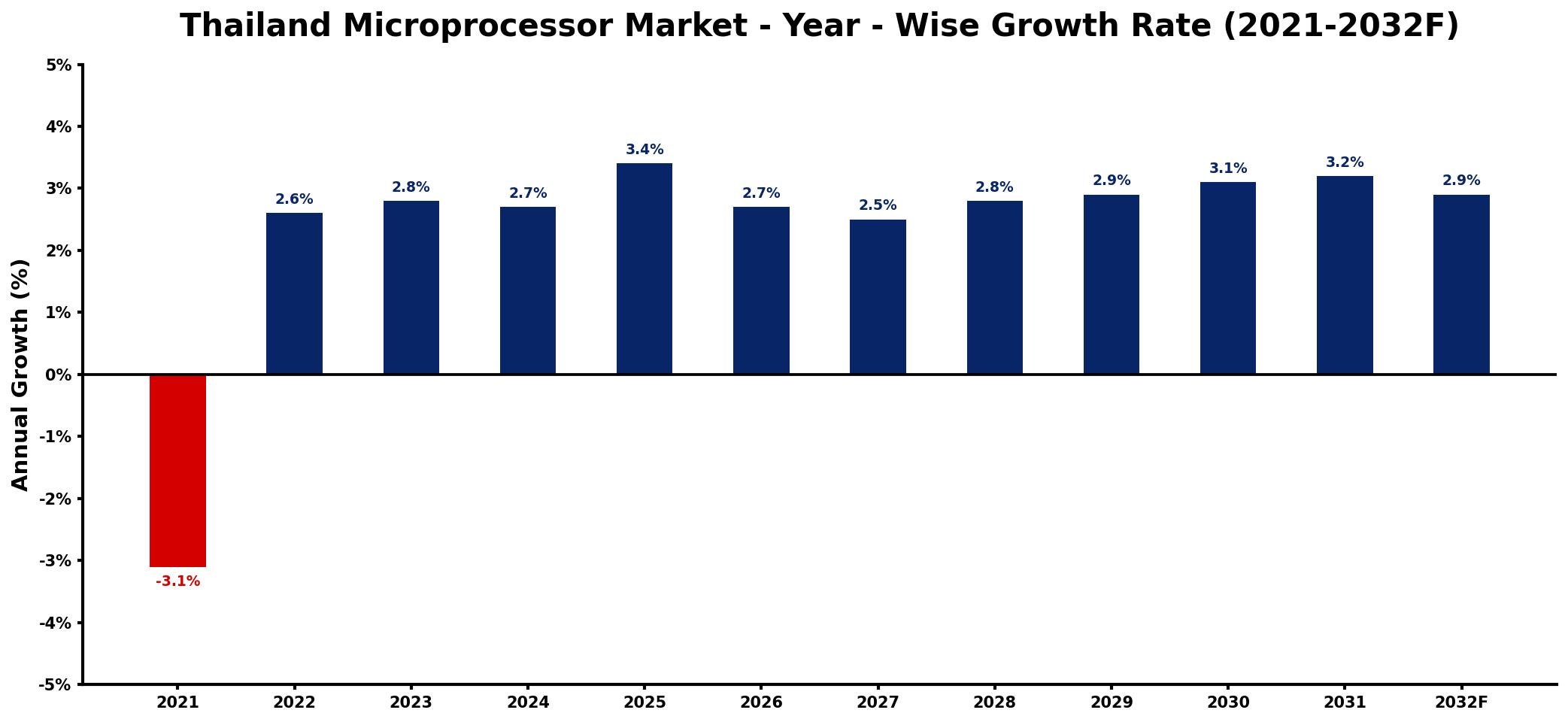
The table below presents the year‑wise growth rates along with the key drivers influencing the market
| Year | Growth Rate | Major Drivers |
| 2021 | -3.1% | Global supply chain disruptions impact |
| 2022 | 2.6% | Rising demand for smart devices |
| 2023 | 2.8% | Expansion of AI technology applications |
| 2024 | 2.7% | Increased investment in automation |
| 2025 | 3.4% | Growth in data center requirements |
| 2026 | 2.7% | Surge in consumer electronics demand |
| 2027 | 2.5% | Emergence of 5G technology rollout |
| 2028 | 2.8% | Advancements in IoT connectivity solutions |
| 2029 | 2.9% | growing regional consumption patterns |
| 2030 | 3.1% | growing emerging market penetration |
| 2031 | 3.2% | Increased focus on renewable energy |
| 2032 | 2.9% | stronger distribution network expansion |
Note: Market size estimations and growth projections presented in this report are based on 6Wresearch's proprietary forecasting methodology, utilizing the latest available industry data, government publications, and primary research inputs.
Thailand Microprocessor Market Synopsis
Currently, the increasing penetration of consumer electronics is the strongest force shaping the Thailand Microprocessor Market. With the rising adoption of smartphones, laptops, and IoT devices, the need for sophisticated microprocessors has surged, pushing manufacturers to innovate rapidly.
Additionally, the automotive sector's shift towards automation and smart technologies has amplified the demand for microprocessors. As Thailand continues to establish itself as a manufacturing hub, local companies are benefitting from investments and collaborations with multinational firms, further enhancing the market's potential.
Thailand Microprocessor Market Key Takeaways
- The Thailand Microprocessor Market is on a steady growth path driven by technological advancements in electronics.
- Increasing demand from automotive and industrial sectors is contributing significantly to market expansion.
- Local manufacturers are gaining traction by leveraging Thailand's strategic position as a manufacturing hub.
- Innovations focusing on energy efficiency and smaller processing nodes are critical for market competitiveness.
- The impact of global supply chain challenges continues to shape the market landscape.
Evaluation of Restraints in Thailand Microprocessor Market
The Thailand Microprocessor Market faces notable constraints linked primarily to the pace of technological evolution and supply chain reliability. Manufacturers are under pressure to innovate continuously, addressing the dual challenges of shrinking transistor sizes and increasing power efficiency. This rapid evolution demands significant investments in research and development. Additionally, the global semiconductor shortages caused by recent supply chain disruptions have highlighted vulnerabilities, impacting the availability of critical components across various sectors reliant on microprocessors.
Thailand Microprocessor Market Trends
Emerging trends within the Thailand Microprocessor Market indicate a growing focus on artificial intelligence (AI) and machine learning (ML). As industries adopt these technologies, the demand for high-performance microprocessors that can handle complex computations is on the rise. Furthermore, the shift towards energy-efficient designs reflects a broader commitment to sustainability, which is becoming a priority for manufacturers aiming to reduce their carbon footprint.
Thailand Microprocessor Market Opportunities
There are substantial growth and investment opportunities within the Thailand Microprocessor Market, particularly in sectors like automotive, healthcare, and smart home technology. The integration of advanced microprocessors into electric vehicles and automated industrial systems presents a lucrative avenue for innovation. Additionally, partnerships between local firms and international technology giants are set to enhance research capabilities and accelerate the development of next-generation microprocessors.
Government Initiatives in the Thailand Microprocessor Market
The Thai government has implemented several initiatives to bolster the microprocessor market, including investment incentives for technology companies and support for research and development in the semiconductor sector. Programs aimed at enhancing the skills of the workforce in electronics manufacturing are also in place, ensuring a competitive edge in technology-driven industries. These efforts reflect a commitment to positioning Thailand as a key player in the global electronics supply chain.
Future Insights of the Thailand Microprocessor Market
Looking ahead to 2026-2032, the Thailand Microprocessor Market is expected to evolve in tandem with advancements in artificial intelligence, IoT, and the automotive sector. Demand for high-performance chips will grow as industries increasingly automate processes and embrace smart technologies. The rise of electric vehicles and the integration of microprocessors into various applications will likely drive innovation and investment, positioning Thailand as a critical node in the global microprocessor landscape.
Thailand Microprocessor Market Latest Developments (2025 - 2026)
Recent developments in the Thailand Microprocessor Market indicate a push toward partnerships aimed at enhancing local production capabilities. Companies are increasingly collaborating with research institutions to innovate in microprocessor design and manufacturing processes. Moreover, the government has announced initiatives to attract foreign investment in semiconductor manufacturing, aiming to mitigate the impact of global supply chain disruptions and secure a robust local supply chain.
Thailand Microprocessor Market - Key Attractiveness of the Report
- 10 Years of Market Numbers
- Historical Data Starting from 2022 to 2025
- Base Year: 2025
- Forecast Data until 2032
- Key Performance Indicators Impacting the Market
- Major Upcoming Developments and Projects
Key Highlights of the Report:
- Thailand Microprocessor Market Outlook
- Market Size of Thailand Microprocessor Market, 2025
- Forecast of Thailand Microprocessor Market, 2032
- Historical Data and Forecast of Thailand Microprocessor Revenues & Volume for the Period 2022-2032F
- Thailand Microprocessor Market Trend Evolution
- Thailand Microprocessor Market Drivers and Challenges
- Thailand Microprocessor Price Trends
- Thailand Microprocessor Porter's Five Forces
- Thailand Microprocessor Industry Life Cycle
- Historical Data and Forecast of Thailand Microprocessor Market Revenues & Volume By Technology for the Period 2022-2032F
- Historical Data and Forecast of Thailand Microprocessor Market Revenues & Volume By CISC for the Period 2022-2032F
- Historical Data and Forecast of Thailand Microprocessor Market Revenues & Volume By RISC for the Period 2022-2032F
- Historical Data and Forecast of Thailand Microprocessor Market Revenues & Volume By ASIC for the Period 2022-2032F
- Historical Data and Forecast of Thailand Microprocessor Market Revenues & Volume By Superscalar for the Period 2022-2032F
- Historical Data and Forecast of Thailand Microprocessor Market Revenues & Volume By DSP for the Period 2022-2032F
- Historical Data and Forecast of Thailand Microprocessor Market Revenues & Volume By Application for the Period 2022-2032F
- Historical Data and Forecast of Thailand Microprocessor Market Revenues & Volume By Smartphones for the Period 2022-2032F
- Historical Data and Forecast of Thailand Microprocessor Market Revenues & Volume By Personal Computers for the Period 2022-2032F
- Historical Data and Forecast of Thailand Microprocessor Market Revenues & Volume By Servers for the Period 2022-2032F
- Historical Data and Forecast of Thailand Microprocessor Market Revenues & Volume By Tablets for the Period 2022-2032F
- Historical Data and Forecast of Thailand Microprocessor Market Revenues & Volume By Embedded Devices for the Period 2022-2032F
- Historical Data and Forecast of Thailand Microprocessor Market Revenues & Volume By Others for the Period 2022-2032F
- Thailand Microprocessor Import Export Trade Statistics
- Market Opportunity Assessment By Technology
- Market Opportunity Assessment By Application
- Thailand Microprocessor Top Companies Market Share
- Thailand Microprocessor Competitive Benchmarking By Technical and Operational Parameters
- Thailand Microprocessor Company Profiles
- Thailand Microprocessor Key Strategic Recommendations






































