Peru Ploughing and Cultivating Machinery Market Size, Share & Growth Rate
The Peru Ploughing and Cultivating Machinery Market was estimated at USD 640 Million in 2025 and is projected to reach USD 929 Million by 2032, growing at a CAGR of 5.5% from 2026 to 2032. This growth is driven by a combination of increasing mechanization in agriculture, government support for modernization, and a rising demand for sustainable farming practices. As Peruvian farmers seek to enhance productivity through technology, investments in efficient machinery become imperative.
Peru Ploughing and Cultivating Machinery Market Year-wise Growth Rate and Key Drivers
This graph highlights how the Peru Ploughing and Cultivating Machinery Market has steadily grown over the years, supported by major growth factors.
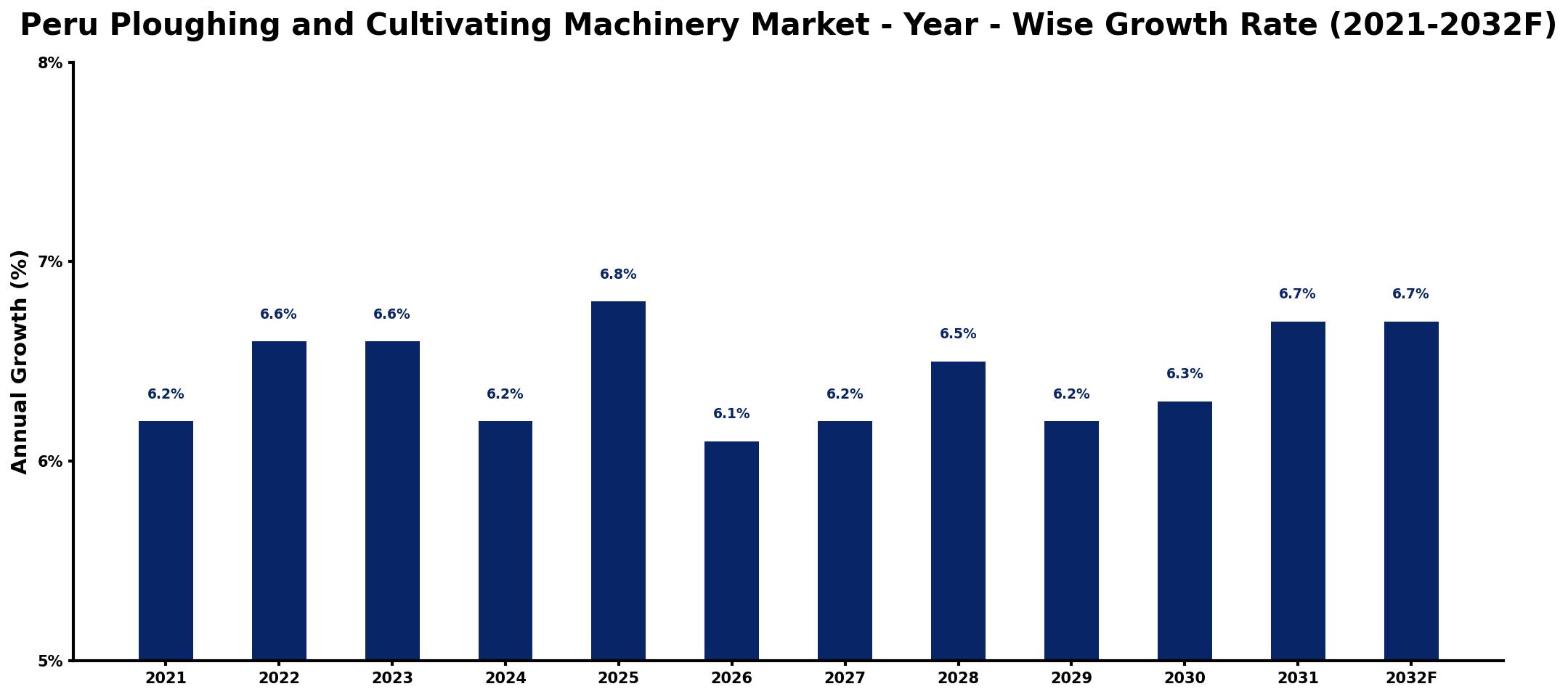
The table below presents the year‑wise growth rates along with the key drivers influencing the market
| Year | Growth Rate | Major Drivers |
| 2021 | 6.2% | Rising agricultural investment trends |
| 2022 | 6.6% | Increasing farmer technology adoption |
| 2023 | 6.6% | Growing demand for efficiency |
| 2024 | 6.2% | Expansion of export markets |
| 2025 | 6.8% | Surging interest in automation |
| 2026 | 6.1% | Development of sustainable practices |
| 2027 | 6.2% | Enhanced financing options available |
| 2028 | 6.5% | Boost in regional agricultural output |
| 2029 | 6.2% | Diversification of crop production |
| 2030 | 6.3% | increased overall sector activity |
| 2031 | 6.7% | Government support initiatives increasing |
| 2032 | 6.7% | Emerging technologies in agriculture |
Note: Market size estimations and growth projections presented in this report are based on 6Wresearch's proprietary forecasting methodology, utilizing the latest available industry data, government publications, and primary research inputs.
Peru Ploughing and Cultivating Machinery Market Synopsis
The Peru Ploughing and Cultivating Machinery Market is witnessing dynamic changes as the agricultural sector embraces modern techniques. Farmers increasingly recognize the importance of mechanization for improving operational efficiency and ensuring sustainable practices.
In this evolving landscape, a diverse range of equipment—including tractors, ploughs, harrows, and cultivators—caters to the specific needs of various farming operations. The emphasis on technological advancements and durability reflects the sector's commitment to enhancing agricultural productivity across Peru.
Peru Ploughing and Cultivating Machinery Market Key Takeaways
- The market is characterized by a shift towards precision agriculture and technologically advanced equipment.
- Government subsidies and financial incentives are enhancing farmers' ability to invest in modern machinery.
- Awareness of sustainable farming practices is driving the demand for mechanization solutions.
- Investment opportunities are emerging in distribution and servicing of ploughing and cultivating machinery.
- Infrastructure improvements are essential for maximizing machinery efficiency in rural areas.
Evaluation of Restraints in Peru Ploughing and Cultivating Machinery Market
Despite its promising growth trajectory, the Peru Ploughing and Cultivating Machinery Market faces significant challenges. The high cost of advanced machinery serves as a barrier, particularly for small-scale farmers who struggle with limited access to financing. Additionally, counterfeit products dilute market quality, undermining trust in new technologies. Furthermore, inadequate technical knowledge and awareness about modern machinery hinder widespread adoption. Rural infrastructure deficiencies exacerbate these issues, preventing efficient machinery use in remote areas.
Peru Ploughing and Cultivating Machinery Market Trends
Current trends indicate a pronounced shift towards advanced machinery that incorporates precision agriculture technologies. GPS guidance systems and variable rate application tools are gaining traction as they optimize field operations and reduce costs. Farmers are increasingly prioritizing equipment that promises durability, reliability, and performance in challenging environmental conditions. Furthermore, there is a growing preference for mechanization solutions that help address labor shortages, further driving innovation in the sector.
Peru Ploughing and Cultivating Machinery Market Opportunities
The landscape is ripe with investment opportunities, particularly for companies focused on providing high-quality, technologically advanced ploughing and cultivating machinery. As the agricultural sector modernizes, potential exists for substantial returns in the distribution and servicing segments. Collaborations with local farmers and organizations can pave the way for long-term partnerships that benefit both parties. Additionally, tapping into the growing demand for sustainable farming practices presents avenues for innovative solutions that align with environmental goals.
Government Initiatives in the Peru Ploughing and Cultivating Machinery Market
The Peruvian government is actively working to bolster the ploughing and cultivating machinery market through various initiatives. Policies aimed at providing financial assistance and subsidies for farmers investing in modern agricultural equipment are in place. Furthermore, the government promotes research and development in agricultural technology to enhance overall productivity and efficiency. Training programs focused on educating farmers about mechanization's benefits also play a crucial role in driving adoption and ensuring that modern practices take root across the nation.
Future Insights of the Peru Ploughing and Cultivating Machinery Market
Looking ahead to the period from 2026 to 2032, the Peru Ploughing and Cultivating Machinery Market is expected to maintain its upward trajectory. Factors such as increased mechanization, ongoing government support for agricultural modernization, and growing adoption of innovative technologies will fuel this growth. The emphasis on efficiency and sustainability among farmers suggests a promising future for advanced agricultural machinery. As awareness expands regarding the advantages of mechanization, the market will likely continue to evolve, creating abundant opportunities for stakeholders.
Peru Ploughing and Cultivating Machinery Market Latest Developments (2025 - 2026)
Recent developments in the Peru Ploughing and Cultivating Machinery Market reflect a strong alignment with contemporary agricultural needs. Innovations in machinery are increasingly focused on enhancing efficiency and sustainability. Additionally, collaborations between manufacturers and local agricultural organizations are gaining momentum, aiming to improve accessibility to advanced farming equipment. These trends underscore the sector's adaptability and commitment to meeting the evolving demands of Peruvian farmers.
Peru Ploughing and Cultivating Machinery Market - Key Attractiveness of the Report
- 10 Years of Market Numbers
- Historical Data Starting from 2022 to 2025
- Base Year: 2025
- Forecast Data until 2032
- Key Performance Indicators Impacting the Market
- Major Upcoming Developments and Projects
Key Highlights of the Report:
- Peru Ploughing and Cultivating Machinery Market Outlook
- Market Size of Peru Ploughing and Cultivating Machinery Market, 2025
- Forecast of Peru Ploughing and Cultivating Machinery Market, 2032
- Historical Data and Forecast of Peru Ploughing and Cultivating Machinery Revenues & Volume for the Period 2022-2032F
- Peru Ploughing and Cultivating Machinery Market Trend Evolution
- Peru Ploughing and Cultivating Machinery Market Drivers and Challenges
- Peru Ploughing and Cultivating Machinery Price Trends
- Peru Ploughing and Cultivating Machinery Porter's Five Forces
- Peru Ploughing and Cultivating Machinery Industry Life Cycle
- Historical Data and Forecast of Peru Ploughing and Cultivating Machinery Market Revenues & Volume By Type for the Period 2022-2032F
- Historical Data and Forecast of Peru Ploughing and Cultivating Machinery Market Revenues & Volume By Ploughs for the Period 2022-2032F
- Historical Data and Forecast of Peru Ploughing and Cultivating Machinery Market Revenues & Volume By Harrows for the Period 2022-2032F
- Historical Data and Forecast of Peru Ploughing and Cultivating Machinery Market Revenues & Volume By Others for the Period 2022-2032F
- Historical Data and Forecast of Peru Ploughing and Cultivating Machinery Market Revenues & Volume By Application for the Period 2022-2032F
- Historical Data and Forecast of Peru Ploughing and Cultivating Machinery Market Revenues & Volume By Soil Loosening for the Period 2022-2032F
- Historical Data and Forecast of Peru Ploughing and Cultivating Machinery Market Revenues & Volume By Clod Size Reduction for the Period 2022-2032F
- Historical Data and Forecast of Peru Ploughing and Cultivating Machinery Market Revenues & Volume By Clod Sorting for the Period 2022-2032F
- Historical Data and Forecast of Peru Ploughing and Cultivating Machinery Market Revenues & Volume By Others for the Period 2022-2032F
- Peru Ploughing and Cultivating Machinery Import Export Trade Statistics
- Market Opportunity Assessment By Type
- Market Opportunity Assessment By Application
- Peru Ploughing and Cultivating Machinery Top Companies Market Share
- Peru Ploughing and Cultivating Machinery Competitive Benchmarking By Technical and Operational Parameters
- Peru Ploughing and Cultivating Machinery Company Profiles
- Peru Ploughing and Cultivating Machinery Key Strategic Recommendations






































