Peru Processed Food Market Size Growth Rate
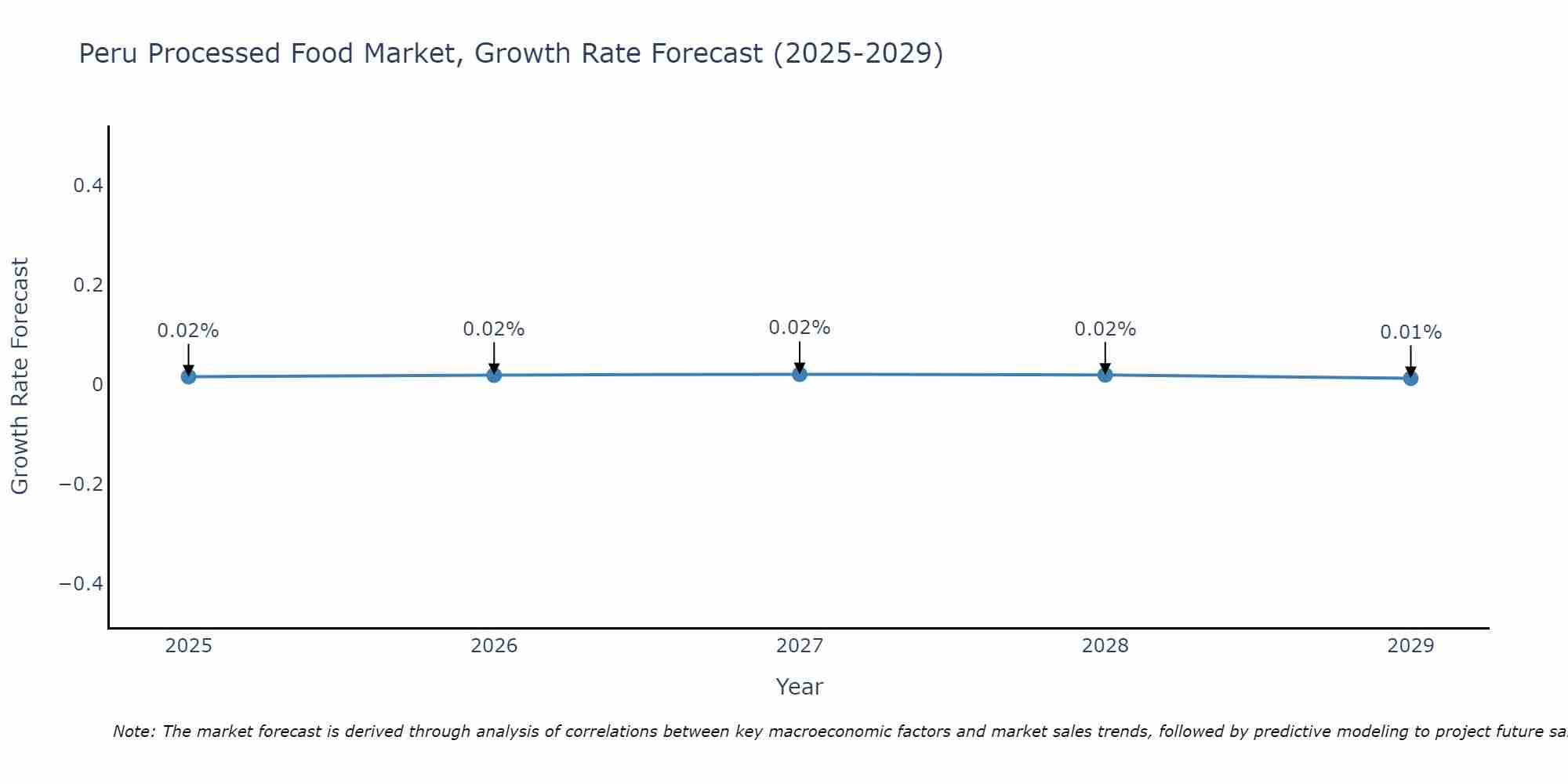
The Peru Processed Food Market is projected to witness mixed growth rate patterns during 2025 to 2029. The growth rate begins at 0.02% in 2025, climbs to a high of 0.02% in 2027, and moderates to 0.01% by 2029.
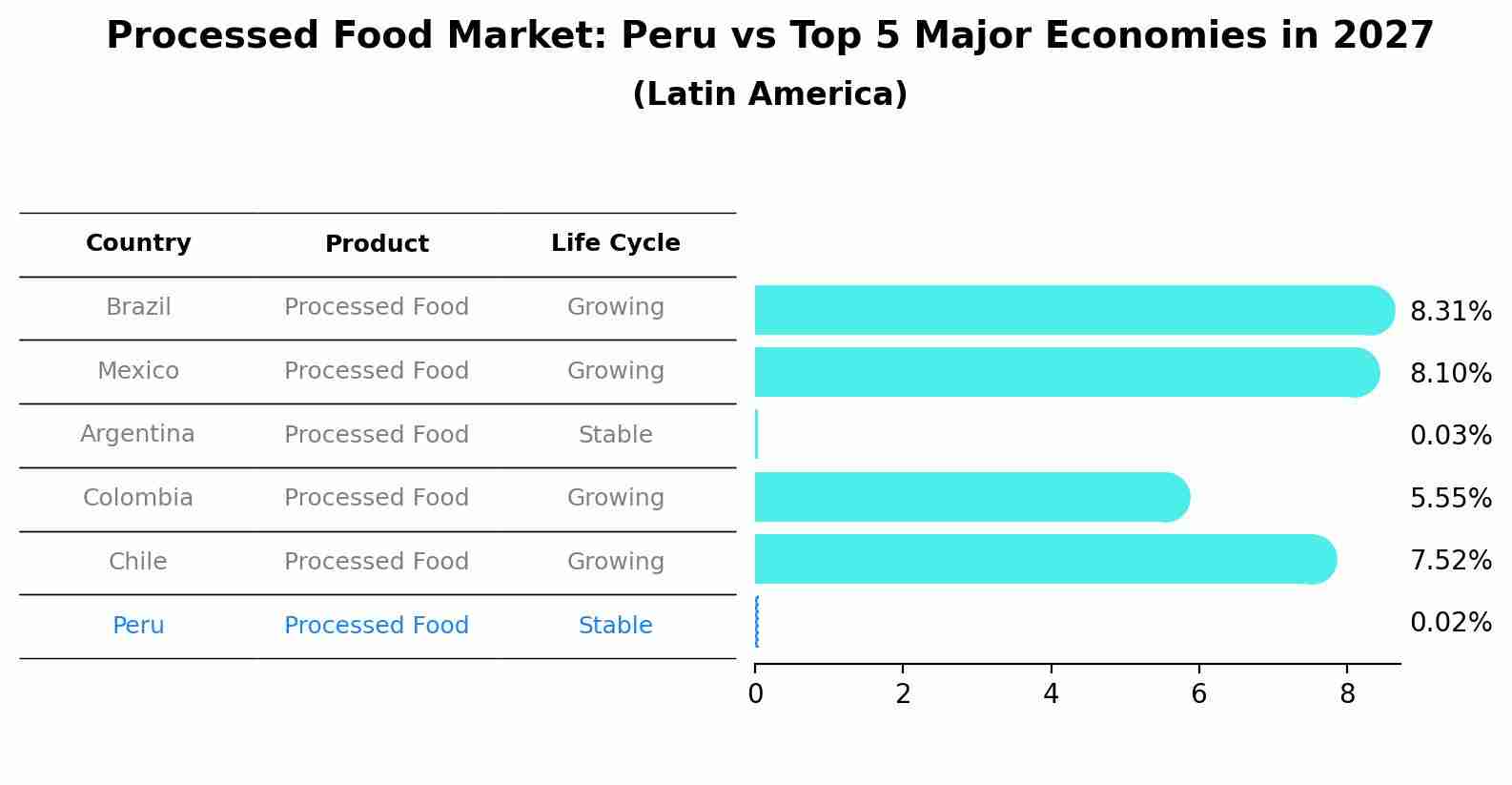
Processed Food Market: Peru vs Top 5 Major Economies in 2027 (Latin America)
Peru's Processed Food market is anticipated to experience a stable growth rate of 0.02% by 2027, reflecting trends observed in the largest economy Brazil, followed by Mexico, Argentina, Colombia and Chile.
Peru Processed Food Market Synopsis
The Peru Processed Food Market is experiencing steady growth driven by factors such as changing consumer lifestyles, urbanization, and increasing disposable income. The market offers a wide range of processed food products including snacks, beverages, canned goods, and convenience foods. Peruvian consumers are increasingly seeking convenient and ready-to-eat options due to their busy schedules. The market is also witnessing a trend towards healthier and natural food products, leading to the introduction of organic and gluten-free options. Key players in the Peru Processed Food Market include both domestic and international companies, competing to cater to the diverse preferences of consumers. With a focus on innovation, quality, and affordability, the market is poised for further expansion and diversification in the coming years.
Peru Processed Food Market Trends
The Peru Processed Food Market is experiencing several key trends. One prominent trend is the growing demand for healthier and more natural food options, leading to an increased focus on organic, non-GMO, and clean label products. Convenience remains a significant factor driving consumer choices, with a rise in demand for ready-to-eat and on-the-go snack options. Consumers are also showing a preference for locally sourced and sustainably produced foods, supporting the growth of the domestic food industry. Additionally, there is a noticeable shift towards international flavors and products, reflecting a growing interest in global cuisine among Peruvian consumers. E-commerce and digital platforms are playing an increasingly important role in reaching customers and driving sales in the processed food market in Peru.
Peru Processed Food Market Challenges
In the Peru Processed Food Market, some of the key challenges faced include consumer preferences shifting towards healthier and more natural options, leading to a demand for clean-label products with minimal additives and preservatives. Additionally, the market is highly competitive with both local and international players vying for market share, making it challenging for new entrants to establish themselves. Supply chain disruptions, fluctuating raw material prices, and regulatory hurdles also pose obstacles for companies operating in the processed food sector in Peru. Adapting to changing consumer trends, improving product quality, and navigating the complex regulatory environment are essential for companies to succeed in this market.
Peru Processed Food Market Investment Opportunities
The Peru processed food market presents promising investment opportunities due to several factors. With a growing middle class and increasing urbanization, consumer preferences are shifting towards convenient and ready-to-eat food products, driving demand for processed foods. Additionally, the country`s stable economic growth and rising disposable incomes are supporting the expansion of the processed food sector. Opportunities exist in various segments such as frozen foods, snacks, canned goods, and ready-to-eat meals. Investors can also explore the potential for innovation and product differentiation to cater to evolving consumer tastes and preferences. Furthermore, Peru`s strategic location as a gateway to South America provides access to export markets, offering additional growth prospects for investors in the processed food industry.
Jordan Agar Market Government Policies
In Peru, government policies related to the processed food market focus on promoting food safety, quality, and innovation. The National Institute of Quality (INACAL) regulates food standards and certifications to ensure products meet health and safety requirements. The Ministry of Production supports the development of the food industry through various programs and incentives to enhance competitiveness and encourage investment in modern technologies. Additionally, the government promotes sustainable practices and the use of local ingredients to boost the growth of the processed food market while also safeguarding the environment. Overall, Peru`s government policies in the processed food sector aim to drive industry growth, ensure consumer protection, and foster innovation in line with international standards.
Peru Processed Food Market Future Outlook
The Peru Processed Food Market is expected to show steady growth in the coming years, driven by factors such as increasing urbanization, changing consumer lifestyles, and rising disposable incomes. Consumers are increasingly seeking convenient and ready-to-eat food options, leading to a growing demand for processed foods. The market is also likely to benefit from the expanding retail sector and the growing popularity of online grocery shopping. However, there may be challenges related to health and wellness concerns, leading to a shift towards healthier and organic food options. Overall, the Peru Processed Food Market is projected to experience moderate growth, with opportunities for innovation and product diversification to cater to evolving consumer preferences.
Key Highlights of the Report:
- Peru Processed Food Market Outlook
- Market Size of Peru Processed Food Market, 2021
- Forecast of Peru Processed Food Market, 2031
- Historical Data and Forecast of Peru Processed Food Revenues & Volume for the Period 2018 - 2031
- Peru Processed Food Market Trend Evolution
- Peru Processed Food Market Drivers and Challenges
- Peru Processed Food Price Trends
- Peru Processed Food Porter's Five Forces
- Peru Processed Food Industry Life Cycle
- Historical Data and Forecast of Peru Processed Food Market Revenues & Volume By Process for the Period 2018 - 2031
- Historical Data and Forecast of Peru Processed Food Market Revenues & Volume By Minimally for the Period 2018 - 2031
- Historical Data and Forecast of Peru Processed Food Market Revenues & Volume By Highly for the Period 2018 - 2031
- Historical Data and Forecast of Peru Processed Food Market Revenues & Volume By Product type for the Period 2018 - 2031
- Historical Data and Forecast of Peru Processed Food Market Revenues & Volume By Plant based for the Period 2018 - 2031
- Historical Data and Forecast of Peru Processed Food Market Revenues & Volume By Fruits for the Period 2018 - 2031
- Historical Data and Forecast of Peru Processed Food Market Revenues & Volume By Vegetables for the Period 2018 - 2031
- Historical Data and Forecast of Peru Processed Food Market Revenues & Volume By Legumes for the Period 2018 - 2031
- Historical Data and Forecast of Peru Processed Food Market Revenues & Volume By Extracted foods for the Period 2018 - 2031
- Historical Data and Forecast of Peru Processed Food Market Revenues & Volume By Others for the Period 2018 - 2031
- Historical Data and Forecast of Peru Processed Food Market Revenues & Volume By Animal based for the Period 2018 - 2031
- Historical Data and Forecast of Peru Processed Food Market Revenues & Volume By Milk for the Period 2018 - 2031
- Historical Data and Forecast of Peru Processed Food Market Revenues & Volume By Application for the Period 2018 - 2031
- Historical Data and Forecast of Peru Processed Food Market Revenues & Volume By Baked foods for the Period 2018 - 2031
- Historical Data and Forecast of Peru Processed Food Market Revenues & Volume By Baby food for the Period 2018 - 2031
- Historical Data and Forecast of Peru Processed Food Market Revenues & Volume By Breakfast Cereal for the Period 2018 - 2031
- Historical Data and Forecast of Peru Processed Food Market Revenues & Volume By Biscuits for the Period 2018 - 2031
- Historical Data and Forecast of Peru Processed Food Market Revenues & Volume By Cheese for the Period 2018 - 2031
- Historical Data and Forecast of Peru Processed Food Market Revenues & Volume By Chocolate confectionary for the Period 2018 - 2031
- Historical Data and Forecast of Peru Processed Food Market Revenues & Volume By Ice creams for the Period 2018 - 2031
- Historical Data and Forecast of Peru Processed Food Market Revenues & Volume By Instant Noodles for the Period 2018 - 2031
- Peru Processed Food Import Export Trade Statistics
- Market Opportunity Assessment By Process
- Market Opportunity Assessment By Product type
- Market Opportunity Assessment By Application
- Peru Processed Food Top Companies Market Share
- Peru Processed Food Competitive Benchmarking By Technical and Operational Parameters
- Peru Processed Food Company Profiles
- Peru Processed Food Key Strategic Recommendations






































